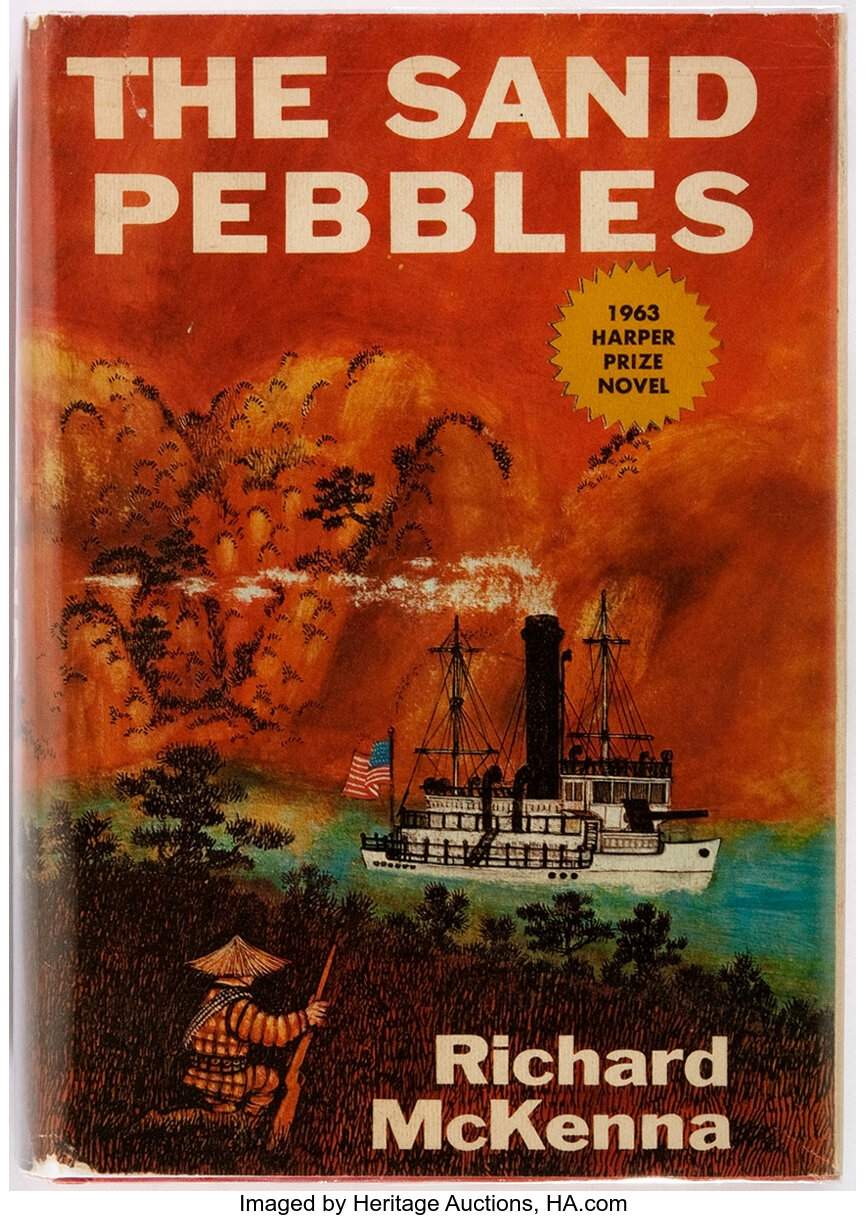
“The
Sand Pebbles” is based on the novel by Richard McKenna. It was directed by Robert Wise (“The Desert
Rats”, “Run Silent, Run Deep”). While he
was developing it, he took some time off to direct a little movie called “The
Sound of Music”. The movie was filmed
in Taiwan (where a planned nine weeks shoot lasted seven months) and Hong Kong
(three months). He wanted Paul Newman as
the lead, but had to settle for Steve McQueen.
McQueen was paid $650,000. I’m
not sure he thought it was worth it as he had a horrible experience. He suffered from an abscessed molar which he
refused to have looked at until he got back to an American dentist. He did not make another movie for two years
(“The Thomas Crown Affair”). He received his only Best Actor nomination, losing
to Paul Scofield in “A Man for All Seasons”. The movie was nominated for a total of eight
Academy Awards, but won none. It was
nominated for Best Supporting Actor (Mako), Art Direction – Color,
Cinematography – Color, Film Editing, Sound, and Original Music Score (Jerry
Goldsmith). Richard Attenborough won the
Golden Globe for Supporting Actor.
The
opening prologue informs that the movie is set in 1926 China. The country is under the thumbs of warlords
and is oppressed by foreign powers. There
are also political factions trying to unite the country. The little gunboat San Pablo (known to the
crew as Sand Pebble) is tasked with patrolling the Yangtze River to show the
flag and protect American property and citizens. Some of those citizens are missionaries who
detest the gunboats because they remind the Chinese of foreign oppression. The San Pablo is docked at Shanghai when a
new crewman arrives. Jake Holman (McQueen)
is a machinist’s mate, first class. He
is a sailor, but the only thing he is interested in is engines. When he comes aboard, the first thing he does
in introduce himself to the engine. “Hello, engine. I’m Jake Holman.” He befriends Frenchy Burgoyne (Attenborough),
but his anti-military body language puts him on the outs with his by-the-book
skipper Lt. Collins (Richard Crenna).
The rest of the crew also are slow to warm to him. The crew (called the Sand Pebbles) does not
officially include the Chinese workers on board. They are called “coolies” and do most of the
work, including taking care of the engine.
Holman butts heads with a coolie named Chien. Chien is the boss of the coolies running the
engine, but Jake plans on running his engine himself. This rocking the boat makes Jake unpopular
with the crew. Jake takes on Po-Han
(Mako) as his apprentice. They develop a
strong bond that will end with one of the more memorable deaths in war movie
history.
Life
on board the gunboat is good. They eat
well and have the coolies doing all the menial labor. They go ashore to a bar where they drink and
go upstairs with the girls. Frenchy
falls in love with one named Maily (Marayat Andriane). Jake is in an awkward relationship with a
missionary named Shirley Eckert (Candace Bergen in her second movie). Both these relationships will buck the
tide. Americans are supposed to use, not
fall in love with, Chinese women.
Missionaries and sailors are on opposite ends of how America should deal
with China. The two romances are going
to be impacted by the increasingly chaotic political situation in China. Forces loyal to Chiang Kai-shek are
attempting to unite the country by eliminating the power of the war lords. Foreigners make convenient targets. The San Pablo is a symbol of that
colonialism. The gunboat ends up
besieged by Chinese mobs led by young revolutionaries. Eventually, it goes on a mission to rescue
missionaries (including Shirley).
“The
Sand Pebbles” is an epic that does not feel like an epic, aside from the
length. It is set during a conflict (The
Northern Expedition 1925-27) that very few Americans were aware of, then and
now. The most the movie cares to do for
historical knowledge is to make it clear that things were very messy. The San Pablo gets caught in the middle of
this mess. There is a debate about how
much the movie was a criticism of our involvement in Vietnam. Although the book came out before we sent
troops, director Wise has stated that he was interested in commenting about the
war. Personally, I don’t see a lot in
the movie that applies to Vietnam. Even
with a length of three hours, the movie does not spend a lot of time on
colonialism. It also does not hammer the
racism theme. The coolies are exploited
and the Chinese are looked down on throughout, but this is not the focus of the
film. Essentially, the movie is the
story of two doomed romances set in a tumultuous period of Chinese
history. Frenchy/Maily and Jake/Shirley
reflect the two themes of condescension toward the Chinese people and the
opposing views of the benefits of colonialism.
Actually, since Jake is apolitical and sympathetic through his
relationship with Po-Han, it’s the crew that represents the worst aspects of
colonialism. There is boxing match between
Po-Han and Stawski (Simon Oakland) in which the big American bullies the weak
Chinaman. The missionaries, like
Jameson, are depicted as very naïve in their belief that the Chinese will make
exceptions for the missionaries just because the missionaries hate colonialism
and are neutral politically.
There
are three main reasons to watch this movie.
First, the acting is stellar from a good cast. McQueen is excellent as the conflicted and
emotionally frigid Holman. He is more
comfortable with machinery than people and McQueen gets this across. It’s appropriate that there is little
chemistry between him and Candace Bergen.
Attenborough is strong as the love-struck Frenchy. His humanity contrasts well with the racism
of the crew. Crenna is perfect as Collins. In the book, Collins is a good leader who
follows the rules no matter what his better judgment tells him. Although the movie is a small unit movie, it
does not highlight a dysfunctional crew and is not anti-authority. Mako had his first big role and it is
probably his most memorable performance.
In a morose movie, he has the most poignant moment. The second reason to watch is the setting and
sets. Filming in Taiwan and Hong Kong
may have been expensive and problematical, but it results in a beautiful
film. You are transported back to 1920’s
China. The San Pablo is a star in the
movie. The $250,000 spent building a
replica of a gunboat was money well spent.
The engine room set is a standout.
Third, although it takes a while to get to it, the movie has one of the
best battle scenes in war movie history.
The San Pedro has to break through a boom blocking their path to rescue
the missionaries. The buildup is tense
and supported by Jerry Goldsmith’s excellent score. The action is visceral and realistically
messy. This scene leads directly into
the powerful climax at the mission. This
movie finishes very strong.
GRADE = B+
THE BOOK:
Spoiler alert
– I will be discussing the plot of the book through the end..
Richard
McKenna served on gunboats in China in the 1930’s. Gunboats like his had traditionally patrolled
the rivers and coastline to protect American interests. The coolies grudgingly benefited from this
and bars and brothels were happy to take American money. Sailors tended to look down on the Chinese
they interacted with and underestimated the anger. The book, more than the movie, makes this
dynamic clear. The book is able to go
into more detail supporting the premise that the crew were ugly Americans. It is clear in the book that the Sand Pebbles
(as the crew was called) wanted to fire on the Chinese regardless of the
international repercussions. Collins is
the only one who looks at the big picture.
The
book begins with Holman arriving at the ship.
“Hello ship”. He goes to see the
engine. “Hello engine”. “Jake Holman loved machinery in the way some
other men loved God, women, and their country”. Boy, does the novel back this up! He is not a fan of the coolie system. He flashes back to meeting Shirley on the
trip. She is described as not
pretty. Lt. Collins is skeptical of
Holman because his record shows he avoids leadership. Chien runs the engine room and he and Jake
take an instant dislike for each other.
Later, in an incident similar to the movie, Chien is mortally wounded trying
to fix the engine. The coolies do not
blame Holman, they are upset because they think Chien’s ghost is haunting the
engine.
The
romance between Frenchy and Maily is fairly close in the movie. The boxing match between Po-Han and Ski is similar
(but even more unrealistic), but the reason is Holman has gotten the crew to
agree that if Po-Han wins, the crew will agree to take Po-Han back after Lop
Eye had fired him. Frenchy does win
enough money to get Maily. The auction
occurs after the fight. In the book,
Collins’ wants Holman to transfer because he does not like his attitude that
the engine is an important job and can’t be left to the coolies. He does not consider Jake to be a Jonah. Po-han death is similar, but he was not set
up by Lop Eye, he volunteers to go into the city to get milk. Jake is totally broken up by what he had to
do and takes a while to recover. The
incident where a shore party is pelted by a Chinese mob is essentially the
same. The courtship between Jake and
Shirley is chaste and ends after an awkward moment of intimacy. Shirley does plant in Jake’s mind the idea of
deserting and going to China Light to run the machinery. Frenchy’s death is similar, but more poignant. No one else is involved, Jake simply finds
Frenchy dead in an alley. Maily’s fate
is left unclear, but it could not have been good. The Chinese do not surround the ship and
demand Jake because they accuse him of killing Maily. Their excuse is Jake punched Lop Eye in an
incident involving a pig! The crew is
justifiably upset that Jake brought this mess on because of a pig and they do
want to turn him over. The morale was
already bad because there is a food boycott.
Jake was already being viewed as a Jonah. Reading the book gives you a better feel for why
the crew is anti-Holman. Collins refuses
to turn over Jake and has a mutiny on his hands. Collins comes close to committing suicide,
but then decides to restore order and regain the ship’s honor by going to China
Light to rescue missionaries who don’t want to be rescued. With the prospect of action, the crew regains
its morale. The fight at the boom is
enhanced in the movie. Jake’s only role
is to cut the cable with an axe. He is not armed with a B.A.R. and he does not
kill anyone and certainly not Cho-Jen.
Collins leads a small group to China Light where Craddock (Jameson in
the movie), Gillespie (not in the movie, possible love interest for Shirley)
and Shirley refuse to leave. They change
their minds after a messenger arrives with word that Cho-Jen was killed at the
boom and the Chung (a radical group) are coming to execute Craddock. The
Chung arrive and open fire, killing Craddock.
Holman convinces Collins to leave with the others and stays to be
killed.
I
would recommend the book if you want to understand the movie better. For instance, Jake is in the navy because he
took the fall for alcohol at a high school party and the judge gave him the
choice of the military or reform school.
Personal motivations and characters are fleshed out in the book,
naturally. You also understand the
political situation better. The crew is
almost a person in itself with Jake being an outsider. In the book the crew comes off as prejudiced,
petty, lazy, and cowardly. They can’t
wait for a war to begin so they can open fire on their tormentors, and yet they
are willing to give up Jake to a mob because they are afraid. They respect Collins, but refuse to follow
his orders during a crisis. McKenna
obviously knows his sailor life as the book is full of sailor slang and
traditions. The movie avoids most of
this. He also knows his engines as there
is a lot of explanation of the parts of the engine and how it works. I found those parts very boring. There are other entire chapters that are
tedious. Jake dominates the book (although not as much as the movie), but
McKenna makes side trips to China Light to catch up with Shirley. Cho-Jen, her genius prodigy, has a much
bigger role in the book. There are
entire sections that are left out of the movie, for good reason. Maily, after her “marriage” to Frenchy, lives
with Po-Han’s family. Jake and Frenchy
visit several times. The ship is stuck
in Changsa harbor and the Chinese are inflamed by a drought which they blame on
foreigners. Rain ends this anticlimactically. This is a good example of how a screenwriter
can remove unnecessary scenes to tighten the narrative.
As
usual, I find the movie better than the book.
The screenwriter Robert Anderson (who was nominated for a Golden Globe)
had the advantage of the source material.
He was able to lop off some of the branches and trim the tree. He made some changes to what he kept and
those changes were for the better in most cases. This is true for the Frenchy/Maily arc and
the improvements he makes to the boom battle and the climax. Because of time constraints, Anderson had to
abandon the discussions in the book that explained why things were
happening. For box office purposes, this
was a necessary decision. No one watches
this movie to learn about the Northern Expedition. The tightening of the structure has the
effect of sharpening the unpredictable nature of the novel. When you read the book, you are less
surprised by major developments like the death of Frenchy.
GRADE = B-