Sunday, July 17, 2022

One Minute to Zero (1952)


                “One Minute to Zero” is a movie set in the early days of the Korean War.  It was the last movie that Howard Hughes produced.  He got a lot of cooperation from the Pentagon.  It was filmed in Fort Carson, Colorado with the aid of the 148th Field Artillery.  The Pentagon almost rescinded the cooperation after actor Charles McGraw (the gladiator trainer from “Spartacus”) got into a bar fight with a soldier and unlike in “Spartacus”, McGraw won.  Hughes had to mollify the military.  Even though the brass seemingly had the high ground, Hughes successfully refused to remove the killing civilians scene.

       The movie begins in the days before the Korean War broke out.  A narrator tells us what a game bunch the South Koreans were.  Propaganda alert!  Col. Janowski (Robert Mitchum) is upset with his ROK charges and hops in to show them how to bazooka a tank.  It won’t be long before they will need that skill because the North Koreans will soon be implementing “plans made in Moscow”.  The romance arc kicks in when Janowski meets a do-gooder named Linda Day (Ann Blyth).  Before you can doubt these two will ever get together, a strafing Yak forces them into each other’s arms to the strains of “When I Fall in Love”.  Like we needed the aural cue.  The romance is shockingly not a smooth one.  They disagree about the conduct of the war.  Guess which one is the pacifist liberal.  But the movie is not just a trite romance.  It also has some combat mainly in the form of footage of American (F-80s) and Australian (P-51s) air power pummeling commies.  If you love rockets and napalm (great name for a band, by the way), this is the movie for you.  Throw in some footage of burnt bodies so you know war is not all fun.  On the ground there is a lot of hip-shooting and bazooka-plinking.  Meanwhile, the romance is proceeding with Janowski’s and Linda’s paths continuously crossing.  One of those encounters allows Robert Mitchum to sing a Japanese song which Linda follows with the English version.  Mitchum concludes by whistling “When I Fall in Love”.  Please get back to the bombing!  Back at the front, we are losing because the enemy cheats.  It seems those dastardly Reds are infiltrating refugee columns.  Why take chances, right?  Janowski is in charge of eliminating the few North Korean soldiers in disguise by slaughtering all the Orientals.  Linda has some problems with this policy since she is a bleeding heart.  This would kill the romance if this was not a movie.  The resolution is not acceptable to Amnesty International.  Back at the front, we stop retreating and start containing.  Stick around  for one of the most ridiculous deaths in war movie history.

                “One Minute to Zero” would be one of the many forgettable Korean War movies made during the war.  The Korean War has a very high ratio of forgettable movies.  What separates this dog from the pack is the civilian massacre scene.  It appears to be based on the No Gun Ri Massacre which occurred in July, 1950.  This was the chaotic early weeks of the war which were characterized by constant retreating by not only U.S. and ROK forces, but also South Korean civilians.  The crafty North Koreans infiltrated the civilian columns with disguised soldiers and this increased the chaos.  Orders came down from on high to bombard any columns approaching American positions.  On July 25, a column was diverted off the road to be searched.  The search uncovered some weapons but no enemy soldiers.  However, an air strike was called in the next day and this was followed by ground fire on the defenseless civilians.  Subsequent investigations posited between 250-300 deaths.  The incident was covered up and did not see the light of media scrutiny until 1999.  Apparently, “One Minute to Zero” flew so far under the radar that nobody asked if the scene was true.  But more incredibly, the Pentagon allowed the scene to stay in the finished movie.  I have done some reading on the symbiotic relationship of the Pentagon and Hollywood.  Producers are desperate for Pentagon cooperation and normally the military doesn’t mind providing equipment in exchange for recruiting bumps and some control over how the military is portrayed.  The goodies usually come with script consultation.  Plenty of objectionable scenes have been edited from war movies over the years because the Pentagon drew a line in the sand.  Not this time.  Although the movie gyrates laughably to justify the killing of civilians, it still bucks the trend of the military deep-sixing a scene that puts it in a negative light. 

                In spite of the recent uncovering of the No Gun Ri Massacre, “One Minute to Zero”is still not worth seeing unless you are an air bombardment addict.  It does have its fans because of that aspect.  There is lots of aerial footage and much of it involves explosions.  The movie also has a lot of ground action and some of it is archival as well.  Unfortunately, most of the action is acted out and badly.  There are some hilarious deaths and amusing hand-to-hand combat.  The cast is decent, but they slum through it.  Robert Mitchum is not at his best here, but the script does not help.  The romance is pedestrian and predictable.  The reoccurrence of the song just emphasizes this.  The dialogue is lame and the inclusion of “Walk in the Sun”-wannabe banter must have made veterans cringe.

                “One Minute to Zero” is a terrible movie.  The only reason to see it is if you want to see the depiction of a No Gun Ri type massacre.  And if you want to feel better about that sort of thing.  You do what you gotta do in the Cold War, right?


GRADE  =  D-

Wednesday, July 6, 2022

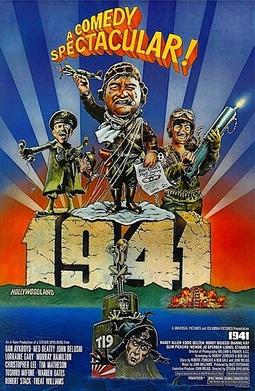
1941 (1979)


            I was student teaching at University High in Baton Rouge in 1979.  One of my students was a teenager named Steven Soderbergh. I became friendly with him and can still remember how excited he was about the upcoming Steven Spielberg movie. Soderbergh was interested in movie- making and went on to become a great director himself.  “1941” was Spielberg’s fifth film after “Duel”, “Sugarland Express”, “Jaws”, and “Close Encounters of the Third Kind”.  Although originally written as a drama, Spielberg had it rewritten as a comedy.  Some of his friends were skeptical that a man who had no sense of humor would be making his first comedy.  The critics were even more skeptical.  They crushed the movie and it has the reputation of being a bomb. It actually was a moderate success, making $95 million against a budget of $35 million.  The movie even received Academy Award nominations for Best Cinematography, Sound, and Visual Effects.  Spielberg offered the role of Gen. Stilwell to John Wayne and Charlton Heston.   Wayne turned it down, telling Spielberg that it was un-American due to it making fun of America’s early days in the war.  Heston probably turned it down for a similar reason. Robert Stack got the part.  It was his first comedy (although it seems like he did not know that).  He found John Belushi to be one of the craziest actors he ever worked with.  Belushi delayed the production a couple of times due to showing up tardy from late night hijinks.   Belushi and Dan Ackroyd were the biggest draws, but they had little screen time together.  Ackroyd was instead paired with John Candy as part of his tank crew. It would be the first of their eight movies together.  The tank was a tractor mocked up to be a M3 Stuart.  Its name, Lulu Belle, was an homage to Bogart’s in “Sahara”.  When Slim Pickens came on board, his role as “Holly” Wood was greatly expanded.  (That was a wise move.)  His listing of the contents of his pockets (“one box of genuine cracker jacks…”) was a reference to his Maj. Kong’s listing of the items in the survival kit in “Dr. Strangelove”.  The movie was one of a few American movies that Toshiro Mifune made.  This was the only one where he used his own voice.  Speaking of only one, there is only one black (Frank McRae) in the movie.


            The plot is a mess, as it careens from arc to arc.  The movie is set about a week after Pearl Harbor in Los Angeles.  Americans are paranoid about an attack and chaos ensues.  One arc follows an insane P-40 pilot (Belushi as “Wild Bill” Kelso) who is tracking phantom Japanese bombers.  The bombers may be figments of his imagination, but there is a very real Japanese sub off the coast that is interested in bombarding Hollywood.  Akroyd is a tank commander who gets involved in the defense of the city.  The tank is part of Gen. Stilwell’s command.  Along with anti-aircraft guns on the rooftops.  This all meanders to the big set piece which fills the streets with fisticuffs and skies of Los Angeles with cinematic fireworks.  The fisticuffs involve a brawl between civilian young men and soldiers.  This breaks out at a USO dance competition.  In the middle of this comes Kelso tracking a Japanese bomber which is actually an American one flown by Tim Matheson in the midst of coitus with a flight groupie.  And I haven’t even mentioned the artillery  piece put in Ned Beatty’s front yard or the two men and a ventriloquist dummy on submarine watch on a Ferris wheel. I wonder how far John Wayne got into the script.


            Before you ask how much drug ingestion was involved in the script-writing, you might be surprised to learn the movie is based on history.  In Feb., 1942, a Japanese sub did bombard an oil refinery in California.  The resulting paranoia led to The Great Los Angeles Air Raid of 1942.  On the night of Feb. 24, anti-aircraft guns opened wild fire in the skies over L.A.  (It was later believed to have been a rogue meteorological balloon that set off the chaos.)  The melee in the streets was based on the Zoot Suit Riots of 1943 when Hispanic youths wearing zoot suits were attacked by sailors and soldiers.  But there still must have been some drugs because the movie is similar to “The Blues Brothers” in mayhem, but lacks the cohesive plot.  It also does not have the central duo of that much better film.  It substitutes an all-star cast (well, all-star might be an exaggeration) and then gives most of them little to do beyond slapstick.  None produces a resume highlight, except for Slim Pickens.  (That goes for John Williams, too.  His theme music is memorable.)  Pickens’ scenes on the sub are comedy gold.  Unlike “Dr. Strangelove”, he was aware that this movie was meant to be a comedy and he goes all-in.  This makes the flailing of the real comedians just more pathetic.  For example, Ackroyd’s character suffers a concussion that makes him go crazy.  This smacks of a desperation move to add some hilarity.  In fact, the movie would have been better if Ackroyd’s tank had been consigned to the cutting room floor.  But then who would have shot out all the lights? 


The movie certainly lacks subtlety.  More is always the answer.  The big “battle” was so noisy that Spielberg had to fire a prop machine gun in the air in lieu of “cut!”  That’s a good metaphor for the movie.  Spielberg had already proven himself to be a great director, but you wouldn’t know it from this effort.  He falls into the trap of believing destruction equals laughs.  As Stilwell says:  “Madness.  That’s the only way to describe it.”  (A line that he might have ad-libbed.)  Speaking of metaphors, the movie ends with a house going over a cliff.  Appropriate.


GRADE  =  C-  

Here is a clip with the great Slim Pickens stealing the movie from all those comedians.


Friday, July 1, 2022

Friendly Fire (1979)


            On April 22, 1979, 64 million Americans watched a TV movie about the Vietnam War.  Average Americans were finally ready for a movie that challenged the government’s narrative about the war.  Ironically, the movie was about an average American couple who challenged the government’s story about their son’s death.  “Friendly Fire” appeared on ABC back when made-for-TV movies could sometimes become water cooler fodder and influence the national view on various topics.  It was a huge hit and won four Emmys, including Outstanding Directing in a Limited Series or Special (David Greene), Outstanding Drama or Comedy Special, and Outstanding Music Composition.  Carol Burnett and Ned Beatty were nominated for their acting.  The movie won a Peabody Award.  It was based on a nonfiction book by C.D.B. Bryan. 

            The movie was dedicated to Michael Mullen, his family, and the men of Charlie Company, 1st Battalion, 6th Infantry Regiment, 198th Infantry Brigade, Americal Division.  Mullen grew up in a typical farm family in Iowa.  In 1969, this John-Boy goes off to Vietnam.  It is unclear whether he volunteered, but it is implied that he’s not enthusiastic about going.  He narrates his letters home which are intercut with a montage of farm activities.  His letters reveal that the war is hell and its kill or be killed.  Some of the soldiers commit atrocities.  His last letter mentions that the army is returning to search and destroy missions.  His mother Peg (Burnett with brown-dyed hair) has a foreboding.  Sure enough, here comes the black car with the chaplain.  The Mullens are told it was friendly fire from ARVN artillery firing at VC infiltrators.  Peg is immediately skeptical (for no good reason).  She is not amused when they get a form condolence letter from Nixon which includes copies of his speeches!  The body is returned for the funeral and it is remarkably unmarred for an artillery victim.  Peg:  “Why couldn’t he have been blown to bits so I could believe he died in a war?”  Peg and Gene begin to press the military for the real story.  They contact his comrades and find out that the government is lying about the big picture (e.g., secret incursions into Cambodia), so it could easily be lying about one death.  The Mullens join the anti-war movement.  You can imagine how that goes over in their conservative farming community.  Peg and Gene have left the Silent Majority.  They get contacted by a reporter.  C.D.B. Bryan (Sam Waterson) had been a reporter in Vietnam.  He helps them get their story out.  The movie eventually gets to the flashback section which reenacts Mullen’s death.  The truth is not going to satisfy the Mullens.

            “Friendly Fire” is very much of its time period.  Made-for-TV movies avoided rocking the boat too much.  This one happens to push the envelope.  Other Vietnam War movies have had scenes featuring the parents of deceased soldiers, but “Friendly Fire” concentrates on the parents of a grunt who died from friendly fire.  It is faithful to the story, which means a modern audience might find it tame.  The Mullens are not Yippies.  But they end up on the left with them.  The movie has no bogey man from the right for them to joust with.  Michael’s commanding officer Col. Schindler (based on Norman Schwarzkopf) is truthful about the incident.  The government is the villain.  Much of the 64 million viewers probably were surprised to learn the well-publicized invasion of Cambodia was not the only incursion.

            Since the movie is historically accurate, it is nice to know so many Americans watched it and learned something significant.  But most did not tune in for a lesson.  They tuned in because you had only three major networks to choose from and the movie starred Carol Burnett in a dramatic role.  (I think it was her first.)  She is excellent, as is Ned Beatty.  The whole cast is fine and the Vietnam flashback has some familiar faces (if you’re a  Baby Boomers).  That sequence is worth the wait if you don’t mind a G-rated take on the war.  The hours leading up to Michael’s death will be familiar to any veterans of any war. SNAFU comes to mind. 

            Several made-for-TV movies impacted the public’s view of the war.  Two others that come to mind were “Tribes” and “A Rumor of War”.  Each was seen by multi-millions.  Each shaped the perception of the war.  For the good, because they are realistic.  When you look at all those names on the Wall, remember that the vast majority were survived by their parents.  No parent should have to survive their child.  We sometimes overlook that on days like Memorial Day.  “Friendly Fire” is a memorial to those parents who had that encounter with the black car and the chaplain.  But it’s not just about their grief, it’s about the manner of their son’s death.  Some of the 58,000+ were victims of friendly fire, which has existed since the dawn of warfare.  I would think many of the viewers when it premiered were ignorant of the fact that it was still a problem.  Hell, how many of the viewers even knew the meaning of the movie’s title?  They learned.

GRADE =  B