Monday, February 21, 2022

MOVIE / BOOK: The Blue Max (1966/1964)


                “The Blue Max” is one of the most famous air combat movies set in WWI.  It may be the best.  Not only does it have great dogfighting, but the central character is one of the more fascinating anti-heroes in war movie history.  Corporal Bruno Stachel (George Peppard) goes from the trenches to the skies.  He is from a lower-class background and is suddenly thrust into a squadron of upper-class snobs.  His goal is not to fit in, it is to become the best.  He is obsessed with the award called the Pour le Merite (the Blue Max).  You achieve it by shooting down 20 planes.  He will do anything to achieve this goal.  This puts him at odds with his commander Heidemann, who is an old school military traditionist.  Heidemann quickly appraises Stachel’s amoral quest and is determined to bring him to justice for his violations of the rules of war.  Stachel’s frenemy is Willi, who not only has the Blue Max that he covets, but a comely aunt that Stachel also sets as a goal.  It’s complicated because she is married to a general and sleeping with Willi.

                SPOILER ALERT:  The following will cover the plot of the book, so if you haven’t seen the movie or plan to read the book, you might want to stop here.  The purpose of this section is to give viewers of the movie an idea of how it differs from the book.  In this case, it differs a lot.

                The book starts with Stachel arriving at the airfield.  The squadron is on a mission and the airfield is bombed.  The squadron returns and a dogfight ensues.  He meets with Heidemann, who is not testy.  There is no talk of his commoner background and this will not become an issue.  He does not mention the goal of the Blue Max and there is no implication that he is ambitious.  On his first mission, he shoots down an S.E. 5, but he does not cause the loss of his wing man.  There’s no balloons involved.  He does get upset because the kill can not be confirmed, but he does not go looking for the wreckage.  The incident where Stachel escorts a British observation plane back and then shoots it down because the gunner aims at him is reenacted closely in the movie.  However, it is downplayed in the book and Heidemann does not accuse him of murder.

                In the book, Stachel has a serious alcohol problem.  It is so bad that he even drinks on missions.  It causes him to be one nasty bastard.  He is very hard on the ground crew and he has a foe in the squadron clerk Rupp.  His conversations with Willi are dripping with snarkiness.  Willi calls him Cobra and questions his honesty about his victories.  Willi’s uncle is a Count, not a general.  His aunt is nice looking, but not a beauty.  Stachel beds her and later finds out that Willi is doing the same.  They never discuss the situation and Willi is not aware of it.  There is no competition for her. 

                The strafing of British soldiers is in the book, although it is limited because British fighters show up.  Oddly, the Brits show up in front of them at low attitude.  Stachel shoots down two and Heidemann shoots down one that is on Stachel’s tail.  Back at base, Otto chews him out for disobeying orders and leaving formation (which is a bit daft because they were bounced by the British).  His encounter with the Red Baron is essentially the same.  Stachel does turn down an offer to join his squadron.

                In the book, Willi is not a great ace and he does not have the Blue Max.  He is in Stachel’s way.  But not for victories.  Stachel is obsessed with getting a new Fokker D7.  When he figures that Willi will get one first, he arranges Willi’s death.  It is not in the form of a challenge to fly under a bridge.  Returning from a mission where he shoots down one and Willi shoots down two, Stachel causes Willi to fly into a tower.  (The movie does this better, but in the book Stachel’s motives are clearer and he is more despicable.)  He claims Willi’s two kills and Heidemann accepts it without any questions.  In fact, Heidemann is supportive of Stachel’s quest for the Blue Max.  He is the opposite of the Otto of the movie. 

                Stachel gets his D7 and has it painted black (with what he thinks is FUCK YOU on the wings).  He goes on a tear, proving he is a very good pilot.  He forces a British bomber to land on his field and learns that the words on the wing are BLOW JOB (this is my interpretation of what was painted since the book is vague about it)!  Although his victories are newsworthy (he shoots down three balloons and two Spads the first time up in his D7), he becomes a celebrity because he rescues a local girl from drowning.  And then he gets the Blue Max.

                After Willi’s death, Stachel visits his “grieving” aunt.  After bouts of steamy sex (off book), he blackmails her because he has Willi’s diary which chronicles his affair with her.  He’s drunk when he does this and it’s a rock bottom moment.  He visits a priest about his alcoholism and goes cold turkey.  He actually becomes a better person.

                Heidemann and Stachel go to Berlin to test planes.  Otto gets promoted to head of aviation propaganda.  He reveals to Stachel that he greased the skids to make Stachel famous.  This explains why he never questioned his claims.  And he fired Rupp when he revealed Stachel’s alcoholism.  Stachel is bemused.  Before testing the new Adler D-11, Stachel recognizes it’s a death trap, but he flies it anyway.  He survives and tells Heidemann that there are no problems and to put it through acrobatics.  Stachel has a change of heart at the last minute and tries to stop Heidemann, but Heidemann doesn’t believe him.  Heidemann crashes.  This is almost completely the opposite of the book and Willi’s uncle and aunt are not involved.  The movie does this better because there has been no redemption arc changing the flow of Stachel’s corruption.  It puts a period on its main theme whereas the book uses the incident as the last of Stachel’s flawed attempts to remake himself.

                Stachel sees this as a turning point in his life.  He wants to be a good man.  He is determined to marry Heidemann’s widow.  On the way to condole her, he is intercepted by the Countessa.  She has evidence proving Stachel murdered Willi and blackmails him into marrying her so she can piggyback on his fame.  So he tried to change, but his past came back to haunt him.  At the end of the book, he meets Herman Goring.  Goring proclaims that the future of Germany will be in the hands of men like them.  The movie brings closure, the book portends.  I’ll give the book credit with a delicious twist ending.

                As you can see, the movie differs drastically from the book.  The screenwriters completely jettisoned the alcoholism subplot.  They substituted the classism.  They played up how the military overlooked his flaws to create a hero.  For this purpose, Willi’s uncle was made into a general.  In the book, Heidemann is the propaganda manipulating figure.  He is not an adversary of Stachel, he is more of a manager.  The movie is trying to make a point about manipulation of heroes.  The book saves this point until the very end.

                Where the movie concentrates on Stachel, Willi, Heidemann, and the Count and Contessa, the book develops a few more significant characters.  Rupp has a much bigger role in the book.  He is a loathsome figure who acquires alcohol for Stachel, although they hate each other.  Stachel tells him:  “I will pop you like a flea and then I will poop on your goop.” (Can you imagine Peppard’s Stachel saying that line?)   He ends up bringing Stachel down.  Kettering (the squadron adjutant) is a character that deserved more in the movie.  He is into pornographic photos and is witty.  His conversations with the maintenance chief (who is another foil for Stachel) are entertaining.

                I have a theory that a war movie should be (and usually is) an improvement on the source novel.  This is because the screenwriter(s) have the book as a foundation to base the movie on.  He or they can make improvements on the plot.  Once again, I have to say that the movie is better than the book.  Not that the book is not good.  It has some great dialogue.  But the second half is too talkie.  For instance, there is a long scene with Stachel talking to the priest.  It is more of a psychological drama than the movie.  In some ways, it is the story of an alcoholic. Who happens to be a fighter pilot.  Stachel is less likeable in the book than in the movie, but this is blamed on his alcoholism.  The movie Stachel has no excuse for his actions.  He’s just an asshole.  There are some vibrant combat passages in the book, but there is a lot of drama around them.  The movie seems to have more combat.

                I recommend watching the movie and then reading the book.  I always do this, as opposed to the standard of reading the book and then watching the movie.  I don’t like watching movies where I already know what will happen.  I prefer to read the book after to get more details and background.  In this case, the book does not act as much of a spoiler because it differs substantially from the movie.  Reading this book adds the element of seeing how a producer might buy the rights to a book and then turn it over to a screenwriter(s) who make adjustments to attract viewers.  They may even come up with a different focus for the film.  And a different ending.

MOVIE  =  B+

BOOK  =  B

Friday, February 18, 2022

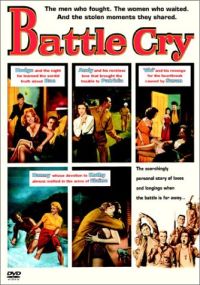
CLASSIC or ANTIQUE? Battle Cry (1955)


                In the mid-50s the Marine Corps was looking to duplicate the recruiting success of “Sands of Iwo Jima”.  It thought it had the perfect movie in a version of Leon Uris’ smash bestseller.  Warner Brothers was looking for its first successful war movie.  It got Uris to write the screenplay and Raoul Walsh (Objective Burma!, They Died With Their Boots On, Fighter Squadron) to produce and direct.  The Marine Corps was very cooperative.  It allowed filming at Fort Pendleton and the Marine Corps Recruiting Station.  It provided thousands of extras.  Witness the numerous newly sheared recruits and the screen spanning marchers.  Although the Corps demanded that the movie be G-rated, it accepted PG.  Did the Marines and Warner Brothers get what they wanted?  Yes.  Did war movie lovers get what they wanted?  No. 

                The film follows a squad of Marines from leaving home to returning.  It opens with the men saying goodbye to loved ones and then starting the bro-bonding on the train.  When they leave, one mother yells:  “And if they don’t treat you right, come right back.”  We know this will be a cinematic heterogeneous unit because the narrator spells it out for us.  They consist of a “Texan with a guitar”, an All-American athlete, a hick, an Indian, a slum kid, a book worm, a womanizing lumberjack, a prankster, and a troublemaker.  They go through boot camp with a D.I. who calls them “meatheads” and “skinheads”, but does nothing to discourage young men in the audience from joining the Corps.   The mother at the train station had nothing to be worried about.   Future recruits can figure out the reality after they sign the papers.  Boot camp flies by with no montage, no hijinks, and no drama.  They all get selected for radio school!  And yet, they won’t be separated when they go to war.  Nor will most of them ever be shown carrying a radio.  Did I mention going off to war?  The movie starts in January, 1942  and goes all the way to 1944, and yet these gyrenes spend most of their time drinking and wooing.  The movie would have been better titled “Liberty Call”.  These numerous liberties allow three romances to develop.  Danny (Tab Hunter) has a fling with a married woman while away from his girl next door fiancé.  Nerdy Marion (John Lupton) connects with a hooker, but he doesn’t know she is one until she shows up on the arm of a buddy.  Ouch!  Lumberjack Andy (Aldo Ray) falls for a war widow.  In between the soap opera arcs, the guys visit Guadalcanal and Tarawa to mop up and then finally get to prove they are not just lovers on Saipan. 

                “Battle Cry” was a big hit with the American public.  It finished #4 at the box office.  Critics were kind to it with some even comparing it favorably to “Sands”.  For a war movie fan, such comparisons are delusional.  The movie has all the elements that appealed to mass audiences in the 1950s and leave modern audiences shaking their heads.  It is a history lesson to read about the vetting the Marines did to the script.  They attempted to make sure the Marines were depicted as Boy Scouts.  They succeeded to a large degree.  You want those extras and equipment, don’t you, Mr, Warner?  The big bar brawl is toned down, for instance.  (Oddly, the fight is with a bunch of waiters instead of other servicemen.)  They were less successful in having any reference to the Marines liking sex taken out.  Specifically, they did not like Danny sleeping with the married Mrs. Yarborough.  Recruitment trumped prudishness as the Corps backed down on that arc.  The Corps had no problems with all of the officers being depicted as what that mother would want for her son.  Join the Marines – it’s easy, except for the occasional long march.  And that builds character.  

                Character building does not come from combat, apparently.  The movie has about five minutes and it’s not like quality over quantity.  Walsh went to an island in the Caribbean to find a beach and unjungle-looking field to stage his big battle scene.  The Marines march in lines across a brushy field to attack Japanese who are out in the open!  Just like in the Civil War.  

                Apparently, 1950s audiences loved war movies with a high dose of schmaltz.  The characters are all stereotypes familiar from Old School small unit movies.  Credit is due for having two Native Americans as Navajo code talkers.  This good will is diluted by a scene where one of them is given a hot foot and he proceeds to hop around whooping like a savage from a Laurel and Hardy western!  Comic relief is provided by Justus McQueen as L. Q. Jones.  That’s right!  Justus changed his name after this movie.  He shines, but the rest of the cast is just so-so.  Hunter became a major star with this movie.  James Whitmore is fine as Sgt. Mac, but his presence is a reminder of “Battleground” – a much superior movie that similarly followed a squad.  But where that movie bonded the men in combat, this one tries to bond them through action far from a battlefield.  If you are a war movie lover like me, it’s clear which movie took the right approach.  I’m not saying I’m right about the quality of each, but consider the fact that one is well-remembered and the other is long-forgotten.

GRADE  =  D

Tuesday, February 15, 2022

Hart's War (2002)

 On this day in 2002, "Hart's War" was released.

        “Hart’s War” is a POW / court room hybrid. It’s like a mash-up of “A Soldier’s Story” and “The Great Escape”. It is based on a novel by John Katzenbach. It was directed by George Hoblit. The movie was filmed at a studio in Prague. 

            Hart (Colin Ferrell) is a green staff officer who has no worries about combat because he is a Senator’s son. Unfortunately, the Battle of the Bulge sneaks up on him (it is quieter in this movie than in others) and he gets taken captive by some of those Germans-disguised-as-Americans. Within a two minute section, the movie also manages to toss in a reference to the Malmedy Massacre. I was surprised they didn’t throw in McAuliffe saying “Nuts!”  Hart is interrogated by your typical suave Nazi. He wants to know where the fuel dumps are. You know, like the one at the end of “Battle of the Bulge”. Does Hart talk? Unsure. He is put on a POW train which passes by a train full of Jews. Check that reference off. At one point a P-51 strafes the train in a scene reminiscent of the crossing the Volga scene in “Enemy at the Gates”. There are explosions, quick cuts, and generally frenetic running about.

            When Hart arrives at Stalag VI A, he is greeted by the sight of three Russian prisoners hanging. The German commandant Col. Visser (Marcel Iures) is evil and the opposite of Col. Klink. The ranking American officer is Col. MacNamara (Bruce Willis). He suspects Hart ratted out the fuel dump. This conveniently results in Hart being relegated to an enlisted man’s barracks so the movie can move in a new direction. The plot is roiled by the arrival of two Tuskegee Airmen. Would you believe they are not welcomed by the white soldiers? One of them commits an act that gets him sentenced to death by the Germans. McNamara insists on a court-martial since it will distract from the tunnel they are digging. Visser agrees to this for his and our entertainment. Hart is appointed defense attorney. Now we have hybrid POW/military justice movie. Two for the price of one.

            “Hart’s War” is a war movie for people who do not care about war movies. It is aimed at the generic audience. The producers appear to have doubted whether a regular prisoner escape movie would be profitable so they added a court room drama and then threw in a Tuskegee Airmen / Red Tails subplot so the film could have some gravitas. The fact the movie did not do well at the box office tends to show that you shouldn’t structure a war movie based on demographics. With that said, it is not a bad movie. It is entertaining, if you can suspend disbelief and just sit back and watch. The acting is good. Willis is strong and seems to have bought into the character. Ferrell is adequate. Iures is sufficiently malevolent as the commandant. Terrence Howard should be able to play a Tuskegee Airmen in his sleep at this point. The characters are not one-dimensional.  This includes the commandant who is much more intriguing than your typical POW movie commandant. The dialogue is fine and includes a speech by Scott on the witness stand.  He includes reference to the treatment of blacks at Tuskegee contrasted to that of  German POW's en route to camps in the South.

            The major flaws in the movie are due to aiming at a mass audience. The themes are trite. Redemption of Hart from being a rat. Sacrifice for your country and men (McNamara). Honor is more important than life (Scott). The biggest problem is that in order to develop the themes, the script has to pile on implausibilities and unrealities. For instance, the whole opening scene where Hart is captured is absolutely ridiculous to anyone familiar with the Battle of the Bulge. Even small touches can be aggravating. In the trial, Scott claims to have shot down nine German planes in thirty missions. No Red Tail came close to that figure. Some cool twists partly make up for the predictability of the themes. Another balancing factor is the production values are strong. The camp is one of the best in the subgenre. Real effort went into it. The tunnel is also well done and similar to that of “The Great Escape”. However, I’m not sure if reminding people of “The Great Escape” is a good idea when your movie is much inferior.

            How does it compare to the book by John Katzenback?  First, let me mention that one of the two screenwriters claimed that he did not read the book.  In the novel, Hart is the only survivor of a B-25 crash in the Mediterranean.  The commandant sets the vibe by refusing to bury two prisoners who die in a tunnel cave-in.  Bedford (Cole Hauser in the movie) establishes his racism by proclaiming “It’s a damned n*****!” when the black pilot named Scott arrives.  The fight breaks out in the barracks when Bedford accuses him of stealing.  McNamara breaks it up.  The next day, Bedford’s body is found.  Evidence points to Scott.  Visser, who is a Gestapo agent, observes the trial.  Hart is just one of three defense attorneys.  Hart gets the real killer to admit it by confronting him in the tunnel.  Hart is the rope tugger in the escape. He kills Visser when he discovers the tunnel.  By the way, the escapers have on intention of blowing up a munitions plant.

            The movie makes several significant changes to characters.  Hart is not a newbie.  He has been in the camp for two years before Scott arrives.  MacNamara is not a major character in the book.  Hmm, I wonder why they enhanced his role in the movie.  The commandant is not as evil in the book and of course, Visser is not the commandant.  The case is much more complicated.  The movie adds a few crowd pleasers like the P-51 strafing scene and the dog fight over the camp.  (I guess the book did not have access to CGI.)  There are some nice twists, but the book is too long.  It tends to be repetitive.  Katzenback is a bit pedestrian in his writing and he can be trite and preachy.  

GRADE = B-