Saturday, November 19, 2022

Trial on the Road (1971)  


            “Trial on the Road” (also know as “Checkpoint” or “Check-Up on the Road”) is a black and white Soviet film directed by Aleksey German.  It is based on his father’s novel “Operation ‘Happy New Year’”.  The movie was pulled after release and not shown for another 15 years because of its controversial depiction of partisans and collaboration.

            The movie is set in 1942, at a time when the war was not going well for the Red Army.  The movie opens with the Nazis destroying a village to retaliate against the partisans.  In the tit-for-tat that characterized the Great Patriotic War, the partisans ambush a German column and capture a former Soviet soldier who is in a German uniform.  Lazarev (Vladimir Zaminsky) had switched sides when he had been captured earlier by the Germans.  He wants a second chance and Commander Lokotkov (Rolan Bykov) is sympathetic.  Normally, a collaborator would have been executed, so Lazarev is very lucky.  But he has to prove himself in order to avoid that eventual outcome.  Many of the partisans in his new unit are skeptical about his change of heart.  His big chance to prove himself will be an attack on a railway station.

            This is an unusual movie in that it does not fit the usual Soviet war movie template.  Normally officers are treated well, but here the commissar is a jerk.  But more amazingly, a traitor is the hero.  Lasarev is a unique character.  He does not excuse his collaboration, so he clearly was not forced to join the Germans in killing Russians, especially partisans.  He is in need of redemption (note his name being similar to Lazarus), but does he deserve it.  It is unrealistic that he is not immediately killed when he was captured.  Audiences and the Soviet government certainly expected that and it was doubly controversial by having Lasarev end up a hero.  How the movie got green-lit is perplexing, but its long-term ban is not.  Another problem is the partisans are not lionized as in every other Soviet film.  The peasants suffer for connection to them and at one point they are willing to blow up a bridge with a barge full of Russian prisoners underneath it. 

            The movie has a style to it.  Cinematographer Yakov Sklansky uses lots of long takes, stationary cameras, and deep focus.  The acting does not match the flash.  It’s only average.  Even Zamansky does not stand out.  The problem with the film is he is playing an unrealistic character.  It’s not just that he should not have survived his capturing.  He seems to be a good soldier and one must wonder why he would have collaborated with the Germans.  A bigger problem is the attitude of Lokotkov. Why does he risk his own life by trusting Lasarev?  And he risks the unit by trusting him to lead the last mission.  That mission is suspenseful, but predictable because Lasarev’s fate does not break the mold for his sort of redemption.

            “Trial on the Road” is not one of the great Soviet war movies.  I am a fan of this subgenre and feel it falls below the upper rank like “Come and See” and “The Dawns Here Are Quiet”.  However, it is entertaining and thought-provoking.  It provokes thinking specifically about how the heck it got made.  And you are left wondering if Lasarev was just pretending to be a sincere partisan just to stay alive.

GRADE  =  B-

Saturday, November 12, 2022

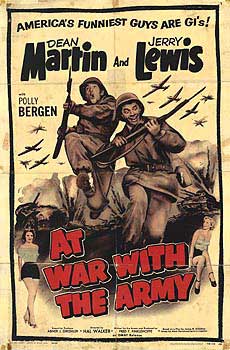
A TRIO OF DUOS: The Flying Deuces, Keep ‘Em Flying, At War With the Army


             There is a subgenre of war movies called “service comedies”.  Basically, these are comedies that do not occur in a war zone.  Recent examples would be “Stripes” and “Biloxi Blues”.  They are pretty rare these days, but in the 30s, 40s, and 50s they were common.  The three great comedy duos from that time – Laurel and Hardy, Abbott and Costello, and Martin and Lewis – all made more than one.  I thought it might be fun to compare one each from them.  And see if they hold up.

                “The Flying Deuces” is a Laurel and Hardy movie from 1939.  The duo are living in Paris.  Ollie falls in love with an innkeeper’s daughter, but it is not meant to be, of course.  Not only is she way out of his league, but she is also married to a French Foreign Legion officer.  Ollie decides to commit suicide by jumping in the Seine.  The level of the humor is such that he expects Stan to join him and there is a rogue shark swimming around.  Georgette’s husband comes along and convinces them to join the Legion to forget.  After an extended laundry gag, the pair decide they have forgotten well enough to go home.  In the middle of their attempt to desert, Ollie sings “Harvest Moon” and Stan dances.  It’s that kind of movie.  Later, in jail, Stan plays the bed frame like a harp in an homage to Harpo Marx.  The movie gets its name from the fact that they escape by stealing an airplane.  This results in some fairly nice stunt flying, but not a big finish.  It’s an appropriately lame ending for a movie that lacks entertainment value.  It is just an excuse for slapstick routines that don’t bring mirth.  In fact, the song and the harp scenes are pretty embarrassing.  If you are not already a Laurel and Hardy fan, skip it.

                “Keep ‘Em Flying” was the fourth Abbott and Costello movie in ten months and it shows.  It was their third service comedy after “Buck Privates” and “In the Navy”.  This one shows the signs of overkill.  Many of the gags are retreads and the public saw through this as the movie was not a success.  The boys are working for a circus.  Their best friend, Jinx Roberts (Dick Foran), is a stunt pilot who is a ladies’ man, naturally.  A typical gag involves Lou being hit numerous times with a baseball bat.  Ahh, the golden age of comedy.  When the trio gets fired, they join the Air Corps so hijinx can ensue.  This being a 40s comedy, you must have romance and songs.  Martha Raye plays twin sisters, so the plot includes mistaken identity.  Raye does a good job adding life to an otherwise tired effort.  She sings a song called “Pig Foot Pete” which incredibly was nominated for Best Original Song!  There is a subplot with Jinx being the best pilot trainee, but an old nemesis is the flight instructor.  You can guess where this is heading.  Meanwhile, there are several songs and several slapstick routines.  One of them involves Bud and Lou riding a torpedo all over the base.  To top this, the duo later accidentally take-off so we can be entertained by their buffoonery in the air.  The scene is marginally better than the one in “Flying Deuces”, but that is not saying much.  It you want similar, but funny, try Buddy Hackett and Mickey Rooney in “It’s a Mad, Mad, Mad World”.  Actually, the funniest moment is unintentional.  Jinx goes up to rescue the flight instructor when his parachute gets caught on his tail.  Sure, why not?  The film is bereft of laughs and has less than “Flying Deuces”, but the plot is better, although predictable and cliché-ridden.  It’s typical patriotic bull shit and Abbott and Costello should have learned that less is sometimes more. However, you can’t blame the studio for taking advantage of how hot the stars were at the time. 

                Speaking of hot, Martin and Lewis were coming off their smash debut in “My Friend Irma”.  “At War with the Army” was actually their first starring feature, but was held back for the release of “My Friend Irma Goes West”.  It was directed by the competent Hal Walker of Crosby/Hope road pictures fame.  He later directed Martin and Lewis in “Sailors Beware”.  It is based on a play and that is obvious since most of the action takes place in a headquarters building.  The movie sets the theme of being a satirical look at military life when the narrator informs us that the deadliest weapon in the Army’s arsenal is – the sergeant’s whistle.  I did not see that coming!  Dean plays his typical ladies’ man and verbally abusive friend to Jerry who plays an Audie Murphy type.  Just kidding, he’s a sad sack, of course.  Dean is a paper pusher who wants combat.  He and Jerry are songwriters which is an excuse for songs.  Jerry gets to mug his way through a pair and Dean gets to woo the ladies with a couple.  There is a cursory subplot involving a dumb Dora who is pregnant.  Who’s the father? We are supposed to care, but the cast doesn’t, so why bother?  The only reason to watch is to see Lewis steal the show.  He was that time period’s Robin Williams and he is funny here.  He gets to play drag and has a classic run through the obstacle course which is silly stuff, but amusing.  Dean makes a good straight man (but he does get to zing Jerry occasionally) and this early pairing evinces the formula that would result in sixteen movies and superstardom.  The movie pokes some fun at the Army bureaucracy, but it is not exactly hard-hitting satire.  It doesn’t aspire to much more than fluff and manages to achieve some entertainment value.

                None of the three movies is good, but “At War with the Army” is clearly the best of the trio.  My theory would be that Martin and Lewis were not tired.  Their trajectory was just ascending, whereas the other two duos had seen better days and were kind of phoning it in.  I like all three of the duos, but the comedy in their war films cannot compete with modern comedies like “Stripes”.  They do hang with crap like “Down Periscope”.  By the way, why don’t we have comedy duos any more?


The Flying Deuces  =  D

Keep ‘Em Flying  =  D

At War With the Army  =  C+        


Thursday, November 10, 2022

DOCUMENTARY: In the Year of the Pig (1968)


                “In the Year of the Pig” is a documentary by Emile de Antonio.  He was a member of the arts scene and the counterculture in the 1960’s and 1970’s.  De Antonio was close friends with Andy Warhol.  He made documentaries that criticized politics and society.  An avowed Marxist, he was surveilled by the FBI, which compiled a 10,000 page dossier on him.  One of his first films documented the career of Joseph McCarthy.  ”In the Year of the Pig” was his most controversial film.  And his personal favorite.  It was nominated for an Academy Award for Best Documentary Feature.  Theaters that showed it were victims of bomb threats and vandalism.  When asked about the leftist messaging in his films, he famously responded:  “Only God is objective, and he doesn’t make films.”  For this film, he interviewed many “fellow travelers” like Daniel Berrigan, David Halberstam, and Harrison Salisbury.

                The movie begins with assorted images -  “Make Love Not War” on a helmet, a monk self-immolating, the 54th Massachusetts monument in Boston.  Don’t ask what that last one has to do with Vietnam War.  Where did it all begin for us?  After WWII, the United States turned over Japanese weapons to the French so they could reassert control over French Indochina.  On the other side was the “George Washington of Vietnam” -  Ho Chi Minh.  David Halberstam points out that the best of a generation joined the Viet Minh.  Those rebels lugged artillery pieces up the hills around Dien Bien Phu.  Before you know it, the French are out and in come the Americans.  Giap outlines his guerrilla strategy (without the general being identified).  The domino theory is used to explain why America is there.  Strategic hamlets alienate rural South Vietnamese and Madame Nhu alienates all the Buddhists.  The Battle of Ap Bac proves the ARVN can’t win the war on its own.  A monk named Quan Doc burns himself to gross out Americans.  Mission accomplished.  Diem is overthrown with American approval.  The Gulf of Tonkin Incident is our excuse to send troops.  Pretty soon, those soldiers are searching to destroy and settling for burning villages.  Gen. Westmoreland proclaims that we are not mistreating prisoners.  De Antonio follows that with footage of prisoners being mistreated.  If you haven’t guessed it yet, the film cherry picks footage and events to make the war look like a big mistake.  The choice of interviewees erodes the perception that Vietnam was a righteous war.

                It says something about the Academy Awards that this film was nominated for an Oscar.  It is not worthy of that kind of recognition.  It is clearly slanted toward doves.  It’s doubtful many hawks went to theaters to see a movie that assaulted all their government-sponsored beliefs about the war. All the interviewees were anti-war, although it does include snippets of speeches by hawks.  Curtis LeMay promises we will use our power in the most humane way.  Until “no two bricks are stuck together”.  Well, I guess it depends on your perspective of the war whether that solution to Vietnam was humane.  I can’t imagine that the movie changed many minds.  The war itself is going to do that, but the film was made before the Tet Offensive.  It was released before the anti-war movement boomed in America.  I can picture De Antonio kicking himself for not waiting a year to complete the film.  So much good material.

Does it work as a history of the war?  Not really because you have to already have some knowledge of the situation in Southeast Asia.  This would have been uncommon in 1968 and is very rare today.  Read a book about the war before watching this movie.  It doesn’t help that it is unclear what year the film is covering.  And sometimes the interviewee is not identified.  And I’ve already mentioned that you are getting only one side’s history of the war.  That side is Ho Chi Minh and the North Vietnamese side of the war.  They could do no wrong.  And the U.S. Air Force was bomb-happy.  The film includes footage of an F-105 being shot down by a SAM.  Since my father flew Thunderchiefs in the war, I found that the film jumped the shark in that moment.  It’s one thing to paint one side as heroic, but it’s another to root for it.

“In the Year of the Pig” is propaganda, but effective propaganda if you entered a theater to see it.  Your prejudices would have been confirmed.  But as a documentary, it was not worthy of an Oscar nomination.  It has some value as a history of the America’s involvement before Tet.  It could be watched along with reading histories and memoirs of the war (from both sides).  However, as a stand alone, it comes off as a Marxist’s dominoes leading to a mouse trap.

GRADE =  C