Showing posts with label Casualties of War. Show all posts

Tuesday, March 5, 2019

CONSENSUS #84 Casualties of War (1989)


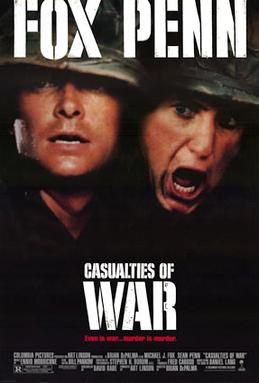
SYNOPSIS:  It is the tale of an atrocity in the Vietnam War.  A small recon patrol is sent out to locate an enemy base camp.  For recreational purposes, the sergeant (Sean Penn) has them kidnap a Vietnamese girl.  One of the men (Michael J. Fox) is not on board for the “entertainment” and after the mission ends in a fire-fight, brings charges against his squad-mates.

BACK-STORY:  Casualties of War” is Brian De Palma’s entry into the Vietnam War movies competition.  It was based on an actual incident known as “the incident on Hill 192” which occurred in 1966.  De Palma wanted to make the movie after reading Daniel Lang’s article in The New Yorker in 1969.  Lang later turned the article into a book entitled “Casualties of War”.  The movie was filmed in Thailand where the local cuisine ravaged the cast.  The bridge used in the climactic scene was part of the Japanese Burma railway system of River Kwai fame.  The budget was $22 million and the box office was $19 million.  The movie was a hit with most critics and is considered by some to be one of the better Vietnam War films.

TRIVIA:  Making of documentary, Wikipedia, imdb

1.  Brian DePalma wanted to make the movie after reading Daniel Lang’s article in the New Yorker in 1969.  Lang wrote about the “incident on Hill 192”.  Later Lang turned it into a book entitled Casualties of War.  No studio wanted anything to do with a controversial Vietnam War movie at the time.  DePalma was only able to get financing after his successes with movies like “The Untouchables”.

2.  Screenwriter David Rabe was a playwright.  He was a veteran of Vietnam.  He wanted to end the film with Eriksson having a nightmare about the other four getting revenge.  He was not happy with DePalma’s more upbeat conclusion.

3.  DePalma was very anti-Vietnam War.  He had avoided the draft by doing several things including claiming to be homosexual.

4.  DePalma approached Michael J. Fox about doing the film.  Fox was interested in continuing to break out of light comedies.  He had already made “Light of Day” and “Bright Lights, Big City”.  Fox got very ill from the Thai food and spent some time in a hospital during the shoot.  He gave gifts to the snake-beaters who protected the sets.

5.  Sean Penn was already an established star.  He stayed away from Fox during the production and made remarks about Fox’s status as an actor.  Whether this was to enhance the tension between their characters or he was being a dick is unclear.  I think the latter.  Fox was diplomatic in describing the experience.

6.  John C. Reilly had been hired as an extra.  He had just gotten off a 24 hour flight back to Chicago when DePalma had him reboard to assume the role of Hatcher.  This was necessitated by the firing of Stephen Baldwin.  The movie was Reilly’s debut.  This was  also true for John Lejiuzamo.

7.  Thuy Thu Le answered a casting call in Paris because she wanted to meet DePalma.  It was her first and only role.  She became a schoolteacher in California.  Her voice as the girl on the train was dubbed by Amy Irving.

8.  Principal photography was done in Thailand.  The bridge in the climactic scene was part of the Burmese Railway featured in “Bridge on the River Kwai”.

Belle and Blade  =  4.5
Brassey’s              =  2.0
Video Hound       =  N/A
War Movies         =  N/A
Military History  =  not on list
Channel 4             =  #55
Film Site                =  yes
101 War Movies  =  no

OPINION:  “Casualties” is often overlooked in the Vietnam War canon.  While not in a league with the iconic films like “Platoon” and “Full Metal Jacket”, it does have the advantage of being a true story and is actually pretty accurate in covering the incident on Hill 192.  Fox does a great job as the naïve, but principled protagonist.  Unfortunately, the movie is taken down a notch by a grating performance by Penn.  The rest of the cast is fine with early roles for John Leguizamo and John C. Reilly.  It’s position at #84 shows that the experts can sometimes get things right. 

Wednesday, January 28, 2015

HISTORY or HOLLYWOOD: Casualties of War (1989)


GUESS WHICH ARE HISTORY AND WHICH ARE HOLLYWOOD

1.       Meserve saves Eriksson’s life when he falls into a Viet Cong tunnel during a Viet Cong ambush.

2.       Meserve’s best buddy Brownie is killed by a grenade thrown by a farmer.  Eriksson hits a grenade with his grenade launcher.

3.       Meserve briefs the men on the mission.  They will go on a long range patrol to observe a Viet Cong camp.  He proposes kidnapping a Vietnamese girl for sex.

4.       The squad consists of Meserve, his crony Clark, the malleable Hitch, the new guy Diaz, and the moralistic Eriksson.

5.       They kidnap a girl from her hootch.  She is forced to carry a pack and is coughing a lot.

6.       Hitch shoots at a water buffalo that he mistakes for the enemy and Meserve chews him out.

7.       Eriksson stands up to Meserve who calls him a queer and threatens him with friendly fire.

8.       The rest of the squad take turns raping the girl including Diaz who reluctantly participates because peer pressure.

9.       Eriksson is left alone with the girl and is planning to leave with her when Clark returns.

10.    From their observation post overlooking the Viet Cong camp, Meserve orders Eriksson to kill the girl, then Hitch, then Diaz.

11.    Eriksson opens fire to halt the murder.

12.    Clark stabs the girl.

13.    There is a wild fire fight with numerous enemy casualties.  A gun boat arrives and is hit by friendly fire from helicopters.

14.    During the fire fight, the girl tries to escape down the train track.  Everyone except Eriksson open fire and she is killed and falls to the river bank.

15.    When Eriksson goes to Lt. Riley, Riley relates his baby at the hospital story and tells him “what happened is the way things are, so why try to buck the system?”

16.    Eriksson goes to Capt. Hill and is told that Hill is handling everything, but courts-martial are notoriously lenient.  He is very unsympathetic and mentions that Meserve did save Eriksson’s life.

17.    Clark attempts to frag Eriksson in the latrine and Eriksson confronts his tormentors with a shovel.

18.    Eriksson’s talk with a chaplain gets the courts-martial started.

19.    The four accused get various sentences with Meserve getting ten years hard labor for murder.

 THE ANSWERS

1.  Meserve saves Eriksson’s life when he falls into a Viet Cong tunnel during a Viet Cong ambush.  HOLLYWOOD  This crap was put in to start the movie with some action and establish that Meserve is a good soldier and Eriksson owes his life to him.

2.  Meserve’s best buddy Brownie is killed by a grenade thrown by a farmer.  Eriksson hits a grenade with his grenade launcher.  HOLLYWOOD  This scene was totally fabricated, but Eriksson did once hit a grenade with his grenade launcher.

        3.  Meserve briefs the men on the mission.  They will go on a long range patrol to observe a Viet Cong camp.  He proposes kidnapping a Vietnamese girl for sex.  HISTORY  Meserve felt the “boom boom” would be good for unit morale.  In reality, he added that they would kill the girl when they were done with her.

4.  The squad consists of Meserve, his crony Clark, the malleable Hitch, the new guy Diaz, and the moralistic Eriksson.  HISTYWOOD  The movie changed the names of the men and gave them Hollywood stock personalities.  There were actually five men on the mission.

5.  They kidnap a girl from her hootch.  She is forced to carry a pack and is coughing a lot.  HISTORY

6.  Hitch shoots at a water buffalo that he mistakes for the enemy and Meserve chews him out.  HISTYWOOD  The Hitch character did take a shot at a water buffalo, but Sgt. Gervase did not get upset.

        7.  Eriksson stands up to Meserve who calls him a queer and threatens him with friendly fire.  HISTORY

8.  The rest of the squad take turns raping the girl including Diaz who reluctantly participates because peer pressure.   HISTORY  No one showed any reluctance.

         9.  Eriksson is left alone with the girl and is planning to leave with her when Clark returns.  HISTYWOOD  Unbelievably, Storeby was left alone with the girl, but he did not try to let her escape.

         10.  From their observation post overlooking the Viet Cong camp, Meserve orders Eriksson to kill the girl, then Hitch, then Diaz.  HISTYWOOD  During the fire fight, Gervase and Thomas (Clark) began to worry that the girl would be spotted by Americans.  Gervase did not order several men to murder the girl.

         11.  Eriksson opens fire to halt the murder.  HOLLYWOOD

         12.  Clark stabs the girl.  HISTORY  Thomas took the girl into the bushes and stabbed her three times.

         13.  There is a wild fire fight with numerous enemy casualties.  A gun boat arrives and is hit by friendly fire from helicopters.   HOLLYWOOD  It was not much of a fight and only one enemy body was found afterwards.

          14.  During the fire fight, the girl tries to escape down the train track.  Everyone except Eriksson open fire and she is killed and falls to the river bank.  HISTYWOOD  The girl did try to escape, but Thomas chased her down and shot her in the head with his M-16. 

          15.  When Eriksson goes to Lt. Riley, Riley relates his baby at the hospital story and tells him “what happened is the way things are, so why try to buck the system?”  HISTORY 

           16.  Eriksson goes to Capt. Hill and is told that Hill is handling everything, but courts-martial are notoriously lenient.  He is very unsympathetic and mentions that Meserve did save Eriksson’s life.  HISTYWOOD  Hill did not so much cover up the crime as try to overlook it.  He was right about the probable result of a court-martial, but he was not belligerent and did not bring up Meserve saving Eriksson’s like because that had not happened.  Meserve did have a reputation as a good soldier.

          17.  Clark attempts to frag Eriksson in the latrine and Eriksson confronts his tormentors with a shovel.  HOLLYWOOD  There were some veiled warnings, but Storeby was transferred to a new unit as soon as he first told his story and there never was any attempt on his life.

          18.  Eriksson’s talk with a chaplain gets the courts-martial started.  HISTORY 

          19.  The four accused get various sentences with Meserve getting ten years hard labor for murder.  HISTORY  The movie covers the trials as one when actually there were four separate trials and Storeby was the lone prosecution witness at each.   The movie gets the sentences right, but De Palma curiously does not add a post script detailing the shameful reduction of the sentences.  All of the convicted spent substantially less jail time than they were originally sentenced to.  I was not able to find out why Gervase was not charged with rape.


RATING  =  .58

Saturday, January 24, 2015

CRACKER? Casualties of War (1989)


                “Casualties of War” is Brian De Palma’s entry into the Vietnam War movies competition.  It was based on an actual incident known as “the incident on Hill 192” which occurred in 1966.  De Palma wanted to make the movie after reading Daniel Lang’s article in The New Yorker in 1969.  Lang later turned the article into a book entitled “Casualties of War”.  The movie was filmed in Thailand where the local cuisine ravaged the cast.  The bridge used in the climactic scene was part of the Japanese Burma railway system of River Kwai fame.  The budget was $22 million and the box office was $19 million.  The movie was a hit with most critics and is considered by some to be one of the better Vietnam War films.

                The movie opens with a night patrol in which PFC Max Eriksson (Michael J. Fox) falls partly into a Viet Cong tunnel and has his about-to-be-stabbed life saved by his Sgt. Meserve (Sean Penn).  Eriksson is a cherry who wants to be friendly with the Vietnamese civilians in spite of what the veterans tell him.  Their point of view seems to be confirmed when Meserve’s best friend “Brownie” is killed when a farmer throws a grenade while the squad is relaxing near a “friendly” village.  Back at base camp, Meserve outlines a mission to scout a Viet Cong camp.  He proposes they make a side trip to a village to acquire a Vietnamese girl as a sex slave.  Eriksson is not on board for this, but the other members of the squad go along with it. Clark (Don Patrick Harvey) is Meserve’s henchman.  He is a bitter ass hole who hates “gooks”.  Hitch (John C. Reilly) is a hick who is easily manipulated. Diaz (John Leguizamo) is a new addition who just wants to get along. 

                They kidnap a girl and take her with them.  They set up in an abandoned hootch and proceed to rape her.  Each takes a turn with Diaz participating due to peer pressure, but Eriksson refusing in spite of threats from Meserve and Clark.  The next day they locate the Viet Cong camp and set up an observation post to call in an air strike and a gun boat.  Meserve decides the girl must be killed.  The resulting atrocity leads to Ericksson bringing charges against the other members of the squad.  A court-martial results.

                 Michael J. Fox does an outstanding job playing the naïve, moralistic Eriksson.  It is his best performance in my opinion.   John C. Reilly (his first film), Don Patrick Harvey (playing his usual typecast bad guy), and John Leguizama (his second role) are solid. Thuy Thu Le is remarkable as the doomed Oanh (it was her only acting credit). Plus we get the bonus of Dale Dye in a fiery take on ass-covering brass. The only problem is the scene-chewing of Sean Penn as Sgt. Meserve. The performance has been praised, but not by me. His hammy portrayal of the villain is distracting.  (See the poster.)  He plays Meserve as a retarded bully and made the “actor” decision to vocalize him as such.  Oscar please!  Imagine a movie where he is the weak link in a cast with three comedians in their first substantial dramatic roles. His emoting of faux grunt slang is the worst thing about the movie.  At one point he spouts the familiar “this is for fighting, this is for fun” but gets the hand gestures backwards!  This is typical of a script that seems to throw in grunt slang to establish realism, but comes off as trying too hard and has Hollywood actors mouthing words they obviously don’t understand.  Meserve refers to an enemy ambush as a “mad minute”, for instance.  (For those not familiar with Vietnam War slang, a "mad minute" was when an American unit fired all its weapons into the bush for a minute.)  More bizarrely, when they locate the enemy camp Hitch proclaims “there’s a bunch of them cruel-hearted little people.”  Huh?

                Although the soldier talk is lame, the rest of the script is powerful and the movie tells a story that needed to be told.  In fact, the story was so powerful that the movie could not have been made until well after the war.  De Palma adds some military justice to combat to produce a movie that is similar to “Paths of Glory” in that respect.  It is not in a league with that classic, but it does tell a true story well.  The cinematography is what you would expect from De Palma.  He uses deep focus, odd angles, and off center shots.  The rape scene is especially well done as a stationary camera from mid distance gives the outside looking in perspective.  The music is orchestral with a lot of pan flute and surprisingly no Vietnam era tunes.

 The movie does not avoid some common Vietnam movie clichés.  We get the required death of the clueless cherry and the authorities trying to cover up the atrocity.  One of the unit is looking forward to going home soon when he is killed.  The movie would have seemed even more clichéd if it wasn’t based on a true story.  The movie does track the book fairly well until the obligatory Hollywood insistence on a big set piece battle to satisfy combat junkies.  The enhancements are acceptable because the movie does bring to the screen a story that needed to be told.  The Eriksson character was a real hero even though he does not fit the usual war movie template of killing the enemy in heroic ways.  In a war like Vietnam, more should be made of the heroism of the soldiers who did not succumb to the corruption of that war.  Unfortunately, although De Palma obviously was trying to make a statement about that corruption, he dilutes his message by not adding a post-script about the Army’s wrist-slapping handling of the war crime.

Is it going to crack my 100 Best War Movies?  Probably not.  It is a must see movie and well done, but it is only in the middle of the pack of Vietnam War movies.


GRADE =  B
the trailer


Thursday, April 10, 2014

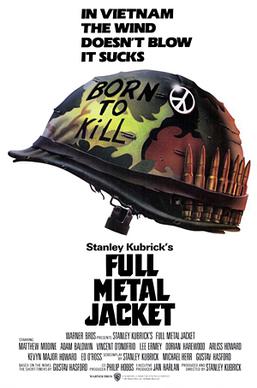
FULL METAL JACKET (3) vs. CASUALTIES OF WAR (6)


VS.


CHARACTERS
“Full Metal Jacket” has one of the iconic characters in Vietnam War movies. Gunnery Sergeant Hartman, as played by R. Lee Ermey, is mesmerizing. He is the main reason the first third of the movie is so strong. However, I do need to point out that Ermey was basically playing himself and many of his lines came directly from the novel “The Short Timers”. “Pyle” is another iconic character. His evolution from sad sack to boot camp graduate to psycho is fascinating and chilling. The rest of the characters are fine, if unspectacular. Modine’s “Joker” has the right amount of cynicism, panache, and wit to anchor the last two thirds. Having a writer for “Stars and Stripes” get involved in the fighting in Hue was a grand idea. Of the “Lust Hog” squad, Cowboy is a likeable and sympathetic character, but “Animal Mother” is the standout. B

“Casualties of War” is a character driven movie. There are only six significant characters in the film and each is distinct. Although based on a true story, it is obvious Hollywood differentiated the characters to service stereotypes. Still, it’s an interesting mix. Fox’s Eriksson is appropriately naïve and principled. Clark is the psycho creep meant to represent young American boys corrupted by the war. Brule is the country hick. Diaz is Eriksson without the guts to resist peer pressure. The problem is Penn’s Meserve. His eccentric performance drains the character of credibility. His sudden change from savior to sociopath is loopy. C

FIRST QUARTER SCORE

Full Metal Jacket = 8
Casualties of War = 7


BEHAVIOR

FMJ is not meant to be a realistic take on soldier behavior, but it actually is fairly authentic. The boot camp scenes were accused of going over the top and were one reason why the Pentagon declined to cooperate with the film. However, in reality Marine training was harsh and not only verbally, but physically abusive. The military also objected to the language which is ridiculously prudish since the grunts in the film talk very much like soldiers. The behavior of Joker and Rafterman as correspondents feels right. The camaraderie of the men conforms to the macho attitude of American boys in Vietnam. The banter is not forced like in “Hamburger Hill” and the lusty humor is characteristic of the U.S. military for most of the 20th Century. The behavior of the Lust Hogs in Hue seems spot on to me. B

COW deals with an actual atrocity, but the incident was atypical. It is unfair to lightly assume American soldiers would kidnap a girl for sexual purposes and with the intent of murdering her at the end. This was also extremely unlikely behavior for a LRRP. The behavior of the men is an aberration. In fact, this was one sorry ass patrol. If the movie was not based on an actual atrocity, I would be tempted to complain about the caricatured depiction of American soldiers by a clueless liberal. C

HALF TIME SCORE

Full Metal Jacket = 16
Casualties of War = 14


WEAPONS AND TACTICS

The weapons highlighted in FMJ are authentic, with a fairly significant exception. In boot camp the recruits use M-14s and it is the weapon used on Hartman. However, in Vietnam the actors are armed with M-16s, not the appropriate M16A1s. Animal Mother is armed with a M-60 and although shooting from the hip was rare, it was not unbelieveable. It does seem unlikely that Joker would have been designated to fire an M-60 during the sapper assault on his base, but it’s possible. As far as tactics, the actions by Americans in Hue leave something to be desired. When the unit, supported by tanks, is entering the city and encounters fire, they proceed forward without calling in artillery fire on the suspected enemy position. This would have been unlikely considering the tendency of the Americans to plaster any threats, especially after casualties had resulted. The duel with the sniper has a truer feel to it. You would expect the men to go to great lengths to rescue a wounded comrade even if he was clearly sniper bait. C

COW gets the M16A1s right. The squad also has an M-79 (Eriksson) and an M-60 (Clark). In an early scene, Eriksson hits an incoming grenade with is M-79. Unbelievably, this incident actually happened. As far as tactics, the movie has some problems. This is apparent from the beginning when Eriksson is sent off to defend part of the perimeter by himself and armed with an M-79. The foliage is thick and it is ridiculous to think he could have done anything with that weapon. The movie covers the tactics used on the mission fairly closely. The problem is that the tactics shown in the film are not true to a normal LRRP mission. These guys go stumbling around in the jungle like a herd of elephants. At one point, Brule shoots at a water buffalo and Meserve does not seem to mind (at least in the book, he scolds him). Their “love shack” is laughably indefensible. The final “battle” is pure Hollywood and far from the actual incident. What the Hell is the gunboat doing there? D

THIRD QUARTER SCORE

Full Metal Jacket = 23
Casualties of War = 20


ACCURACY

FMJ is not meant to be historically accurate. It is based on a novel, but Hasford was a correspondent in Vietnam and supposedly based the book on personal experiences. The Joker character is apparently based on him. The boot camp segment is realistic as to Marine boot camp in 1967. If anything, the movie underplays the physical abuse. (The DI in the book is more brutal.) The “Stars and Stripes” reporting strategy is accurate. Da Nang was one of the targets for the opening Tet attacks (note the fireworks in the background –nice touch). As far as Hue, civilians were executed by the Communists. There was a sniper problem as part of the urban house-to-house combat although the movie does not refer to a specific incident. Last, but not least, there were hookers in Vietnam that offered to sucky sucky for ten dollars. My only real problem is I doubt the sniper could have been that accurate using a standard AK-47 from that distance. C

COW is based on an atrocity investigated by a reporter for the New Yorker magazine. I read the resulting book and the movie is very hit and miss. The opening scenes that are designed to establish Meserve as a hero who cracks are patently Hollywoodized. He did not save Eriksson’s life, thus creating a dilemma for Eriksson later in the movie. However, the kidnapping and rape are accurate up until the murder which was not nearly as dramatic and action packed. The fire-fight that transpires parallel with the murder is way overblown. In actuality (true to Vietnam), the skirmish resulted in the search for one KIA. Boring! The court-martials are accurate although the cover-up is clichéd. Oh, and there was no fragging incident. B

FINAL SCORE

Full Metal Jacket = 30
Casualties of War = 28


ANALYSIS

This was closer than I anticipated although “Casualties of War” has its fans. I call them Brian DePalma fans. It is a good little movie and tells a story that needed to be told. Watching it reminds one of how Hollywood takes interesting stories and makes them more interesting by playing fast and loose with the facts. Did I mention John Reilly’s character was added? Ironically, “Full Metal Jacket” does the opposite by taking a fictional story and making it less entertaining than the source material. Even though the screenplay could have been better, it is still an outstanding film. It is uneven, but its strengths were enough to defeat a pesky underdog. It will be interesting to see if its weaknesses cost it in the next matchup.

Sunday, March 23, 2014

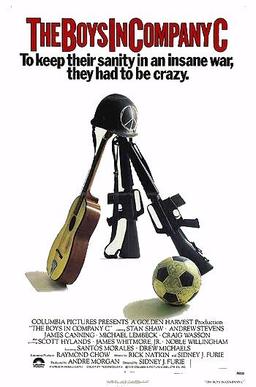
THE BOYS IN COMPANY C (11) vs. CASUALTIES OF WAR (6)


VS.


If you are new to the tournament, go to the opening post.

ACTING“The Boys in Company C” is an ensemble movie with a B-list cast of actors who probably thought they would become household names. Dream big, baby. The movie is dominated in the first 37 minutes by R. Lee Ermey as the Drill Sergeant in charge of training a motley crew of stock characters. Since the film was largely forgotten when it came out (including by Stanley Kubrick), people think Ermey was discovered for “Full Metal Jacket”. He is doing the same “acting” in this film. He is excellent, of course. However, the rest of the actors are embarrassingly bad. You would think it was their first movie. Several of the performances are grating, especially Andrew Stevens as Pike and Michael Lembeck (son of Harvey from “Stalag 17”) who plays the caricatured Italian wise-guy from Brooklyn. Argggh! D

“Casualties of War” has a much better cast. Michael J. Fox does an outstanding job playing the naïve, moralistic Eriksson. John C. Reilly (his first film), Don Patrick Harvey (playing his usual typecast bad guy), and John Leguizama (his second role) are solid. Thuy Thu Le is remarkable as the doomed Oanh (it was her only acting credit). Plus we get the bonus of Dale Dye in a fiery take on ass-covering brass. The only problem is the scene-chewing of Sean Penn as Sgt. Meserve. The performance has been praised, but not by me. His hammy portrayal of the villain is distracting. His emoting of faux grunt slang is the worst thing about the movie. Imagine a movie where he is the weak link in a cast with three comedians in their first substantial dramatic roles. A

FIRST QUARTER SCORE

Boys in Company C = 6
Casualties of War = 9


PLOT

“The Boys in Company C” covers a heterogeneous unit from boot camp to vignettes in Vietnam culminating in a soccer match. The plot is cliché-ridden and predictable. The characters are all stereotypes (the hippie, the ghetto drug dealer, the writer, the athlete, the ladies’ man). It’s painful to watch bad actors playing time-worn characters. The incidents in the movie are progressively ridiculous, culminating in the egregious soccer match. Every scene in the film has been done better in other films. F

“Casualties of War” is based on a true incident involving the rape and murder of a Vietnamese girl by a long range patrol. One member (Fox’s Eriksson) did not participate and was instrumental in bringing on a court-martial. It is a powerful tale well told. The movie is actually weakest in the set-up which attempts to establish the nature of the war and is too truncated in the trial phase, but the mission is the centerpiece and is strong. The theme of war’s corrupting influence and the moral that you must not compromise your principles are advanced efficiently. B

HALF TIME SCORE

Boys in Company C = 12
Casualties of War = 17


COMBAT

“Boys” is sometimes lauded for being one of the better Vietnam War movies and praised for its realism in reflecting the soldier experience. The combat scenes have some fair action, but they are Hollywood’s idea of Vietnam combat. We get the convoy ambush, patrol ambush, and the search and destroy mission. Lots of blanks are fired (from M-16s with banana clips) and there are plenty of explosions. All the unused ordnance is literally thrown in at the end to tack on a war is terrible theme. C

“Casualties” is not designed to be a combat movie and it shows. This is De Palma’s only war movie and he does not stage combat well. In the opening scene (which is a night ambush) Eriksson is sent out by himself to lock down a flank with a grenade launcher in the thick foliage! (Next time we see him he has a M-16. Good editing!) This is all to set up a ridiculous tunnel episode used for Meserve to save Eriksson’s life. (This is followed by Merserve referring to the ambush as a “mad f****** minute” – one of several of the inaccurate uses of slang in the movie.) The show piece of the latter half of the film is the assault on a VC base camp. The five man squad wipe out a much larger enemy force with the help of naval and air support. In the midst of the bells and whistles, we get a wrenching death. C

THIRD QUARTER SCORE

Boys in Company C = 18
Casualties of War = 24


REALISM

“Boys” is illogical and laughable. Once we get to Vietnam, the movie degenerates into a series of vignettes that are all ridiculous. A soldier steps on a mine in a rice paddy. A character plans to send dope back to the States in body bags. A general’s trailer is blown up with a claymore. And don’t get me started on the soccer game. These guys (who have never played soccer and do not practice) are competitive against a talented Vietnamese squad. Hey, American audience, soccer is so easy anyone can play it! D

“Casualties” is a pretty accurate rendition of the book it is based on. I have read the book so I can vouch for the realism of the film. The only major revision is with the attack on the base camp. No surprise that in reality the body count was much lower in reality. And no war-mongering Americans met ironic deaths in the process. Also, I would hazard that the complete lack of noise discipline for a long range patrol is a bit off. Sadly, the atrocity is not only factual, but not unrealistic. As far as Michael J. Fox playing a soldier, I won’t get into that. B

FINAL SCORE

Boys in Company C = 24
Casualties of War = 32


ANALYSIS:

“Boys” is highly thought of in some circles. It was the first significant post-war movie. It did poorly at the box office and some blame this on Americans not being ready for this type of film. And yet, the very next year marked the boom in Vietnam War films – starting with “The Deer Hunter” and “Apocalypse Now”. Obviously it did not flop because of the timing. It did poorly because it sucks. Compare it to “Go Tell the Spartans” (which came out the next year). “Casualties” is superior in every way and it is not an outstanding movie. It is significant and has a worthy cause. It also did not do well financially which proves that the public was not ready for dirty laundry as much as it did not want to see war as a farce.