The
sinking of the USS Indianapolis is perhaps the most horrific incident for the
U.S. Navy in WWII. The Indianapolis had
delivered the atomic bombs to Tinian and was on its way to the Philippines when
it was sunk by a Japanese submarine. The
survivors were in the water for four days and were decimated by sharks before
they were spotted and rescued. The post- script was the court-martial of Captain Charles McVay III for not zig-zagging
and not abandoning the ship quickly enough.
The combination of tragedy and courtroom drama is perfect for a war
movie. And there have been two attempts
at bringing the story to the screen. The
first was a made-for-TV movie entitled “Mission of the Shark” (1991) starring
Stacy Keach. In 2016, Hollywood weighed
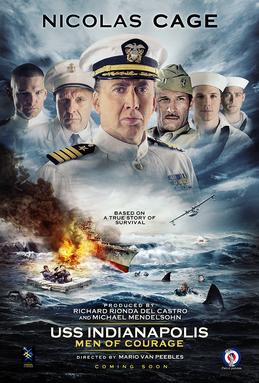
in with “USS Indianapolis: Men of
Courage” starring Nicholas Cage. Did
either do justice to the men of the Indianapolis?
The
Cage movie begins with “the following is based on a true story”. Ah, the old “based on” claim. Viewer beware. If that was not enough of a warning, the
first scene doubles down. The
Indianapolis is attacked by kamikazes off Okinawa and Capt. McVay (Cage) is on
the bridge yelling “fire!” to his batteries.
What a hands on captain he is! In
a terrible CGI scene, one of the kamikazes hits the ship. Meanwhile, in a smoke-filled room, a group discusses
the need to destroy Hiroshima with an atomic bomb. Kill every man, woman, and child. “Radioactive
fallout” is mentioned which is prescient since even the Manhattan Project scientists were unclear
about this effect. A fast ship should be
sent on a “suicide mission” to deliver the bomb to Tinian. Nick Cage talks to his wife’s portrait. This is our first warning that we are getting
the bad Cage. Thankfully, this is not a
biopic and we will have to suffer through command and tar characters. A military love triangle is introduced as two
buddies are in love with the same girl, but the fiancé of the two is
unaware. If you think both will survive
to duel for her, you have never seen a military love triangle depicted in a
movie. At this point, all optimism (or
delusion) about quality is erased by the appearance of Tom Sizemore as crusty Chief Petty
Officer McWhorter. That’s right, this
movie has bad Cage and
Sizemore. Why do the producers hate us?
The
ship returns to San Francisco to repair and take on a mysterious box. Someone asks if it has anything to do with
the Manhattan Project. I guess
historians referring to the atomic bomb development as top secret was an
exaggeration. The ship is in port so we
must have a night on the town scene, but since this is a modern war movie, the
clicheish fight is not between sailors and soldiers, it is between a white
sailor and a black sailor. Hollywood
diversity!
On
the trip to Tinian, McVay decides that the doctrine of zig-zagging is a waste
of time because the Japanese subs have “kaiten” (human torpedoes) that can
outrun any ship. Apparently McVay thinks
the Japanese no longer use regular torpedoes.
A meeting with the I-58 awaits.
The I-58 is a hard-luck boat that has had little success in the war. That is about to change. Along comes a fat juicy target sailing
blithely along in a straight line. The
torpedoes result in hilarious chaos. All
the main characters hit the water, including the black fighter who rescues his
antagonist. War brings enemies
together. Or war movies do.
The
survivors are in several groups in the water.
Besides the sharks, they have to deal with lack of food and water. Some become delusional. Some are suicidal, like members of the
audience at this point. McWhorter has a
leg wound which means Sizemore has to play pain.
Come on sharks! There is a hated
officer who insists on a cushy seat in a life raft. Someone has to break the shark monopoly on
villainy. Eventually the few are
rescued, but not us because there is that pesky trial that we were
promised. Here is one case where you
will beg for a title card post script.
In
case you haven’t figured it out, this movie is terrible. It is very disrespectful of the men who were
on board the Indianapolis. They deserved
better. I suppose if you know nothing
about the event and you do not care about historical accuracy, you might get
something out of it. But there is no way
you will find it entertaining. Unless
you are big fan of current Cage and Sizemore.
Or you find “Sharknado” to be a documentary. Or you watch it as a comedy. It could be
argued (over a six pack) that it is one of the funniest war movies ever
made.
The
dialogue is trite. The plot is lame and
riddled with clichés. The cast is weak
and the acting is what you would expect from a cast that is headlined by
Cage/Sizemore. At least there was no
pressure on the rest of the actors.
Besides, how would director Mario Van Peebles even recognize good acting?
“Mission
of the Shark” begins with McVay (Keach) arriving at the five year reunion of
the crew with some trepidation. We then
flash back to 1945. The Indianapolis
sails for Tinian with a box on deck. McVay mentions kaiten as the excuse for
not zig-zagging. However, when the ship
is on the way to the Philippines, McVay orders the cessation of zig-zagging due
to the darkness of the night. Like the
Cage movie, this one intercuts with the sub’s actions. When the torpedoes hit, there is made-for-TV
chaos which are less laughable compared to straight-to-DVD chaos. The effects are very cheap. The survivors are divided into four
groups. One of them has Doctor Scott
(Richard Thomas). This film completed
his vaunted war trilogy (“Red Badge of Courage” and “All Quiet…”) and made him the rare actor who has appeared
in war movies set in the Civil War, WWII, and WWII. Another group includes this movie’s dickish
villain. Kinderman (Don Harvey) is a
malcontent who believes it is every man for himself. The shark attacks are ridiculous and consist
of fins causing the men to thrash about.
Some of the men drink salt water and go crazy. Not every man is a hero. Some of the deaths are poignant. And some are unpredictable. This movie is not as funny as the other.
“Mission”
also concludes with the court-martial.
There are some interesting differences.
In both films, the surprise witness is I-58s Captain Hashimoto. In “Mission”, he claims that if the
Indianapolis was zig-zagging, it would have forced him to maneuver to get off a
shot. In “Courage”, he testifies that
zig-zagging would not have made a difference.
Oddly, in "Mission", he confesses this to McVay when they meet after the trial. McVay does not ask him why the hell he did
not mention that on the witness stand!
I
had seen “Mission” when it first appeared on TV and had remembered it as better
than it actually is. It is merely an average
made-for-TV movie. This is apparent in
the acting and effects. As blah as those
are, they are superior to “Courage”.
Keach and Thomas are not at their best, but they run rings around (swim
circles around?) Cage and Sizemore. The
plot is too cursory to do the story justice.
It merely touches on problems other than the sharks. It introduces the theme that the brass were
partly to blame, but does not pursue it much.
It takes less liberties with the truth and is a slightly better history
lesson. I don’t think the dead turned
over in their graves as much as they did with the more recent movie. It is boringly sincere.
What
does it say when after two movies about the Indianapolis tragedy, the best
memorial to the crew is still Quint’s soliloquy in “Jaws”?
COURAGE = F-
MISSION = C-
HISTORICAL ACCURACY: The
USS Indianapolis was not the victim of a kamikaze. But it was hit by a bomb dropped by a
Japanese plane off Okinawa. It was sent
to San Francisco for repairs and there was given the secret mission. The delivery was uneventful. Because the mission was top secret, it was
decided that the ship would proceed to the Philippines without escort. McVay was not told that a destroyer had been
sunk by a sub in the area and an ULTRA intercept proved there was a sub in the
area, but notification was above McVay’s rank.
The I-58 was the sad sack ship depicted in “Courage”. It had been in action since Pearl Harbor and
had zero kills. Ironically, it left for
patrol from Hiroshima the day the Indy left from San Francisco. McVay (who was the son of an admiral)
declined to zig-zag due to the darkness of the night. The ship happened to cross I-58s path and it had
to do little other than fire six torpedoes.
It seems clear that if the Indy had been zig-zagging it may well have
survived. Two torpedoes hit and knocked
out power and communications. For this
reason, the second charge of not abandoning ship with alacrity was unjustified.
McVay could not contact the engine room so the cruiser continued to plunge
ahead at high speed. Ten minutes after
the first explosion, McVay gave the order to abandon ship. There was indeed chaos as fire and smoke
consumed the ship. The ship sank within
twelve minutes of the first torpedo. It
did not break in two. More than 300 men
went down with the ship, but that left around 800 men in the water. About 200 died by dawn due to wounds.
Although
a message from the I-58 was intercepted and decoded, the message was deemed
fake and was not followed up on. When
the Indy failed to arrive on time, there was no concern. Meanwhile the men were going through a hell
that no movie can realistically depict.
It became the largest recorded encounter between men and sharks in
history. The dead were shoved away as
food. The wounded were shunned. The screams were nightmare-inducing for
decades. But that was not the extent of
the horror. The days were sun-baking and
sun-blinding and the nights were chilling physically and emotionally. Life jackets were designed for only three
days before getting water-logged and many sailors did not even have one, much
less place in the sparse life rafts.
Some men drank sea water and became deranged. There were some murders. Some men simply gave up the fight for
survival.
On
the fourth day, a PV -1 Ventura on routine patrol spotted one of the groups and
called it in. A PBY under Lt. R. Adrian
Marks was immediately dispatched.
Outbound, Marks passed over the USS Doyle and radioed for it to
follow. When Marks arrived, he made the
decision to land and become a large floating raft for survivors. He saved 56 men. The Doyle arrived a few hours later and
subsequently several other rescue ships got to the area. Out of 1,196 crewmen, only 317 survived.
In
November, 1945 the Navy needed a scapegoat and chose McVay. He was court-martialed for not zig-zagging
and not abandoning ship quickly enough.
The Navy covered up the fact that his orders said he could “zig-zag at
his discretion, weather permitting.” It
also did not take the blame for not informing McVay of the warnings about a
submarine in the area and for messing up the rescue. Hashimoto testified that zig-zagging would
have made no difference. He was not a
surprise witness. McVay became the only
ship captain to be court-martialed for losing his ship in WWII. Soon after, Adm. Nimitz remitted the sentence
and restored McVay’s rank. He retired in
1949 as a Rear Admiral. Although most of
the survivors forgave their captain, some of the relatives of the deceased were harsh. In 1968, McVay took his own life. In Oct., 2000, Congress passed a resolution
exonerating McVay and Pres. Clinton signed it.

