“Wil” is a
Dutch film that deals with the role of Dutch police during the Nazi occupation
of the Netherlands. The main character is Wilfred Wils (Stef Aerts). He
narrates as the film flashes back to WWII. He forewarns the viewer by asking us
to not judge him. It’s 1942 in Antwerp and Wil is a rookie cop. An evil German
forces him to take him to a Jewish family. When he and his partner step in to
save the mother and daughter, the German is killed. Oops. It’s a provocative
start to a movie that focuses on the difficult line humane Dutch policeman had
walk to please their German masters and yet not be traitors to their nation. The
central plot will be the investigation to find out who killed the German. Wil
and his friend do not go into hiding. They continue their job while hiding the
Jewish family. It’s remarkably brave act, especially since Wil is an obvious
suspect and does many stupid things that should have prevented flashing back to
the war from comfortable old age. For instance, his mentor is a man who turns
out to be anti-Jewish. Wil is not a good judge of character. He has an affair
with an unstable woman.
As far as the rounding up of Jews,
the film is willing to show that many Dutch were anti-semitic and some even
aided in the Holocaust. There is a scene where a Dutch audience leaves a
showing of a anti-Jewish film to head for the synagogue. It is also not above
depicting Dutchmen who collaborated. Wil might have saved the Jewish mother and
daughter, but he ends up collaborating and participates in round-ups.
This is not the first movie that
deals with Dutch resistance and collaboration. It is a bit different because it
concentrates on one individual. Unfortunately, the main character is too
inconsistant in his actions. Is he supposed to be a hero or a villain? I know
some will say he represents good men who were forced to do bad things, but few
Dutch were both resistance members and collaborators. Most picked a side. Wil
does not. Other characters are poorly drawn. The evil Nazi’s actions make no
sense. He overlooks Wil’s clear guilt and instead tortures Wil’s boss. The
showy cinematography, which includes lots of circular filming, adds to the
weird vibe the movie gives off. I know many critics will praise it, but it is
not a good war movie and not a good Holocaust movie.
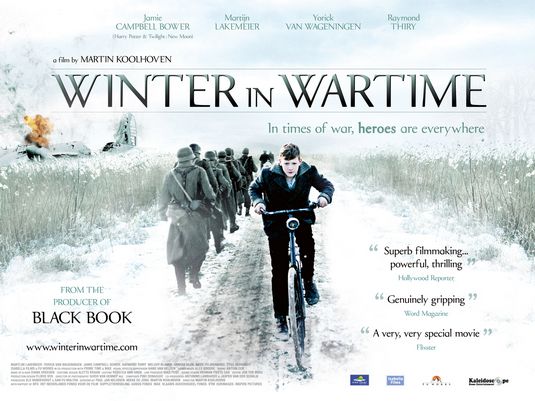
“Winter in Wartime” is a Dutch
movie based on a young adult novel by Jan Teurlouw.It was directed by Martin Koolhoven who
decided to aim at a more mature audience than the book.The film was a huge hit in the Netherlands and
was voted movie of the year by the Dutch press.
The film is set in occupied
Netherlands in January, 1945.A British
plane crashes outside a Dutch town and the surviving crewman is forced to shoot
a German soldier who discovers him hanging from a tree that his parachute is
ensnared in. A fourteen year old boy named Michiel (Martin Lakemeier) and his
friend stumble upon the crash site and their faces evidence the excitement of
teenage boys who see only the glamour of war.
The local town is divided between citizens who
collaborate with the Germans and those who secretly work against them.Michiel’s father is the mayor and he is in the
group that tries to tolerate the Germans as a matter of survival.This is contrasted by Michiel’s uncle Ben
(Yorick van Wangingen) who is associated with the Resistance.Although Michiel does not resent his father’s
attitude, he clearly idolizes his uncle.The movie avoids cliché by not putting Michiel in the middle of a
struggle for his soul.
Michiel’s teenage world is
overturned when two friends are outed as Resistance members and Michiel is left
as caretaker of the British airman Jack (Jamie Bower) who has been hidden in
the forest.Michiel is thrilled with the
adventure of it all.Michiel is forced
to involve his sister Erica (Melody Klaver) because she is a nurse and Jack has
an injured leg.Naturally, romance
develops.Uncle Ben is also brought in
because Jack has a package that needs to be delivered back to England.
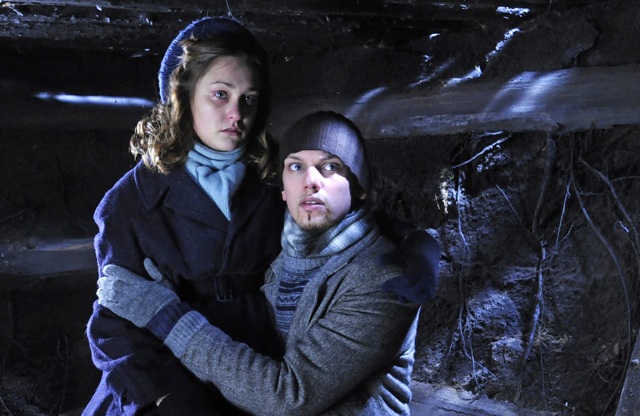
Erica and Jack (no, he's not a vampire)
Two escape attempts by Jack and
Michiel are foiled.Meanwhile, the
Germans discover the body of the dead German and take hostages in the town to
force revealing of the “murderer”.Michiel’s father is one of the hostages.Jack wants to turn himself in, but Uncle Ben promises Michiel he can get
his father released.No one questions
how a shady resistance operative will convince the Nazis to do this.Uncle Ben promises more than he can deliver.However, he will make up for this by aiding
in the escape of Jack.This gets
complicated when one of the quartet turns out to be not who they seem to be.
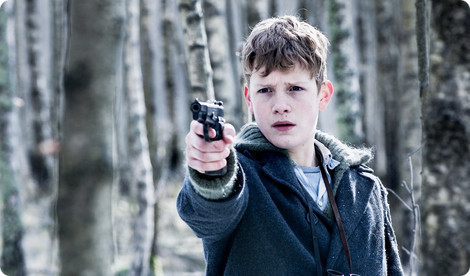
don't you want to know who Michiel is about to shoot?
“Winter in Wartime” is a well-made
film.The winter setting is snowily
pristine which is contrasting to the underlying malevolence of Nazi
occupation.The cinematography is an
interesting blend of styles.There is
some hand-held, some slo-mo, and some POV.The score is your basic epic orchestral.It fits well.Not too pompous or
manipulating.The movie is not violent
or graphic and the language is not strong.It is very perplexing why this movie was rated-R.
The plot has weaknesses.The several escapes are implausible.The Nazis lack persistence and Jack and
Michiel are two lucky dudes. The romance
between Jack and Erica seems thrown in, but it does not sour the movie.The strength of the plot is in the twisty,
thought-provoking ending.The film
finishes strong.The theme of how war affects
young people is explored effectively.Michiel evolves from wide-eyed innocence to hardened stoicism.His excitement upon discovery of the downed
plane and then the downed airman contrasts with some of the very hard adult
decisions he ends up having to make.Within a week he goes from teenage boy to prematurely aged young
man.This has been seen before, but
Lakemeier is up to the task.The rest of
the cast is satisfactory.
The film attempts to explore the
dynamics of an occupied town.Some of
the citizens (like neighbor Shafter) are collaborators.Some, like Michiel’s father, are just trying
to survive by tolerating the Nazis.Others, like Uncle Ben, are actively working against the occupiers.This was reality.The movie clearly depicts the dangers of
being in that last group. Curiously, the
movie does not take the time to develop empathy for the Dutch people. The
townspeople are not really suffering under Nazi domination.There are some shocking examples of violence,
but they seem thrown in to advance the plot.
so, you thought war was exciting?
I meant to read the book in
conjunction with this review, but my local library could not get it.Based on Caroline’s excellent review at Beauty is a Sleeping Cat, it is
apparent there are some differences between the movie and the book.I gathered from what Caroline writes that the
parents in the book are much more involved in the Resistance than they are in
the movie.Michiel’s father is not an
ass-kisser like Shafter, but he is not using his home to aid the Underground.Caroline says:“Every night they open their doors to distant relatives,
people on the run, displaced persons, provide shelter and food for one night.”This does not happen in the movie which is
good because the movie widens the gulf between the father and the uncle.The movie also does not really show
hardships like hunger affected the people.The movie does not spend a lot of time on the village dynamics.
“Winter in Wartime” is an
entertaining movie, but does not belong with the greats of the Resistance
subgenre.Focusing on a teenage boy is a
nice touch and instructive.Although the
director targeted it at a more adult audience than the novel, the movie still
works best if aimed at a teenage audience.It has an important “what would you do?” vibe to it.
BACK-STORY:“Soldier of Orange” is a Paul Verhoeven (“Black
Book” and “Starship Troopers”) film about the Dutch Resistance in WWII.It is based on the autobiography by Erik
Hazelhoff Roelfzema.It was the most
expensive Dutch movie up until then and was their most popular movie in
1977.It was nominated for the Golden
Globe for Best Foreign Film.
OPENING:The film opens with a blend of real and faux
newsreel footage of Queen Wilhelmina returning to a liberated Netherlands in
1945.At her side is her aide Erik
Lanshof (Rutger Hauer) .
SUMMARY:The movie follows a group of frat boys during
WWII.It opens in the city of Leiden in
1938.The main characters are introduced
via a wild frat party at a night club.Erik is pledging and undergoes the Dutch version of hazing.The frat president Guus (Jeroen Krabbe) makes
him sing a song and then pours soup on his head followed by braining him with
the soup tureen.What an a-hole!First blood – ten minutes in.This bodes well.The next day Guus apologizes to Erik and a
fast friendship begins.Erik goes to
live in the frat house and the core group develops.Jan is a Jewish boxer,Alex has a German mother, Nico is so anal they
call him “Mr. Precise”, Jacques is a serious student, Robby is going steady
with a Jewish girl.They are living the
frivolous lives of rich college boys.
When England declares
war on Germany, the boys are interested, but naïve about its potential impact.Erik remarks that “a spot of war would be
exciting”.Wish granted. A spot of war entails four days of Nazi ass
kicking (off screen aside from a lame bombing scene).Erik and Guus tool around in tails on
motorcycles to try to enlist, but too late.Clueless rich guys.Oh well,
there’s always the Resistance or collaboration.Pick one.
Erik and Guus in tails on choppers
Guus and Erik hatch a
hare-brained plan to motorboat to England, but a petrol leak causes a fire and
explosion.The comic genius of
Verhoeven!The home front begins to get
serious as Jan beats up two Gestapo wannabes who were harassing a fellow
Jew.Erik allows Jan to take his place
on a boat to England, but said boat is intercepted by a German gunboat (there’s
a mole!).Jan is taken captive and
tortured (briefly but memorably) then guillotined.It turns out clandestine Radio Robby has been
turned due to blackmail involving his Jewish fiance Esther.
Guus, Susan, and Erik
At this point the boys
have all picked sides (except Jacques who has decided to sit the war out).Alex is channeling mommy and has joined the
German army where it turns out he is good at his new job.Nico is a Resistance
leader.Robby is a collaborator.Jan is headless.Erik and Guus are off to England to spy for
the Queen and bed a sexy British secretary Susan (it’s a Verhoeven film so we get
some gratuitousness - see above) to Col. Rafelli (Edward Fox!).The British are willing to use the duo for
their little spy games.
Guus returns to
Holland to help Nico and others escape to England.Erik returns to rescue Guus from the trap
laid by the compromised Robby.Erik runs
into Alex and they do a tango, literally.There is some homoeroticismin
the film, but you would have guessed it would have been Erik and Guus dancing.The rescue is botched, but Erik and Guus escape in different
directions.Robby gets his in a ride-by
shooting by bicyclist Guus.Unfortunately, Guus gets captured and unlike Gerbier in “Army of
Shadows”, there’s no miracle escape ensuing.Meanwhile, Alex plays Nazi snob to an urchin and is rewarded with a
Vietnam style fragging.
CLOSING:It’s time for a career change for Erik, so he
follows his dream to be a pilot by joining the RAF.No training montage.He flies a Mosquito on bombing raids over Germany.It’s faster than a motorcycle, but you can’t
wear tails.The Queen has taken a liking
to him (but thankfully not in a disrobing way) and makes him her adjutant.He flies her back to the Netherlands to much
fanfare.Erik hooks up with
collaborator-shorn Esther (they had dabbled a bit during her engagement to Robby).He then
reunites with Jacques so we can wonder if sitting out the war wasn’t the
shrewdest move of the frat boys.
RATINGS:
Acting -C
Action -6/10
Accuracy -B
Realism - B
Plot -C
Cliches -B
Overall -C+
WOULD CHICKS DIG IT?Yes.The
cast is attractive.The violence is
brief and not hard core.There are two
female characters that invade the boys club.Their main purpose appears to be to reduce the guyness of the film. It is more balanced than most war films.
HISTORICAL ACCURACY:Having not read the book it is based on, I can’t
vouch for much of the film.Erik
Hazelhof Roelfzema was a law student at Leiden University when the war broke
out.He did join the Resistance.He escaped to England on a freighter along
with Bram van der Stok (one of the three escapees from Stalag Luft III of “The
Great Escape”). In England, he met the
Dutch intelligence chief Gen. Francois van’t Sant (Van der Zanden is modeled
after him).I do not know if Roelfzema
tried to kill him because he was told he was a traitor.
Roelfzema set up a
group of spies called the Mews.Their
goal was to make contact with the Dutch underground.The Germans ended up turning many in the
Dutch Resistance, but Roelfzema’s superior refused to accept that and they had
a falling out.Because of this bad
blood, Roelfzema enlisted in the RAF and went to Canada for training in 1942.He returned in 1944 as a Mosquito-flying
pathfinder.He was awarded the
Distinguished Flying Cross.In April,
1945, Queen Wilhelmina tapped him as her adjutant and he returned to Holland
with her.The real Roelfzema appears in
the newsreel footage shown in the film.Roelfzema wrote Soldat van Oranje in 1970 and it made him a
legendary figure in the Netherlands.
It would appear that
the movie uses composite characters for Erik’s friends.I also assume many of the vignettes are made
up for entertainment purposes.
CRITIQUE:“Soldier of Orange” is proficient
entertainment.Verhoeven has an
interesting visual style.He likes
colorful sets and colorful characters.This is obvious from the beginning with the frat hazing scene.The sets are realistic to wartime Holland and
he gets the small touches right.At one
point, Erik and Guus encounter some Dutch guards who have them say words with
“sch” in them because no German could handle that sound.
The acting is only
average.The movie made Hauer a star,
but he is nothing special.The supporting
cast is competent.Krabbe stands out in
the flashiest role.The movie is in some
ways a buddy film.I did not find that
the rest of the core group was well-developed.Their motives were not explored much.Even Erik and Guus become members of the Resistance for unclear reasons.
The plot is basically
a series of vignettes following the frat boys, but mostly focusing on Erik and
Guus.The scenes are fun partly because
they toy with reality a bit.There is an
underlying surrealness to the behavior of some of the characters.Alex and Erik dancing cheek to cheek would be
an example.Or is it silliness?The movie has several ridiculous elements.The escapes are routinely unlikely. They are also repetitive.
The movie is
technically sound.The cinematography is
fine, but not laudatory.Verhoeven does
not throw a lot of pizazz at us.The
sound track is unobtrusive and does not beat you over the head.It also does little to add to the movie.There are long stretches with no score.
The movie stands out
in its even handed treatment of the Dutch home front.Two of the characters go over to the dark
side.Robby is the cliched turncoat who
does not have the moral courage to stand up to evil.Alex is the cliched douche who revels in the
power that comes with the uniform.The
movie was controversial in the Netherlands for showing the reality of how the
war divided the country.Some were also
upset that the film depicted the harsh treatment of Dutch Jews.That treatment was not just by the Nazis.There was quite a bit of anti-semitism in the
populace.
“Soldier of Orange”
fits comfortably into the small unit, ”who will survive?” subgenre.It is suspenseful in that respect, but a good
bit of that suspense is diluted by the opening which specifies that the main
character will survive his adventures.This was a perplexing decision on the part of Verhouven.Was it because he wanted to show off the
faux-real blend of newsreels?Another
perplexing element is the lack of palpable danger in their Resistance
escapades.You are not put on the edge
of your seat.The torture scenes are
truncated and are basically snap shots that your imagination is asked to
expand.
CONCLUSION:It took me a while to locate this movie.That is why it is appearing out of
sequence.When I first started this
project of reviewing all one hundred of the Military History 100 Greatest War
Movies, it stood out as one of the few on the list that I had never heard
of.It was also one of the minority that
I had never seen.For those reasons, I
was looking forward to watching it.The
long wait added to the buildup.Plus, it
is #28 on the list.
I have to say, the
movie was very disappointing.As I have
approached the top of the list, it has become increasingly rare for a movie to
hold a head-scratching position on the list.However, the panel really got #28 wrong.There is nothing special about “Soldier of Orange”.It may be based on a remarkable man, but it
is definitely not a remarkable movie.I
realize I am flying in the face of virtually all the experts and I did read
several very positive reviews that left me questioning my sanity, but in the
end I decided to stick with my gut and not compromise my reviewing by forcing
myself to join the crowd.
First, there are many
Resistance movies that did not make the list and are superior to it.Hell, Verhoeven’s “Black Book” is better in
every way.So are “Flame and Citron” and
“Army of Crime” to mention two similar films.Although I am not a fan of “Army of Shadows”, if the panel wanted a
critically overrated example of the subgenre anyone could make a stronger case
for it.Second, who in their right mind
could place “Soldier of Orange” ahead of “The Deer Hunter” (#29)?