“A Time to Love and a Time to
Die” is based on Erich Remarque’s novel.
It is sometimes referred to as “All Quiet on the Eastern Front” although
it is set in the second world war and bears little resemblance to the classic. Remarque co-wrote the film and acts in
it. It was directed by Douglas Sirk
(“Battle Hymn”). It was filmed in West
Germany. Because of its sympathetic
portrayal of German soldiers, the movie was banned in Israel and the Soviet
Union.
The film opens with a German
unit retreating on the Eastern Front.
They billet in a vacant village where they uncover the frozen body of a
comrade. The men are exhausted and most
are bitter and cynical. The exception is
a hard-core Nazi named Steinbrenner.
Every unit has one. Some of the
men are ordered to execute some civilians who have been determined to be
“guerrillas”. One of the men (a young
Timothy Hutton) takes his own life because of this.
Ernst Graeber (John Gavin) is
given a furlough after two years at the front.
He returns home to find no home and no parents. When he tells an old man that he has come
from the front, the old man responds:
“This is the front.” Graeber
meets Elizabeth (Liselotte Pulver) and the relationship starts like every movie
romance – rocky. While searching for his
parents, Graeber meets an old classmate who is now a Nazi official. Binding (Thayer David) lives like prince in
his mansion decorated with stolen art.
He is very chummy with Graeber, however.
Ernst and Elizabeth dine in a fancy restaurant where the rich are unaffected by the war. Until an air raid blows up the
restaurant. Air raids are a recurring
theme of the movie. If the actors did not speak German, you might think you wandered into a movie set in the Blitz. Ernst and Elizabeth get married and even the
bombing of her apartment can’t dampen their love. What does put a damper on things is the fact
that the Gestapo is searching for Elizabeth.
Her father had been shipped off to a concentration camp for criticizing
the war. Maybe Binding can help, plus
this gives the plot the chance to introduce a loathsome Nazi (Klaus Kinski, probably not acting) who enjoys his
work in the concentration camp. These
air raids are getting dangerous, lucky thing Graeber has to return to the
front. His respite from executing
civilians is about to end.
“A Time to Love and a Time to
Die” is largely forgotten today because it is forgettable. Most people don’t know there is another war
movie based on a Remarque novel. I have
not read the book, but I would hazard that the book is as inferior to All
Quiet… as the movie is to the movie. It was impossible for Remarque to replicate
the brilliance of his earlier novel and it is commendable that he did not
try. The movie is more of a romance than
a war movie. There is no combat and
little of the soldier interaction that the first is noted for. In exchange, we get a lame romance with lame
dialogue. It does not help that there is
no chemistry between the leads. Pulver
plays Elizabeth as a bubbly, Bohemian in spite of her father’s fate. Gavin is just a bad actor. He is his usual wooden self. (He is better than Lew Ayres, I must
admit.) The rest of the cast is not bad
and Remarque (who plays a dissenting German teacher) is surprisingly good. Acting honors go to Keenan Wynn who brings
some needed levity as one of Graeber’s friends.
The movie strangely lacks suspense.
It does set up potentially interesting scenarios like the search for the
parents and the Gestapo wanting to locate Elizabeth, but then does not pay
off. It also has a perplexing case of
villain interruptus.
With all that said, the movie
was better than I expected. I had never
seen it and had no desire to see it, so I assumed it was a dog. While not being a gem, it’s worth a watch if
you are determined to see every decent war movie or you want to know the basic
plot of another Remarque novel. Or see a
famous novelist playing in a movie based on his novel. Or you are a big John Gavin fan. Ronald Reagan probably watched the movie
several times.
EFFECTS,
SOUNDS, MUSIC: “All Quiet” (1930)
has great effects for a movie released in 1930.
Like most WWI movies, the bombardment effects are impressive. However, the effects director tends to have
his bombardments appear as a perfect line of explosions. No artillery barrage could have been that
accurate. There is certainly a lot of
earth thrown around. The sound effects
tend toward noisy over quality. Most of
the shells whine. There are some really
cool staccato machine gun sounds. As far
as music, there is no soundtrack. I
believe it is better to have too little music than too much, but a little would
have enhanced the film. GRADE
- B-
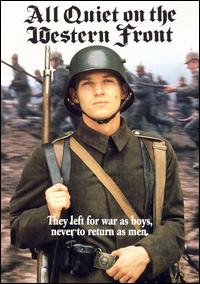
“All Quiet” (1979) is a made-for-TV movie so you can’t
expect spectacular effects. The
bombardment effects are fine. The sounds
are excellent. When the men go through
the barbed wire, you hear the tinkling.
Surprisingly for a modern war movie, there is not much of a soundtrack. Alyn Ferguson was a well-respected composer
for mostly TV productions. He was not
looking to win an Emmy for his work here.
The soundtrack does not tug at emotions or tell you how to feel. Most scenes have no music. GRADE - C
FIRST
QUARTER SCORE: 1930 -
7 1979 - 6
INTERIORS
AND EXTERIORS:“All Quiet” (1930) is
weak on interiors. The dugouts are too
simple. There are no bunk beds
evident. This is not accurate for
depicting the elaborate underground structures the Germans constructed. The billets are fine, but lack much mise en
scene. The military hospital is too pristine and quiet. No one is screaming in pain. There was no chaos. No man’s land is excellently recreated. There are plenty of shell craters and barbed
wire. The trenches are fairly generic
and there is little evidence of the zig-zag nature of the real trenches. GRADE - B-
“All Quiet” (1979) has a bunker scene with bunks. It is sturdily built. Several billets are in bombed out buildings. The hospital looks more realistic than in the
1930 version as it is crowded and busy, but still too quiet. The classroom and Paul’s home appear to have
verisimilitude No man’s land is medium scale, but a crane
shot shows it as appropriately pock-marked.
The trench is zig-zag in configuration and a later scene even has a
fire-step. The towns in France show the
effects of bombardment (but that just might be the Czechoslovakian locales the
movie was filmed in). GRADE
- A-
HALFTIME
SCORE: 1930 -
14 1979 - 14
CINEMATOGRAPHY: “All Quiet” (1930) was nominated for Best
Cinematography at the Academy Awards.
Arthur Edeson was one of the great Old School cinematographers. He was fond of shots through doorways and
windows. As you watch the movie, you are
aware of the movie’s composition. It is
one of the reasons the film is considered a masterpiece. Although made in 1930, the big trench battle
is a tour de force with tracking shots and the POV shots of the machine guns
mowing down the fodder. The movie is
most famous for its shots of the French jumping into the trench. GRADE - A
John Coquillon filmed the new version. He also did “Cross of Iron” among many other
movies. His efforts are workmanlike and
there are few bells or whistles. I did
not drop my jaw a single time. It’s
above average for a made-for-TV movie.
Some of the cinematography makes nods to the original, like the severed
hands on the barbed wire and the hand-to-hand combat. GRADE - C
THIRD
QUARTER SCORE: 1930 -
23 1979 - 20
CHARACTER
DEVELOPMENT: There are ten
significant characters in both movies.
The 1930 version does a great job on three of them: Paul, Kat, and Tjaden. Himmelstoss is one note. We know he is a postman who lets power go to
his head. The squadmates are hard to
distinguish without a scorecard. GRADE
- C
The 1979 version spends more time establishing the
various personalities. In particular,
the new version is much better at Paul’s arc from naïve schoolboy to cynical
veteran. Almost every scene centering on
Paul is an improvement over the original in developing his character. A subtle
theme is Paul’s eventual smoking of cigarettes. The movie makes a point of
identifying his comrades in an early voiceover.
GRADE - A
FINAL
SCORE: 1930 - 29
1979 - 29
MATCH
ANALYSIS: Wow, another
tie. I think under the circumstances I
am going to advance the original. Using
a boxing analogy, if you want to take the crown from the champ, you have to
beat them decisively. I do not feel the
categories were the right ones for determining which is the better movie, but I
have to stick to the format. I am
working on a future post that will determine which movie is the better version
of the novel.
It all began in the summer of
2010 after I saw the movie “Julie and Julia”.That is a movie about a young woman who decides to blog about trying all
of Julia Childs’ recipes.I was looking
for something to create a blog about and had recently gotten a copy of Military
History magazine’s “100 Greatest War Movies” issue.Add this to my lifelong love of war movies
and the project took shape and I was off and running. The initial idea was to
review the 100 on a weekly basis.That
quickly proved too ambitious for a full-time teacher and soccer coach, hence
the plus four years to reach #1.Amazingly, I have been able to view every one of the 100, although some
were difficult to obtain.I decided early on that I wanted to branch out
and do more than just the 100.The blog
expanded to include a variety of war movies.Although finishing the project is very satisfying, it is not the end of
my journey.I now move on to compiling
my own list of the 100 Best War Movies and continue the variety of reviews I
have been doing.There are still plenty
of war movies, war miniseries, and war television series to be watched.And the occasional war film that makes it to
the theater.
BACK-STORY:The first great anti-war film was based on the
greatest anti-war novel ever written.Lewis Milestone took on the task of bringing Erich Remarque’s book to
the screen and even considered casting Remarque as Paul Baumer.Lew Ayres won the role and was so affected by
it that he became a pacifist and jeopardized his career by claiming
conscientious objector status in WWII.His brave service as a medic helped regain much good will from the
public.Milestone had learned filmmaking
in the Signal Corps during WWI.He knew
what war looked like from editing war footage.He recreated no man’s land on a ranch in California.Shell holes were blasted with dynamite and
then filled with muddy rain water.A
French village was built on a back lot and included a canal that was dug for
the swimming scene.Twenty tons of black
powder and ten tons of dynamite were used for the battle scenes.One explosion resulted in Milestone being hit
by debris and knocked unconscious.2,000
extras were found in California by requesting help from American Legion
posts.The US Army could not provide
soldiers because American doughboys could not appear in foreign uniforms on
film.The 99 day shoot was double the
planned 48.The $.9 million budget
boomed to $1.4 million.It paid off as
the movie was a smashing success and won the Best Picture Oscar.Milestone won Best Director and the film was
nominated for Writing and Cinematography.It was ranked #54 on AFIs original list of the 100 greatest movies, but
did not make the revised list issued in 2007!(See below for the list of war movies that made the list.)It was not a smashing success in Nazi
Germany, a country Remarque had been forced to flee for his life.At its premiere, Goebbels had the Brown
Shirts release mice, stink bombs, and sneezing powder to clear the theater.The movie was pulled after a week and not
shown again in Germany until 1952 ( the year Remarque returned to his homeland
).
OPENING:A title card:“This story is neither an accusation nor a confession and least of all
not an adventure, for death is not an adventure to those who stand face to face
with it.It will try simply to tell of a
generation of men who, even though they may have escaped its shells, were
destroyed by the war…”(This is the
opening to the book and previews the fact that the movie follows the book
closely.)It seems to be an adventure as
the opening scene has enthusiastic soldiers march through a German town to
cheers from the populace.In a high
school classroom, Kantorek (Arnold Lucy) harangues his charges about their duty
to the Fatherland.They are “the iron
men of Germany, the gay heroes who will repulse the enemy…”The camera pans to the boys’ faces as each
imagines what enlistment will mean.One
visualizes his heartbroken mother and his proud father.Another sees himself riding in a parade
sandwiched between two babes.(Milestone
cut several other imaginings including Paul working at home on his writing and
being torn between it and the army.)Peer pressure and the band wagon effect have the boys enlisting en
masse.Added bonus:no more school!
SUMMARY:Exit class, enter training center.The boys-now-men naively look forward to
combat, but the arrival of their ex-postman Himmelstoss (John Wray) throws cold
mud in their faces.He gives the typical
denigrating speech where he calls them stupid and tells them to forget everything
they know.“I’ll take the mother’s milk
out of you.I’ll make you
hard-boiled.I’ll make soldiers out of
you or kill you.”Having never seen a
war movie drill sergeant (since they had not been invented until this movie),
they consider Himmelstoss’ tough training methods to be outrageous.(Milestone cut two scenes fleshing out
Himmelstoss’ pettiness.For example,
Paul and Albert cleaning the floors with toothbrushes.)Especially the trips to “the muddy field”.Revenge involves a caning and a mud
puddle.They don’t bother to thank
Himmelstoss for hardening them for the front.
The
muddy field does not prepare them for the chaos and death which awaits them the
moment they exit the train.They are
thrust in with some veterans who sneer about newbies being “fresh from the
turnip patch”.Making his grand entrance
with a purloined hog comes the first scrounger in war movie history.Katczinsky (Louis Wolheim) also doubles as
the crusty non-com who actually runs the unit.He questions why they left school.They will too - shortly.Kat
shepherds them on their first taste which is a routine wiring detail in no
man’s land at night.The lorrie driver tells
them:“If there any of you left, I’ll
pick you up in the morning.”A close
shell causes one of them to crap his pants – you don’t see that kind of realism
in modern war movies.The same soldier
(Behn – the most reluctant of Kantorek’s boys) is the first to die.He overemotes to death.
In
a claustrophobic dugout scene, the crew undergoes a bombardment (and a rat
assault) and several of the new guys exhibit shell shock.Kimmerich (Ben Alexander) panics and ends up
in the hospital.He passes on and passes
on his awesome boots.They are so
comfortable that the men dismiss the cursed nature of them as a running theme
has them being passed from soldier to soldier.
The
big battle scene is one of the greatest in war movie history.I show it in my classes to prepare them for
their letter from the trenches of WWI.A
panning shot of the German trench is intercut with views of no man’s land.A rolling barrage is followed by a wave of
French poilu reaching the Germans in spite of the staccato rhythm and results
of the Hun machine guns.Emphasis on
machine.Milestone takes advantage of
the pre-Victorian Production Code to show the iconic severed hands on the
barbed wire visual.This also explains
the hand-to-hand fighting with bayonets and entrenching tools.Retreat, counterbarrage, counterattack,
withdrawal.Result =lots of dead men + no territorial
change.WWI in a nut shell.
One
advantage of fifty percent casualties is the survivors get double rations of
beans and sausages from a REMF cook.War
wouldn’t be so bad if it were not for the death.The après-dinner discussion of war is cynically
pacifistic.
How do they start a war?
One country
offends another.
How can one
country offend another?You mean there’s
a mountain over in Germany that gets mad at a field in France?
No.One people offend another.
Oh, I shouldn’t
be here at all.I don’t feel offended.
Kat concludes the discussion with his opinion
that the Kaiser’s got everything he needs, but he never had a war.Every leader needs to have a war and it
benefits the manufacturers.“It’s a kind
of fever – no one wants it, but suddenly here it is.”He makes the common sense suggestion that the
leaders of the opposing sides meet in their underwear in a field with clubs.
Guess
what despised ex-drill master shows up at the front?Himmelstoss’ by the book authority trip is jeered
at by his former pupils.“Take a run and
jump at yourself”.If this were Vietnam,
he would be frag-bait.In the next
battle, Himmelstoss overcomes a bout of cowardice with rote obedience to
command.Paul survives a bombardment by
taking refuge in a grave and then has his encounter with the Frenchman in the
shell crater.It seems all the soldiers
are human beings in spite of having different colored uniforms.Paul:“You’re dead, but you’re better off than me.”
Lew Ayres and the only cast member who does not chew the scenery
An
interlude with some madmoiselles (sex for bread and sausage) is followed by
Albert (those cursed boots!) and Paul being wounded and sent to a
hospital.After surviving the “dying
room”, Paul gets to visit the clueless home front.He doesn’t fit in and is repulsed by the
armchair generaling by his father and his blathering friends.(Milestone cut a scene where Paul is berated
by an officer for not properly saluting.)A visit to Kantorek finds him recruiting more “iron men of Germany”.Paul’s impromptu guest speaker stint ends with
hisses from the future fodder as he tells it like it is.“We live in the trenches. We fight. Sometimes
we get killed.That’s all.”(Milestone cut Paul’s awkward visit with
Kimmerich’s mother where he lies and tells her he died painlessly.)
Paul gives his sausage to a French girl
CLOSING:Paul returns to his real home to find that only
Tjaden and Kat are still around. He goes to find Kat on a failed scrounging
expedition.An incredibly accurate
sniper plane picks out the pair and drops a bomb that wounds Kat in the
shin.Paul is carrying Kat to the aid
station when the bastard drops another bomb that kills Kat.Paul does not know this until the medic tells
him his friend is “stone dead”.Later,
as the war approaches its end, Paul notices a butterfly (he collected
butterflies as a kid) and upon reaching for it, he is killed by a French sniper
(who is the vengeance minded brother of the guy he stabbed in the shell
crater.Oops, spoiler alert- that is the
plot twist in the upcoming new Hollywood version of the movie).By the way, Milestone came up with the ending (the book is vague as to what happens to Paul)
after principal filming ended so he used his own arm for the scene.
WOULD
CHICKS DIG IT?If they are war movie
fans, certainly.It is a classic and set
the template for all future war movies.It
is well balanced and covers more than just soldier stuff.It even has five female speaking roles!Although three are French and not
subtitled.You can figure out what the
girls are saying, however.The combat is
not graphic or bloody.The language is
tame as is to be expected for a film from that time period.If your significant other is not a war movie
fan, they still might enjoy it.In fact,
I would imagine women might tolerate the overemoting more than most guys.
HISTORICAL
ACCURACY:Obviously “All Quiet” is
not a true story.However, Remarque was
a German infantryman during the Great War and all of the incidents in the film
are realistic and most were probably based on incidents in Remarque’s
experiences.The film has a great deal
of verisimilitude.
The
opening public enthusiasm is appropriate for people who had not had a dose of
Hell since the Franco-Prussian War thirty years earlier.The way young men were manipulated by the
authorities to go to war is a major theme.(It is important to note that if the script had been reversed and the
boys were Americans, the movie never would have been made.)The training scenes are realistic, if
softened.The Himmelstoss of the book is
harsher and closer to the Prussian style. The dynamic between the new
replacements and the hardened veterans is appropriate and could be from any war
and any country (and any war movie).
You
can learn a lot about soldier life in WWI from this movie.The movie is especially strong in its
depiction of soldier camaraderie.The
bonds are forged in the furnace of the trenches.The film throws in numerous details of the
hardships the soldiers endured.It hits
many of the “lacks”:food, female
companionship,sleep, hygiene
The
wiring detail is a nice touch and reenacts a common WWI duty that is seldom
depicted.The dugout bombardment scene
is well done and gets the claustrophobia and stress right.The movie only implies that this situation
could last for up to a week and it is not surprising that some of the new
soldiers cracked.As far as the rat
assault, this is an effective cameo from a creature that was a major nuisance
in the trenches.Speaking of critters,
there is an appearance by the ubiquitous lice.
One
could carp a bit about the rather too pristine hospital scene with the amputee
Kimmerich, but the reality of wound mortality is accurate.The combat set pieces are the highlights of
the film.Although understandably
truncated, you can not ask for a more accurate depiction of the insanity of
trench warfare.Where “Paths of Glory” showed
the suicidal nature of many attacks, “All Quiet” concentrates on the
attack/counterattack nature of the tactics.The audience is left to wonder what was the purpose of attacks that did
not change the situation and yet resulted in terrible casualties.
Just
as important is how Paul’s return home reflects the detachment of the populace
from the realities of the war.Paul is
your typical soldier who finds his home to be a surrealistic reflection of a
bygone life that he has trouble remembering ever existed.It seems he is more comfortable in the dugout
with his new family. The mattress in
Paul’s bedroom is too soft.The
butterfly collection seems childish.The
old men, representing the powers that shipped the “iron youth” off to war, are
clueless about the actual status of the war.Just like in every war before and since.
CRITIQUE:“All Quiet” is a technical marvel and Milestone
belongs on the Mount Rushmore of war movie directors just for this movie alone.(He also made “A Walk in the Sun” and “Pork
Chop Hill”.)It is the kind of film
where you notice the cinematographic flourishes in a positive way. Milestone
has a penchant for framing scenes through doorways and windows.This tends to detach the audience or the main
characters from the exterior events.This is apparent from the opening scene where we see the parade through
a doorway and then we transition to Kantorek’s class as the parade passes
by.Milestone then has the fired-up boys
marching out to join the war.The battle
scenes include a variety of shots.There
is a magnificent panning shot over the trench intercut with views of no man’s
land.We even get some POV which was
rare for films from that era.The
interplay of the machine gun mowing down the wave of French does a chilling job
of depicting modern mechanized warfare.The
most memorable sight is of the French soldiers leaping into the trench.The most commendable aspect of the combat
scenes is the sound effects.For a movie
in the transitional stage from silent to sound, it is amazing how they got the
sound of the explosions so indelibly real.The sets also bear lauding.No
man’s land looks appropriately hellish.The village built for the movie is perfect.The dugout shows a real attention to mise en
scene.The enormous $1.4 million budget
was well spent.By the way, none of the
budget was spent of a soundtrack as Milestone felt it would trivialize the
plot.The lack of the usual sappy,
prod-your-emotions score of most black and white movies is a big plus.
The
main flaw in the movie and the main reason why I had disappointing results from
showing it to students is the elements that reflect the carryover from the
silent era.This is mainly reflected in
the acting which tends to be hammy.Some
of the actors’ facial contortions and scenery chewing are distracting.This is particularly apparent in highly
charged scenes like the one where Paul is stuck in the shell crater with the
Frenchman he stabbed.Speaking of which,
Lew Ayres is a weak link in the cast.He
is not up to the role and is either too passive or is too histrionic.Most of the rest of the cast also behave as
though they were told they were making a silent movie.Only a few seem comfortable with the new “talkie”
style of restrained acting.Wolheim
(Kat) and Summerville (Tjaden) take the acting honors.Interestingly, playing veterans, they seem
more comfortable in soldier’s boots.The
dialogue is not part of the acting problem.It is actually not bad and has an appropriate dose of cynicism and
soldier humor.This is undoubtedly due
to the fact that much of the dialogue comes from the book and Remarque knew how
soldiers talked.
The
acting keeps the film from being great entertainment.On the other hand, the themes make it an
important war movie.The movie is a good
retelling of the most significant war novel ever written.You do not have to read Remarque’s novel to
get his messages.The movie does that
for the audience.Remarque clearly
intended to write an anti-war testament and the movie passes this on
admirably.It has been said that all war
movies are anti-war.I disagree with
this, but “All Quiet” has got to be one of the most unambiguous examples of
this theory.The movie is much deeper
than “war sucks”.It also posits that
the soldier age generation was betrayed by the establishment (teachers,
fathers, generals).A third theme is
that the soldiers were the same no matter the side.This was hammered at in the shell crater
scene.The scene with the French women
expands this theme.A corollary to this
is the soldier discussions that emphasize that soldiers don’t have a clue about
what war is all about and why they are fighting.The cynicism and disillusionment that effect
soldiers because of the incompetence and pomposity of leadership are
effectively depicted.
CONCLUSION:If you have followed this blog, the revelation that
“All Quiet” finished #1 has probably not come as a surprise.Military History magazine did not go out on a
limb with this choice.It’s not like
naming Jennifer Aniston the sexiest woman ever.And the choice confirms my often stated theory that the panel read
“greatest” as meaning “most important”.If that is true, then there was no other choice for #1.“All Quiet” is the king of war movies.In many ways it created the genre as we know
it, although it is not the first war movie.You could argue it was the first anti-war movie.Hollywood took a while to evolve to clearly
anti-war movies.Before U.S. entered the
war, most war films advocated neutrality.Then they supported preparedness (The Battle Cry of Peace).Once we entered, the movies favored
intervention.In the Twenties, Hollywood
depicted the war as an adventure (What Price Glory?, Wings, The Big Parade).By the end of the decade, books like “All
Quiet” steered the industry toward cynicism and thus it is the granddaddy of
movies like “Platoon”.More important,
the movie established many of the tropes that define war movies.The comradeship and bonding of soldiers at
the front.The detachment from the home
front.The clueless leaders.The crusty veterans.The officer who lets power go to his
head.The friends who go to war together
and evolve into experienced soldiers until they die.Specifically, it created the subgenre of “who
will survive?”It’s a testament to the
greatness of the book/movie that the deaths are not predictable and are so
memorable.


_poster.jpg)