Showing posts with label Guillermo del Toro. Show all posts

Friday, January 2, 2026

PINOCCHIO (2022)


                 “Pinocchio” (also known as “Guillermo del Toro’s Pinocchio”) was a passion project for the director. He had wanted to make the film for decades as he was a huge fan of the novel The Adventures of Pinocchio by Carlo Collodi. The novel was published in 1883 and set in 1880s Italy. Del Toro decided to move his story to WWII Italy. He wanted his version to be darker than Disney’s. He was influenced by “Frankenstein”. The famed director wanted one theme to be generational differences between a father and his son. He also wanted the film to be about compassion. Pinocchio is not only a liar, but he is meant to be a typical boy lacking self-control. He contrasts with the puppet-like behavior of the children in fascist Italy. The twin journeys of the father and son find Pinocchio becoming more human and Geppetto becoming more loving. He based his character designs on artist Gris Grimly’s illustrations for the 2002 edition of the novel. He changed many of the characters. Spazzatura the monkey replaces the Cat. Count Volpe (Christopher Waltz) is a composite of the Fox, Mangiafuoco, and the Ringmaster. The Coachman becomes the Podesta (Ron Perlman). And del Toro adds Mussolini (Tom Kenny) as the figurehead of fascism. 

Del Toro decided to go with stop motion animation. It became the longest stop motion film ever made. The film was announced in 2008 and later Del Toro predicted a release in 2013, Unfortunately, he had trouble finding a studio that would finance a big budget adaptation of a classic animated film. Finally, Netflix decided to bankroll the film. It was a good decision because although the production cost $35 million, it made $110 million. Del Toro assembled an all-star line-up of vocal actors including Ewan McGregor, Ron Perlman, Christopher Waltz, and Tilda Swinson. Cate Blanchett begged to be on the project, but the only role left was the monkey Spazzatura. She jumped at it. For Pinocchio, del Toro chose Gregory Mann for Pinocchio because he had a normal child’s voice, not an animated character voice. The film was critically acclaimed and won best animated movie awards from the Academy Awards, BAFTA, Golden Globes, and Screen Actor’s Guild.

Twenty years after the end of WWI, Geppetto (David Bradley) lives in an idyllic village in Italy. He lost his son in the war and a treacly song over a montage of their lives together makes it clear his happiest days are over. One night while drunk, he carves a boy out of a tree that grew on his son’s grave. A wood sprite brings the puppet to life and assigns a cricket (Ewan McGregor) to guide Pinocchio. He narrates the film. Guiding him won’t be easy as Pinocchio has the self-control of a toddler. Geppetto can’t handle him so like parents over the centuries, he sends him to school to have the teachers parent him. In a movie full of villains, the town has an evil priest, the local fascist leader, and his bully son. Before he can attend school, he is connived into joining the circus by Count Volpe (Christophe Waltz) and his nefarious monkey (Blanchett). When Geppetto comes to recover his lying son, an altercation results in the death of the puppet. This is when he finds out he cannot die for good. He is revived after a certain amount of time, each time. In one of those lives, he is a propaganda tool for the government until an ill-fated run-in with Il Duce himself. He then ends up in boot camp because what could be better than a soldier who can’t be killed. But everyone else in this movie can be and most are. This movie has a stunningly high death count among its main characters. But don’t worry, Del Toro made a gritty, harsh Pinocchio, but he did not have the guts to forego a happy ending.

“Pinocchio” is barely a war movie. It is set in WWII and the war comes to the town by way of the air, but Pinocchio does not get into combat. Oddly, it is not hard on fascism and Mussolini is only lightly lampooned. You may want to explain to your children who that war criminal is. And why he is the least villainous of the villains. The number of villains stands out, but they are mostly stereotypes. The movie also has several cliches, including redemption arcs for two main characters. And there is the “you’re a burden” scene that you see in dysfunctional father-son movies. The animation is awesome. However, the songs are underwhelming. The movie is a feast for the eyes, but not for the ears.

In conclusion, “Pinocchio” is overrated, especially as a war movie. It certainly is a different take on the classic and for that reason it is worth the watch. And the talent that went into it is very apparent. I feel it is a bit harsh for younger children, so you may want to wait a few years before letting them watch it. And make sure you are viewing it with them.

GRADE =  B


Tuesday, October 29, 2024

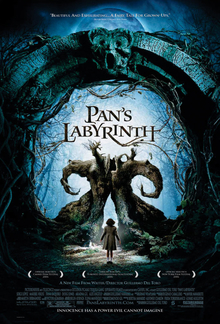
THE 12 NIGHTS OF HALLOWEEN: 2. Pan’s Labyrinth (2006)


                “Pan’s Labyrinth” was written by del Toro based on notes and sketches he did in a notebook over several years.  Not only did he write the screenplay (which was nominated for an Academy Award), but he translated the dialogue and wrote the subtitles. He turned down double the budget offered by a Hollywood studio because the money came with the demand that it be done in English.  Was the movie a labor of love?  Duh.  The movie was a big hit with critics and discerning movie goers (you know – the ones who are willing to read subtitles).  It premiered at Cannes where it received a twenty-two minute standing ovation.  It ended up winning Oscars for Art Direction, Cinematography, and Makeup (which must have made Doug Jones, who played the Faun and the Pale Man, feel better about the hours he spent in getting make-up).  It was nominated for Best Foreign Film (it lost to “The Lives of Others” but probably should not have).

                The movie is set in Spain in 1944.  Although the Spanish Civil War has been over for five years, there is still a resistance movement called the Maquis.  These rebels are in the mountains standing up to the Franco government using tactics like sabotage.  Into this environment comes a little girl named Ofelia (Ivana Baquero) and her pregnant mother.  They are going to meet her stepfather who is a captain in the Spanish army.  Vidal (Sergei Lopez) has been assigned the task of wiping out a rebel band in the area.  He plans on accomplishing this task by any means necessary.  Since he is a Fascist, you can about imagine what lengths he is willing to go to.  Plus he’s evil.  When he viciously executes two suspects you know this is not a kid’s movie.

                The movie follows two narrative tracks.  Vidal is hunting for the rebels and Ofelia is in a fantasy arc that has her performing tasks assigned by a Faun after a fairy takes her to a labyrinth on the grounds of the estate.  The Faun believes that Ofelia is the reincarnation of a princess who died and needs to return to her rightful place with her father the King of the Underworld.  The tasks come from the mind of del Toro and some drug use may have been involved.  The first involves getting a key from a giant toad and a dagger from a monster who has one eye and it’s in his palm (the Pale Man).  While Ofelia is living out her fantasy (or is it?), her stepfather’s war with the Maquis is a realistic portrayal of guerrilla warfare and counterinsurgency at its most brutal.  Vidal is getting increasingly frustrated as the rebels are a thorn in his side.  His housekeeper Mercedes (Maribel Verdu) is with the insurgents and befriends Ofelia.  This is where the two stories intertwine.

                “Pan’s Labyrinth” is an amazing movie.  It is one of those movies that deserves multiple viewings.  The special effects are outstanding.  There is a mixture of CGI, animatronics, and make-up (that Oscar was a no brainer).  The scares are potent.  Stephen King (who saw the film with del Toro) squirmed when the Pale Man chased Ofelia.  If those images were in del Toro’s head for years, he must have lost some sleep.  The score fosters the eerie vibe and the cinematography is stellar.  The Oscar for Art Direction was well deserved.  Vidal’s room is designed to mirror the inside of his watch.  Did I mention this is not a kid’s movie?  Not only is it scary, but the non-fantasy segments can be gory.  Like most guerrilla wars.  There is a visceral fire-fight in the forest that includes execution of the wounded.  There is torture for confession.  And there is a dedicated counterinsurgent who would fit well in the Gestapo.  In fact, Vidal belongs in Satan’s secret police.  He is one of the most villainous characters I have encountered.  Lopez sinks his fangs into the role, but the rest of the cast is strong, too.  Baquero is perfect as Ofelia.  She auditioned so well that del Toro changed the age of the character to fit her.  Verdu is the rare strong woman in a war movie. 

                 Most war horror movies are low budget affairs. I considered about 30 movies for this list and most are bad and not scary. “Pan’s Labyrinth” stands alone in its awesome graphics and story line. If you can get Stephen King to squirm, you certainly are looking at a scary movie. There are no flaws to the film, other than it is not firmly in the war movie genre. For the purposes of this list, it fits and whether you care for war movies or not, it is a  must-see. Few war horror movies combine a horrific human with creepy creatures.

GRADE =  A+


Friday, October 25, 2024

THE 12 NIGHTS OF HALLOWEEN: 6. The Devil’s Backbone (2001)

            “The Devil’s Backbone” is a Spanish film (“El Espinozo del Diablo”) by Guillermo del Toro (“Pan’s Labyrinth”). He originally conceived of the story when he was in college. The film was sixteen years in development. It is considered the brother to del Toro’s “Pan’s Labyrinth” which he likens to the sister in the relationship. The film was critically acclaimed and was nominated for the Saturn Award for Best Horror Film.

            The movie is set in Spain in 1939, which was the final year of the Spanish Civil War. A young boy named Carlos (Ferdinando Tielve) arrives at an orphanage run by Republican Loyalists. He meets a bully named Jaime (Inigo Garces), but they soon become friends after they break curfew and Carlos takes the blame. It was on this night of a prank that Carlos encounters the ghost that haunts the eerie orphanage. The belief among the boys is the specter is that of an orphan who disappeared during an air raid that left an unexploded bomb in the courtyard. The ghost is not the only disconcerting element of the orphanage. Most of the adults who run it are dangerous, including an ex-orphan who now works there. He is interested in locating a stash of gold hidden on the grounds. He will do anything to get rich. Once again in a horror movie, greed is the catalyst for the horror. Most of the adults will end up dying, but from human evil, not the ghost. Carlos and the other orphans are put in dire peril, but they have the ghost of an orphan on their side.

            “The Devil’s Backbone” is not really a war movie. It does fit into the subgenre of war horror movies. It is not as good as “Pan’s Labyrinth”, but it is still memorable. The acting is fine. Remarkably, Carlos is played by a boy who had auditioned to be an extra. Del Toro chose him to be the lead because he had the right kind of innocence. The ghost was inspired by the one in the Japanese film “The Ring”. It is spooky and creepy. The effects are outstanding, which is what you would expect from a del Toro film. If you know your history, it makes sense that he set his two great war horror movies in the tragedy of the Spanish Civil War. “The Devil’s Backbone” may not be a war movie, but the civil war factors in to the plot. Greed and war are a bad combination, as though orphans don’t already have it rough.

GRADE  =  A


Thursday, March 5, 2015

Pan’s Labyrinth (2006)


                “Pan’s Labyrinth” is a Guillermo del Toro film that may or may not be a war movie.  It certainly fits into the fantasy genre.  The movie was written by del Toro based on notes and sketches he did in a notebook over several years.  Not only did he write the screenplay (which was nominated for an Academy Award), but he translated the dialogue and wrote the subtitles. He turned down double the budget offered by a Hollywood studio because the money came with the demand that it be done in English.  Was the movie a labor of love?  Duh.  The movie was a big hit with critics and discerning movie goers (you know – the ones who are willing to read subtitles).  It premiered at Cannes where it received a twenty-two minute standing ovation.  It ended up winning Oscars for Art Direction, Cinematography, and Makeup (which must have made Doug Jones who played the Faun and the Pale Man feel better about the hours he spent in getting make-up).  It was nominated for Best Foreign Film (it lost to “The Lives of Others”, but probably should not have).

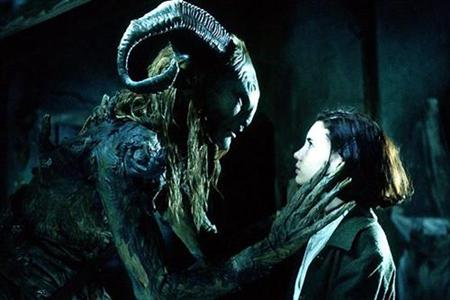
a faun and a fawn
                The movie is set in Spain in 1944.  Although the Spanish Civil War has been over for five years, there is still a resistance movement called the Maquis.  These rebels are in the mountains standing up to the Franco government using tactics like sabotage.  Into this environment comes a little girl named Ofelia (Ivana Baquero) and her pregnant mother.  They are going to meet her stepfather who is a captain in the Spanish army.  Vidal (Sergei Lopez) has been assigned the task of wiping out a rebel band in the area.  He plans on accomplishing this task by any means necessary.  Since he is a Fascist, you can about imagine what lengths he is willing to go to.  Plus he’s evil.  When he viciously executes two suspects you know this is not a kid’s movie.

                The movie follows two narrative tracks.  Vidal is hunting for the rebels and Ofelia is in a fantasy arc that has her performing tasks assigned by a Faun after a fairy takes her to a labyrinth on the grounds of the estate.  The Faun believes that Ofelia is the reincarnation of a princess who died and needs to return to her rightful place with her father - the King of the Underworld.  The tasks come from the mind of del Toro and some drug use may have been involved.  The first involves getting a key from a giant toad and the second a dagger from a monster who has one eye and it’s in his palm (the Pale Man).  While Ofelia is living out her fantasy (or is it?), her stepfather’s war with the Maquis is a realistic portrayal of guerrilla warfare and counterinsurgency at its most brutal.  Vidal is getting increasingly frustrated as counterinsurgents tend to get.  His housekeeper Mercedes (Maribel Verdu) is with the insurgents and befriends Ofelia.  This is where the two stories intertwine.
the worst monster in the movie

                “Pan’s Labyrinth” is an amazing movie.  It is one of those movies that deserves multiple viewings.  The special effects are outstanding.  There is a mixture of CGI, animatronics, and make-up (that Oscar was a no brainer).  The scares are potent.  Stephen King (who saw the film with del Toro) squirmed when the Pale Man chased Ofelia.  If those images were in del Toro’s head for years, he must have lost some sleep.  The score fosters the eerie vibe and the cinematography is stellar.  The Oscar for Art Direction was well deserved.  Vidal’s room is designed to mirror the inside of his watch.  Did I mention this is not a kid’s movie?  Not only is it scary, but the non-fantasy segments can be gory.  Like most guerrilla wars.  There is a visceral fire-fight in the forest that includes execution of the wounded.  There is torture for confession.  And there is a dedicated counterinsurgent who would fit well in the Gestapo.  In fact, Vidal belongs in Satan’s secret police.  He is one of the most villainous characters I have encountered.  Lopez sinks his fangs into the role, but the rest of the cast is strong.  Baquero is perfect as Ofelia.  She auditioned so well that del Toro changed the age of the character to fit her.  Verdu is the rare strong woman in a war movie. 

                But is it a war movie?  It fits most definitions.  It not only is set in a war situation, but it includes combat.  However, for purposes of my 100 Best War Movies list, I think I will not consider it for inclusion.  I am currently leaning toward excluding movies that clearly fall into another genre before they would be considered to be part of the war movie genre.  This is why I probably will not include any Westerns on my list.  “Pan’s Labyrinth” is much more comfortable in the fantasy genre.  I do not think war movie comes to mind when people think of the movie.  With that said, it is a great movie and should be seen by all cinephiles whether they are war movie buffs or not.

GRADE  =  A