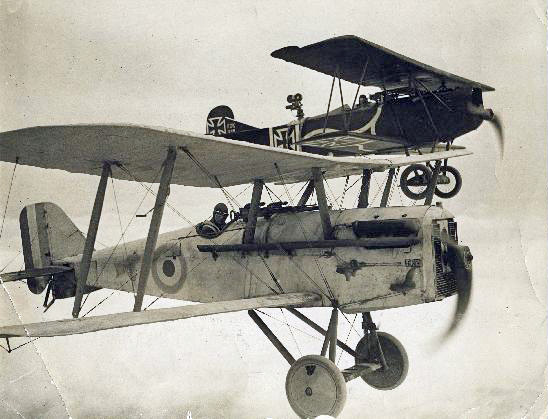
BACK-STORY: “Hell’s Angels” is a WWI aerial combat war movie released in 1930 and memorably directed by Howard Hughes in his debut. The production is legendary. The movie was intended to be Hughes’ answer to “Wings”, but the advent of “talkies” prompted him to convert it to sound at great additional cost. At around $4 million, it was the most expensive motion picture released to that date. The switch to sound also necessitated the dumping of the thickly accented Greta Nissan and her replacement with Jean Harlow. Hughes insisted on going big so the famous dogfight scene used 70 pilots (many of them WWI vets) and many actual WWI biplanes. Three of the pilots died in filming and Hughes himself crashed and broke some bones filming a sequence none of the pilots would agree to attempt. The movie had one of the grandest openings ever at Grauman’s Theater and was a hit although it had difficulty recouping the cost.
OPENING: “Germany before the war”. Two college buddies are drinking at a beer garden. Cigarette smoke wafts as though produced by a fog machine. (There will be at least ten scenes with someone smoking.) Surprisingly for a Hughes movie, the flirty German bar maid does not display massive cleavage. Roy (James Hall) and Karl John Darrow) are joined by Roy’s wastrel brother Monte (Ben Lyon).
SUMMARY: Monte gets caught on a couch with a German aristocrat’s wife. The Pee Wee Herman lookalike challenges Monte to a duel which he skips town back to London to avoid in spite of his brother’s arguments for upholding the family honor. Roy takes his brothers place and is wounded in the arm by Pee Wee. The scene is shot from a distance and we see the duelists in silhouette. Cool.
Back at the frat house, Monte is unapologetic and carrying on like a frat boy. War is announced and Karl is despondent because being a German he might have to go to war against the country he loves – England. Sure enough, Karl gets a draft notice from the German military. Roy joins the Royal Flying Corps out of patriotism and Monte joins him after being recruited in exchange for a kiss.
Monte and Roy go to a ball. The scene is colorized! Roy introduces Monte to his girlfriend Helen (Jean Harlow) who we just met coming out of the bushes with another gent. It quickly becomes apparent that Roy is the only bloke in England that does not know that Helen is a slut. Helen is wearing a dress presumably designed by Howard Hughes which ranks with Marilyn Monroe’s from “Some Like It Hot”. She boldly kisses Monte while Roy is off getting drinks. They go back to her apartment where she utters the famous line: “Would you be shocked if I put on something more comfortable?” Flash forward to Monte feeling awfully guilty.
The next scene is the famous Zeppelin bombing London scene. It is a night attack through hazy clouds and has a sci-fi look to it. The first view of the ship has a “Star Wars” opening feel. The German commander is scar-faced, naturally. Karl is a reluctant crew member. A listening post picks up the bomber and Roy and Monte’s squadron is scrambled. Karl is lowered in an “observer’s car” to play the role of bombardier. He cannot bring himself to bomb London, so he drops the bombs in a lake. When the fighters arrive, the pod is slowing the Zeppelin’s escape so the commander cuts Karl loose. We do not get to see Karl’s reaction to his sudden bout with gravity. Speaking of gravity, members of the crew robotically jump to lighten the craft in a chilling scene. Roy and Monte get shot down, but walk away from the crash. The last British fighter goes kamikaze, crashing into the Zeppelin which erupts like the Hindenburg in a fiery display of movie making. Would you believe it almost lands on Roy and Monte?
Next, our heroes (or hero and brother actually) are in France where Helen is now a flirtatious canteen gal. She is still a slut (but now a patriotic one) and Roy is still a sap who is yet to sample her wares. He finally gets clued in when he catches Helen with another man and she proceeds to tell him she never loved him and basically he is an old stick in the mud. Way harsh! Monte’s sage advice is “Never love a woman, just make love to her.”
Back at the officer’s club, the men are assigned to a hazardous night patrol. Monte (who already has a reputation as a slacker) refuses to go, ranting that the war is a “politician’s war” not worth sacrificing his future bed-hopping for. He is headed for a court-martial when he suddenly (and out of character) volunteers for a mission to fly a captured German bomber to destroy a munitions depot. Roy can’t let him go alone, of course. They spend the pre-raid hours not learning how to fly the foreign craft, but at a brothel getting drunk with some loose French women. Are there any other kind? (Sorry, Caroline) Monte, reverting to his yellow stripe, almost convinces Roy to go AWOL.

Guess who is defending the ammo dump? The “Flying Circus” of Red Baron fame. Since Roy and Monte are “disguised” as Germans they are able to fly under the watchful eyes of the squadron and drop bombs on the depot. This results in a series of explosions that would put many modern explosion-fests to shame. It takes a little while, but the Huns figure out that the bomber is not German and they set off in pursuit. Things look bleak when here comes the cavalry in the form of a squadron of British fighters. The ensuing dogfight featuring numerous vintage WWI biplanes is awesome. There is a mid-air collision and we get to see facial views of the pilots as they are killed (some of them afire). It’s kind of creepy, but unique. It looks like the shot up bomber might make it when Von Richtofen himself swoops in and sends it into a death spiral. Well, not quite a “death” spiral since our duo improbably survive the crash. They are taken prisoner.
CLOSING: Roy and Monte are brought to German headquarters where guess who is the general. It’s Pee Wee! In a nod to the intelligent people in the audience, the screenwriters added a line about what a coincidence this is. Pee Wee wants information on the upcoming offensive. The brothers naturally refuse and are sent to their cell to think it over. An execution outside their window makes it clear what their fate will be. Monte turns chicken once again and wants to talk. Roy goes instead and convinces the general he will turn traitor, but wants to first silence his mate so he can’t rat him out after the war. Pee Wee gives Roy a gun with one bullet. I’m wondering what Roy will do with one bullet. Back at the cell, Monte still insists on saving his own skin over the thousands of British Tommies so Roy shoots him in the back! The biggest scene chewer in the movie is given an extended melodramatic death scene. Roy is led out and shot off screen. The offensive immediately begins.
RATINGS:
Acting - 6
Action - 7
Accuracy – 5
Realism – 4
Plot – 7
Overall – 7
WOULD CHICKS DIG IT? If they are a flapper/hippy/women’s libber, yes. Helen is a modern girl and whether you agree with her morals or not, she is a fascinating character. The leads are okay and you have a choice between the ladies’ man (Monte) and guy next door (Roy). The movie is not overly graphic although some of the pilot deaths are squrm-inducing.
ACCURACY: The film is obviously not meant to be factual, so historical accuracy is not a major issue. The two big aerial combat scenes are a mixed bag. The Zeppelin bombing raid is well done and realistically staged. The Germans did bomb London at night using the airships. I was surprised to find that the “observation car” (sometimes called a “spy car”) was accurately depicted. The Germans did lower a crew member on a cable in a pod to a lower height so he could guide the bombing. A telephone connected him to the bridge, as shown in the film. Of course, there is no evidence of an Anglophile German purposely misdirecting bombs and no incident where crew members sacrificed themselves to save the ship.
The big dogfight scene, while accurate in its chaos, is not based on an actual event. I have found no evidence that a captured German bomber was used on a raid like this. It’s pure Hollywood. I find it hard to believe that a pilot (Baldie) could communicate with Monte by yelling above the roar of the planes. A small, but significant, note about the portrayal of Von Richtofen. In the movie, he is shown as staying out of the melee and then closing in for the kill on the bomber. This is out of character for the Red Baron who was never one to avoid the opportunity for mixing it up.
CRITIQUE: “Hell’s Angels” can best be described as an entertaining old school war movie. What makes it a cut above similar classic black and white war movies is it is also an interesting movie. Hughes did some things outside the box that make the movie stand out and those unorthodox elements have allowed the movie to have a longer shelf life than most war movies its age. The money the eccentric millionaire spent was well worth it if he wanted the movie to live in posterity.
The special effects are ground-breaking and well ahead of their time. The Zeppelin looks less like a model than many aircraft in more modern movies. It is not laughable like you might expect. The dogfight is, of course, done without the aid of CGI. Compare that scene using real planes and stunt fliers to similar scenes in “Flyboys” and you can see that Hollywood is still not capable of duplicating Hughes accomplishment. Then again, noone died making “Flyboys”. (No, that is not a shame!) The cinematography justifiably got an Academy Award nomination, but the sound effects are equally impressive. I was not as impressed with the sound of the soundtrack which tended toward the schmaltzy score so popular back then.
The acting is not outstanding, but it also is not terrible. Even Harlow, who took a lot of grief for her lack of thespian skills, is not cringe-inducing. I found Helen to be a fascinating departure from virtually every other female in black and white war movies. Unless you admire her “anything goes” philosophy, she is pretty dislikable. Hollywood would produce few Helen’s for a long time after this movie because Helen had a lot to do with the Hayes Code crack-down. The movie also had some salty language of the SOB variety during the dogfight scene that prompted the censorship. As far as the other actors, Lyon hams it up in a grating performance, but the character is supposed to be loathsome. Hall is solid as Roy. Lucien Prival as Baron Von Kranz (Pee Wee) previews the way Nazis will be handled in the 1940s – cool and malevolent.
The plot is a weakness. It is your typical cliché-ridden lover’s triangle. You get the two friends (in this case brothers) torn by the same woman. One is good and the other bad. In a bit of a departure, the girl is bad, too. You get a heavy dose of “it’s a small world”. For example, meeting up with the Baron again. Or Helen working a canteen in France near the air base. Or Roy and Monte attacking Karl’s Zeppelin. The clichés include the redemption of the coward. Another is the noble sacrifice for the greater good.
CONCLUSION: “Hell’s Angels” is a special movie. It was revolutionary at the time and still stands out today. The Zeppelin scene and the dogfight are iconic. You have to admire Hughes for his commitment to making a great war movie. While the plot keeps it from being great, it is certainly memorable. It was a grand effort by Hughes and the film belongs in the trio of significant WWI air combat movies with “Dawn Patrol” (#38) and “Wings” (#11). As far as the ranking by Military History at #43, that seems overrated. Although entertaining in a hokey sort of way and marked by some remarkable scenes, it is not better than at least twenty of the movies I have already reviewed. It certainly belongs in the 100 Best War Movies list, just not as high.
_04.jpg)