Showing posts with label Joseph Heller. Show all posts

Wednesday, July 17, 2024

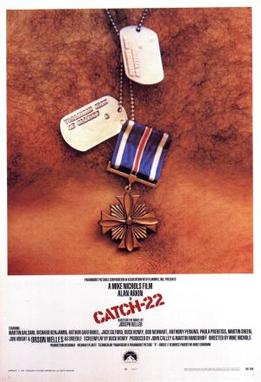
100 BEST WAR MOVIES: #52. Catch-22 (1970)


Complex novels can be difficult to bring to the screen.  Mike Nichols (“Charlie Wilson’s War) took on one of the more difficult novels when he decided to make “Catch-22”.  Joseph Heller’s novel is nonlinear and full of bizarre characters and labyrinthian dialogue.  Buck Henry (who plays Lt. Col. Korn) wrote the screenplay and Nichols assembled an eclectic cast.  Paramount gave Nichols a big budget and he used part of it to get 17 vintage B-25 Mitchell bombers.  Six months were spent on the camerawork for the bombers alone.  This required 1,500 flight hours.  Unfortunately, little of the footage made it into the film as it is not an aerial combat movie.  It is an anti-war satire that is often compared to “M*A*S*H”, which was released the same year.  It was this coincidental release that probably contributed to the box office failure of “Catch-22”.  The increasing unpopularity of the Vietnam War seemingly left room for only one successful war satire and the public chose “M*A*S*H”.  Another factor was probably the fact that it made fun of WWII.

            The movie opens sans music over the credits. The bombers line up for takeoff. The pilots give the thumbs up to the tower, but bombardier Yossarion gives the finger.  The takeoffs of the 17 bombers is one of the great war movie openings. This transitions to a discussion between Milo Minderbinder (Jon Voight) and Col. Cathcart (Martin Balsam). Minderbinder has an idea for how the unit can make some money. Their discussion continues  unfazed despite the crash of a bomber nearby. This is our first clue that the movie is a black comedy.  Yossarian is the main character among an ensemble of colorful characters. He is suffering from PTSD due to an incident involving a wounded gunner on his bomber.  He is also frustrated by Cathcart’s continual bumping up of the number of missions required to go home.  The standard is 25, but the colonel gradually moves it to 80.  Yossarian believes his only hope of survival is to be declared insane.  In an iconic scene, he discusses this option with Doc Daneeka (Jack Gilford).  Doc explains that Yossarian cannot be removed from combat because of Catch-22.  To be flying these dangerous missions, you would have to be insane.  But if you proclaim that you are insane, it means you are sane because you realize how dangerous things are. Either way, there is no way out.

ACTING:                     A

ACTION:                     N/A

ACCURACY:                N/A

PLOT:                            B

REALISM:                      N/A

CINEMATOGRAPHY:   A

SCORE:                          none

QUOTE:  Yossarion:  Let me see if I've got this straight. In order to be grounded, I've got to be crazy. And I must be crazy to keep flying. But if I ask to be grounded, that means I'm not crazy anymore, and I have to keep flying.

BEST SCENE:  the base bombing

                The movie pares down the numerous arcs of the book to a manageable few.  Yossarian’s character is the glue that holds together the arcs.  Henry has created a mostly linear plot, with intercuts to Yossarian’s wounded gunner incident playing out periodically.  While many of the scenes are vignettes fleshing out the supporting characters, there is a central arc involving Lt. Minderbinder (Jon Voight) creating a black-market syndicate with the cooperation of Cathcart.  This manages to incorporate two of the movie’s themes:  even in war, America remains a capitalist country (war is a business) and the higher you go in the chain of command, the more incompetence and corruption you encounter.  This is exemplified when Minderbinder arranges to have their air base bombed in order to unload surplus cotton.  In another scene, the squadron is awarded medals by Gen. Dreeble (Orson Welles) for a tight bombing pattern even though Yossarian had the bombers drop the bombs in the sea.  Yossarian receives his medal in the nude.  Scenes like this harken to the insanity of the Vietnam War, even though the movie is set in WWII and the squadron is based on an island in the Mediterranean.

            “Catch-22” deserved better than it got when it was released.  It has become something of a cult classic since then.  People now appreciate the game effort to bring an unfilmable book to the screen.  Henry was faithful to the dialogue of the book and some of his own lines had Heller wishing he had thought of them. A good example is when Yossarion argues with Minderbinder about how the dead Nately would not benefit from Minderbinder’s “investments.” When Minderbinder states that Minderbinder’s family will benefit, Yossarion points out they are already rich. Minderbinder: “Then they will understand.”    Henry eliminated many characters and switched some of their dialogue and experiences with other characters.  Most of these changes and omissions were wise cinematically.  The ensemble cast does a fine job and the casting was spot on, with the coup being Orson Welles.  All of the main characters are familiar and appealing comedic actors.  Arkin is fine as Yosserian, but Voight shines as Milo.  The nature of the absurdity does require the actors to lay it on a bit thick at times, especially in a silly scene involving Dreeble’s WAC.

            Nichols brings some flair that is missing in “M*A*S*H”.  The cinematography is noteworthy with special mention going to the take-off of the bombers and the pyrotechnical fireworks of the bombing of the base.  Cinematographer David Watkin uses a stationary camera and avoids the hyper-cutting of modern war movies. He uses some long takes, deep focus, and rear projection. The aerial scenes are quality over quantity and the interiors are authentic-looking. The editor did some nifty transitioning between scenes.

                  “Catch-22” is not for everyone and it is easy to see why it did not do well in 1970.  It is not a typical war comedy.  You have to bring some intellect to the table and be in the mood for satire tinged with absurdity.  It has some shock value.  Shocking for a 1970 big budget picture, there is full frontal nudity provided by Paula Prentiss - of all people!  To be fair, we also get Arkin’s ass.  You get to see Martin Balsam sitting on a toilet.  The big reveal about Snowden’s cause of death packs a punch. As does the whole movie as it skewers the “Good War.”

Thursday, January 16, 2020

Catch-22 miniseries (2019)


Last year I went to the WWII museum in New Orleans for a special advanced showing of Hulu’s miniseries “Catch-22”.  It was an ambitious attempt to bring the famous Joseph Heller novel to the small screen.  The 1970 film is highly respected, but the novel is massive and complicated so a two-hour movie could not really do it justice.  The miniseries is more than twice as long as the Mike Nichols’ movie.  This new version was developed and written by Luke Davies and David Michod.  They took on the difficult task of transforming the nonlinear, farcical novel that Buck Henry had ably adapted for the movie.  George Clooney got involved as an executive producer and directed two of the episodes.  He also took on a minor role.  Although a prestige production for Hulu, the rest of the cast was fairly unknown except for Kyle Chandler and Hugh Laurie in small roles.  The miniseries got good reviews, but only Emmy nods for Sound Effects and Special Visual Effects.  It was filmed in Sardinia and Italy.  The film used some authentic B-25s.

                        Davies and Michod decided to make the miniseries linear, probably as a sop to Hulu’s audience.  It opens with the main character Yossarian (Christopher Abbott) in training to be a bombardier.  He is having an affair with his commanding officer Scheisskopf’s (Clooney) wife.  He tells her that he chose the air corps because he figured that by the time his training was over, the war would be over.  So it is established early that Yoyo is a coward.  The rest of the show covers enough bombing missions to prove he would have to be very brave to handle his job without being affected by it.  Although the movie runs for 270 minutes, it basically covers two storylines.  One is Yossarian’s attempts to get sent back home and the other is the black market machinations of Milo Minderbinder (Daniel David Stewart).  There are ten missions spread out through the narrative and one montage.  Interspersed with these are some scenes that develop some of the other characters.  Col. Cathcart (Chandler) is a martinet who is constantly upping the number of missions necessary for ending your tour.  It starts at 25, but will go up throughout the miniseries.  Major Major (Lewis Pullman) is a mousy incompetent who is appointed squadron leader.  Maj. – de Coverley (Laurie) is in charge of renting rooms when new cities are occupied.

                        The writers had some options when they took on Heller’s book.  Buck Henry decided to do a greatest hits wrapped around the Yossarian / Minderbinder threads.  Snowden’s death was his nonlinear device to explain Yosarrian’s breakdown.  Davies and Michod could have simply replicated that with their own take on the characters and added more scenes and characters from the book.  They could have amped up the black humor and silliness of the novel.  Instead, they decided to play it relatively straight and concentrate on Yossarian’s efforts to get to the mission goal.  There is little added from the book and some scenes were not in the book or movie.  This was a poor decision because the movie is not so well known or recent that Hulu’s viewers would have wanted a different approach.  And then you have the fans that did not want the novel tampered with.  With 270 minutes, the logical approach would have been to cover more of the book and allow the actors to give their own takes on the books’ characters.

                           Surprisingly, the best thing about the series is the missions.  The B-25 interiors are authentic.  The CGI flak is intense.  The sound effects match.  You can see and feel why Yoyo is worried about his life expectancy.  At one point, a fellow bombardier gets splattered on his windscreen.  The problem here is the experiences do not match Yossarian’s reactions.  His is not a consistent descent into PTSD.  He remains dedicated to his bombing with some exceptions.  Bizarrely, after doing his best to avoid missions, Yoyo changes strategy and does multiple missions to reach 50 (the montage).  He is dedicated on all of them and gets off each bomber with a smile on his face.  (Unlike the Yossarian of the book, he does not care which pilots he flies with.)  By the way, even though he is freelancing, he is always the lead bombardier.  The key mission where Yoyo decides to go around a second time to bomb a bridge is placed too late to make sense.  Even more perplexing, the death of Snowden is in the last episode!  It is not used to explain why Yossarian is so motivated to get out of combat.  Instead, it is treated as a breaking point that leads to Yossarian adopting a no clothes policy.  Here is one example of the series going beyond the movie/book, but this does not happen enough to become a characteristic of the show.  The writers were too tame in this respect.

                        The critics have been kind to the series, although the Emmys were not impressed.  However, if you have seen the movie and/or read the book (which I have, twice), this miniseries is a severe disappointment.  The movie’s characters channeled the book’s well and the cast was outstanding.  This ensemble is definitely second-rate, but the script gives them no opportunity to make their characters interesting.  It was a poor decision to cast actors that mostly look alike.  And, in spite of the expanded length, the other air crewmen like Nately, Orr, Arfy, McWatt, etc. are short-changed.  Hell, we don’t even get Gen. Dreedle.  Clooney’s Scheisskopf is substituted as a mustache twirling villain.  Only Minderbinder makes an impression and only Daniel David Stewart is in a league with his cinematic equivalent (Jon Voight).  The series adds two Italian lackeys for Milo and forgoes many of the unseen characters from the book, like Hungry Joe.  Across the board, the characters are boring in comparison to the book/movie.  It is infuriating for fans to see the Chaplain depicted as a typical chaplain!   Nately’s whore likes him!  Did the writers even read the book?  Christopher Abbott is adequate as Yossarian, but his performance lacks nuance.  Yoyo is unlikeable and much more of a straight coward than Alan Arkin’s portrayal.

                        This series needed to be as black, if not blacker, than the movie/book.  There is little humor in the series.  In a telling moment, Yossarian’s scrotum surgery (not in the book) forces him to wear silly pants.  It was  too late to shift to farcical.  Why would you add a scene where Yoyo spends some time in an Italian village and skip some of the iconic scenes? You had 270 minutes!  There is no briefing with Dreedle’s WAC being the focus.  Milo does not have a cotton problem.  There is no Luciana.  Arfy does not visit Yoyo during a mission.  The key scenes that are reenacted are all inferior to the movie.  For example, Kid Sampson’s death is played for shock value and makes no reference to Doc being on board McWatt’s plane. 

                        I do not understand the critics who have complimented the miniseries.  To me, it is a big disappointment.  The decision to disregard the tone of the book and not simply expand on what the movie covered is head-scratching.  To take beloved characters and remove their quirks is inexcusable.  The changes that were made to the story dilute the satire.   There’s no verve.  Next time, use “MASH” as the template.

GRADE  =  D


Thursday, March 7, 2019

BOOK / MOVIE: Catch-22 (1961 / 1970)


                Complex novels can be difficult to bring to the screen.  Mike Nichols (“Charlie Wilson’s War) took on one of the more difficult novels when he decided to make “Catch-22”.  Joseph Heller’s novel is nonlinear and full of bizarre characters and labyrinthian dialogue.  Buck Henry wrote the screenplay and Heller assembled an eclectic cast.  Paramount gave Nichols a big budget and he used part of it to get 17 vintage B-25 Mitchell bombers.  Six months were spent on the camerawork for the bombers alone.  This required 1,500 flight hours.  Unfortunately, little of the footage made it into the film as it is not an aerial combat movie.  It is an anti-war satire that is often compared to “M*A*S*H”, which was released the same year.  It was this coincidental release that probably contributed to the box office failure of “Catch-22”.  The increasing unpopularity of the Vietnam War seemingly left room for only one successful war satire and the public chose “M*A*S*H”.

                The movie opens sans music over the credits.  The drone of bombers covers a conversation between Capt. Yossarian (Alan Arkin) and Col. Cathcart (Martin Balsam) and Lt. Col. Korn (Buck Henry).  We don’t know what they are discussing, but soon after Yossarian throws away his bombardier wings and is knifed by a mysterious person.  The movie then flashes back to how Yossarian got to this moment.  Yossarian is suffering from PTSD due to an incident involving a wounded gunner on his bomber.  He is also frustrated by Cathcart’s continual bumping up of the number of missions required to go home.  The standard is 25, but the colonel gradually moves it to 80.  Yossarian believes his only hope of survival is to be declared insane.  In an iconic scene, he discusses this option with Doc Daneeka (Jack Gilford).  Doc explains that Yossarian cannot be removed from combat because of Catch-22.  To be flying these dangerous missions, you would have to be insane.  But if you proclaim that you are insane, it means you are sane because you realize how dangerous things are.
 
                The movie pares down the numerous arcs of the book to a manageable few.  Yossarian’s character is the glue that holds together the arcs.  Henry has created a mostly linear plot, with intercuts of Yossarian’s wounded gunner incident playing out periodically.  While many of the scenes are vignettes fleshing out the supporting characters, there is a central arc involving Lt. Minderbinder (Jon Voight) creating a black-market syndicate with the cooperation of Cathcart.  This manages to incorporate two of the movie’s themes:  even in war, America remains a capitalist country and the higher you go in the chain of command, the more incompetence and corruption you encounter.  This is exemplified when Minderbinder arranges to have their air base bombed in order to unload surplus cotton.  In another scene, the squadron is awarded medals by Gen. Dreedle (Orson Welles) for a tight bombing pattern even though Yossarian had the bombers drop the bombs in the sea.  Cathcart convinces Dreedle that they must avoid the bad publicity by proclaiming the mission a success.  Yossarian receives his medal in the nude.  Scenes like this harken to the insanity of the Vietnam War, even though the movie is set in WWII and the squadron is based on an island in the Mediterranean.

                “Catch-22” deserved better than it got when it was released.  It has become something of a cult classic since then.  People now appreciate the game effort to bring an unfilmable book to the screen.  Henry did a good job adapting it and Heller commended the script.  Henry was faithful to the dialogue of the book and some of his own lines had Heller wishing he had thought of them.  Henry eliminated many characters and switched some of their dialogue and experiences with other characters.  Most of these changes and omissions were wise cinematically.  The ensemble cast does a fine job and the casting was spot on, with the coup being Orson Welles.  All of the main characters are familiar and appealing comedic actors.  Arkin is fine as Yosserian, but Voight shines as Milo.  The nature of the absurdity does require the actors to lay it on a bit thick at times, especially in a silly scene involving Dreedle’s WAC.
 
                Nichols brings some flair that is missing in “M*A*S*H”.  The cinematography is noteworthy with special mention going to the take-off of the bombers (followed by an awesome crash that does not cause the scheming Mindbinder and Cathcart to even flinch) and the pyrotechnical fireworks of the bombing of the base.  Cinematographer David Watkin uses a stationary camera and avoids the hyper-cutting of modern war movies.  The aerial scenes are quality over quantity and the interiors are authentic-looking. The editor did some nifty transitioning between scenes.

                  “Catch-22” is not for everyone and it is easy to see why it did not do well in 1970.  It is not a typical war comedy.  You have to bring some intellect to the table and be in the mood for satire tinged with absurdity.  It has some shock value.  Shocking for a 1970 big budget picture, there is full frontal nudity provided by Paula Prentiss - of all people!  To be fair, we also get Arkin’s ass.  You get to see Martin Balsam sitting on a toilet.  The big reveal about Snowden’s cause of death packs a punch.

THE BOOK – Spoiler alert!

                The novel is much more complicated than the movie.  Heller uses a nonlinear structure.  Although Yossarian is the main character, different characters get their own chapters.  The movie certainly is a good alternative for reluctant readers as Heller has a challenging style that requires focus on every sentence.  It is not a book you can peruse.  Some of his sentences contradict themselves purposefully, for instance.

                Henry decided to construct his screenplay in a linear format, with the exception of flash backs to handle the Snowden incident.  The scenes he chose to depict are faithful to the book and borrow much of the dialogue.  Some characters have been eliminated.  For instance, it is a different doctor that gets Yossarian to masquerade as the dying son for his visiting parents.  In the book, the room is darker which is the rare scene where the movie is more absurd than the book.  Henry was forced to remove some back-story which can lead to some head-scratching.  The movie replicates the decapitation of Hungry Joe by McWatt (Kid Sampson in the book), but leaves the impression that Doc was on board the plane and is now dead and a ghost.  Novel readers know that Doc is only officially dead because he was having his name put on flight manifests to fulfill a requirement.  Henry makes more significant changes in the last part of the film.  Dobbs wants to kill Cathcart and enlists Yossarian’s aid, but they do not carry out their plan. The bombing of the base is the same, but there is no shooting.   Nately and Dobbs are killed when their bombers collide.  The movie surprisingly does not support the tenet that the missions are dangerous and deadly.  On the other hand, Henry does a good job developing Milo into a fascist/capitalist hybrid.  He added the scene where Yossarian visits the brothel run by M&M Enterprises trying to find Nately’s whore.  This allows Henry to add the best line in the movie. 

            Milo:  Nately died a wealthy man, Yossarian. He had over sixty shares in the syndicate.
                Yossarian: What difference does that make? He's dead.
                Milo: Then his family will get it.
                Yossarian: He didn't have time to have a family.
                Milo: Then his parents will get it.
                Yossarian: They don't need it, they're rich.
                Milo: Then they'll understand.

The biggest change Henry made was with the ending. In the book, when the Chaplain informs Yossarian about Orr’s escape to Sweden, Yossarian plans to go to Rome to get Nately’s whore’s sister.  As he leaves the hospital, Nately’s whore tries to stab him and misses.  The end.  It is safe to say that Henry’s decision to have Yossarian row to Sweden in a raft was brilliant.

CONCLUSION:  There is something to be said for both the book and the movie.  The book is challenging reading, but the satire is brilliant.  Heller wrote one of the great anti-war novels and it is the rare one that is humorous.  It is not for everyone, however.  It is too long and tends to hammer its themes.  The characters are not likeable, including Yossarian.  The movie smooths the book’s edges.  It keeps the foundation, so it is a good option if you do not want to read the novel.  Seeing a crack acting ensemble personify the characters in the book is a kick.  And the movie has the B-25s.  It also has some memorable scenes and leaves you with the image of a man rowing in a raft to Sweden.  Nichols and Henry deserve more credit than they got.

BOOK  =  B

MOVIE  =  B