Showing posts with label Operation Market Garden. Show all posts

Thursday, January 2, 2025

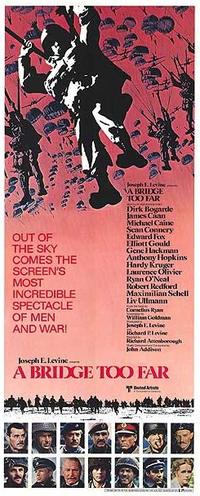
THE 100 BEST WAR MOVIES: 19. A Bridge Too Far (1977)


                “A Bridge Too Far” is basically a sequel to “The Longest Day” and suffers a bit in the comparison. They are both based on books by Cornelius Ryan. ABTF was released in 1977, three years after the book. It has a similar format as its sister film – the all-star cast in a war epic. The movie was something of a flop which should not have been a surprise given that it was about a mostly British affair and a loss at that.  It did not help that the film clocks in at around three hours.  Given the odds stacked against it, the movie mirrors the event it portrays in that respect. The film was shot in Netherlands. Some of the actual sites were used. It was nominated for BAFTAs for Best Picture (losing to “Annie Hall”), Best Director, and Editing. It won for Best Supporting Actor (Edward Fox), Original Music, Production Design, and Sound.

                 A woman’s voice narrates black and white footage relating the war up until then. The narration is effective in bringing the audience up to speed on the war in 1944 and is crucial in explaining the strategic dilemma facing Eisenhower. Ike is dealing with two prima donna generals – Montgomery and Patton – each of whom has a sure-fire plan to win the war quickly. Of course, each plan involves giving them most of the scarce resources for their roll of the dice. Montgomery’s plan is codenamed Operation Market Garden and Eisenhower opts for it in a decision that smacks of politics (although the movie does not make it clear why Ike chose Monty over Patton).

                 The Germans are retreating and Gen. Von Rundstedt is pessimistic. The German characters speak German and the movie has subtitles – an early clue the producers are serious. Meanwhile, at British headquarters, Lt. Gen. Browning is outlining Operation Market Garden. The plan will end the war in 90 days. It will be the biggest airborne operation ever. The plan calls for dropping thousands of British and American paratroopers behind enemy lines to capture three key bridges to open a corridor that will be exploited by the British XXX Corps which will move over 60 miles in two days to reach the last bridge at Arnhem. Or so the plan calls for. The plan calls for daring and speed – two words not associated with the British in WWII.

                   One of the movies themes of FUBAR is apparent in the next scene as Rundstedt moves a resting Panzer unit to the “quiet sector” of Arnhem. The second theme of overly optimistic high command is emphasized when Browning refuses to believe intelligence reports which include photo recon indicating Arnhem will be very well defended by a paratroopers worst nightmare – armor. And even if they are true, Browning says “This time the party is on and nobody is going to call it off”. The Browning family could not have been happy with his portrayal in the film. It is clear he represents a composite of Browning and Montgomery and his character would have struck a chord with the post-Vietnam audience. The British leaders prove that wanting something done does not mean it gets done. The third theme of incompetence and disregard for losses is apparent when the British parachute leaders are informed they will have to land 8 miles from the Arnhem bridge.

                 The take-off and landing of the paratroopers is handled in a great scene featuring thousands of extras and authentic aircraft. No CGI here! We even get the perspective of the paratroopers as they bail out and drift to earth. The landings go according to plan. That will be the last time anything goes according to plan.

             Meanwhile, the XXX Corps led by Gen. Horrocks (Edward Fox) and spearheaded by Gen. Vandeleur (Michael Caine) start down the single lane, raised highway. Horrocks instruction to “Ride like hell… speed is the key” is ominous to any student of the British army in WWII. The attack is preceded by an impressive artillery bombardment with lots of explosions. The Germans are realistically portrayed as withstanding the chaos and then opening fire to take out several tanks which are exposed on the raised road. This movie has no evil Nazis. The Germans are worthy adversaries. The British call in fighter-bombers which blast the hell out of the enemy causing them to surrender but it is a bad omen for keeping the timetable.  The road soon acquires the nickname "Hell's Highway".

The movie is episodic. It intercuts between the various bridges. Although a British affair, American parachutists are involved. The movie focuses on the Arnhem bridge. The combat is realistic and exciting. British pluck is on full display as the Germans hold all the cards. It’s an Alamo situation. The British try to keep the Germans from crossing the bridge and then it is house-to-house fighting. At Nijmegen, the Americans are forced to make a daring, daylight combat assault across the river in flimsy boats (which are slow in arriving, thus accurately portraying the “hurry up, then wait” nature of warfare). Maj. Cook (Robert Redford – paid $2 million for seemingly 5 minutes of work) leads the assault repeating the “Hail Mary” (there are no atheists in assault boats). The scene accurately reflects the suicidal nature of this type of action, but also what determined men can do in the face of ridiculous odds.

The film includes some anecdotes like an American (James Caan) forcing a doctor to work on his friend. We also meet our opening footage narrator Kate ter Horst (Liv Ullman) as a Dutch woman who allows her house to be used as a hospital and helps the wounded with an elderly doctor portrayed by Sir Laurence Olivier. ( I guess Marlon Brando was not available ).

ACTING:   A                

ACTION:   A (7/10)

ACCURACY: A     

PLOT:  A                

REALISM:   A 

CINEMATOGRAPHY:   A

SCORE:   A


SCENE:  the river crossing

QUOTE:  Maj. Cook (Robert Redford):  [reporting another delay to his officers] Ah, I suppose you're wondering why I called you here. I want to tell you that I've decided to cross the river like George Washington; standing in the prow of the boat.

CRITIQUE:  The obvious thing to do is to compare this movie to “The Longest Day”. In some ways it is a sequel and we all know about sequels – they seldom live up to the original. However, ABTF has some big shoes to fill and it is probably asking too much for it to surpass or even equal its parent. Technically, it is a superior film. The airborne landing scene and the fighting in Arnhem are superior to any action in TLD. Compare the combat in Arnhem specifically to the scenes in Ouistreham and you will see what I mean. Also, for those of you of the younger generation, ABTR is in color! Alas, you still have to read when the Germans talk.

                Another comparison is ABTF is more command-centric than TLD. There is only one grunt character – Dohun. TLD is full of privates. I do not know if it reflects the difference, but Sean Connery portrays a private in TLD and he has been promoted to general by ABTF (think on that ). It does not have to be either/or as TLD proves with its blend of scenes showing the strategic ( the generals ) and the tactical ( the foot soldiers and their officers ). ABTR does not blend as well.

                I admire the guts of the producers and director Richard Attenborough in making a movie that is a history lesson and a downer at that. I cannot believe the marketing people were thrilled with that. Kudos for swimming upstream.

                 The movie came out in the mid-seventies and reflects the transition from old-school war movies ( like TLD ) to the more cynical modern war film ( Patton ). It clearly reflects the post-Vietnam view of the military and warfare in general. The emphasis on SNAFU, clueless strategists, the waste of human lives, and pressing on with flawed plans are apparent in the movie.

ACCURACY:  Gen. Urquhart described the movie as a “reasonably accurate spectacular”. This is a fair description of a movie that tried hard to make a realistic, yet entertaining retelling of a complicated military event. This effort is obvious from the multitude of technical advisers which included Urquhart, Horrocks, Gavin, Vandeleur, and Frost. It would have been hard to stray far with those guys on the set.

                 The basic facts are not tampered with so it is a good history lesson about Operation Market Garden. Since this failed campaign had been gathering dust historically speaking, the filmmakers do an admirable job of reminding us of the sacrifices the soldiers made in the operation. They deserved the recognition the movie brought. The movie also accurately portrays how command decisions can be flawed and even the best plans do not survive the first clash of arms. The role of SNAFU in warfare is also clear in the events portrayed.

               One character in the movie allows for a discussion of how Hollywood will tamper with a perfectly good story to “enhance it for your viewing pleasure”. I am referring to the Eddie Dohun tale. First, his name was Charles ( I guess Hollywood did not think Charles was cool enough ). Second, his buddy Capt. “Legs” Johnson was already in the hospital’s “dead pile” when Dohun located him (having come to recover Johnson’s wallet). Johnson had received his head wound while riding on the hood of a jeep which was evacuating him because of an earlier shoulder wound. There was no mad dash in a jeep driven by Dohun. Dohun does force a doctor at gun point to save Johnson’s life, but the doctor did press charges. A Lt. Col. put Dohun under arrest for one minute and then released him. Is the movie’s version more entertaining? Yes, but I would argue the real story was good enough to begin with. This is what separates war movie fanatics from average Joes, I guess.


CONCLUSION:  "A Bridge Too Far" is a movie that deserves a better reputation.  It covers an operation, Market Garden, that would otherwise be forgotten by most moviegoers.  It is a good bookend to the all-star war epics that began with "The Longest Day".  One critic referred to it as "the last dinosuar".  You could argue that it is the second best of that genre which includes "Tora! Tora! Tora!", “Battle of Britain", "Battle of the Bulge", and "Midway". 

                 "Bridge' is a good example of a war movie that appeals to war movie buffs, but not to average viewers.  A lover of war movies is cautioned to not watch this movie with someone who is not a fanatic.  You will be frustrated by their lack of respect for the craft and fidelity to the truth of the moviemakers. 

Thursday, January 28, 2016

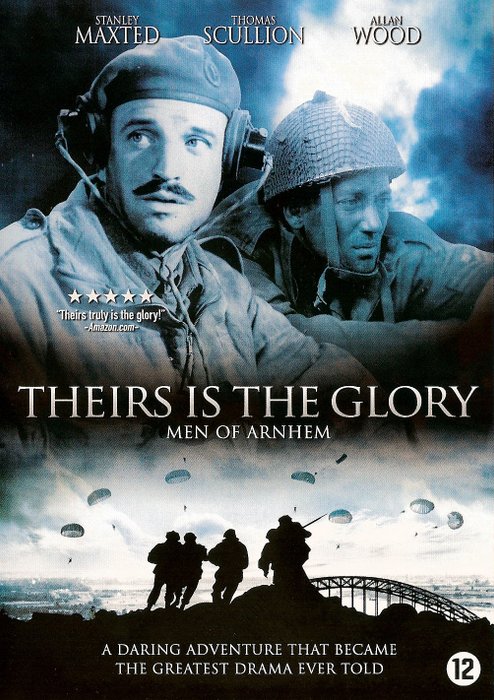
Theirs Is the Glory (1946)


                “Theirs Is the Glory” is a unique war movie.  It reenacts the British participation in Operation Market Garden.  It was “produced entirely without the use of studio sets or actors.  Every incident was either experienced or witnessed by the people who appear in the film.”  Everyone in the 200 person cast was either a British soldier who participated in Operation Market Garden or a Dutch civilian who lived through the battle.  The veterans were paid three pounds per diem.  They had a lot of input in the action and dialogue.  Director Brian Desmond Hurst (“Malta Story”) was a veteran of the Gallipoli Campaign of WWI.  He considered the movie to be his finest achievement in a stellar career. It was a labor of love. The filming began one year after the battle on the actual sites.  The premiere occurred on the two year anniversary of the battle and was attended by the Prime Minister.  A private showing was provided for King George VI.  The film was a huge hit in Great Britain and was the top grossing film for a decade.

                The movie opens with a view of the destroyed bridge at Arnhem.  A montage of sites familiar to students of the battle follow.  The Operation Market Garden plan is outlined via a map.  Several paratroopers in a barracks are identified by the narrator.  The campaign begins with an armada of gliders and transports dropping paratroopers.  Upon reaching the Arnhem Bridge, a flamethrower sets off ammunition and a mixed bag of Germans are taken captive, but the bridge cannot be taken.  The unit at the bridge is cut off from the main body that ends up surrounded at Oosterbeek.  The rest of the movie consists of the last stands of both these bodies of men.

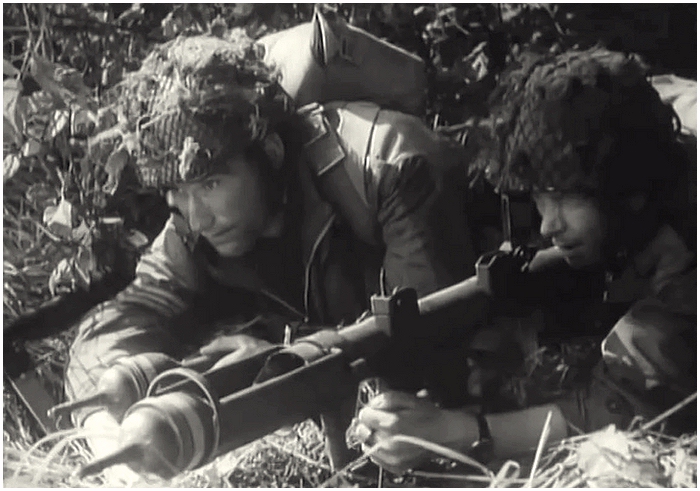
                This is a gem of a movie.  It is unique in using the actual participants in an historical event.  Surprisingly, the “actors” do a commendable job.  They are obviously not professionals, but they are still better than many B movie actors.  Notice how they duck and flinch at explosions like they have been there before.  They have also seen enough death to know how a soldier dies.  No one throws his hands in the air and twirls around.  The dialogue is natural as is to be expected from men who had input in what they say because they may have said it.  One unfortunate decision was not to identify the men.  Only keen students of the battle will recognize Majors “Freddie” Gough and “Dickie” Lonsdale, for instance.  Look closely and you will see Kate ter Horst (the Liv Ullmann character in “A Bridge Too Far”) reading psalms to the wounded.
Set up Montgomery's reviewing stand over there

                The movie is an amazing blend of footage and reenactments.  Basically, whenever anyone speaks it is a reenactment.   A narrator provides the documentary feel and also does a great job informing.  The narration is sincere, but not treacly.  Maps are used well.  A nice touch is the use of an embedded war correspondent to give eye-witness accounts of what is happening within the Oosterbeek perimeter. 
 
                If the acting is satisfactory, the action is outstanding.  And there is a lot of it!  The bitter aspects of a last stand against overwhelming odds is reenacted with verve.  There is some realistic tank action and excellent bomb effects.  The only false note has a Brit throwing a grenade to silence a German broadcasting a surrender demand.  It stands out in a movie that is a sober portrayal of the hell of war.  There are some emotional deaths in the movie and one can assume they were emotional for the reenactors.  The movie ends by returning to the barracks to inform that most of the paratroopers did not return.

                “Theirs Is the Glory” is as good as it gets when it comes to telling the story of the British 1st Airborne’s role in Market Garden.  It honors the participants.  It is not a propaganda puff piece, but it does leave out a few details that would slightly mar the theme.  The movie is mostly free of reference to the mistakes the campaign is famous for.  There are no communications problems in the film, for instance.  There is only brief mention of Gen. Urquhart being cut off from his men for crucial hours and no mention about the flaws in the overall plan.  There is no controversy, not surprisingly.

                “Theirs Is the Glory” has often been compared favorably to “A Bridge Too Far” as though one must choose between them.  In reality, they are both great movies and when paired do complete justice to the campaign and the men who participated in it.  “Bridge” gives the big picture and “Glory”concentrates on just Arnhem and Oosterbeek.  I strongly suggest you watch “Bridge” first and use “Glory” as an addendum.  Whatever order you choose, watch both because they both are among the 100 Best War Movies.


GRADE  =  A

Monday, March 18, 2013

A BRIDGE TOO FAR (5) vs. A WALK IN THE SUN (12)


VS.


A BRIDGE TOO FAR (5) vs. A WALK IN THE SUN (12)
 
ACTING:
 
                "A Bridge Too Far" has an all-star cast of both British and American A-Listers.  They took the production seriously.  There are excellent performances across the board.  Maybe it was the competition.  The standouts included James Caan as a grunt who saves his “dead” lieutenant and Elliot Gould as a crusty American officer who has to build a Bailey Bridge.  Michael Caine, Anthony Hopkins, Sean Connery, and Gene Hackman are commanding as commanders.  Kudos to Dirk Bogarde for taking on the thankless role of Gen. Browning (Monty’s incompetent lap dog – or so the movie implies) and making American audiences shake their heads smugly. 

               "A Walk in the Sun" has a cast of familiar B-Listers from the 1940s.  They do as well as could be expected, but can’t compete with the “Bridge” cast.  Dana Andrews is strong in the lead role, but noone breaks out.  A couple of the performances get a little grating after a while (ex. Richard Conte as Ramirez) .  However, given the small nature of the film, the acting is more than adequate.

FIRST QUARTER SCORE:      BRIDGE    9            WALK     7

CLICHES: 

                “Bridge” is not the type of war movie that lends itself to clichés so this category is slightly unfair.  I tried thinking of some “epic war movie” clichés like pompous orchestral music, but could not come up with a comparable list to the combat movie clichés list.  With respect to similar movies like “The Longest Day”, “Midway”, and “Tora! Tora! Tora!”, it follows the typical plot pattern.  Concentration on leadership instead of the troops, coverage of several units, jumping between Allied and Axis perspectives, a few grunts getting personal stories (ex. Dohun), etc.

                “Walk” is a small unit dynamics movie in the classic sense.  It begins with a thank you to the Armed Forces. The group is heterogeneous (including the Brooklynite), but the different backgrounds are not a major plot point.  There is a commentator in the form of Windy Craven who is composing a letter to his sister in his head.  The hero (Tyne) has leadership forced on him.  There is a distinct objective that they move towards.  The plot alternates between action and dialogue.  On the other hand, it is missing several of the other clichés.  There is no redemption character and no real conflict within the group.

HALF TIME SCORE:     BRIDGE     17             WALK    14

PLOT:

                “Bridge” is the true story of Operation Market Garden and it is based on the outstanding book by Cornelius Ryan.  The movie does justice to both.  It does an excellent job juggling the command perspectives of both sides and integrating the battle scenes.  Considering the complexity of the campaign, the film is not confusing and manages to stick to a linear structure.

                “Walk” has a much simpler plot.  It also is based on a great novel by Harry Brown so it is not a true story.  The plot builds slowly to an assault on a German farm house in Italy. The combat scene at the end is the obligatory payoff for a movie that is more interested in soldier interaction than action.  This means the plot is uncommon for a war movie and thus its competent direction by Lewis Milestone makes the movie very interesting, but not for everyone.  In other words, if you have seen ten war movies, you will probably hate it.  If you have seen 100, you’ll probably love it.  The movie is almost totally the opposite of “Bridge” in its concentration on the small picture.  The movies make outstanding companions.

THIRD QUARTER SCORE:    BRIDGE    26        WALK    22

COMBAT:

                “Bridge” is very underrated as a combat film.  There are several very well done combat sequences.  The scenes involving the Arnhem Bridge stand out, but there is also the best river crossing under fire scene in war movie history.  The action is violent and pretty graphic.  There are plenty of realistic explosions.  Compared to its most obvious equivalent, “The Longest Day”, it packs a lot more punch.

                “Walk” is at a big disadvantage in this tournament when it comes to combat.  It throws some in, but almost as an afterthought.  There is a scene involving ambushing an armored car which is cool, but mainly because of the staging and cinematography.  The assault on the farm house has a weird feel to it with most of the action from a German machine gunner point of view and Americans making a frontal charge leading to falling bodies.  It’s pretty bloodless.  Other than the lack of blood, the movie is honest about the boring nature of warfare where long bouts of sitting around and talking are broken up by short intense moments of violence.  However, this reality does not go over well with most war movie fans.

FINAL SCORE:    BRIDGE    35      WALK    27
 
COLOR ANALYSIS:  I am a big fan of "A Walk in the Sun", but sometimes bigger is better.  "Walk" could not hang with the more talent-laden "Bridge".  Realistic soldier talk and behavior makes "Walk" a fine representative of the minimalist school of war films, but in a match-up of combat films it lacks bang.  The fact that its day in the life of a platoon is true to the basically boring nature of war is commendable.  However, it ran into a movie that was true to the massive nature of a military campaign.  "Bridge" lived up to its pedigree with excellent acting and set pieces.  It just overwhelmed "Walk".

Monday, August 23, 2010

#94 - A BRIDGE TOO FAR


BACK-STORY: 

“A Bridge Too Far” is basically a sequel to “The Longest Day” and suffers a bit in the comparison. They are both based on books by Cornelius Ryan. ABTF was released in 1977, three years after the book. It has a similar format as its sister film – the all-star cast in a war epic. The movie was something of a flop which should not have been a surprise given that it was about a mostly British affair and a loss at that.  It did not help that the film clocks in at around three hours.  Given the odds stacked against it, the movie mirrors the event it portrays in that respect.

OPENING SCENE:

A woman’s voice narrates black and white footage relating the war up until then. The narration is effective in bringing the audience up to speed on the war in 1944 and is crucial in explaining the strategic dilemma facing Eisenhower. Ike is dealing with two prima donna generals – Montgomery and Patton – each of whom has a sure-fire plan to win the war quickly. Of course, each plan involves giving them most of the scarce resources for their roll of the dice. Montgomery’s plan is codenamed Operation Market Garden and Eisenhower opts for it in a decision that smacks of politics (although the movie does not make it clear why Ike chose Monty over Patton).

SUMMARY:

The Germans are retreating and Gen. Von Rundstedt is pessimistic. The German characters speak German and the movie has subtitles – an early clue the producers are serious. Meanwhile, at British headquarters, Lt. Gen. Browning is outlining Operation Market Garden. The plan will end the war in 90 days. It will be the biggest airborne operation ever. The plan calls for dropping thousands of British and American paratroopers behind enemy lines to capture three key bridges to open a corridor that will be exploited by the British XXX Corps which will move over 60 miles in two days to reach the last bridge at Arnhem. Or so the plan calls for. If you know nothing about Operation Market Garden, but do know about the British army in WWII and Montgomery in particular, you know this movie will not have a happy ending. The plan calls for daring and speed – two words not associated with the British in WWII.

One of the movies themes of bad luck is apparent in the next scene as Rundstedt moves a resting Panzer unit to the “quiet sector” of Arnhem. The second theme of overly optimistic high command is emphasized when Browning refuses to believe intelligence reports which include photo recon indicating Arnhem will be very well defended by a paratroopers worst nightmare – armor. And even if they are true, Browning says “This time the party is on and nobody is going to call it off”. The Browning family could not have been happy with his portrayal in the film. It is clear he represents a composite of Browning and Montgomery and his character would have struck a chord with the post-Vietnam audience. The third theme of incompetence and disregard for losses is apparent when the British parachute leaders are informed they will have to land 8 miles from the Arnhem bridge.

The take-off and landing of the paratroopers is handled in a great scene featuring thousands of extras and authentic aircraft. No CGI here! We even get the perspective of the paratroopers as they bail out and drift to earth. The landings go according to plan. That will be the last time anything goes according to plan.

Meanwhile, the XXX Corps led by Gen. Horrocks (Edward Fox) and spearheaded by Gen. Vandeleur (Michael Caine) start down the single lane, raised highway. Horrocks instruction to “Ride like hell… speed is the key” is ominous to any student of the British army in WWII. The attack is preceded by an impressive artillery bombardment with lots of explosions. The Germans are realistically portrayed as withstanding the chaos and then opening fire to take out several tanks which are exposed on the raised road. The British call in fighter-bombers which blast the hell out of the enemy causing them to surrender but it is a bad omen for keeping the timetable.  The road soon acquires the nickname "Hell's Highway".

The 101st Airborne led by a Col. Stout (Elliot Gould) assault the first bridge only to have German 88s take it out moments before they reach it. A bailey bridge will be needed. Luckily for the Allies, the German Gen. Model is mirroring Browning’s “I won’t believe anything that does not fit my preconceived notions” philosophy by refusing to blow the other bridges.

The British arrive at Arnhem with no resistance, but without their commander Gen. Urquhart (Sean Connery) who has been separated from the unit and spends most of the movie working his way back. They assault the bridge led by the stereotypical British officer carrying an unopened umbrella (based on an actual person who survived the battle, but not in the movie). They knock out a pillbox when a flamethrower accidentally cooks off ammunition nearby. In a great scene, the Germans counterattack using armored cars that are taken out by British bazookas. So far, so good, but what happens if the Germans bring up armor?

The movie now veers away from its command-centric story line to tell the tale of Ssgt. Eddie Duhon (James Caan). Duhon locates the body of the supposedly dead Capt. Johnson and in an homage to the Jeep drives through a forest and then through a German unit under fire to reach a hospital. The doctor refuses to work on the hopeless case until Dohun pulls a pistol and insists. The Capt. is saved and the doctor decides not to court-martial Dohun.

We get a realistic and informative look at the building of a bailey bridge (possibly unique in war movie history). The XXX Corps crosses the bridge and is on its pokey way again, but way behind schedule. Surprise!

In Arnhem, armor arrives and a tank crosses the bridge into the town and into the British position. House to house fighting begins and the casualties mount including the resistance/spy family introduced earlier in the movie.  The British are gamely led by Lt. Col. Frost (Anthony Hopkins).   We also meet our opening footage narrator Kate ter Horst (Liv Ullman) as a Dutch woman who allows her house to be used as a hospital and helps the wounded with an elderly doctor portrayed by Sir Laurence Olivier. ( I guess Marlon Brando was not available ).

At Nijmegen, the Americans are forced to make a daring, daylight combat assault across the river in flimsy boats (which are slow in arriving, thus accurately portraying the “hurry up, then wait” nature of warfare). Maj. Cook (Robert Redford – paid $2 million for seemingly 5 minutes of work) leads the assault repeating the “Hail Mary” (there are no atheists in assault boats). The scene accurately reflects the suicidal nature of this type of action, but also what determined men can do in the face of ridiculous odds. The Germans attempt to blow the bridge which would have meant the assault would have been in vain, but the charges do not go off. Not all luck in war is bad. However, instead of bursting ahead, the British armor hunker down to brew their tea as they wait for their infantry to come up. Cook confronts the British commander in a moment which must have resonated with American vets of the European Theater. He angrily points out that “those are British troops in Arnhem. They’re hurt bad. And you’re just gonna sit here and drink tea?”

The Polish brigade is sent to reinforce the British in Arnhem. They are led by the reluctant Gen. Sosabowski (Gene Hackman) who knows the mission is doomed, but reflects another theme of the movie – good soldiers swallow their doubts and wade in. The landing is a bloody disaster and only a few Poles reach the British. By this time, the Germans are overwhelming the lightly armed British in the streets of Arnhem and they get orders to withdraw as best they can. Only a few, including Urquhart, manage to escape through the woods during the night. Urquhart confronts Browning about Montgomery’s summary of the operation as being 90% successful. Browning responds that “I always thought we tried to go a bridge too far”.

THE FINAL SCENE:

Kate and the doctor leave her ruined house and join a long line of refugees. The movie fades with the refugees moving out of frame. Not a happy ending. No Doolittle raid like in “Pearl Harbor”. Bizarrely, in a movie that begins with a tidy review of the war up until the operation, there is no preview of what happens next, nor are the events of the film put in perspective.

RATINGS:

Action - 8 ( not graphic )

Acting - 8 ( especially Connery, Caine, Gould, and Hopkins )

Accuracy - 9

Realism - 9

Plot - 8

Overall - 8

WOULD CHICKS DIG IT?

I do not think most would. My wife found it to be too “military”. It is a very macho movie, but does have one significant female character – ter Horst. Surprisingly, Ullman’s character was based on a real person and not just simply thrown in to attract a female audience. The “Angel of Arnhem” is accurately portrayed.  It is also long, even for a war movie.  Not a good selling point for women.

ACCURACY:

Gen. Urquhart described the movie as a “reasonably accurate spectacular”. This is a fair description of a movie that tried hard to make a realistic, yet entertaining retelling of a complicated military event. This effort is obvious from the multitude of technical advisers which included Urquhart, Horrocks, Gavin, Vandeleur, and Frost. It would have been hard to stray far with those guys on the set.

The basic facts are not tampered with so it is a good history lesson about Operation Market Garden. Since this failed campaign had been gathering dust historically speaking, the filmmakers do an admirable job of reminding us of the sacrifices the soldiers made in the operation. They deserved the recognition the movie brought. The movie also accurately portrays how command decisions can be flawed and even the best plans do not survive the first clash of arms. The role of SNAFU in warfare is also clear in the events portrayed.

One character in the movie allows for a discussion of how Hollywood will tamper with a perfectly good story to “enhance it for your viewing pleasure”. I am referring to the Eddie Dohun tale. First, his name was Charles ( I guess Hollywood did not think Charles was cool enough ). Second, his buddy Capt. “Legs” Johnson was already in the hospital’s “dead pile” when Dohun located him (having come to recover Johnson’s wallet). Johnson had received his head wound while riding on the hood of a jeep which was evacuating him because of an earlier shoulder wound. There was no mad dash in a jeep driven by Dohun. Dohun does force a doctor at gun point to save Johnson’s life, but the doctor did press charges. A Lt. Col. put Dohun under arrest for one minute and then released him. Is the movie’s version more entertaining? Yes, but I would argue the real story was good enough to begin with. This is what separates war movie fanatics from average Joes, I guess.

CRITIQUE:

The obvious thing to do is to compare this movie to “The Longest Day”. In some ways it is a sequel and we all know about sequels – they seldom live up to the original. However, ABTF has some big shoes to fill and it is probably asking too much for it to surpass or even equal its parent. Technically, it is a superior film. The airborne landing scene and the fighting in Arnhem are superior to any action in TLD. Compare the combat in Arnhem specifically to the scenes in Ouistreham and you will see what I mean. Also, for those of you of the younger generation, ABTR is in color! Alas, you still have to read when the Germans talk.

Another comparison is ABTF is more command-centric than TLD. There is only one grunt character – Dohun. TLD is full of privates. I do not know if it reflects the difference, but Sean Connery portrays a private in TLD and he has been promoted to general by ABTF ( think on that ). It does not have to be either/or as TLD proves with its blend of scenes showing the strategic ( the generals ) and the tactical ( the foot soldiers and their officers ). ABTR does not blend as well.

I admire the guts of the producers and director Richard Attenborough in making a movie that is a history lesson and a downer at that. I cannot believe the marketing people were thrilled with that. Kudos for swimming upstream.

The movie came out in the mid-seventies and reflects the transition from old-school war movies ( like TLD ) to the more cynical modern war film ( Patton ). It clearly reflects the post-Vietnam view of the military and warfare in general. The emphasis on SNAFU, clueless strategists, the waste of human lives, and pressing on with flawed plans are apparent in the movie.

CONCLUSION:

"A Bridge Too Far" is a movie that deserves a better reputation.  It covers an operation, Market Garden, that would otherwise be forgotten by most moviegoers.  It is a good bookend to the all-star war epics that began with "The Longest Day".  One critic referred to it as "the last dinosuar".  You could argue that it is the second best of that genre which includes "Tora! Tora! Tora!", "The Battle of Britain", "Battle of the Bulge", and "Midway".  Although it is a downer because the Allies lose, we Montgomery-haters can enjoy the discomfiture of the limeys.

"Bridge' is a good example of a war movie that appeals to war movie buffs, but not to average viewers.  A lover of war movies is cautioned to not watch this movie with soemone who is not a fanatic.  You will be frustrated by their lack of respect for the craft and fidelity to the truth of the moviemakers.