Now that I have watched my way through the first ten movies on the list, I would like to rerank them and get opinions. Just ranking these ten movies I would place them in the following order:
10. Ben Hur (which I have already determined is not a war movie)
9. The Thin Red Line
8. Guns of Navarone
7. Northwest Passage
6. They Were Expendable
5. Thirty Seconds Over Tokyo
4. Midway
3. A Bridge Too Far
2. Breaker Morant
1. Last of the Mohicans
Of these, I can see "Breaker Morant" and "Last of the Mohicans" being ranked substantially higher in my final standings than they are ranked by Military History Magazine. Some of the others (and obviously "Ben Hur") will not make my Top 100. I can't wait to add deserving movies to the Top 100, but that is far in the future. The journey is well under way, however.
Monday, September 20, 2010


Saturday, September 18, 2010
#91 - Breaker Morant
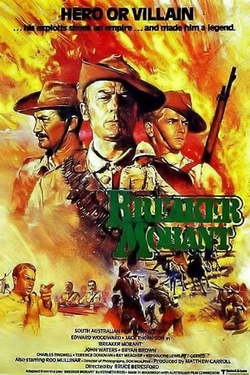
BACK-STORY: “Breaker Morant” was released in 1980 and was the first of three films made in Australia that marked the arrival of Australian cinema as a force in war movies. The other two films were “Gallipolli” (1981) and “The Lighthorsemen” (1987). The film was directed by Bruce Beresford, has an all-Australian cast, and was shot in Australia. It is based on the play by the same name which tells the story of the court-martial of Harry “Breaker” Morant, a well known warrior/poet. It was a box office success in America and was nominated for an Oscar for Best Adapted Screenplay.
OPENING SCENE: The movie begins with text explaining that the war is set in the Boer War (1899-1902). The war was between the British Empire and the Boers (mostly Dutch settlers) in South Africa. The year is 1901 and the British occupied most of Boer territory, but is having trouble with the mobile Boer guerrillas. “The issues are complex, but basically the Boers wished to retain their independence from England”.
A military band plays in a gazebo in Peitersburg in Transvaal, South Africa. The movie cuts to a court of inquiry involving three soldiers. One of the three, “Breaker” Morant recounts his military career to let the audience know he is a volunteer from Australia who was a distinguished officer. He takes full responsibility for his actions, but claims he was acting under orders.
SUMMARY: The film flashes back to the incident that touches off the inquiry. A small unit of Bushveld Carbineers (a commando unit created by Lord Kitchener to fight the Boers on their turf with their tactics and methods) launches an attack on a farm house supposedly harboring some exhausted Boer guerrillas. It’s an ambush and Capt. Hunt is mortally wounded and left by the retreating British.
Back in the present, at Kitchener’s headquarters in a beautiful mansion, the commander-in-chief meets his hand-picked prosecutor for the upcoming trial. Kitchener tells Maj. Bolton that the Germans are protesting the death of a German mercenary that Morant is implicated in the death of. The Germans are threatening to enter the war to aid the Boers, but really (according to Kitchener) they have their eyes on South Africa’s gold and diamonds. Bolton, with a twinkle in his eye, comments that the Germans “lack our altruism” toward the Boers indicating the hypocrisy of the British position. It is obvious the three colonials will have to be sacrificed for international relations.
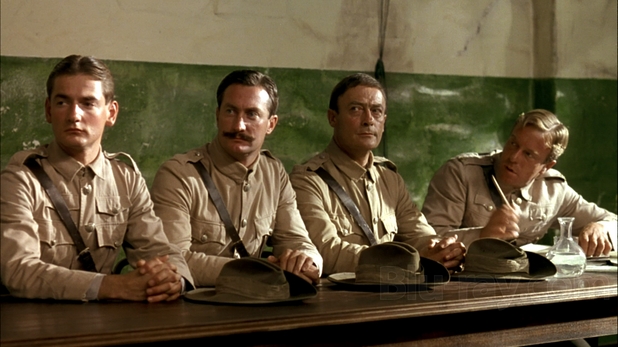 |
| the defendants and defender |
In another flashback, Morant goes after the killers of Hunt and is visibly upset when he views the badly mutilated body of his friend. He vows revenge and when the find the Boer camp, he leads an immediate charge that results in some intense action and ends with the deaths of several Boers and the capture of one wearing Hunt’s jacket. Morant orders the execution of the prisoner named Visser citing Kitchener’s order pertaining to Boers captured wearing British kit. It is clear, however, that Morant is more motivated by revenge than policy.
At the trial, Morant takes the stand (chair) and maintains that the Carbineers fight by a new set of rules appropriate for this new style of warfare. They did not carry military manuals into the field. As far as the execution, they used the “rule of 303” (a reference to their .303 caliber Enfields) which the audience is left to figure out for itself. Good luck, ladies. (Sorry, I guess that was sexist.) Morant’s killer line is “it is customary in war to kill as many of the enemy as possible”. At this point in the movie, the audience is so firmly in Morant’s corner that most will overlook that Morant is arguing that it is okay to kill enemy prisoners.
The next flashback shows that Hunt had ordered the killing of prisoners and at first Morant had balked until Hunt confirmed that the orders came from Kitchener. The next witness is the Fort Edwards intelligence officer Taylor who testifies that it was common practice to execute prisoners. His testimony is tainted by the fact he is also on trial for executing prisoners.
 |
| the accused defending their jail |
One of the charges is the murder of a German missionary named Hesse by Morant and Handcock. The missionary has the reputation of collaborating with the enemy. He arrives at Fort Edwards at an awkward moment – Morant has just ordered a firing squad for a group of Boers who had come in under a white flag. When Morant sees Hesse talking with the prisoners, he is enraged and sends Handcock off on a “mission”. Hesse is found dead. The prisoners are stood up against the wall despite the protest of Witton.
When Handcock is called to testify, his alibi for the Hesse murder is he was “entertaining” some ladies at the time. The two ladies are married and to Boers at that. The tribunal of stuffed shirts are appropriately morally repulsed by Handcock, but believe him. Back in jail, Witton is shocked when Handcock admits he killed Hesse. Morant counters Witton’s naivety with a proclamation that “it’s a new kind of war. It’s a new war for a new century.” This new war includes killing civilians, even missionaries. Who do moviegoers side with on this – Witton or Morant?
Thomas’ summation is an anti-war classic. I can’t avoid reproducing part of it here.
"The fact of the matter is that war changes men's natures. The barbarities of war are seldom committed by abnormal men. The tragedy of war is that these horrors are committed by normal men in abnormal situations, situations in which the ebb and flow of everyday life have departed and have been replaced by a constant round of fear, and anger, blood, and death. Soldiers at war are not to be judged by civilian rules, as the prosecution is attempting to do, even though they commit acts which, calmly viewed afterwards, could only be seen as unchristian and brutal. And if, in every war, particularly guerilla war, all the men who committed reprisals were to be charged and tried as murderers, court-martials like this one would be in permanent session. Would they not? I say that we cannot hope to judge such matters unless we ourselves have been submitted to the same pressures, the same provocations as these men, whose actions are on trial."
Although the trio is found innocent on the Hesse charge, they are thrown overboard for the Visser execution and the firing squad of the Boer quitters. In a powerful, sparse scene the three are informed of their fates individually. Death at dawn for Handcock and Morant and a life-time of penal servitude for Witton. Morant sums it up for Witton: “Well, Peter, this is what comes of empire building.”
THE FINAL SCENE: In probably the greatest execution scene in war movie history, Morant and Handcock are led to two chairs in a field. When asked about comforting by a priest, Morant tartly replies that he is a pagan. Handcock: me, too. Morant (ever the Renaissance man) references Matthew 10:36. (“And a man’s foes shall be they of his own household”) With an actual Morant poem in the background, they face their executioners. Morant tells the squad “shoot straight, you bastards. Don’t make a mess of it.” They obey.
RATINGS:
Action - 6
Acting - 10
Accuracy - 9
Realism - 9
Plot - 8
Overall - 9
WOULD CHICKS DIG IT? I think many females would enjoy this movie. Although it has no female characters of note, it is also not overly macho. The action is not bloody or graphic. For instance, we do not see the mutilated body of Hunt. The leads are handsome and charismatic. The anti-war message could have a sort of “I told you so” feel for many women. The courtroom drama aspect of the plot should be appealing.
CRITIQUE: I’ll go out on a limb and proclaim that this is the best movie ever made about the Boer War. You get a feel for the war, although looking it up in an encyclopedia will help with the big picture. It also helps if you are familiar with the Vietnam War because you can transpose that war for much of ”Breaker Morant”. The closing speech by Thomas could have been given by Lt. Calley’s lawyer at his My Lai trial.
In fact, the parallels to the My Lai Massacre (although probably unintentional) are eerie. Calley was also “just following orders”, but could not prove it. Many feel he was made a scape-goat by his superiors. (Like Witton, his sentence was also commuted due to public outrage). Few of Calley’s men refused to obey his orders even though they were obviously inhumane. At least the carbineers were not encumbered emotionally by the Nuremberg dictum that you must disobey unlawful orders to kill prisoners.
The American boys, like Morant, had been changed by the war. If a sophisticated poet like Morant can be corrupted, what can be expected of a nineteen year old grunt? Morant was set off by his best friend’s death, Calley’s men were reacting to recent losses to booby traps. Although Calley’s unit was not the Green Berets (the Vietnam equivalent of the Carbineers), they were fighting the enemy the way he fought them. How many American policy makers in the Vietnam War were familiar with the Boer War? I get the impression America thinks it invented counter-insurgency. The Morant court-martial was known before this movie brought it to the general public. Was it studied at West Point? Did the British Empire look backwards before the Boer War? Were we the new British Empire in the sixties? Are we still?
“Breaker Morant” is also one of the great anti-war movies. I recently got into a debate about whether all war movies are anti-war. Realistically, they should be, but actually a lot glorify war without showing any of the seamier side. The themes of prisoner abuse, never-ending guerrilla war, and scape-goating lower echelon soldiers resonate today. I sure hope this movie is being shown at West Point these days! It would not hurt for cadets to be told to focus on the “war corrupts good men” theme. Officers coming out of West Point are in many ways our “Breaker” Morants. It is the second best “soldiers on trial as scape-goats for command decisions” movie. After watching “Breaker Morant”, pair it off with its sister – “Paths of Glory”.
The only problem I have with the movie is if you really think about it, Morant was guilty of war crimes. Before the death of Hunt, he was clearly conflicted about the verbal orders from higher-up to kill prisoners. When he takes over, he did not have to obey those orders even if he thought they were official and it is clearly implied he became vengeance-minded. It is one of the strengths of the movie that even the death of the missionary seems like a railroaded charge when, of course, it was an egregious breech of the rules of war. How many in the audience see it as it is accurately depicted – an assassination of a priest for choosing the wrong side and for potentially informing on a war crime?
The non-trial flashbacks are accurate. Hunt did die in a similar fashion, but he was buried before Morant could see the body. He certainly was told about the mutilations so his anger was certainly accurate. Ironically, historians have since determined that the mutilation was most likely done by black witch doctors! Another slight alteration from the facts was that Visser was not captured wearing Hunt’s jacket, but instead had some British kit in his possession. This makes the real “Breaker” Morant even more unjustified in executing Visser. The dawn attack on the fort did occur and the trio did perform brave enough to get them pardoned, under normal circumstances. The movie includes three of Morant’s poems as proof he was the real deal.
The filmmakers get the little details right. In one scene, a British soldier takes a bath in a wash-tub. Some of the British soldiers wear kilts. The Enfield rifles are accurately depicted. The Boers were famous for their sharp-shooting, although probably not as dead-eye as in this movie. Heck, even the British seldom miss.
CONCLUSION: This is a great movie. The scenery is beautiful as Australia stands in for the unbroken horizons of the Transvaal. The acting is fantastic. In the courtroom scenes, watch the facial expressions of the actors. You can read a lot from those faces! Woodward is seething, Brown is roguish, Fitz-Gerald is naïve, and Thompson is outraged. Denny (the head of the tribunal) and Kitchener are appropriately hissable.
Director Bruce Beresford made a film that is interesting to watch. He uses a stationary camera effectively. He also often has the actor off-center in the frame. He does not use a swelling soundtrack to tell us how we are supposed to feel.
As a history lesson and a lesson in military ethics, the movie is valuable and should be viewed by a public that is at war in a war (Afghanistan) similar to the Boer War. Clearly the film should be mandatory viewing for soldiers involved in a counter-insurgency situation and for the leaders who are fashioning that counter-insurgency policy.
Next up: Battle of Britain
Sunday, September 12, 2010
#92 - Midway

BACKSTORY:
“Midway” was released in 1976 and was meant to be the definitive treatment of the turning point battle in the Pacific in WWII. In some ways it is a dinosaur marking the end days of the epic old school war movies like “The Longest Day”. Similar to that film, it features an all-star cast and tells the story from both the American and enemy perspectives. Unlike “The Longest Day”, it is not based on a book by Cornelius Ryan and thus does not have Ryan’s deft blending of commanders and grunts roles. It also takes it easy on its audience by having the Japanese speak English. The movie was a disappointment at the box office in spite of its revolutionary Sensurround technology that was supposed to make the audience “feel” the battle. (It was one of only 4 movies made with this dead-end technology).
The producers made the decision to make as much use of actual war footage as possible. In addition, combat footage from other war films like “Tora! Tora! Tora!” are used. Admirably, the cinematographer tried to reduce the quality of the modern film to be more seamless with the circa WWII footage. It is an uneasy blend, however. The navy provided the U.S.S. Lexington (commissioned in 1943) which served for both the American and Japanese carrier scenes.
OPENING SCENE:
The movie opens with a written reminder that Midway was the turning point in the Pacific. It posits the theme that battles are a mixture of “planning, courage, error, and chance”. The audience is informed that they will be seeing actual combat footage. We then see the “Doolittle Raiders” taking off and bombing Japan in a seeming example of this. (Actually the footage is from the movie “Thirty Seconds Over Tokyo”.)
The first scene is in Hiroshima on April 18, 1942 at the home of Admiral Yamamoto (the great Toshiro Mifune). He sees the raid on Japan as an opportunity to initiate his plan to destroy the American fleet in a decisive battle.
SUMMARY:
 |
| Cast members standing by a Hellcat playing a Wildcat |
Yamamoto goes over his plan. It is very ambitious and accurately reflects the overconfidence and aggressiveness of the Japanese high command at this stage of the war. Some of his subordinates are leery, but he insists they must destroy the American fleet before America’s industrial might kicks in.
At Pearl Harbor, CINC Chester Nimitz (Henry Fonda playing him again after “In Harm’s Way”) gets briefed on the Battle of Coral Sea. The cryptanalysts led by Rochefort have determined the next Japanese target codenamed “AF” in Japanese messages. They concoct a scheme to get the Japanese to reveal that AF is Midway. The movie gives props to the code-breakers that made the victory possible.
Matt Garth meets the Nisei fiance Hiroku who explains that she is not a subversive. Not surprisingly, her parents are opposed to the marriage. In a later scene, Garth visits an intelligence officer and swallows his pride to successfully get the girl and her parents released. He then confronts Tom and cheesily tells him “you better shape up, Tiger or some hot-shot Japanese pilot is going to flame your ass!” Cringe!
The movie now turns to the battle. It accurately walks through the main events interspersing combat footage with command decisions by both sides. The Japanese bombard Midway Island in a scene with lots of explosions. Meanwhile, both fleets have scout planes out looking for the other. However, the Japanese in their hubris do not think the Americans can be anywhere near. Commander Watanabe argues for a renewed attack on Midway. Adm. Nagumo reluctantly agrees necessitating switching the planes from ship-killing torpedoes to airfield-cratering bombs. In a seemingly screenwriters’ fiction (but in fact based on fact), the last Japanese scout plane discovers the American fleet causing Nagumo to reverse the order.
The American strike force is on its way led by the torpedo bombers. We see actual footage (albeit of later types of planes) blended with close-ups of the actors in front of a screen. The scene concentrates on George Gay who survives the suicide attack to end up bobbing in the middle of the battle. We hear the usual war movie radio chatter. Tom Garth is shot up and badly burned. Nagumo gives props to the American air crews by saying “they sacrifice themselves like samurai”.
 |
| a Japanese carrier gets hit |
The Americans return with Tom in a lot of distress. He crash lands on the carrier deck, but survives. The filmmakers use famous footage of a Hellcat crashing. (Tom was supposed to be in a Wildcat and the actual pilot walked away from the crash.)
There’s still that one Japanese carrier out there and planes from it have hit the Yorktown so another strike force is organized. One of the hits is by a kamikaze in a cool shot of the plane coming right at the bridge. Pilots are needed for the strike force and guess who volunteers? If you guessed Charleton Heston, you have obviously seen some war movies. Heck you have seen some movies, period.
Garth leads the attack on the Hiryu, but he misses. Just kidding. His bomb lands smack in the middle of the deck causing the model to catch fire. Like son, like father, Matt has plane problems and crashes, but burns on return. He’s a martyr!
THE FINAL SCENE:
Back at Pearl, Tom is put in an ambulance. Hiroku is there, but oddly shows no emotion. Nimitz wonders “were we better or just luckier?”
RATINGS:
Realism - 8
Action - 7
Acting - 8
Accuracy - 9
Plot - 7
Overall - 7
WOULD CHICKS DIG IT?
Doubtful. The tacked on love story does not overcome the fact that most of the movie is old white guys playing army (or in this case navy).
ACCURACY:
The movie is commendably accurate. If you want to learn about the Battle of Midway and do not want to read, it is a good tutorial. The main facts and chronology are factual. The actors portraying real historical figures get the personalities right. The little things like the AF code-breaking gambit are incorporated with good effect and show the filmmakers cared about getting things right. The Japanese point of view is shown with sympathy. They are not demonized like in a 1940’s or 1950’s movie. In fact, the characters are portrayed as able and intelligent, which is what they were. Their hubris brings them down.
The love story involving the Issei parents and the Nisei daughter manages to bring the unfortunate mistreatment of Japanese-Americans into the film. Although the internment policy has nothing directly to do with the Battle of Midway, I can forgive the makers for reminding us that we were not perfect as a country in WWII. However, although it is a fact that Japanese-Americans were put in internment camps in America, very few of the families were interned in Hawaii and those that were were segregated by sex (unlike Horoku’s parents).
The most obvious inaccuracies in the movie have to do with the combat footage. Any person knowledgeable of WWII aircraft will notice planes that did not fight in the Battle of Midway. For instance, there are numerous times when F6F Hellcats are portraying F4F Wildcats. Tom Garth takes off in a Wildcat and crashes in a Hellcat. Heck, there are even some British and German planes in dogfight scenes that were shot for the movie “The Battle of Britain”. Also, the U.S.S. Lexington is not the right class of carrier. With that said, I do not think your average viewer cares and the makers deserve credit for trying to use as much real footage as possible.
Some experts quibble about the kamikaze hitting the bridge. The fact is kamikaze attacks were not policy at the time of the Battle of Midway. However, there were examples of individual Japanese pilots deciding to crash into the enemy earlier in the war. Usually it was when their plane was crippled. There is no evidence this happened in the battle. It’s the coolest visual in the movie so let’s cut it some slack.
When I saw “Midway” in a theater in 1976, I can remember leaving the theater outraged that the movie concluded without reference to the sinking of the Yorktown. It seemed an attempt to make the victory perfect instead of great. For me this cancelled out a lot of the fairness of the movie. Looking back, I may have been too historically fanatical, but I still think it was a flawed decision by the filmmakers to not mar the feel-good ending.
CRITIQUE:
“Midway” begs to be compared to its sisters “The Longest Day” (1962), “Tora! Tora! Tora!” (1970), and “A Bridge Too Far” (1977). They are all epics with all-star casts. Each looks at both sides of the battle. Each wants to be the definitive account of an historical event and they succeed. They all concentrate on command decisions. The most obvious comparison is to “Bridge” (#94). They are only one year apart. They each concentrate mainly on leadership characters, although “Bridges” has its Dohun representing the average Joe and “Midway” has Gay. “Bridge” forgoes the fictional main character and the cheesy love story. It has more lusty action scenes which could be because its more visceral to witness boots on the ground than planes in the air. I will have to watch “Tora!” again to compare it to “Midway”, but I feel “Bridge” is a better movie than “Midway”.
As far as “The Longest Day”, no comparison. It amazes me that while “Midway” owes its existence to the granddaddy of all-star battle epics, it ignores the formula that made “Longest” special. “The Longest Day” has the generals, but also the privates so you get the full spectrum. Most of the enlisted men are portrayed by second tier actors, but they hold their own with the John Waynes. Remember Red Buttons’ character? It also has some humor. There is no humor in “Midway” and the bit players are pretty bad. Eddie Albert as Tom Garth is cringe-worthy. TLD did not build its plot around a fictional character, either.
This is not to say the movie is bad. It works hard to be accurate. It is fair to the Japanese. The score by John Williams is not overly patriotic. It tells the story of an important event in history in a more interesting way than a documentary would. You get to see lots of actual combat footage. Best of all - Charlton Heston dies.
Saturday, September 4, 2010
#93 - The Guns of Navarone

BACKSTORY:
“The Guns of Navarone” was released in 1961 and was the top box office attraction of that year. It is based on the popular novel (1957) by Alistair MacLean, although the characters underwent major changes by screenwriter Carl Foreman ( for instance, there are no major female characters in the book ). At $6 million, the film was one of the most expensive up to that time. It paid off as the movie was a smash hit and critically acclaimed. It served as a template for the James Bond series with its mixture of action, characters, and exotic locale. It is often linked with similar movies from that time period, specifically with “Bridge on the River Kwai”, “The Longest Day”, and “The Great Escape”. It was nominated for 7 Academy Awards and won for Best Special Effects. It was awarded the Golden Globe for Drama. One of the Oscar nods went to Foreman for his first credited screenplay since being blacklisted as a Communist. The movie was filmed mostly on the island of Rhodes which hosted an all-star cast. One of whom, David Niven, almost died during filming because of immersion in a pool of water for the explosives on the elevator shaft scene.
OPENING SCENE:
In a tutorial similar to “A Bridge Too Far”, a narrator explains that it is 1943 and 2,000 British soldiers have been marooned on the Aegean Island of Keros. They have a week to live because the Germans plan to invade the island and wipe them out as a show of force to intimidate Turkey into entering the war. The only way to rescue them is for a fleet to pass by the island of Navarone. Unfortunately, Navarone has some big-ass cannons mounted in a cave on a cliffside which are capable of sinking the rescue flotilla. You are about to watch a movie featuring those forgotten titans of naval warfare – the shore guns! (For the average viewer: a shore gun was a long-range, large caliber gun guarding the entrance to a harbor. They would outrange any enemy ships plus they usually had an altitude advantage which made them unhittable by warships. It was close to suicidal to take them on).
_02.jpg) |
| "Who wants to go on a suicide mission?" |
SUMMARY:
There is still one more member of the team to be revealed. Mallory meets a survivor of the Greek army named Stavros (Anthony Quinn) in a hotel. Mallory and Stavros had been on missions together, but there is obviously bad blood between them. The team leaves via fishing boat in disguise. Of course the voyage includes an encounter with a snoopy German patrol boat. The team opens fire on the boarders and kills all the Germans and even blow up the German ship. Even though the ships are next to each other, the fishing boat suffers no damage or casualties from the massive explosion.
During the trek, Mallory reveals to Miller that Stavros is planning to kill him after the war for inadvertently causing the deaths of his family. It’s going to be a tense mission. Mallory weighs in on warfare with “the only way to win a war is to be just as nasty as the enemy”. (This anti-war theme is going to fly over the heads of most moviegoers.)
_01.jpg) |
| "I will not let you kill yourself" |
They escape a German patrol by taking refuge in an old temple. In some ways the movie is more of a chase film than a war film. There they are joined by Pappadimos’ sister Maria who is a resistance fighter. She is accompanied by Anna, a pretty blonde who is mute due to torture by the Gestapo.
On the fourth day, they escape strafing by Stukas and enter the town to seek help for Franklin. Stavros, Maria, Franklin, and Brown are captured at the doctors. The others try to blend into a wedding party. A Greek sings a Greek folk song which of course is the cue for James Darren to join in ala Ricky Nelson in “Rio Bravo”. The Germans recognize his singing voice as that of an American pop star (jsut kidding) and they are captured, too.
At German headquarters, the team is questioned by a “good cop” German officer and then a blonde hair, blue eye (naturally) S.S. officer arrives to be “bad cop”. Stavros pretends that he is a reluctant participant and plays the sniveling coward which distracts the Germans although they know exactly who he is (they have his picture for God's sakes!). The act works and they disarm the Germans and put on their uniforms. They have to leave Franklin behind but Mallory has planted a false invasion story so when Franklin gets truth-serumed, he will tell the Germans a different plan. They steal a vehicle and go to a monastery. Miller goes off on Mallory for “using” Franklin. Miller represents the conscience of the group, although earlier he was in favor of leaving Franklin to the Germans with the plans for the mission intact in his head which would have gotten them all killed. Later, Mallory and Anna spoon.
The last day starts with smoke from the town indicating retribution for sheltering the commandoes. The Nazis are evil. They arrive at the fortress-town and see the guns for the first time. Meanwhile, Franklin talks and the Germans rush out of the fortress to counter an expected invasion. Unfortunately the lack of defenders is matched by the team’s sudden lack of explosives since someone has tampered with them. Miller suspects Anna and demands to see her scars from the torture. The 1961 audience gets to be titillated by the bare, unscarred back of Anna. If that is not shocking enough, Anna is also not mute! She is a collaborator who switched sides because “I can’t stand pain”. Miller insists Mallory do his duty, but Maria shoots the traitor before Mallory can do it. Interestingly, the no dialogue scenes have now been balanced by some very verbose ones.
 |
| the big-ass cannons |
Miller places explosives (where did he get them?) on the guns, but figuring they will be found he also places some at the bottom of the elevator shaft to be triggered by the descending elevator. Mallory and Miller go over the cliff by rope and then swim to the boat. They pick up Stavros with Mallory offering him a hand up like in the earlier scene. The Germans find the explosives on the guns using metal detectors that are apparently not distracted by all the metal in the vicinity.
FINAL SCENE:
The elevator keeps coming down, but not down enough to trigger the explosives! We are on the edge of our seats, but I have to admit I did want to see those guns fire at least once. Our wishes are granted as the guns fire twice at the sitting ducks British armada before the inevitable explosion occurs. It’s a big one! The entire top of the mountain is blown up and the guns plunge into the sea. The fleet lets loose with its horns and the crews cheer. If there had been high-fiving in 1961, audiences would have been out of their seats. I guess they settled for a rousing “Bravo!”
Stavros decides to let bygones be bygones as he stays behind with Maria who he has fallen in love with. Did you think they would spend the rests of their lives sad and lonely? They will now be happy together killing Germans. It’s very romantic. Miller apologizes to Mallory for being something of a British twit distracted by human feelings. They arrange to meet again for “Force Ten from Navarone”, but few cared.
RATINGS:
Realism - 6
Action - 8
Acting - 9
Accuracy - 5
Plot - 8
Overall - 7
WOULD CHICKS DIG IT?
It is not really a date movie, although the box office receipts indicate women did go to see it. There is a strong female character (Maria) and Foreman must have changed two male characters’ gender to make the story more female-friendly. Plus, James Darren was a teen idol type probably chosen to appeal to a female audience. (Certainly he does not sing for the males in the audience!) The movie is more character driven than many war movies. It is not graphically violent. It is not pure action and if you like talking (some women do), there are some very talkative scenes.
ACCURACY:
The book and movie are loosely based on the Battle of Leros. In 1943, after the Italian government capitulated, the British seized several Aegean islands in the Dodecanese Campaign. It was a classic case of overreach, however. The Germans had a preponderance of forces in the area and did not sit back. They regained the islands including taking back Leros in an amphibious assault that resulted in the loss of the British occupiers who were not rescued as the movie implies. MacLean built his story around this incident, but he obviously did not mean for it to be a history lesson. In fact, you have to dig a lot to discover that there is any link to an actual event.
CRITIQUE:
Although considered one of the great manly films, “Guns” is probably a bit overrated. It has some ridiculous moments like the escape from the German arresters and Pappidamos’ machine gun duel. Not to mention squeezing a song into a war movie! It also has several standard movie clichés like Stavros finding a woman in the end to restart his life. The Germans are depicted as not so much evil as stupid. The movie is also a little slow and talkie at times. When compared to a similar MacLean inspired movie, “Where Eagles Dare” (which did not make the list), it comes up short in almost every way.
However, as an example of an old school action movie set in war, it is pretty good. It has the old-fashioned soundtrack, stellar acting, and the twist of the mute collaborating girl. Most people will not see that coming. I also appreciated the scenes where the action did the talking. Speaking of talking, another nice touch was the Germans spoke German without subtitles. The audience is left to figure out what they are talking about. Imagine that. Of course, today most viewers are probably just thankful they don’t have to read and to hell with what they are saying.
By the way, if you bet that 3 of the 6 team members would die (assuming the Germans kill Franklin), you win! 50% - not bad for a cinematic suicide mission.
CONCLUSION:
I suggest you watch "Inglourious Basterds" along with this movie to see how suicide mission war movies have evolved over the years. I think you will find that the modern version is quite a bit more extreme. I would argue audiences today want more bang for their buck from their war movies. "Guns" seems very tame today. I am not sure this is a good trend. However, when it comes to standard fare like "Saving Private Ryan" we may find in our cinematic journey that modern war movies are generally better than the old school types like "All Quiet on the Western Front". We shall see.
Subscribe to:
Posts (Atom)