“The Night of the Generals” is the rare
mystery set in war. It was a Franco-British
production helmed by Sam Spiegel who was attempting to replicate the success of
his “Lawrence of Arabia”. To maximize
his chances, he reunited Peter O’Toole and Omar Sharif for the first time since
that epic five years earlier. This might
have worked except for the fact that neither star was happy to be involved in
the movie. The two actors were forced to
make the movie for laughably low salaries for new mega-stars because they were
still under an earlier contract. In
fact, Donald Pleasance was paid a lot more than the other two. Sharif was uncomfortable with playing a Nazi
and had a very awkward moment in a Warsaw café when he forgot he was in
uniform. Spiegel hired Anatole Litvak as
director instead of a new up and coming director. He then proceeded to micro-manage and
undercut Litvak throughout the shoot. It
took four screenwriters to put together the script. In spite of all this dysfunctionality the
movie was a big hit – not!
The
movie opens with the murder of a prostitute in Warsaw in 1942. A Major Grau (Sharif) from the Abwehr (Nazi
intelligence) is brought in because the girl was a German agent. The three suspects are three German generals. It is no spoiler to admit that it is obvious
from his first appearance that Gen. Tanz (O’Toole) is the murderer. End of mystery, but unfortunately not end of
movie. Stick around for a truly bizarre
performance by O’Toole. He plays Tanz as
a looney and a sadist. He is insane and
evil even for a Nazi. He has a soft spot
for kids while he is wiping out their neighborhood with tanks and
flamethrowers. Grau is snooping around
when he gets transferred to Paris. Guess
what three suspects end up in Paris two years later at the time of a similar prostitute
murder? It’s a small war after all. The film throws in a subplot about the
conspiracy to kill Hitler and does a satisfactory job reenacting the
assassination attempt. Tanz kills
another prostitute and frames his driver, but then lets him flee so he can
later implicate him when we flash forward to Hamburg in 1965.
This
movie is a misfire of epic proportions.
Nothing works. It is a mess. It has no flow, partly due to the nonlinear
structure. It drags along like a
crippled otter. There is a romance
involving Tanz’s driver that is lame and has no logical reason for being in the
movie. Except to give the great Tom
Courtney something to do to please his multitude of fans. The weaving of the mystery with the
assassination conspiracy does not work.
More importantly, the mystery is undermined by O’Toole’s truly weird
performance. It is painfully clear that
he sabotaged the movie out of spite for his paltry salary. At one point he makes a trip to a museum and
freaks out over a self-portrait of Van Gogh.
The next day he returns to the museum and stares at the painting and
then leaves. WTF? Of course, you have to put some of the blame
for that on the four screenwriters, but he did not have to play Tanz as the
Hitler Youth voted Most Likely to Kill Prostitutes. He also does not bother to even attempt a
German accent. Then again, neither does any other member of the cast.
patriotic music
/ no name cast / story by Samuel Fuller! that’s a good sign / a narrator tells us it’s
the “story of tanks and tankers” / the 3rd Armored Division
(“America’s iron fist”) is near St. Lo -
it is piercing the Siegfried Line /
first cigarette – three minutes in / those look like real Shermans /
quite a bit of hardware – did the Pentagon cooperate? / realistic tank
interiors / they take on a Panther, but the shells bounce off; they fire white phosphorous to blind it and
then flank it to knock it out - pretty
good scene / terrible narration / commander of the featured tank is wounded and
replaced by Sgt. Sullivan (Steve Cochran) – he’s cocky; he brings with him his
alcoholic driver / they run into a sexy war correspondent named Pat; Sully is a
wolf / Sully plays hard-ass with his
crew and does not make any friends including with the unit’s leader / some
footage that is fairly seamless / one of
the crew is a German-American – he catches grief (they call him “Heinie”), but
defends his patriotism / a guy plucks a
duck – only time in war movie history! /
they run into an 88, Sully charges it and takes it out / Ike (not Eisenhower) goes to complain to the general about
German 88s being better than our 75s;
the general says new 90s (M26 Pershings) are on the way and promises Ike
the first one / Cal attacks Sully who
easily beats him up / there is some
fairly good footage of Germans / Marconi
is sent out as a forward observer and calls in fire on his own position; Pat shows up to interview him and Sully puts
him up for a Silver Star / here comes
Ike’s 90! he is so good he needs no
training and takes the new tank straight into battle! / they reach the Siegfried Line / under artillery bombardment Sully charges
forward and gets stuck on dragon’s teeth – WTF / Sully borrows a bulldozer to open a breach /
the German-American goes into town to see his grandparents; Sully grows a heart and hugs a dog / Sully turns down promotion to stay with his
crew - turns out he was not such a jerk
after all
ANALYSIS: “The Tanks Are Coming” (don’t get it confused
with the 1941 movie of the same title) is not as bad as you would expect. It is definitely a B-movie with a no name
cast. The acting is average and typical
of this type of movie. Sully is an
interesting and unpredictable character until Hollywood insists he have a
personality change towards the end.
Heinie is a different character and probably reflects the fact that in
1951 during the Cold War we were rehabilitating German characters in war
movies. There is some good tank
action. The blended footage is fine. The effects are surprisingly good. The plot is episodic and does not flow well
which is disappointing because Fuller wrote the story. There is too much narration. At least twenty places are mentioned. The movie tries to recognize the 3rd
Armored Division that fought at St. Lo and the Siegfried Line. The movie does a nice job showing the disadvantages
Shermans had when going up against Panthers.
Often our shells would simply bounce off.
The Pershings helped solve this problem.
Unfortunately for Ike, the M26 Pershings were not available at the time
of the Siegfried Line breakthrough. The
movie tank is actually a post-war M46 Patton.
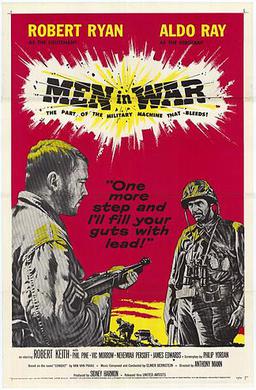
“Men in War” is a gritty Korean War movie directed by
Anthony Mann (“Heroes of Telemark”).
This was Mann’s first war movie.
He was famous for his Westerns.
The story was based on a novel entitled Day Without End by Van
Van Praag. He set his story in the
Normandy campaign of WWII and from what I have read the movie is significantly
different from the book. It takes place
on one day in the Korean War in 1950. The
Pentagon pulled its cooperation when it realized the movie highlighted
insubordination and indiscipline.
A title card opens the movie. “Tell me the story of the foot soldier and I
will tell you the story of all wars.” A
platoon from the 24th Infantry Division is surrounded and out of
contact with the main force. The camera
introduces the members, but we don’t find out much about each. This is not going to be “Platoon”. The men are basically homogeneous. They have one common trait – they are all
suffering from combat fatigue. The man
attempting to hold the unit together and get them back to friendly lines is a
Lt. Benson (Robert Ryan). He keeps
collecting dog tags as the men keep getting picked off by sneaky North Koreans
and Chinese. Suddenly a jeep shows up
driven by a sergeant called Montana (Aldo Ray!). Montana is transporting his colonel who is
shell-shocked. Benson commandeers the
jeep to the displeasure of Montana who is not interested in hooking up with these
pansies. Montana and Benson should be on
a submarine where their command dysfunction would be normal. Benson is a tough, but empathetic leader who
wants to get as many of his men to safety as possible. Montana is a warrior who does not care much
for the rules of warfare or chain of command.
He has a knack for Korean War combat.
For instance, he shoots a surrendering prisoner because he just knows
the guy has a pistol hidden in his hat.
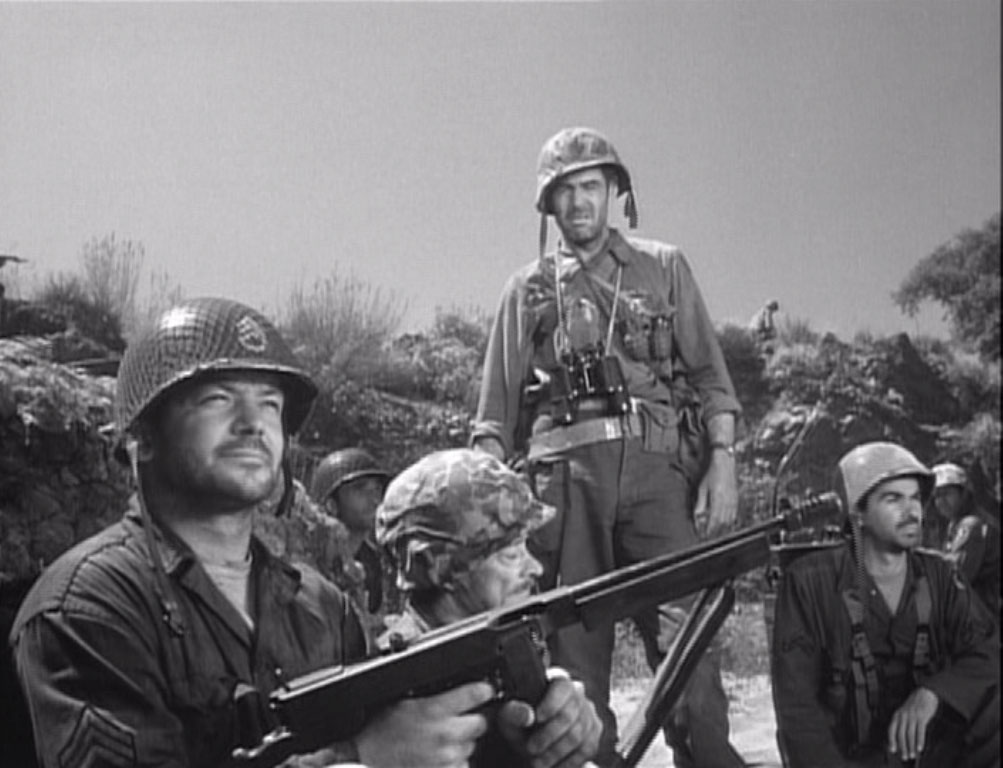
If you don't want to see the movie after seeing this picture, you are not a war movie lover
The dwindling platoon is moving through hostile
territory. They have to withstand an
artillery barrage and a minefield.
Meanwhile, Benson and Montana are butting heads. That’s what helmets are for, I guess. When they reach the hill, Benson ( who is
having some of Montana rub off on him – “God help us, it takes your kind to win
this war”) sends forward a prisoner who gets shot by North Koreans masquerading
as Americans. Benson decides they will
have to take the two machine gun nests dominating the hill. He excuses Montana because he is only
interested in protecting the colonel.
Benson eschews creativity (and Army tactical doctrine) and orders a
frontal attack which does some more whittling.
Guess who’s left to make the final assault? With a flamethrower that had been overlooked
before then.
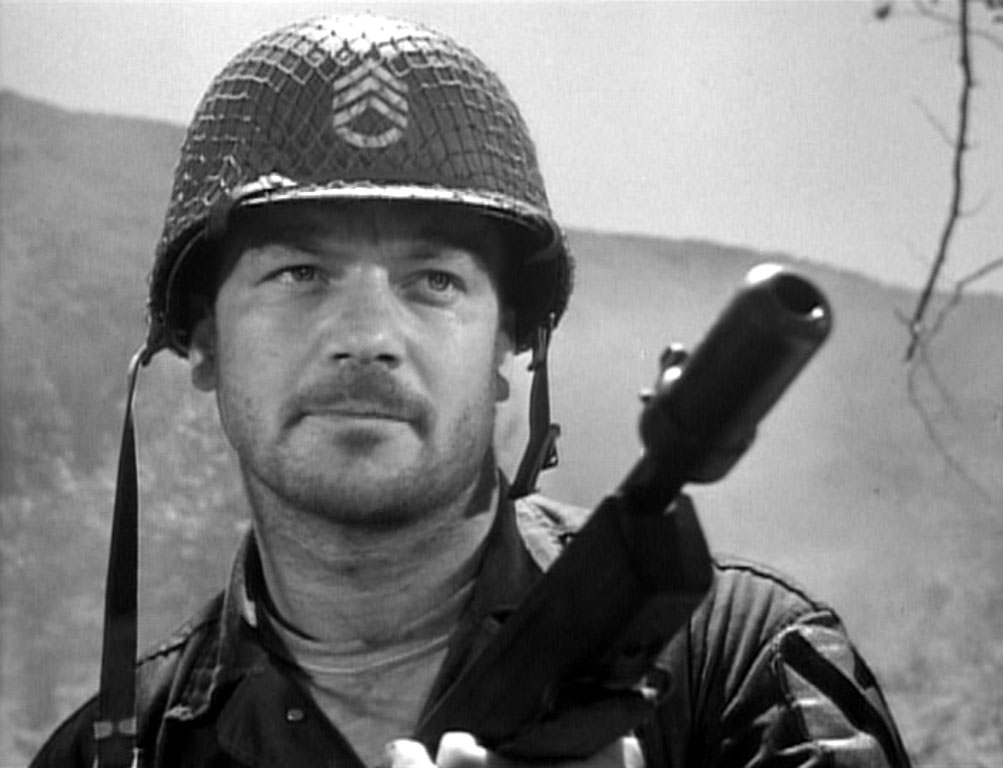
Why does Aldo Ray need a gun?
“Men in War” starts out intriguing, but has a hard
time sustaining the vibe. It is a
different type of war movie from the usual Old School films made in the
1950s. You might even argue that Montana
is an anti-hero before that type of character became de riguer in the
1960s. Benson is one of Aldo Ray’s best
roles. Ray (who was frogman at Normandy)
is perfect as the wiseass, insubordinate loner.
He reminds of Gene Evans in “The Steel Helmet” as the movie is also
reminiscent of that earlier film’s gritty style. Robert Ryan is also strong. This was not his first rodeo, as they say
about actors who made a lot of war movies.
The rest of the cast is noteworthy.
It includes a pre-“Combat” Vic Morrow, Nehemiah Persoff as a panicky
veteran who runs away like a girl, James Edwards as the clicheish minority “dead
meat” who dies with a helmet full of flowers (don’t ask), and L.Q. Jones. Unfortunately, the movie is not big on
character development. It’s pretty much
a two man show. Mann gets the most out
of his cast and although the movie was low budget, it has the feel of a movie
made by a big time director. This is
partly due to the cinematography of Ernest Haller. The movie is very micro with lots of
close-ups and a seldom seen, menacing enemy.
It has the unusual theme of the one and
the many. The one is the colonel and the
many are the platoon. The platoon, not
the army. At one point Benson states
“the regiment doesn’t exist. Battalion
doesn’t exist. The USA doesn’t exist. We’re the only ones left to fight this
war.” It is definitely not a
flag-waver. This sincerity is marred by
two weaknesses. One, the movie has some
extended stretches of boredom. The
running through the artillery barrage scene lasts an incredible fifteen
minutes! Second, there are several silly
developments that are laughable in a movie that is supposed to be bereft of
humor. I know the black guy has to die,
but killed by a sniper while picking flowers?
Give me a break!
“Men in War” is in the upper half of Korean War
movies, but I do not think I would label it as a gem. It’s worth a look just for the teaming of
Ryan and Ray. It also flouts most Old
School conventions.
“The Lost Battalion” was an
A&E production that first appeared on TV in 2001. It was directed by
Russell Mulcahy and filmed in Luxembourg. It was nominated for three technical
Emmys. The movie tells the tale of the famous “Lost Battalion” that was
surrounded by German forces in the Argonne Forest in 1918.
The movie opens strong with a
patrol coming in from no man’s land. The cinematography is reminiscent of “Band
of Brothers”. Maj. Whittlesey (Rick Schroder) waits in the trench and is
splattered with the blood of one of the men. Later, at the headquarters bunker,
Gen. Alexander orders Whittlesey to participate in an attack that Whittlesey
(given the exhausted condition of his unit) deems suicidal. Alexander, being a
WWI general, questions the commitment of this “New York lawyer” and reiterates
his standard “no retreat” philosophy. To Hell with losses.
The pre-battle scenes are
instructive. New replacements arrive and are sobered by the sight of wounded
soldiers (like Taylor’s arrival in “Platoon”). The newbies are brought up to
speed by the seasoned veterans like Sgt. Gaedeke (Jamie Harris) and Pvt. Rosen
(Michael Goldstrom). The duo provide comic relief by using their thick New York
accents to describe different types of German artillery. We are introduced to
the main characters. Whittlesey is morose, but a respected leader. His able
second in command is Capt. McMurtry (Phil McKee) who is brotherly to his men.
We even get introduced to a little carrier pigeon named Cher Ami – “the runt of
the litter”.
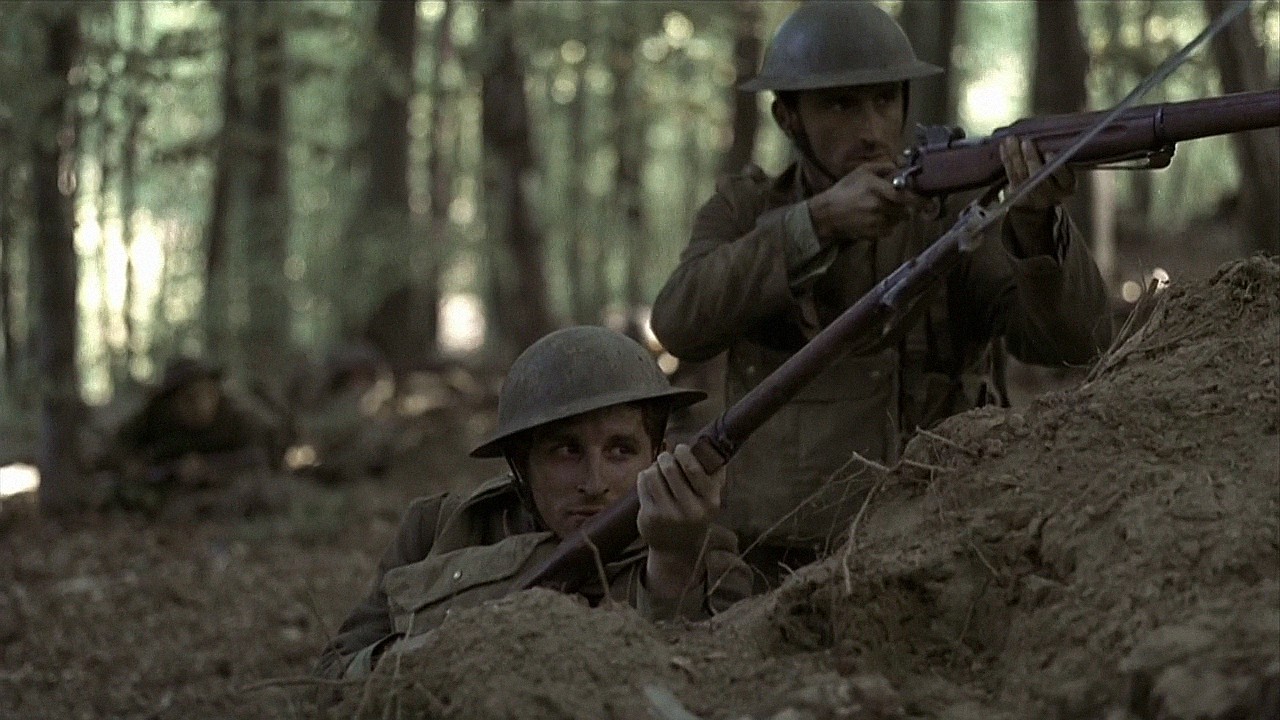
Gaedeke and Rosen shutting up long enough to fight
The minutes before the attack
are tense and foreboding. Whittlesey does the obligatory walk past his charges (like Dax in "Paths of Glory") then blows his whistle and its game on. The game is incredibly intense. We are
plunged into no man’s land. The set is surprisingly realistic. The attack
reminds one of “Paths of Glory” except with modern cinematography, effects, and
sound. We have come a long way. This attack is possibly the best of any WWI
movie that I have seen. It is very graphic and violent for a made for TV movie.
I show the scene in class to prepare my students for their writing assignment
on trench warfare (along with the scene from “Paths of Glory” and the “Sgt.
York” scene).
After pushing the German front
line back, the Americans enter a forested area that is eerily vacant. What they
don’t realize is that as they push forward is that the support units on each
flank are not keeping pace. This results in the Lost Battalion creating a
pocket and when the Germans cut off their rear, they end up being surrounded.
But not lost. Just cut off. Thus begins five days of pummeling by Germans
intent on wiping out this salient. As anyone with any knowledge of military
tactics can attest, salients are just begging to be pummeled and must be
destroyed.
The Germans throw several waves
of attackers at the besieged. Because the pesky Americans keep insisting on not
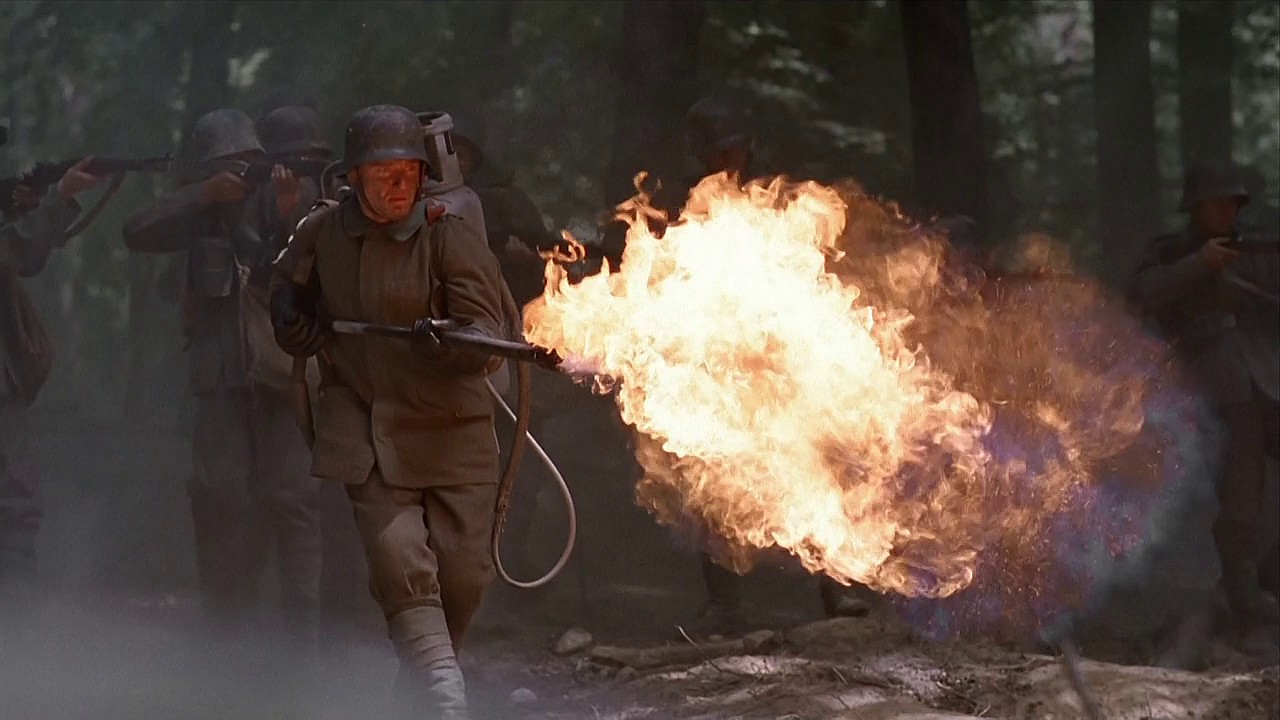
being wiped out, the Germans eventually throw in Storm Troopers and
flamethrowers. The fighting sometimes is hand-to-hand. It could not be worse for
the Americans, right? Wrong. There’s a little problem called “friendly fire”.
At first, when the American artillery starts raining in fire only yards away,
the Americans stand up and cheer (being quite confident in the accuracy of our
artillerists) until that incredible accuracy turns into incredible
incompetence. In one of the most awesome visuals in war movie history, one of
the Americans is literally blown up by a shell. (This actually happened to the
real Gaedeke.) Some other problems include lack of food, shortage of water, and
no way to care for the wounded properly. They have to reuse bandages from the dead. Plus although not technically lost, Gen.
Alexander is not sure where they are and every runner sent out tends to get
killed or captured.
Mein Gott, it's a flammenwerfer!
This is a very underrated movie.
The acting is good from an average cast. Rick Schroeder is excellent as
Whittlesey. He gets the personality down pat. He does the opposite of
scene-chewing which is appropriate for a reluctant hero who committed suicide
because of the unwanted fame. The subordinate characters are well-developed.
The movie balances its portrayal of the officers with some meaty roles for the
enlisted. Gaedeke and Rosen stand out and although some of their comic banter
is lame, you do care about them and the death of one is very touching. The
Germans are handled sympathetically (perhaps a bit too much). The German
commander comes to respect the “New York gangsters” and admires their
brashness.
The thing that stands out is the
amazing cinematography of Jonathan Freeman (a virtual unknown). He blends the
“Saving Private Ryan” style with “Band of Brothers”. If this is the future of
war movies (and it certainly looks like it is), we are in good shape. For a
made-for-TV movie, the action is shockingly graphic. It would definitely have
been rated-R for violence if shown in theaters. A&E deserves a lot of
credit for green-lighting this movie and showing it on TV uncut. The story
needed to be told, but who would have guessed it would be told as dynamically
as this.
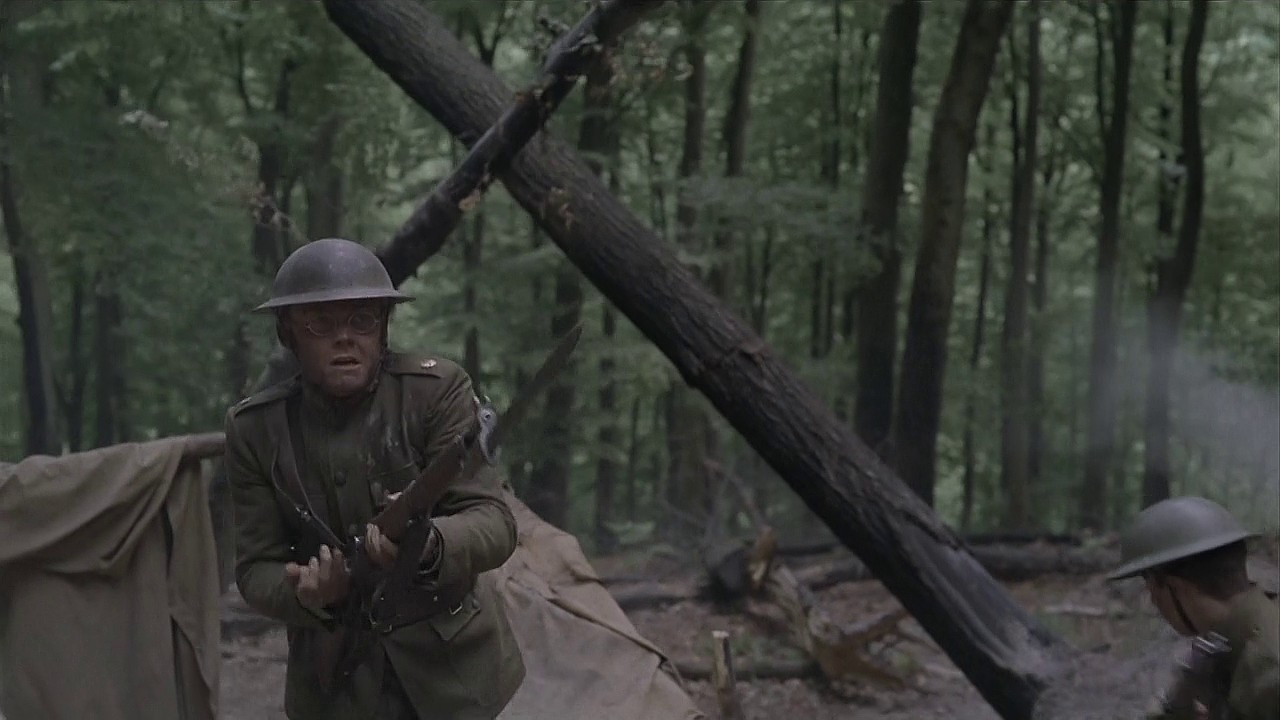
the fighting got so desperate that Rick Schroeder had to grab a rifle with bayonet
The movie does not manage to
completely break the tethers of a TV movie. The dialogue is PG and trite at
times. There are the usual clichés. For instance, Gaedeke and Rosen give the
new guy a hard time, learn to respect him, and then have to deal with his
untimely demise. You also get the pompous, callous general. The dynamic between
Whittlesey and Alexander reminded me of Capt. Staros and Lt. Col. Tall in “The
Thin Red Line” (which by the way, this movie is better than – that’s right, I
said it!). The unit is decidedly heterogeneous and they even throw in a cowboy
to go along with the gangsters. The Brooklyn trope is well represented.
The movie is commendably
accurate with the usual exaggerations and simplifications. It gets the gist of the incident right, but
tends to inflate the significance of the battalion's accomplishment. In this respect it reflects the view of the
media from that time period. The
historical characters are realistically portrayed, but Gen. Alexander’s family
could have a problem with his depiction as an uncaring jerk. The truth is that Whittlesey did not confront
him personally and did not claim the orders were suicidal. The “no retreat” order would have been pretty
standard for a battle like this and partly resulted from previous incidents
where Germans tricked units into retreating by sending false orders. Whittlesey, McMurtry, and Holderman are all
well done, but the German leader Prinz has been promoted to American expert
in charge of interrogation. The movie
character is a Hollywood creation which works in an entertaining way. The fighting is very small scale and
simplified. There was no visceral
breaking of the enemy line to lead off.
The subsequent German assaults on the pocket are fine and there was some
hand-to-hand and the use of flamethrowers.
The movie attempts to show the hardships in the pocket, but cannot
completely do them justice. The friendly fire incident and Cher Ami’s heroism
are a highlight. The film gets the
details right. The collection of dog
tags. Officers using whistles. The use of carrier pigeons. Since the movie is a tribute to the unit and
Whittlesey in particular, it steers away from controversies like whether
Whittlesey’s incorrect coordinates were responsible for the friendly fire and
why he refused to break out when it was apparent they were being
surrounded.
In conclusion, I am a big fan of
what I call the Truthy Unit subgenre. These are war movies that cover a
particular unit that is either famous or should be. “The Lost Battalion” does a great job
reviving a famous, but somewhat forgotten story. After all, how many people have seen the 1919
version that starred several of the participants including Whittlesey,
McMurtry, and Alexander? I have not seen
it, but I’m betting the 2001 version does a much better job entertaining and
educating the masses. I can see it
landing on my 100 Best War Movies list.