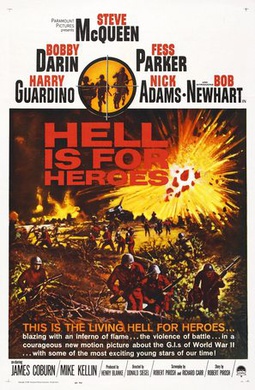
VS.
Cross of Iron (7) vs. Hell is for Heroes
(10)
ACTING: “Hell is for Heroes” (1962) is a
small unit movie with a good ensemble cast of solid actors. The film is
dominated by Steve McQueen’s portrayal of the loner Pvt. Reese (broken down from
Sergeant presumably for infractions outside of combat). It may have been method
acting or his displeasure with involvement with the production, but McQueen is
quite convincing as the dislikeable jerk. He also has the “thousand yard stare”
down pat. The rest of the cast (James Coburn, Harry Guardino, Bobby Darin, Fess
Parker, Nick Adams) are solid.
“Cross of Iron” (1977) is anchored by
James Coburn’s portrayal of Sgt. Steiner. He is outstanding as the cynical,
anti-authority figure. It is one of his greatest performances. It is not a
one-note performance like McQueen’s. He gives Steiner some humanity and
compassion for his men. The other stars (James Mason, Maximilian Schell, and
David Warner) do good work, but the unknowns who make up Steiner’s squad are
only adequate.
FIRST QUARTER
SCORE: Cross of Iron 8
Hell is for Heroes
8CLICHES: “Hell is for Heroes” is a typical small
unit, “who will survive?” movie. The unit is heterogeneous as it consists of the
surly Reese, the scrounger Corby, the mechanic Henshaw, the kid Cumberly, the
no-nonsense Sergeant Larkin, the noncombatant clerk Driscoll, etc. There is a
mascot-type in the Polish soldier-wanna-be Homer. These characters are not
really developed and are not particularly stereotypes. Nobody is from Brooklyn.
You do get the cliché of who will get killed next and how. The hero (actually
anti-hero) Reese does have leadership thrust upon him, but rather than complain,
uses it to launch an ill-conceived mission against a pill box. There is no real
conflict within the group and no rituals. The movie falls nicely into the "last
stand" subgenre. There is a redemption theme, but Reese’s climactic action is
more to avoid another court-martial than to redeem himself.
“Cross of
Iron” is also a small unit movie, but it is much more complex. The final half of
the movie has the standard hero leading his unit on a mission that involves
making it back to friendly lines. The unit is heterogeneous, but the characters
are given little back-story and only have small quirks to identify them. The
clichés are mainly reserved for the officers. Steiner is the anti-hero,
anti-establishment stereotype. Stransky is the cowardly, glory-hound. This
movie’s mascot takes the form of a Russian boy taken prisoner and adopted by the
squad. The movie also throws in Steiner abandoning a comely nurse (Senta Berger) to return to his comrades because in war movies its always "bros before hoes". There is no conflict within the group, but there is a major command
conflict that is strangely left unresolved. There is no redemption. That would
be an out of place theme in a movie that does not believe in redemption.
HALF TIME SCORE:
Cross 15
Hell
15PLOT: “Hell is for Heroes” was written by
Robert Pirosh who also did “Battleground” and went on to create the TV series
“Combat!” (which has a very similar tone to the movie). The plot moves from the rest
area to the combat zone pretty quickly. Enough time for the usual grousing about
“why us?!” Reese arrives during the rest time and goes off with his new unit
after making quite an impression as an ass hole. The rest of the plot involves
the stretched thin squad’s attempt to defend an outpost on the Siegfried Line.
There are plot contrivances like a German listening device that gives the
producers the chance to shoe-horn a Bob Newhart telephone routine that is funny,
but ridiculously out of place in a gritty combat film. It is not the only bit of
comic relief as Corby fills the wisecracker role. From here it’s the plot’s job
to kill off most of the squad in a variety of ways and then leave us with a big
set piece.
“Cross of Iron” is based on an excellent novel entitled
The
Willing Flesh by German WWII veteran Willi Heinrich. It follows the plot of the
book closely. The movie opens and closes with battle. In between there is some
good solders-in-the-bunker comradeship and some tense headquarters debates. A
subplot involves whether Stransky lied about his bravery in battle in order to get the Iron Cross and his
attempts to eliminate Steiner because Steiner could torpedo the decoration. The first half plays the Steiner/Stransky conflict out punctuated
by desperate defense of the front line. The bridge between the first and second
halves is Steiner’s often surrealistic stay in a hospital. The second half is
more of a trek film as the survivors of Steiner’s unit work their way back to
their own lines. A unique encounter with female Soviet soldiers highlights this
section. This half of the movie also picks off the men as we near the climactic
showdown between Stransky and Steiner.
THIRD QUARTER SCORE:
Cross 23
Hell
22COMBAT: “Hell is for Heroes” has some pretty
gritty combat for a 1962 film. The first is a German night raid that has Reese
using his helmet and a bowie knife to kill a German and Henshaw roasting another
with a flame-thrower and letting him burn. The next big scene is the attempt to
crawl up on the German bunker at night through a mine field. It’s more
suspenseful than violent. It takes an unexpected turn. Finally we get the
frontal assault across no man’s land that ends with Reese literally take out the
pill box by himself. That last scene is marred by some silly old school deaths.
The combat is satisfactory for a low budget film.
“Cross of Iron” is
loaded with combat. I am hard pressed to think of another war movie that has a
higher percent of actual fighting. (Actually, I just thought of “Black Hawk
Down”.) The action is very Peckinpahish. It was his only war film and he
basically channels “The Wild Bunch” in the cinematography. The big battle scenes
are mixtures of explosions, slo-mo, quick cuts, chaos, and violence. The combat
scenes also are more extended than in most war films. Pekinpah may abhor war,
but he revels in the violence. Although not a big budget film, Pekinpah makes
great use of his limited resources to deliver some large battle scenes. This is
especially true in his use of the three Yugoslavian T-34 tanks. Seldom have
tanks been used more effectively. There are two huge set pieces sandwiched by
two more intimate combat episodes involving the squad by itself. Peckinpah’s way
of composing the violence was to have an impact on war films for the next two
decades (see “Hamburger Hill”, for instance).
FINAL SCORE:
Cross of Iron 33
Hell is for Heroes 29COLOR ANALYSIS: This was
an excellent match-up that came down to the last quarter. It was obvious that if
"Cross" could hold off the game "Hell" until the combat section kicked in,
"Cross" could cruise to victory. The surprising thing had to be the lack of
advantage "Cross" had in the cliche sphere. It seems Peckinpah was not as
iconoclastic in his characterizations and plotting as one might expect and
"Hell" was less clicheish than one would expect from a glorified made-for-TV
looking vehicle. In the match-up of the superstars, both performed well, but the
edge has to go to Coburn (in Cross, not Hell).