Sunday, June 28, 2020

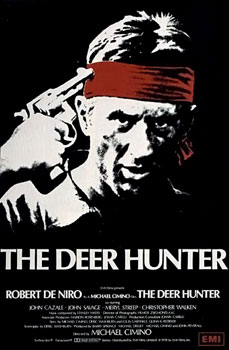
CONSENSUS #40 - THE DEER HUNTER (1978)


SYNOPSIS:  It covers the impact of the Vietnam War on some working-class buddies who live in a Pennsylvania steel town.  The first part depicts a traditional wedding of one of them.  Three of the friends go to Vietnam and are captured by the Viet Cong and tortured.  They eventually get away, but one stays in Vietnam as the other two return home.  Michael (Robert DeNiro) goes back to try to find Nick (Christopher Walken).

BACK-STORY:  “The Deer Hunter” was released in 1978 and was the first important major motion picture about the Vietnam War.   Its success marked the rise of the subgenre that has produced some great war movies.  Significantly, 1978 also saw the releases of “Coming Home”, “The Boys in Company C”, and “Go Tell the Spartans”.  The movie was directed and co-written by Michael Cimino and marked the peak of his career.  He battled the suits to get his vision on the screen and succeeded for the most part.  The movie was a big critical hit and did well at the box office.  It was awarded Oscars for Best Picture, Director, Supporting Actor (Christopher Walken), Editing, and Sound.  It was nominated for Actor (Robert De Niro),  Supporting Actress (Meryl Streep), Cinematography, and Original Screenplay.  It is ranked #53 on the most recent AFI’s greatest movies list.  The film was Streep’s first big movie role and ironically, John Cazales’ last film.  He was dying from cancer and passed before he saw the finished product.

TRIVIA:  wikipedia, imdb, TCM

1.  De Niro was a last minute replacement for Roy Scheider who left because of creative differences.

 2.  John Cazale was dying from terminal cancer.  When the studio wanted to drop him, Meryl Streep (who was in a relationship with him) and Cimino threatened to drop out.  Since he was uninsurable, De Niro paid the insurance.  nominated for Best Picture.

3.  Streep’s role was enhanced after she was cast.  Cimino had her write her own lines.

4.  It was based on a script called “The Man Who Came to Play” which was about Russian roulette in Las  Vegas.

5.  The scenes in Clairton were actually filmed in eight different towns in four states.

6.  The wedding scene lasts 51 minutes.  Cimino originally claimed it would last 21 minutes.  The Russian immigrants who were the extras for the scene were asked to bring wrapped boxes as authentic looking gifts. When production was over, the crew opened up the boxes and found actual wedding gifts.

7.  The deer (actually an elk) that Michael lets go was later used in commercials for Connecticut Life.

8.  The river Michael and Steven fall into was the River Kwai.  DeNiro and Savage did their own stunt – fifteen times.

9.  When Nick spits in Michael’s face, Walken ad-libbed it and De Niro was not happy.

10.  The slapping by the Viet Cong leader was for real.  Cimino cast an actor who hated Americans

11.  When Steven is in the cage and yells “Michael, there’s rats in here”, it was Savage telling Cimino that there were actual rats on the set.

12.  De Niro has said that Michael’s visit to see Steven in the hospital was the most emotional scene in his career.  He also said the movie was the most physically exhausting of all his movies.

13.  When Michael puts the pistol to Stan’s head to reenact Russian roulette, De Niro insisted on a bullet being in the gun.  Cazale insisted on checking the gun before each take.

Belle and Blade  =  2.5
Brassey’s              =  4.0
Video Hound       =  3.1
War Movies         =  4.4
Military History  =  #29
Channel 4             =  #12
Film Site                =  no
101 War Movies  =  yes
Rotten Tomatoes  =  #30 

OPINION:  This is an extremely well-made movie.  The cinematography and acting keep you focused through the slow moments.  The interior shots are intimate, the exterior shots of Clairton are industrially grimy.  The hunting scenery is breathtaking.  The camera work is not pretentious.  The score is fine.  The movie also has an eclectic mix of period songs.

                The acting could not be better.  De Niro and Walken are electric from their first appearance.  This was Walken’s first major role and seldom is it more obvious that you are watching the beginning of a great career.  Streep is Streep, of course.  She wrote some of her lines and the role was expanded because of her talent.  The rest of the cast is up to these three.  Special mention has to be made of John Cazales.  It was tragic that this was his last film, but he went out on top.  As usual, he plays a dislikable character, but he makes a good foil for Mike.  Savage is kind of odd man out, but he gives a sincere performance as the weakest of the “warriors”.  The screenplay tends to be a little heavy-handed.  The themes are hammered in.  War impacts not just the warriors.  There are different types of wounds – physical and mental.  Cimino comments on working class patriotism and male bonding in a knowing way.

                In conclusion, “The Deer Hunter” is an important movie.  It opened the flood gate of Vietnam movies and still remains one of the best.  I think it is appropriately placed at #40 on the list of great war movies.  
           

Wednesday, June 24, 2020

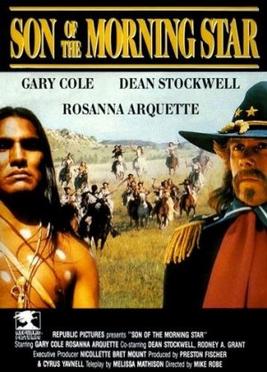
THE BEST CUSTER MOVIE: Son of the Morning Star (1991)


                        “Son of the Morning Star” was an epic made-for-TV miniseries about George Armstrong Custer and the Battle of Little Bighorn.  It aired on CBS in two parts.  It was based on Evan S. Connell’s bestseller.  Part of it was filmed on private property near Little Bighorn National Monument.  A fort was built for $200,000.  400 horses and 150 Native Americans were used.  100 re-enactors participated and served as technical advisers.  CBS considered Kevin Costner to play Custer, but decided that he was not a big enough name at the time.  Ironically, “Dances With Wolves” came out a few months ahead of it.  The movie got low ratings, but won Emmys for Sound Editing, Sound Mixing, Make-up, and Costumes.

                        Spoiler alert:  Custer (Gary Cole) dies in the end.  The movie recognizes that anyone with half an education knows that already and starts (as does Connell’s book) with the aftermath of the defeat.  Capt. Benteen (David Strathairn) sets the theme by stating that “mistakes were made”.  The movie then flashes back to Kansas ten years before the Battle of Little Bighorn.  It is linear from here (unlike the book).  Although it is basically a biopic of Custer, there is an arc for Crazy Horse.  The Custer arc is narrated by Custer’s wife Elizabeth (Patricia Arquette) and Crazy Horse’s is by a Cheyenne named Kate Bighead (narration by Buffy Sainte Marie, role by Kimberly Guerrero).  The two women offer the white and Indian perspectives.  The movie hits the high marks of both men’s careers.  Although the movie is based on Connell’s book, the movie is closer to Stephen Ambrose’s “Crazy Horse and Custer”. 

                        “Son of the Morning Star” is by far the best of the many Custer movies.  It is the opposite of “They Died With Their Boots On”.   The history of the cinematic Custer is one that starts with adulation of Custer as a hero killed by savages (e.g., “They Died…”) to Custer as a villainous poster boy for the mistreatment of Native Americans (e.g., “Little Big Man”).  This movie does not shift the pendulum back, but is more even-handed than recent depictions.  The narration offers a debate between the two views of the man.  Elizabeth Bacon Custer’s is laudatory (which reflects her great literary effort to create his public image after his death) and is in line with movies like “They Died…”  Kate’s is the Native American view and reflects movies like “Dances With Wolves”.  For instance, Kate mentions the unverified claim that Custer had an affair with a Cheyenne woman.  That said, it was probably true.  The movie is amazingly accurate, especially when you compare it to the others.

                        The movie is clearly made-for-TV, but the production values are a bit above the average.  The costumes are excellent and the reenactors and Native Americans brought verisimilitude to their roles.  This reminds me of “Gettysburg” which is a similar movie dealing with a famous battle.  Interestingly, there is a connection between the two.  When “Son” tanked, CBS gave up on its “The Killer Angels” project and Ted Turner picked it up.  The cast here does not match “Gettysburg”.  Gary Cole was criticized for his portrayal of Custer, but I found his megalomaniacal Custer to be realistic.  Custer himself was a bad actor who had delusions of grandeur.  Roseanne Arquette could also be faulted for a weak performance, but Elizabeth was his publicist and worshipped him.  The romance is creepy, as it was in reality.  They clearly were in love and had a partnership which both hoped would end up in the White House.  The supporting cast is TV stock.  David Strathairn was coming off “Memphis Belle” and is excellent as Benteen.  The movie gets the Custer – Benteen dynamic right.  Rodney Grant was in “Dances With Wolves” and does a good Crazy Horse, although given the laconic, mystical nature of the man, it did not require much emoting.

                        The movie flows well as each scene is not allowed to linger.  This is partly due to simplified takes on famous incidents like the Fetterman Massacre.  The movie does an admirable job interjecting the political machinations into the narrative.  The true villains of the movie are Sheridan (Dean Stockwell) and Sherman (George Dickerson) as they manipulate the reluctant Pres. Grant (Stanley Anderson).  These political scenes also allow the movie to show the bipolar nature of Custer as he steps on Grant’s toes by criticizing his Indian policy.  The use of narration to introduce the episodes works well.  It is balanced between the two women and the two viewpoints.  A key moment in the movie is when Elizabeth claims 158 warriors were killed in the Battle of the Washita and Kate admits to 11.  The movie makes it clear that most of the Indian deaths were women and children and Custer was far from holding his men back.  It is reminiscent of the scene in “Little Big Man”.    Most of the combat is saved for an extended recreation of the Battle of Little Bighorn and it is worth the wait.  No movie has better covered the battle.  It is excellent at depicting the chaos of the last stand and although it has to pull its punches, the gore is implied efficiently.  The cinematography is good with some well-positioned slo-mo.  It features some excellent stunt work on horseback.  You will definitely be rooting for the Indians by this point and will be able to list the numerous mistakes that were made.  The movie makes it clear that Custer was a charismatic leader, but not a good one.  There is no question that Crazy Horse is the hero of the movie and Custer is the villain.  Most historians would agree with that.

                        I do not normally consider Westerns to be war movies.  This is one of the rare ones that I put in the war movie genre, because it is the story of a battle.  I am very familiar with the subject as I have read extensively on the Plains Indians, Custer, and the Battle of Little Bighorn.  This movie is as good as you can expect from a made-for-TV production, especially if you want accuracy.  Not only does it recreate many of the seminal moments in Custer and Crazy Horse’s careers, but there are numerous direct quotes filtered in.  It even throws in details that only fanatics like me would recognize, like the regimental flag ominously falling down the night before the battle.

                        The Battle of Little Big Horn has been the subject of many books and a few movies.  Most of the books have tried to offer an explanation for what happened and most of the movies have filmed the legend of Custer’s Last Stand.  This is the first movie to try to be an accurate biopic.  Custer is a fascinating figure and fits well into the modern style of biopics that were inaugurated with “Patton”.  In othe words, we get Custer, warts and all.  And it’s mostly warts.  What makes the film special is not only the accurate depiction of Custer, but the inclusion of a much better role model in Crazy Horse.  “Son of the Morning Star” is an acclaimed (and highly overrated book), but the movie is better and a better history lesson for those not familiar with this very famous battle.  It’s also a great antidote to the ridiculous movies that came before it.  Hopefully, the 21st Century will be marked by this movie’s interpretation of Custer, instead of “They Died With Their Boots On.”

GRADE  =  A    

Saturday, June 20, 2020

MINISERIES: Generation War (2013)


                        “Generation War” is a German miniseries set in WWII.  It is literally entitled “Our Mothers, Our Fathers”.  The series was shown in three parts on German television.  It was well-received, but has created some controversy.  It follows five friends from 1941-1945.

                        Charlotte (Miriam Stein) will become a nurse on the Eastern Front.  She is in love with Wilhelm (Volker Bruch) who is an officer in Russia.  His brother Friedheim (Tom Schilling) is a book-worm who has joined the army and is shipped east.  Greta (Katharina Schuttler) is an aspiring singer.  Her boyfriend is Victor (Ludwig Trepte) who is Jewish.  In June, 1941 in Berlin, the quintet has one last party before their paths diverge.  They make plans to meet again at the end of the war.  Their various paths will converge several times before the war ends because this is a miniseries.  Each character has a different arc.  Greta achieves her fame as a singer by way of an advantageous affair with a Gestapo officer.  Victor gets shipped off to a concentration camp, but escapes to join a Polish resistance group.  Greta works in hospitals where she sees the horrors of the war and worries about Wilhelm.  Wilhelm ends up in a disciplinary battalion.  Friedheim surprises everyone by becoming a warrior.  Not all of them will make that post-war get-together.

                        The series is well-cast with an attractive ensemble.  Each character is distinctive and you care about what will happen to them.  And a lot happens to them.  Some of it is unrealistic as the movie has a small world feel to it.  There are a lot of coincidences.  This was unavoidable given the need to intersect the arcs for narrative purposes.  It gets a bit ridiculous towards the end, however.  All five arcs make sense and take us to some rare cinematic destinations.  Greta in the hospitals.  Victor in the resistance unit.  Wilhelm in a punishment battalion.  Most of what happens is unpredictable which is something of a weakness in the end because none of them should have survived.  The series is clearly anti-war, but it dilutes this with a relatively positive ending.  
  
                        The series shifts between characters seamlessly which means we shift from soap opera (Greta) to medical drama (Charlotte) to partisan warfare (Victor) to combat film (Wilhelm and Friedheim).  The battle scenes are of the new style associated with “Saving Private Ryan”.  For example, Wilhelm suffers from sensory deprivation at one point.  The sets are realistic and the weapons and uniforms seem to be authentic.  These scenes are enough to keep the combat junkies satisfied, but the movie is a traditional war miniseries similar to “War and Remembrance” in that it concentrates more on human interaction rather than combat.

                        The series has been criticized for several theme choices.  Some were upset with the depiction of the Polish resistance as being very anti-semitic.  Victor has to hide his identity from his mates.  The same critics were upset that Victor did not get to the concentration camp. They felt the series did not reference the Holocaust enough.  I would argue that we have enough concentration camp movies and it was a bit refreshing to see Victor fighting the Nazis, instead of being a victim.  Ironically, another criticism is that the series seems to make the Germans the victims.  The four non-Jewish Germans are not typical Germans in that none are Nazi supporters.  The series gives the impression that young Germans were caught up in the flow of a war they did not support.  That anti-Nazi sentiment would not have been common.  These complaints are legitimate, but as entertainment, with some basic education, the series works.

                        “Generation War” is one of the better war miniseries.  Although legitimately criticized for being too sympathetic toward its characters, it is surprisingly harsh for a German production.  You certainly don’t wish you had been in their shoes.  It seems like the right story for our times.

GRADE  =  A-

Wednesday, June 17, 2020

PICTURE, QUOTE, MOVIE QUIZ #85


1.  What movie is this picture from?

2.  What movie is this quote from?

"Well, here I am, anonymous, all right. With guys nobody really cares about. They come from the end of the line, most of them, small towns you never heard of: Pulaski, Tennessee; Brandon, Mississippi; Pork Bend, Utah; Wampum, Pennsylvania. Two years' high school's about it. Maybe if they're lucky, a job waiting for them back in a factory. But most of 'em got nothing. They're poor. They're the unwanted. Yet they're fighting for our society and our freedom. It's weird, isn't it? They're the bottom of the barrel, and they know it. Maybe that's why they call themselves grunts, 'cause a grunt can take it, can take anything. They're the best I've ever seen, Grandma. The heart and soul.”

3.  What movie is this?

The movie is based on the best-seller by Nicholas Monsorrat. Monsorrat  was a Lt. Commander in the Royal Navy in the North Atlantic so the novel was semi-autobiographical.  The HMS Compass Rose was played by the HMS Coreopsis which was on loan to the Hellenic Navy and was due to be disposed of.  The Royal Navy had already disposed of all its WWII era corvettes.  Scenes were shot in the English Channel and the water tank at Denham Studios.  The movie was the biggest hit of 1953 in Great Britain and a surprise hit in America.