Thursday, July 9, 2020

Sunday, July 5, 2020

NOW STREAMING: The Outpost (2020)


                I used to look forward to the occasional war movie opening in theaters.  The rareness of new war movies made those trips to the theater with my note pad special.  I would have to find a seat with some light and sometimes sat in the aisle to use floor lights.  I wonder if those days are over.  I still have not seen “The Last Full Measure” and “Greyhound” has been pushed back.  I may have to get a trial subscription to Apple+ just to see it.  “The Outpost” actually is playing in theaters, but none near me.  I do not know whether I would have gone to see it if it was nearby.  Thankfully, I did not have to.  One effect of the virus is some movies are going straight to streaming.  In this case it costs $7, but that is about what it would cost in a theater and I got to sit comfortably on a non-sticky floor. 
                “The Outpost” is based on Jake Tapper’s book The Outpost:  An Untold Story of American Valor.  Tapper was not embedded like Sebastian Junger in “Restrepo”, but the soldier behavior is authentic due to Tapper doing extensive interviews with the participants.  Rod Lurie (“The Last Castle”) was a good choice as director since he graduated from West Point and served in the Army.  Some of the participants acted as technical advisers and a few even act in the film.  It was filmed in Bulgaria where an accurate mock-up of the post was reconstructed.  The movie got the stamp of approval from Gold Star families who attended a private screening.
                The movie leads with background that basically tells the military history neophytes that locating a base in a valley surrounded by mountains is not a good idea.  Combat Outpost Kamdesh was called “Camp Custer”, but could better have been called “Camp Dien Bien Phu”.  The movie sets the menacing scenario early on with the arrival of new targets by way of a nighttime helicopter ride.  The naïve newbies are informed the choppers don’t dare ingress except on a moonless night.  At daybreak, the camera pans over the surrounding mountains to give the audience a clear idea of the lunacy of locating an outpost there.  Welcome to the Alamo.  Sure enough, at the 6:30 mark, the first shots are fired by Taliban fighters hiding in the rocks on a slope.  And meet the American army in Afghanistan because after the elimination of those insurgents, Staff Sgt. Gallegos (Jacob Scipio) physically abuses sad sack Pfc. Yunger (Alfie Stewart) for firing close to him.  Another soldier has a hashish problem.  However, before you get the impression that the movie is a hit piece on the American military, the movie settles into a realistic portrayal of the dynamics within a unit isolated in a post surrounded by the enemy.  If you haven’t seen “Restrepo”, some might be shocked by how the soldiers talk to each other and interact.  As Specialist Carter (Caleb Landry Jones) complains, it’s like living in a frat house.  His inability to participate in the towel-snapping gets him ostracized.  Those familiar with the modern American army in Iraq and Afghanistan (see “The Kill Team”) will notice that none of these men talk about getting their first kill.  They have more of a Vietnam attitude of just surviving.  Their mission matches their position – hopeless.  Their commanding officer Capt. Keating (Orlando Bloom) tries to implement the strategy of wooing the locals away from the Taliban with infrastructure funds, but it’s a pipe dream and his men know it.  One speaks for all:  “We want their hearts and minds, they want our blood and guts.”  The movie only swipes at the brass, but it is clear the REMFs are clueless and the ROEs are ridiculous.  The cynical view of the counterinsurgency efforts is personified by Staff Sgt. Romesha (Scott Eastwood).  He’s the kind of guy you’re going to need when the shit hits the fan.  That won’t be long because the foreshadowing clearly indicates to fasten your seatbelts.  You’ll need to keep your seatbelt on for 35 minutes of unrelenting combat as you wonder if there will be as many survivors as in the Alamo.
                I usually approach new war movies with some trepidation, especially if I have been waiting for them.  They are so rare that it can be depressing when the promise does not match the product.  Here is one that is worth the wait.  It was intended to pay tribute to the soldiers at Camp Keating and it does so.  The ensemble of mostly unknown actors is excellent and we get a star-making turn by Eastwood.  Orlando Bloom was the box office get and his role reminds of Guy Pearce in “The Hurt Locker” (you’ll see what I mean.)  The actors behave like soldiers.  I do not know if there was a boot camp, but they seem comfortable with the language and the interaction.  If you knew little about American soldiers, you’d mistake hate for love.  This is why the Carter character is crucial.  While a cliched redemption character, he represents the typical soldier who will give his life for a comrade, no matter their relationship.  The best moment in the film comes at the end when a counselor asks him if Mace (the man who he risked his life to save) was his friend and he simply says “no”.  There is some character development, especially Romesha, Yunger, and Carter, but there is a bit of “Black Hawk Down” in the “who was that?” deaths.  (I’m pretty sure the one who shows a picture of his dog dies.  Kudos for tweaking that cliché.)  The enemy is totally faceless, aside for some Afghan elders who look 80, but probably were 40ish.  The fighters are fodder, but there are enough of them and they have mortars and RPGs so the assault is very hairy.
                The movie is basically two parts (although technically it is divided between the various commanding officers).  The first part touches on the hearts and minds strategy and throws in the occasional harassment of the outpost, but it is mainly focused on portraying the lives of the men.  It is very effective at this.  By the time you get to the second part, which is the battle, you do care about the men.  The combat is not quite Korean, but certainly kick-ass.  It is reminiscent of “Danger Close”, but more intimate as the hand-held cameras put us in the thick of it.  Like being in a Humvee under fire.  The deaths are unpredictable and random.  Two of the commanders’ deaths are shocking and that’s before the final battle.  The combat is intense and suspenseful.  You’ll be amazed that these same men who were grabbing ass the night before are risking ass by running through fire to help each other.  We may be sending frat boys overseas, but they step up like a Band of Brothers when the going gets tough.
                I have to admit I was not familiar with the Battle of Kamdesh.  Like most Americans, I have not followed the Afghan War since its early years.  But then, it hasn’t gotten a lot of press coverage since the tennis ball was thrown elsewhere.  This movie was necessary to remind us that there were actual battles after the easy initial conquest of the country.  The battle was a pyrrhic victory in a pyrrhic war.  But that wasn’t the fault of the men of Bravo Troop 3-61 Cavalry.  They did us proud and now their battle is the most famous in the war.
GRADE  =  A
HISTORICAL ACCURACY:   I haven’t read the book yet, but my research indicates the movie is admirably accurate.  The biggest problem is with the compression of time, which is a common fudging in historical movies.  PRT Kamdesh was established in that valley because it was a choke point for Taliban weapons and soldiers.  It was also conveniently located for the counterinsurgency efforts popular at the time.  The movie alludes to the three-part strategy of separating the locals from the insurgents, linking the public to the government, and buying friendship through infrastructure projects.  Keating is used to show this, but Keating’s death occurred a couple of years before the battle.  He did die in a truck accident as shown in the movie.  There were other commanders between him and Yllescas.  Yllescas was mortally wounded by a command detonated IED similar to the movie.  It appears the Broward character was invented to represent blind obedience to the Rules of Engagement and as a foil for Romesha.  Lt. Bundermann was in command on Oct. 3, 2009 when more than 300 insurgents attacked with a variety of weapons including mortars and RPGs.  The mortar pit was taken out.  The enemy did penetrate the perimeter within 48 minutes and the Afghani National Army soldiers did not put up much of a fight before fleeing.  (Think ARVN when you think ANA.)  The movie neglects to mention the Latvian soldiers that also manned the outpost.  It also does not show the fact that the jihadists set fire to several buildings.  The defenders did fall back and it was at this point that Romesha led the counterattack depicted in the movie.  He actually did say “We’re taking this bitch back.”   His Medal of Honor performance is well-portrayed, except it leaves out his role in coordinating air support.  Carter’s arc is also accurate.  He did risk his life carrying ammunition and saved Mace.  Romesha and Carter were the first two soldiers to survive to receive the Medal of Honor in the same battle in over fifty years.  The use of transfusions to keep Mace alive was vetted by Chris Cordova, who was on set for the scenes in the aid station.  The movie downplays the amount of time and effort by the helicopters, A-10s, B-1, and F-15s.  8 Air Force Distinguished Flying Crosses were awarded.  Portis did arrive with the Quick Reaction Force, but it was at nightfall.  Stoney Portis visited the set and admired the authenticity of the recreation.  The reconstruction must have been based on memories since the outpost was hastily destroyed two days later.

Friday, July 3, 2020

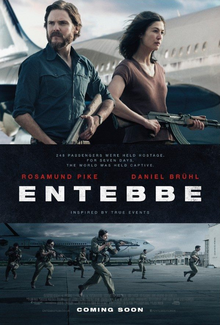
4th TIMES THE CHARM? 7 Days in Entebbe (2018)


                 “7 Days in Entebbe” (also known as “Entebbe”) is the fourth movie to tell the tale of the Israeli raid to rescue hostages held by terrorists in Entebbe, Uganda.  The others were “Victory at Entebbe”, “Raid on Entebbe”, and “Operation Thunderbolt”.  The most recent of those was made over forty years ago.  All are based on Operation Thunderbolt or Operation Entebbe.  This movie was directed by Jose Padhilla.  The screenplay used Saul David’s book Operation Thunderbolt as its source.

                On June 27, 1976, an Air France flight from Tel Aviv to Paris is hijacked by two German terrorists named Wilfried Bose (Daniel Bruhl) and Bridgette Kuhlmann (Rosamund Pike).  They and two Palestinians took over the plane in midflight, taking the crew and over 200 passengers hostage.   They land in Libya to refuel, where Bose allows a woman who feigns a miscarrying pregnancy to be released.  The airliner moves on to Entebbe, Uganda where the terrorists expect support from notoriously anti-Israeli tyrant Idi Amin.  They are not disappointed.  The Jews and non-Jews are separated in the terminal and Bose and Kuhlmann demand that the Israeli government pay $5 million and release 53 prisoners.  Bose is the idealist.  He is not a Nazi!  Kuhlmann is the tougher of the two.  The Israeli government must decide whether to negotiate or rescue.  Prime Minister Yitzhak Rabin and Defense Minister Shimon Peres represent the two options.  Rabin argues for negotiating and Peres is in favor of direct action to free the hostages.  Meanwhile, Bose and Kuhlmann argue reality versus revolution.  You don’t need a spoiler alert to know that the Israeli’s go with the kick-ass commando rescue option.  This means prepare for intercutting between the government deliberations, the treatment of the hostages, and the planning and training for the mission.  The commando arc concentrates on a conflicted soldier and his dancer girlfriend.  The movie builds to the raid which is framed with a modern interpretive dance routine.  This device does separate the film from the other three movies.
                If you are going to make a fourth movie about an historical event, you better bring something new and better to the table.  This movie does not do that.  Since the other three were made soon after the event, you could thank the producers for updating the story and presenting it to an audience that might not be aware of the event.  Unfortunately, “7 Days in Entebbe” squanders its opportunity with stilted story-telling.  It is unengaging.  This is a major flaw in a movie that depicts one of the great raids in history.  It does stick to the facts for the most part, but lacks the suspense that a good documentary would have.  Since its not a documentary, we should get inside the heads of Bose and Kuhlmann.  All we get is the typical psychobabble common to action movies.  Bruhl and Pike are hot actors, but their performances don’t justify their new status.  The passion is not there and it doesn’t help that Bose and Kuhlmann are both written as blah characters.  The back and forth between the government officials is standard fare and boring since we know there will be a raid.  So we spend the whole time waiting for the big payoff.  And it’s not big.

                The biggest problem with movies like this is the more fidelity to the facts, the less entertainment value.  You can go the “Braveheart” route and say to Hell with the historians, or you can go the “Tora! Tora! Tora!” route and be accused of boring your audience.  “Entebbe” leans more toward avoiding artistic license.  This makes the raid commendably accurate, but seemingly easy and unsuspenseful.  And the framing device using the dance is a misfire.  You won’t care about the passengers because none are developed and the cursory attempts to develop empathy for Bose and Kuhlmann is misplaced considering the audience for the movie.  Since 9/11, we don’t want to understand what makes terrorists tick, we want the visceral thrill of seeing the best country in dealing with them do their anti-terrorist thing.

GRADE  =  C-

HISTORICAL ACCURACY:   The movie takes a few liberties with the facts.  Nothing that would cause a historian to foam at the mouth.  Kuhlman was more brutal than the cool customer of the movie.  Bose is accurately depicted personality-wise.  Kuhlmann did not phone her British boy friend from Entebbe.  Rabin and Peres did hold the positions shown in the film.  The chronology is basically as it was.  The takeover was as shown.  One of the passengers did fake a miscarriage to get freed.  The passengers were divided, but it was based on Israeli Jews versus non-Israeli Jews.  The movie perpetuates the myth that the airline crew volunteered to stay with the hostages, when actually they were given no choice.  The planning and training for the raid is realistic.  The main soldier character is fictional, as is his girlfriend.  Choosing to make the soldier a conflicted one is not exactly representing the majority of the commandoes.  They did use a black Mercedes to fool the guards into thinking it was Amin.  Unfortunately, that night the guards were aware that they great leader had switched to a white one, so they challenged the Israelis.  Against orders, and with what could have been disastrous results, the guards were silenced, but this ended the surprise.  The rescue of the hostages was anticlimactic because Bose refused to open fire on the hostages and another terrorist was shot immediately, but not before a hostage was hit in the crossfire.  The other two hostages that died were killed by friendly fire.  The other terrorists, including Kuhlmann, were tracked down in other parts of the terminal.  The firefight with the Ugandan soldiers occurred mainly during the egress.  Some of them were in the control tower as shown.  One of these was the man who killed the mission leader Lt. Col. Yonatan Netanyahu (Benjamin’s older brother).  Netanyahu was not killed early as in the film.  The movie does not depict the destruction of parked MiGs on the airstrip to prevent pursuit.   In a post script not mentioned in the film, the fourth hostage victim was not killed in the raid.  Dora Block had been taken to a hospital because a bone got caught in her throat.  Idi Amin had her murdered in revenge for the success of the mission.   

Wednesday, July 1, 2020

WTF? Frankenstein’s Army (2013)


                “Frankenstein’s Army” is the rare horror war movie.  As though war is not horrible enough, right?  This hybrid of two genres is a Netherlands film that was directed by Richard Raaphorst.  It was his first feature length film.  It stars no one you have ever heard of.  They did not spend the production money on actors.  The movie is of the “found footage” school.  It is reminiscent of “84 Charlie MoPic”.

                The movie starts with a Soviet patrol behind enemy lines in Nazi Germany in the latter days of WWII.  They are accompanied by a documentarian named Dmitri who is filming and interviewing them along the way.  Their mission is to locate the source of a radio distress call from a surrounded Soviet unit.  When they reach the site, they discover a pile of nun corpses.  The nearby church is some type of bizarre factory.  In it they encounter a weird monster which kills their commander.  Dmitri reveals that the real mission is to find and capture a Nazi scientist who is creating “zombots” for Hitler.  The monsters come in a wide variety and are increasingly jawdropping.  Some that were featured included:  wall zombot, crypt monster, moxquito, machete, dragger, propellerhead, grinder, and razor teeth.  There is one with a propeller for a face.  All of them are belligerent.  The basement of the “factory” is a maze in the best tradition of a cinematic haunted house.  The claustrophobic setting lends itself to some gonzo action scenes.  Doctor Frankenstein (a descendant of you know who) is moving on to an experiment that attempts to combine the brain of a Nazi and the brain of a communist.  What could be worse?  Let me suggest the combining of the brain of a war movie lover with that of a horror movie fan.

                “Frankenstein’s Army” is a throwback to the old drive-in movies.  It is weird and different.  And entertaining if you are of the right frame of mind.  Since I do not watch a lot of found footage movies, I found the POV to be intriguing.  Without it, the movie would have been nothing special.  Oh, that and the monsters.  Amazingly, no CGI was used to create the creatures.  Whoever designed them must be hell to sleep with.  One thing is for sure – most of the budget was spent on the monsters.  Little was left for the cast.  The actors are stiffer than the creatures.  The movie does not bother with character development, but who cares when you have such cool monsters?  Although the movie fits into the “who will survive?” subgenre, I did not care who would survive.  And that was not because they were godless communists.  The movie makes up for plot with gore and violence.  It is pretty graphic and bloody.  For example, Dr. Frankenstein removes the skull of a living person and then plays with the brain.  Don’t eat anything while watching this movie!  You really can’t ask for much from a movie like this, but it could have used a little humor to add to the camp value.  It takes itself a bit too seriously.  I guess the director did not want death threats from the zombotics.  On the surprising side, it is not very clicheish or predictable.  It could care less about females, children, or rabbits in distress.

                I rewatched “Frankenstein’s Army” since I recently watched the similarly plotted “Overlord”.  It is the better movie, although it did not get a major release and was not associated with JJ Abrams.  It is simply more fun and horrific.  I could not believe what I was seeing most of the time. 

Grade =  B