Showing posts with label Taliban. Show all posts

Sunday, July 5, 2020

NOW STREAMING: The Outpost (2020)


                I used to look forward to the occasional war movie opening in theaters.  The rareness of new war movies made those trips to the theater with my note pad special.  I would have to find a seat with some light and sometimes sat in the aisle to use floor lights.  I wonder if those days are over.  I still have not seen “The Last Full Measure” and “Greyhound” has been pushed back.  I may have to get a trial subscription to Apple+ just to see it.  “The Outpost” actually is playing in theaters, but none near me.  I do not know whether I would have gone to see it if it was nearby.  Thankfully, I did not have to.  One effect of the virus is some movies are going straight to streaming.  In this case it costs $7, but that is about what it would cost in a theater and I got to sit comfortably on a non-sticky floor. 
                “The Outpost” is based on Jake Tapper’s book The Outpost:  An Untold Story of American Valor.  Tapper was not embedded like Sebastian Junger in “Restrepo”, but the soldier behavior is authentic due to Tapper doing extensive interviews with the participants.  Rod Lurie (“The Last Castle”) was a good choice as director since he graduated from West Point and served in the Army.  Some of the participants acted as technical advisers and a few even act in the film.  It was filmed in Bulgaria where an accurate mock-up of the post was reconstructed.  The movie got the stamp of approval from Gold Star families who attended a private screening.
                The movie leads with background that basically tells the military history neophytes that locating a base in a valley surrounded by mountains is not a good idea.  Combat Outpost Kamdesh was called “Camp Custer”, but could better have been called “Camp Dien Bien Phu”.  The movie sets the menacing scenario early on with the arrival of new targets by way of a nighttime helicopter ride.  The naïve newbies are informed the choppers don’t dare ingress except on a moonless night.  At daybreak, the camera pans over the surrounding mountains to give the audience a clear idea of the lunacy of locating an outpost there.  Welcome to the Alamo.  Sure enough, at the 6:30 mark, the first shots are fired by Taliban fighters hiding in the rocks on a slope.  And meet the American army in Afghanistan because after the elimination of those insurgents, Staff Sgt. Gallegos (Jacob Scipio) physically abuses sad sack Pfc. Yunger (Alfie Stewart) for firing close to him.  Another soldier has a hashish problem.  However, before you get the impression that the movie is a hit piece on the American military, the movie settles into a realistic portrayal of the dynamics within a unit isolated in a post surrounded by the enemy.  If you haven’t seen “Restrepo”, some might be shocked by how the soldiers talk to each other and interact.  As Specialist Carter (Caleb Landry Jones) complains, it’s like living in a frat house.  His inability to participate in the towel-snapping gets him ostracized.  Those familiar with the modern American army in Iraq and Afghanistan (see “The Kill Team”) will notice that none of these men talk about getting their first kill.  They have more of a Vietnam attitude of just surviving.  Their mission matches their position – hopeless.  Their commanding officer Capt. Keating (Orlando Bloom) tries to implement the strategy of wooing the locals away from the Taliban with infrastructure funds, but it’s a pipe dream and his men know it.  One speaks for all:  “We want their hearts and minds, they want our blood and guts.”  The movie only swipes at the brass, but it is clear the REMFs are clueless and the ROEs are ridiculous.  The cynical view of the counterinsurgency efforts is personified by Staff Sgt. Romesha (Scott Eastwood).  He’s the kind of guy you’re going to need when the shit hits the fan.  That won’t be long because the foreshadowing clearly indicates to fasten your seatbelts.  You’ll need to keep your seatbelt on for 35 minutes of unrelenting combat as you wonder if there will be as many survivors as in the Alamo.
                I usually approach new war movies with some trepidation, especially if I have been waiting for them.  They are so rare that it can be depressing when the promise does not match the product.  Here is one that is worth the wait.  It was intended to pay tribute to the soldiers at Camp Keating and it does so.  The ensemble of mostly unknown actors is excellent and we get a star-making turn by Eastwood.  Orlando Bloom was the box office get and his role reminds of Guy Pearce in “The Hurt Locker” (you’ll see what I mean.)  The actors behave like soldiers.  I do not know if there was a boot camp, but they seem comfortable with the language and the interaction.  If you knew little about American soldiers, you’d mistake hate for love.  This is why the Carter character is crucial.  While a cliched redemption character, he represents the typical soldier who will give his life for a comrade, no matter their relationship.  The best moment in the film comes at the end when a counselor asks him if Mace (the man who he risked his life to save) was his friend and he simply says “no”.  There is some character development, especially Romesha, Yunger, and Carter, but there is a bit of “Black Hawk Down” in the “who was that?” deaths.  (I’m pretty sure the one who shows a picture of his dog dies.  Kudos for tweaking that cliché.)  The enemy is totally faceless, aside for some Afghan elders who look 80, but probably were 40ish.  The fighters are fodder, but there are enough of them and they have mortars and RPGs so the assault is very hairy.
                The movie is basically two parts (although technically it is divided between the various commanding officers).  The first part touches on the hearts and minds strategy and throws in the occasional harassment of the outpost, but it is mainly focused on portraying the lives of the men.  It is very effective at this.  By the time you get to the second part, which is the battle, you do care about the men.  The combat is not quite Korean, but certainly kick-ass.  It is reminiscent of “Danger Close”, but more intimate as the hand-held cameras put us in the thick of it.  Like being in a Humvee under fire.  The deaths are unpredictable and random.  Two of the commanders’ deaths are shocking and that’s before the final battle.  The combat is intense and suspenseful.  You’ll be amazed that these same men who were grabbing ass the night before are risking ass by running through fire to help each other.  We may be sending frat boys overseas, but they step up like a Band of Brothers when the going gets tough.
                I have to admit I was not familiar with the Battle of Kamdesh.  Like most Americans, I have not followed the Afghan War since its early years.  But then, it hasn’t gotten a lot of press coverage since the tennis ball was thrown elsewhere.  This movie was necessary to remind us that there were actual battles after the easy initial conquest of the country.  The battle was a pyrrhic victory in a pyrrhic war.  But that wasn’t the fault of the men of Bravo Troop 3-61 Cavalry.  They did us proud and now their battle is the most famous in the war.
GRADE  =  A
HISTORICAL ACCURACY:   I haven’t read the book yet, but my research indicates the movie is admirably accurate.  The biggest problem is with the compression of time, which is a common fudging in historical movies.  PRT Kamdesh was established in that valley because it was a choke point for Taliban weapons and soldiers.  It was also conveniently located for the counterinsurgency efforts popular at the time.  The movie alludes to the three-part strategy of separating the locals from the insurgents, linking the public to the government, and buying friendship through infrastructure projects.  Keating is used to show this, but Keating’s death occurred a couple of years before the battle.  He did die in a truck accident as shown in the movie.  There were other commanders between him and Yllescas.  Yllescas was mortally wounded by a command detonated IED similar to the movie.  It appears the Broward character was invented to represent blind obedience to the Rules of Engagement and as a foil for Romesha.  Lt. Bundermann was in command on Oct. 3, 2009 when more than 300 insurgents attacked with a variety of weapons including mortars and RPGs.  The mortar pit was taken out.  The enemy did penetrate the perimeter within 48 minutes and the Afghani National Army soldiers did not put up much of a fight before fleeing.  (Think ARVN when you think ANA.)  The movie neglects to mention the Latvian soldiers that also manned the outpost.  It also does not show the fact that the jihadists set fire to several buildings.  The defenders did fall back and it was at this point that Romesha led the counterattack depicted in the movie.  He actually did say “We’re taking this bitch back.”   His Medal of Honor performance is well-portrayed, except it leaves out his role in coordinating air support.  Carter’s arc is also accurate.  He did risk his life carrying ammunition and saved Mace.  Romesha and Carter were the first two soldiers to survive to receive the Medal of Honor in the same battle in over fifty years.  The use of transfusions to keep Mace alive was vetted by Chris Cordova, who was on set for the scenes in the aid station.  The movie downplays the amount of time and effort by the helicopters, A-10s, B-1, and F-15s.  8 Air Force Distinguished Flying Crosses were awarded.  Portis did arrive with the Quick Reaction Force, but it was at nightfall.  Stoney Portis visited the set and admired the authenticity of the recreation.  The reconstruction must have been based on memories since the outpost was hastily destroyed two days later.

Saturday, January 20, 2018

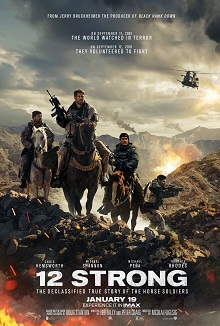
NOW SHOWING: 12 Strong (2018)


                Jerry Bruckheimer produced “Pearl Harbor” and “Black Hawk Down”.  Let’s see where on that spectrum “12 Strong” falls.  The full title of the movie is “12 Strong:  The Classified True Story of the Horse Soldiers” and it is based on the book by Doug Stanton entitled Horse Soldiers.  It was Nicholas Fuglsig’s directorial debut.  The movie is the “true story” of the first Americans into Afghanistan after 9/11.

                The movie leads off with footage of previous terrorist bombings before 9/11.  Capt. Mitch Nelson (Chris Hemsworth) and his Green Beret team are tasked for Afghanistan to get revenge and stop another 9/11.  It’s time to break the news to the ladies.  Chief Warrant Officer Spencer (Michael Shannon) has the wife who is upset that he chooses his career over his family.  “I’ll love you when you get back”.  Sgt. Diller has the wife that pretends she’s okay with it.  She refuses pre-war sex.  “It’s the only way I can make sure you’re coming back”.  Nelson has the supportive soldier’s wife.  “I don’t care how long you’re gone as long as you come back.”  They reach a secret base in Uzbekistan and are briefed (key word brief) on the mission.  They are to link up with a Northern Alliance warlord named Dostum and his militia.  They will facilitate his assault on the Taliban stronghold of Masar-e-Sharif by calling in air strikes.  Nelson briefs his men on the suicide mission against potentially 50,000 bad guys and they are all on board.  Why not, they got nothin’ better to do.  He promises them “I ain’t losing one man.”  We’ll see about that.  A hairy Chinook ride (“the reason why the Army uses Chinooks is so we’ll be good and mad when we go into combat”) places them at an outpost ominously called The Alamo.  The next day, Dostum arrives on horseback.  Surprise!  He and Nelson have different philosophies of war and will have to gain mutual respect through the crucible of battle.    Although only Nelson is experienced with horses, the Americans ride off into history.  They are only supposed to call in air strikes, but pressure from the audience will result in them getting their hands dirty.  And result in the deaths (but not woundings) of numerous hajjis.

                It is hard to review a movie like “12 Strong” because to truly give readers a feel for its flaws I would have to give away much of the plot.  It’s the type of “true story” that leaves you craving the facts to clear up all the head-scratching moments.  I have seen enough war movies to know that sometimes the seemingly most ridiculous things are actually true.  However, the vast majority of the time that I have shaken my head (or laughed out loud), it was because a scene was indeed too good to be true.  “12 Strong” has a very high WTF quotient.  Obviously, there were horses involved.  There is the book and the statue at Ground Zero of a horse soldier to back that up.  However, it is hard to believe that horse rookies could do what these characters do.  I know people will argue “artistic license” and the non-war movie purists will just go with the Bruckheimer flow.  I assume the intended audience will be entertained.  Unless you are discerning about war movie clichés.

                The movie certainly does not break any new ground.  In fact, it assumes we are familiar with old ground.  Some of the clichés are cursory because we know them so well why bother wasting screen time.  The three wives represent the three stereotypes.  They get their minute and then bookend the movie with another minute. One of the men gets a sidekick but he is just there to remind us of “Short Round”.   At least the unit is not stereotyped, because the movie has no time to develop any other than Nelson, Spencer, and Diller.  I assume one of the others is from Brooklyn, but all I know is one wears glasses and another is black.  Nelson is the stereotypical green officer who will have to earn the respect of his battle-hardened crew.   Spencer is the wise noncom.  Diller is the flippant everyman.  Dostum is a fairly interesting character.  He gives us the Afghan perspective and you understand why he is skeptical of the American sticktoativeness.  Unfortunately, the screenwriter makes him a sage.  He’s like a Native American in a modern Western.  In fact, the horses are not the only element that reminds of a cowboy movie.  There is a charge straight out of “She Wore a Yellow Ribbon”.  There is a villain like Magua from “Last of the Mohicans”.  To establish his extreme hissability, he executes a teacher of girls.  This Bin Laden lookalike wears a very redundant black and sticks around for the classic showdown with Dostum.

                People will go to see the movie for two reasons:  Chris Hemsworth and combat.  A teenage girl walked into the theater and at first I thought she was in the wrong place and then I remembered who the star was.  He is pretty good, but the role is unchallenging.  He suffers no real command anguish and is always right.  The combat is surprisingly unengaging.  There is plenty of ammo expenditure and plenty of hajji slaughtering, but I think we are beyond cheering that.  Do we also have to be reminded that Special Operatives are killing machines?  Hell, these guys not only are able to ride horses competently with little instruction beyond point its head in the direction you want to go, but they can accurately mow down bad guys while charging.  They don’t need to be able to reload at full gallop, thankfully.  It’s a movie!  Bruckheimer must have looked over Fuglsig’s shoulder to make sure even the kitchen sink got in.  There are certainly lots of explosions.  In fact, the big “here we go” moment comes when a B-52 is brought in, but this results in a very underwhelming air strike for anyone familiar with how devastating those could be.  But then, what fun would it be if all the Taliban were vaporized from above.  Strangely, the movie gives the bad guys tanks and then only one round is fired.  You see what I meant by WTF?

                 For a war movie lover, fidelity to the facts can overcome clichés and silliness.  I have not read the book yet (so I’ll be reposting in the future), but my research has so far confirmed my concerns.  Basically, the gist of the story is true.  ODA 595 was inserted with the mission outlined in the movie.  The Americans did call in air support that was instrumental in the capture of Mazar-e-Sharif.  They did travel on horses and face terrible odds.  The names of the team members were changed (for no good reason), and only Nelson (Mark Nutsch) and Spencer (Joe Jung) were in the unit.  Dostum is a real person and although probably not a sage, is pretty close to the side-switching warlord.  I seriously doubt the villainous Rezzan killed his family.  Nutsch has stated that the movie is close enough, but his description of the action as “artistic license” is a big red flag.  I don’t question the bravery and accomplishments of the men, but the combat is unbelievable and unrealistic.

                 In conclusion, I will remind you that my reviews are of war movies by a war movie lover.  Some will see this movie and find it entertaining, which is fine.  But I warn war movie lovers that they may find it disappointing.  It does a service by telling the story of the first heroes of Operation Enduring Freedom, but it lays it on too thick.  No matter what your feelings are about artistic license, war movie lovers may also be disappointed by the lazy reliance on clichés. Still, it is the rare war movie that makes it to the screen these days.  We have to take what we can get.  It would be nice if the theater-going matched the anticipation.  Come on “Seven Days in Entebbe”, don’t let me down!


GRADE  =  C


Sunday, December 19, 2010

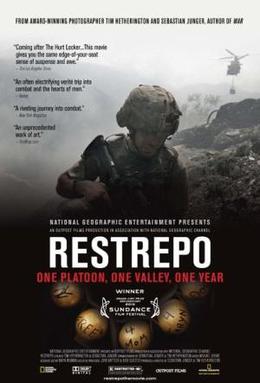
MODERN CLASSIC? "Restrepo"

    
     “Restrepo” is the movie companion to the acclaimed best seller “War” by Sebastian Junger. Junger was a reporter who embedded with an infantry platoon in Afghanistan in 2007-8 to get an eyewitness look at the fighting. What came out of his experience is a grunts-eye view of the war that takes the viewer into a very foreign world where American boys are fighting a forgotten war. If you feel guilty about having forgotten about their sacrifices or if you want to know what is going on over there, you should watch this outstanding documentary.


     The movie is seen through the eyes of the cameramen (Junger and Tim Hetherington) who lived with the soldiers interspersed with frequent interviews with the troops after they got back. The men belong to the Second Platoon, Battle Company, 2nd Battalion, 503rd Infantry Regiment which was sent to the most dangerous place in Afghanistan – the Korengal Valley. They were deployed for 15 months and three of them did not come back including Juan “Doc” Restrepo. Their mission was to provide security for a road-building project that would benefit the obviously ungrateful residents. But based on the book and film, it is apparent their mission was to deprive the Taliban of control of the valley and kill as many of them in the process as possible.

     The movie is intense and personal. You have to admire the cameraman who was right there with the soldiers when they were taking fire. In fact, early in the movie we get an inside the Humvee view of what it is like to be blown up by an IED. Most of the action takes place at an outpost named after their beloved medic Restrepo. The commander named Kearny comes off as an intelligent officer who is trying to rectify mistakes made by the previous leadership which now make it harder to win “hearts and minds”. His decision to establish Outpost Restrepo turns the tide in the valley. (In a postscript, it is revealed that after all the effort in the area, the Army abandoned the valley. See “Hamburger Hill”.)

     Here are some of the things you will learn: 1. Afghanistan is a beautiful country with some truly ugly men. 2. The volunteer army concept is working. These boys are much more motivated than Vietnam War soldiers filmed under similar circumstances in 1969 would have been. 3. One of our main tactics is to make contact by drawing enemy fire. Sucks to be the guy who draws the fire. 4. If you want Americans to expend one thousand rounds, fire a few shots into their compound. 5. Life in an outpost can be so boring that you look forward to fire-fights. One soldier described fire-fights as like crack. 6. We are spending billions of dollars in Afghanistan, but we won’t pay for a farmer’s cow that “wandered into the barbed wire” and became steak. 7. Soldiers in Afghanistan do not curse as much as I thought. 8. This country and our army are not prepared mentally for losses comparable to Vietnam, much less WWII. The platoon lost “only” three men in 15 months, but because of the bonding, the deaths were gut-wrenching. 9. Being reasonable with Afghani elders is probably not going to work. 10. It is possible to make a realistic, informative movie about the war in Afghanistan without taking a political stand.

GRADE  =  A