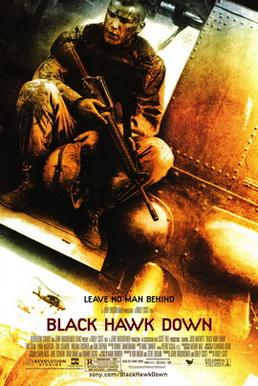
BACK-STORY: “Black Hawk Down” is a film by Ridley Scott (“Kingdom of Heaven”) based on the
bestseller by Mark Bowden. Bowden wrote
the definitive history of the Battle of Mogadishu and the events surrounding
it. Ken Nolan adapted the book with
input from Bowden. The movie was filmed
in Morocco. The Pentagon cooperated with
helicopters and even provided Rangers to do the fast roping (some of whom had
been in the battle). The movie was a
critical and financial success. It won
Oscars for Editing and Sound and was nominated for Cinematography and Director.
OPENING: The movie is “based on an actual
event”. A crawl describes the situation
in Somalia leading into the battle.
Scott leads with a quote from Plato:
“Only the dead have seen the end of war.” 300,000 civilians had died in a famine causing
the United Nations to send in food shipments.
20,000 Marines were inserted to protect the shipments and the starvation
was brought under control. When the
Marines were withdrawn, a local war lord named Aidid who had dreams of ruling
Somalia began to make war on the UN peacekeepers. When 24 Pakastani’s were killed, the U.S.
State Department pushed through a UN resolution calling for the arrest of
Aidid. Pres. Clinton sent Task Force
Ranger to accomplish the mission. It
consisted of Rangers and Delta Force and was led by Gen. Garrison (Sam
Shepard).
SUMMARY: On Oct. 2, 1993, a Black Hawk
helicopter witnesses some of Aidid’s militia opening fire on a crowd at a food
distribution center. The Americans can’t
intervene due to their rules of engagement.
Later that day, a Delta Force team arrests one of Aidid’s inner
circle. When Garrison interviews Atto,
he is told the situation is “a civil war.
This is our war.” Garrison responds
that “300,000 dead is not a war, it’s genocide.” This exchange encapsulates the views of the
two sides.
A
barracks scene introduces us to the main characters. Little snippets of conversation and
activities to personalize them a bit.
The Rangers and the D-Boys (Delta Force) are housed together in a hangar. There is a vibe that the D-Boys are
undisciplined and not team players, but totally bad ass. Sgt. Eversmann (Josh Hartnett), one of the
Rangers, makes a case for viewing the Somalis with some sympathy. The rest of the banter makes it clear that
most of the Rangers are uninterested in the big picture and look forward to
combat in a naïve, prove your manhood way.
On
Oct. 3, a breakthrough occurs when an informant is prepared to finger two more
of Aidid’s people. Garrison outlines the
mission to the various leaders (and the audience). The best laid plans… Lt. Col. McKnight (Tom Sizemore) points out
some possible problems: daytime negates
America’s huge night vision advantage, no armor will be included, they will be
going into Aidid’s turf, and the “skinnies’ will be high on katt (the national
“I don’t give a shit if I’m shot” drug).
No worries. We’re Americans and
it will only take 30 minutes. What could
go wrong? Shit flows down as most of the
force dispenses with extra water, night vision goggles, or body armor. What could go wrong? The preparation montage includes three dead
meat cliches. One Ranger insists on
leaving a “death letter” with a friend.
Another calls home but has to leave a message on the answering machine. A third removes his back armor because he
feels its just extra weight and it’s only a thirty minute jaunt.
 |
| Black Hawks coming |
 |
| Blackburn down |
Just when things could not be worse, a second Black Hawk is hit by an RPG and goes down. Two Delta snipers volunteer to protect whoever has survived. When Schugart (Johnny Strong) and Gordan (Nikolaj Coster-Waldau) arrive, only one of the pilots named Durant (Ron Eldard) is still alive. Skinnies are closing in and the odds are not favorable, to say the least. It’s three against hundreds. Schugart and Gordon do not go down easy and Durant is taken captive.
Just when things could not be worse, a second Black Hawk is hit by an RPG and goes down. Two Delta snipers volunteer to protect whoever has survived. When Schugart (Johnny Strong) and Gordan (Nikolaj Coster-Waldau) arrive, only one of the pilots named Durant (Ron Eldard) is still alive. Skinnies are closing in and the odds are not favorable, to say the least. It’s three against hundreds. Schugart and Gordon do not go down easy and Durant is taken captive.
As
darkness closes in, it is determined that the convoy should return to base and
the Alamo will have to hold out until an armored column provided by the 10th
Mountain Division and UN forces can bash its way to the first crash site. This also means no medevac for Cpl. Smith
(Charlie Hofheimer) who is bleeding out.
The fighting continues with Little Bird helicopter gunships helping keep
the Somalis at bay.
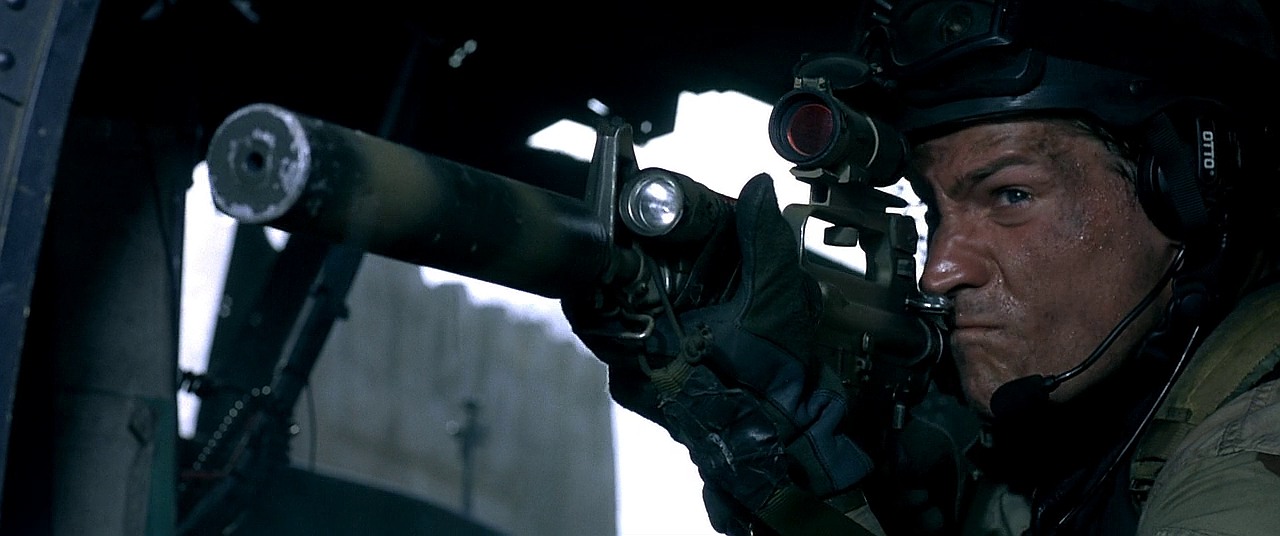 |
| Gordan is Medal of Honor bound |
CLOSING: McKnight leads the UN relief
column to the first crash site.
Withdrawal is postponed in order to extract the body of the pilot
Wolcott (Jeremy Piven). No man left
behind. On the way back, a group of
soldiers including Eversmann, Steele, and Sanderson have to come in on
foot. They run to the sanctuary of the
soccer stadium where they are greeted by Pakistanis with trays of water. Hoot (Eric Bana), a hard core Delta
operative, prepares to go back into the city.
He tells Eversmann that the public “won’t understand why we do
this…. It’s about the man next to
you.” Eversmann says good bye to
Smith. Nobody wants to be a hero, it
just works out that way.
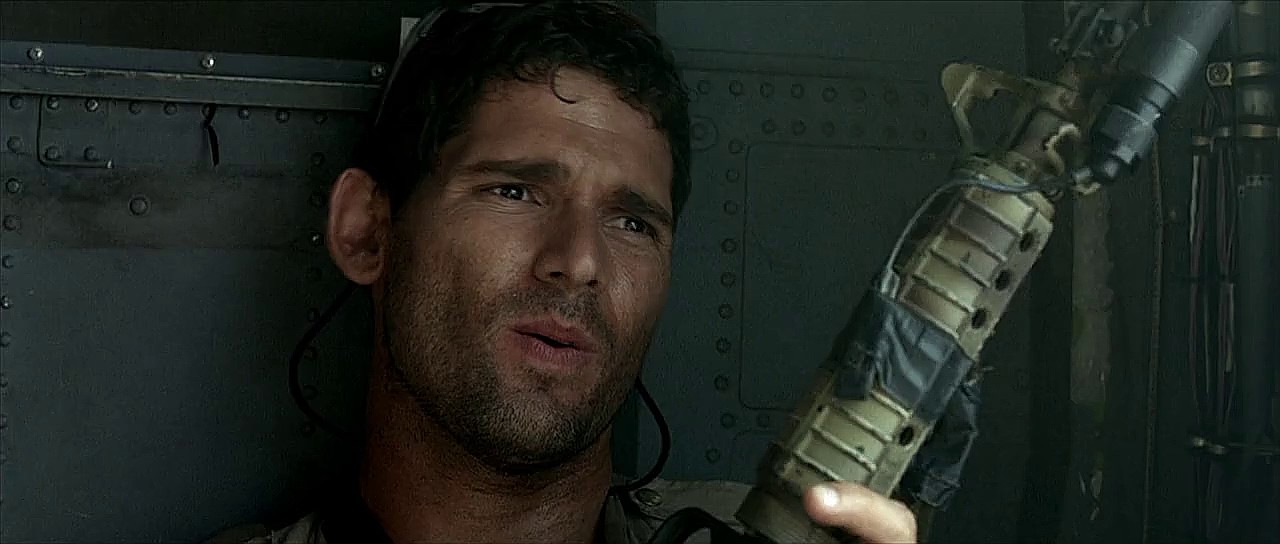 |
| Hoot about to shoot a boor |
RATINGS:
Action 10/10
Acting A
Accuracy A
Plot A
Realism A
Cliches B
Overall A+
WOULD CHICKS DIG
IT? It is definitely
oriented toward males. There is a
tremendous amount of testosterone in it.
The actors are mostly Hollywood hunks, but check whether your
significant other is fascinated by hockey players. That’s the closest equivalent to how much of
them you can see to distinguish the person.
Not a single woman speaks in the film.
There is no romance. There is a
lot of bromance. However, if your girl
is a war movie tolerator, cares about history, or likes action movies, give it a
try. Just be prepared to have to watch
“The Notebook” in retaliation.
HISTORICAL
ACCURACY: When I first saw
the movie in the theater and then read the book, I thought it was the most
accurate war movie I had ever seen. The
research I have done for this post has caused me to back off a little bit on
that. There are inaccuracies, but they
are all explainable and acceptable in a Hollywood context. Nolan and Scott did an admirable job trying
to adhere to the book.
The
crawl at the beginning explaining the situation is spot on. The Rangers/Delta dynamic is substantially as
it was, but the movie overplays the rivalry a bit. In reality, most of the Rangers admired the
Deltas. There was a conflict between the
by the book Steele and the Delta Force commanders (embodied in the fictional
Sanderson). The mission as outlined by
Garrison was correct. The various
potential problems questioned by McKnight and the mistakes made by the
individual soldiers with regard to gear are realistic. Interestingly, other than the brief mention
by McKnight, the film does not show that a large number of the Somali men were
high on katt and correspondingly unconcerned for their lives.
The
ingress and taking of the suspects is accurate.
Blackburn’s fall, Pilla’s death, and Wolcott’s crash all happened as
shown in the film. The plight of the
convoy is realistic. The movie downplays
the confused meanderings for time reasons.
The movement of Chalk 4 / Delta / Rangers to the first crash site is
acceptably handled. The crash of
Durant’s bird and the actions of Schugart and Gordon are very well
reenacted. The movie leaves out the
support from above by gunships.
Similarly, other than the one awesome run during the night stand at the
Alamo, the nonstop efforts of the Little Birds in holding off the skinnies is
skipped.
Probably
the biggest fudging occurs towards the end (see “We Were Soldiers”). McKnight did not lead the relief column and
when it arrived, the crash site was under control and not under fire. The “Mogadishu Mile”was exaggerated because
in actuality they did not run all the way to the stadium.
The
biggest discrepancies with the true story is with the characters. There are about 100 named American soldiers
in the book. The movie pares this down
to 39 which is totally understandable.
It was necessary to create composite characters, again for good
reason. The most important is
Eversmann. The movie needed a “star” and
Josh Hartnett (coming off “Pearl Harbor”) was tapped. Eversmann was a good choice for this role,
but when the convoy left the Olympia Hotel he and Chalk 4 were on board. It was Chalk 2, led by a Sgt. DiTomasso, that
moved to the crash site. Some of his men
got separated, including Twombly and Yurek, but Nelson (the deafened guy) was
with DiTomasso. Almost all of the Delta
guys have fictional names for security reasons, but they seem to be based on
actual operatives. Hoot is mainly
fictional for narrative purposes (to act as a point of view), but is loosely
based on an amazing warrior named Macejunas.
The
most interesting (and tragic) adjustment was for the Grimes (Ewan McGregor)
character. He was based on Johnny
Stebbins who was a clerk that was thrust into the mission (although in reality
he was eager to join). Stebbins, like
Grimes, seemed to attract RPGs. He
earned a Silver Star. The name was
changed because before production, Stebbins was convicted of child abuse.
For
more on the accuracy, see my “History or Hollywood: Black Hawk Down” list. As a preview, almost all the small
interesting details in the movie are true.
Ex. the severed hand with the
watch.
CRITIQUE: Ridley Scott when he has the
right script (“Gladiator”, “Alien”, “Blade Runner”) can be a great
director. He was on his game for this
film. It is hard to imagine the movie being
better made. The cinematography by
Slawomir Idziak is amazing. Academy
Awards went for Sound and Editing. The
choice to use the cities of Rabat and Sale in Morocco to stand in for Mogadishu
was inspired. Many of the veterans
remarked about how much the sets looked like the real thing. (Although given the food problem, it is
doubtful that the Mog had hundreds of dogs running around. Watch the movie again.) The effects are incredible and surprisingly
done without a surfeit of CGI. It is
impossible to tell where CGI is used.
Most of the helicopter stunts are real and showcase the amazing skills
of the Night Stalkers.
The
score by Hans Zimmer is excellent. He
blends two opposing strains. There is a
techno sound to support the American scenes and North African music
representing the Somalis. In some
scenes, like the opening food distribution scene, the two styles meld to stark
effect. Overall, the soundtrack is one
of the great war movie soundtracks.
The
acting is top notch from what appears to be an all-star cast. However, at the time it was not a who’s who
list, it was a who’s gonna be who list.
Aside from Shepard and Sizemore, the young cast was on the cusp of
stardom. One fun thing about the movie
is recognizing the future stars. One problem
with the movie is you really have to look carefully. It is not easy to distinguish between the
characters even with names inauthentically added to their helmets. The movie rewards multiple viewings. On the plus side, no one really stands out
because no one embarrasses themselves.
All of the performances are solid.
As per a modern war movie, the actors went through “boot camp” type
experiences. They move and behave like
soldiers.
The plot has come under some criticism for lack of character development. This is a misguided condemnation. The fact is that the film was meant to be about the soldiers, not about a few individuals. It did not have the same purpose as “Platoon”, for instance. The closest equivalent that comes to mind is “Pork Chop Hill”. It is hard to do an accurate account of a battle (which is clearly the intention of the film) and also develop the characters. You would need a miniseries to do that (like “Generation Kill”). In spite of time constraints, BHD does sufficient character introductions in the barracks scene. Originally the movie was supposed to start with the mission so it could have been even less character driven. Quit complaining.
The plot has come under some criticism for lack of character development. This is a misguided condemnation. The fact is that the film was meant to be about the soldiers, not about a few individuals. It did not have the same purpose as “Platoon”, for instance. The closest equivalent that comes to mind is “Pork Chop Hill”. It is hard to do an accurate account of a battle (which is clearly the intention of the film) and also develop the characters. You would need a miniseries to do that (like “Generation Kill”). In spite of time constraints, BHD does sufficient character introductions in the barracks scene. Originally the movie was supposed to start with the mission so it could have been even less character driven. Quit complaining.
Another criticism is of the lack of coverage of the Somali point of view. This is also unfair. Considering the movie is a tribute to the American soldiers, it is asking too much that the enemy be given equal treatment. They could have easily been demonized (and perhaps should have been), but the movie is sympathetic in a fair way. One of the militiamen (‘sunglasses guy”) is featured in several scenes and gets to shoot down the first Black Hawk. (He also gets a crowd-pleasing demise.) Another interrogates Durant and forcefully represents the Somali point of view. He also gets the best line when Durant turns down a cigarette. “That’s right. None of you Americans smoke anymore.” Overall, the Somalis are depicted as worthy foes. The movie does not portray them as katt-crazed nuts (which many were). It also does not show the use of women and kids as human shields.
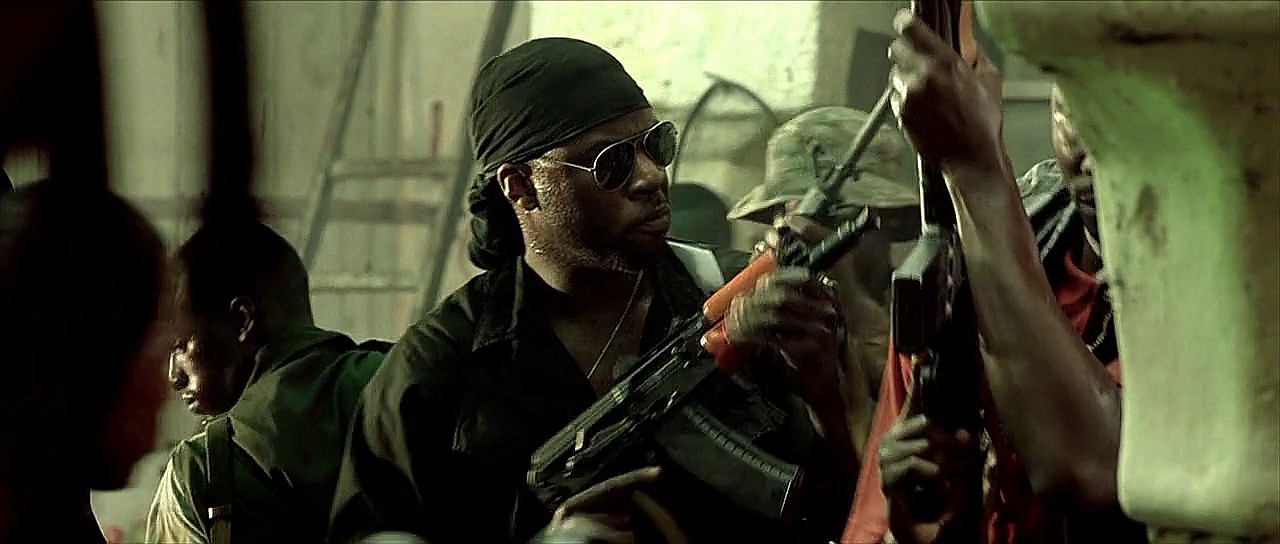 |
| Sunglasses Guy |
The
biggest strength of the movie is it gets the military ethos right. It was meant to be a tribute to the
participants and that mission was accomplished.
The families of the dead were given some closure. Schugart and Gordon, in particular, deserved
this film. The film has been wrongly
labeled pro-war. That is ridiculous. It is pro-military, however. Obviously the Pentagon felt that way
considering the immense cooperation.
That is not to say that the military got a puff piece. The movie does not sugarcoat the mistakes
that were made, but it does not bludgeon us with them either. I would hope the movie is required viewing at
West Point. God forbid the military should
learn from its mistakes. (Interestingly,
although the Pentagon truthfully insists the mission was successful, the movie
does not convey that.) Significantly,
the movie also does not take a stand on the policy of sending Task Force Ranger
to Somalia. Or the Clinton decision to
turn tail and run after the battle.
CONCLUSION: This movie belongs in the top ten
war movies of all time. It is also in
the top ten most accurate war movies of all time. It has many of the things I look for in a war
movie for it to be considered great and important. It accurately tells a story that needed to be
told (ex. “The Great Raid”), it memorializes soldiers who deserved the
accolades (ex. “We Were Soldiers”), it is realistic in tactics and soldier
behavior (ex. “ A Walk in the Sun”), and it is entertaining. It is hard to get those first three and also
arrive at the fourth. You may have
noticed that I grade war movies on action using a scale of 1-10. Surprisingly, many war movies do not have a
lot of action per running time. Once the
mission begins, BHD is almost continuous action. And it’s true, not bull crap.
P.S. There are
three things I take away from this movie.
1. America (and the military)
puts a very high premium on soldier lives as we got further from the Vietnam
War. It was the biggest firefight since
Vietnam and the twenty years had a softening effect. When the first death occurs, everyone is
stunned and the 19 deaths were treated like a disaster. Imagine that reaction in any of our previous
wars. 2.
The military cares a lot about its wounded and dead. Blackburn (the first of many casualties) has
three Humvees detached to transport him back to base. That was 1/3 of the convoy! 3. Our
modern volunteer military is very efficient.
Most of the Rangers had never seen combat and were fighting against a
lot of Somalis who had. They gave way
more than they got and survived against enormous odds.
HISTORY or
HOLLYWOOD: Black Hawk Down
When Aidid’s mlitia opens fire on the crowd at the food
distribution center, the Americans can not intervene because they have not been
fired upon. HOLLYWOOD
The militia are using a technical (a truck with a large
machine gun) which means the Americans could have fired on it. Aidid did use food as a weapon in his quest
for power.
Atto was taken prisoner when a Delta sniper put a round
in his car engine. HISTYWOOD
True, but Atto ran into a building where he was chased and
arrested.
Steele considered the Delta’s to be undisciplined cowboys
and liked to use football analogies in his pep talks. HISTORY
The informant designated the target location by parking
and raising his hood. HISTORY
Ruiz leaves a “death letter” with Sizemore who canot go
because of an arm in a cast. HISTORY
Schugart left a message on his wife’s answering machine. HISTORY Except it was Sgt. Mike Goodale.
Blackburn falls when the Black Hawk dodges an RPG. HOLLYWOOD The
fact is that most likely Blackburn screwed up and simply missed the rope.
Wolcott’s Black Hawk is hit in the tail and crashes in an
open space. A rescue Black Hawk is hit
but stays on station long enough for Busch to be rescued. HISTORY
Eversmann and Chalk 4 are sent to the crash site. Yurek, Nelson, and Twombly are left
behind. HISTYWOOD
It was Chalk 2 under DiTomasso that was sent. Chalk 4 left with the convoy. Nelson was with DiTomasso, but Twombly and
Yurek were separated. Nelson did lose
hearing from Twombly firing close to his ear, but this incident happened at the
Alamo.
Unarmed Somali citizens went to the fighting instead of
away. HISTORY
An RPG embedded itself in the chest of a truck
driver. His hand was severed and picked
up by another soldier. HISTORY It was his arm and it was picked
up by a soldier named Hand.
Yurek takes refuge in a school where the teacher is
protecting her students. HISTORY
Steele refuses to move closer to the first crash site due
to numerous wounded and the Delta’s moved on to the Alamo. HISTORY Steele
did not have a good relationship with the Deltas and refused to communicate
with them during the battle.
Thomas does not want to go back out, but changes his
mind. Sizemore insists on going. HISTORY
Schugart and Gordon put Durant in a room. It’s two against hundreds. Gordan is killed first. HISTYWOOD Durant
was actually propped up against a tree.
Little Birds aided in fighting off the mob. Gordan did die first although the Medal of
Honor citations got it wrong (according to Bowden).
Smith was wounded going to the aid of Nelson as he tried
to get to the Alamo. He died in spite of
Schmid’s efforts to stop the bleeding. HOLLYWOOD/HISTORY Smith was hit while defending the
Alamo. The death scene is accurate.
Hoot took out the crew served weapon and then used it to
kill sun glasses guy. HOLLYWOOD There was a large weapon in a
window. A Delta took it out using a
grenade launcher. Sun glasses guy was
fictional.
A strobe was used to pinpoint the enemy for a Little
Birds run. HISTORY Actually
the strobes were used to mark the American positions. There were also numerous Little Bird runs throughout
the night. The Alamo would have fallen
without them.
McKnight led the relief convoy which consisted of
Pakistani tanks and armored cars. HOLLYWOOD McKnight did not go back out due to a serious
wound. The armored cars were Malaysian.
Some of the men had to run to the soccer stadium. HISTORY The
“Mogadishu Mile” is basically as shown except they did not run all the way back
to the stadium. They were picked up on
the way.
the trailer
Schugart and Gordan at the crash site

