Showing posts with label Akira Kurosawa. Show all posts

Sunday, March 14, 2021

SHOULD I READ IT? The Hidden Fortress (1958)


                “The Hidden Fortress” is a samurai film by Akira Kurosawa (“Seven Samurai”).  It is now famous as an inspiration for George Lucas’ “Star Wars”.  Specifically, the R2D2 and CP3O characters were based on Tahei and Matashicki.  

                Two peasant farmers, Tahei (Minoru Chiaki) and Matashicki (Kamatari Fujiwara), bet on the wrong side and now they are attempting to return home through enemy territory.  They are captured and put to work burying the dead, but they manage to escape.  The two buddies end up hooking up with a mysterious warrior and a teenage girl.  It turns out that Makabe Rokurota (Toshiro Mifune) is a general in the losing army and he is escorting Princess Yuki (Misa Uehara) and the gold necessary to revive their clan’s fortunes.  Yuki is a feisty tomboy.  Tahei and Makashicki are like squabbling ten year olds.  The quartet spend some time at a hidden fortress.  Tahei and Makashicki agree to tag along with the intention of stealing the gold.  The movie becomes a road trip as they have a series of adventures traversing hostile terrain.  The hijinks include a lengthy duel involving spears and a fire festival for spectacle.  Meanwhile, an entire army is chasing them.

                “The Hidden Fortress” is a must-see for cinephiles.  It may be a bit long, but it is giddily entertaining.  Typical of a Kurosawa film, it is noteworthy for its mesmerizing cinematography which includes lots of long shots of remarkable terrain.  The score is equally vibrant and matches the playful mood well.  The cast is great beyond the fact that it includes Mifune.  The movie came four years after “Seven Samurai”, so he was already a superstar.  In fact, he had eight movies released in 1958!  Uehara is hypnotizing as the Princess.  What a character!  She is infuriatingly hot.  Then you throw in the Japanese Laurel and Hardy.  Chiaki and Fujiwara provide the low brow slapstick and it is surprisingly funny.  It’s not all physical humor.  They get some good lines.  For instance, when they are plotting in front of the Princess (who is pretending to be mute), Tahei tells Makashicki not to worry about her overhearing because mutes cannot talk because they are deaf.  Yes, it’s that kind of humor.  There is some good action, but surprisingly for a samurai film, there are no sword fights. Go figure. 

                “The Hidden Fortress” is an outstanding movie, but it will not make my 100 Best War Movies list because it is not really a war movie.  It is more of an action film.  Or better yet, a buddy film.


GRADE  =  A   

Friday, November 6, 2020

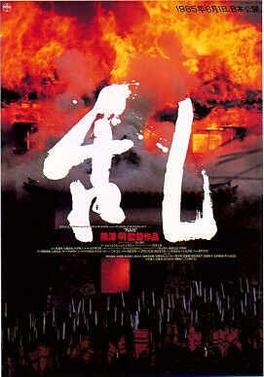
CONSENSUS #18. Ran


SYNOPSIS: This is Akira Kurosawa's epic reinterpretation of "King Lear". It deals with a very dysfunctional royal family. "Chaos" ensues when the reigning warlord decides to retire and leave his kingdom to his first born of three sons. Naturally, the other two son do not accept the decision with grace. The eldest is under the sway of a Lady MacBeth type schemer. A civil war whittles the family down. The movie features two amazing battles and thousands of costumed extras.

BACK-STORY: Ran was the last epic movie by the great Akira Kurosawa. It took ten years to make, partly because of trouble finding financing. It was released in 1985. Kurosawa, who was an accomplished artist, painted brilliantly colorful storyboards of all the scenes while he waited for funding. He was well into his seventies and going blind before the filming began. The movie is famously based on King Lear. The title word is translated into chaos. At $12 million it was the most expensive Japanese film at the time. It was critically acclaimed and won an Oscar for Costume Design (the 1,400 handmade costumes took more than two years to make) and was nominated for Cinematography, Art Direction, and Director. It was not a box office success, however.

Belle and Blade  =  N/A

Brassey’s              =  5.0

Video Hound       =  5.0

War Movies         =  N/A

Military History  =  76

Channel 4             =  62

Film Site                =  no

101 War Movies  =  yes

Rotten Tomatoes  =  17 


ACCURACY: The movie is set in the period of the
Warring States in 16th Century Japan. This was the period when rival warlords called daimyos battled for control of regions of Japan. Kurosawa based Hidetora on the legendary daimyo Mori Motonari who had three sons and used the arrow analogy to explain to them how they needed to remain loyal to each other. That particular story had a happy ending. Kurosawa decided to imagine what would have happened if the sons were bad.

The warfare in
Ran is fairly accurately depicted. The feudal Japanese armies did consist of foot soldiers and cavalry. The armor was accurate for that era. We do see the transition from the samurai with their bows and swords to the peasant levies with their new European style arquebuses. Kurosawa accurately foreshadows the death of the bushido code and its traditional ways of fighting. Modern is not always better.

Tactics in the final battle are off a bit. A competent general (perhaps Jiro was incompetent) would not have led off with a cavalry charge, especially if he could clearly see fire-armed men stationed in the woods to ambush them. Jiro would have led with his infantry, but then we might not have had the thundering hooves scene with the numerous dehorsings.

One other thing, I was not aware that an arquebus could be fired continuously without reloading. Not once in the battle scenes did I see anyone reloading.

CRITIQUE: This is a grand movie in every sense of the word. It is the closing argument for Kurosawa being one of the greatest movie directors. Everything is over the top
the acting, the dysfunctionality, the battle scenes, the visuals. Hell, they built a castle and then burned it to the ground! They spray painted an entire field gold and then did not use the shot in the film!

The themes are powerful. They include the ripple effect of a decision. At the opening, Hidetora decides to pass on his authority to his oldest son and look what happens. Second, the gods have abandoned us. There are several references to this by characters. Third, what you did in your past can literally and figuratively come back to haunt you. Fourth, a family can become a battleground that leads to actual battles.

The imagery is striking. The actor who portrays Hidetora wears traditional Noh makeup that sets his character apart and gives him a demonic look. Kurosawa uses clouds to symbolize the moods of the scenes. Storm clouds
watch out. Much of the film is shot from a distance, even the intimate scenes.

The acting is best described as Japanese. There is a lot of shouting and emoting. I did not particularly like Hidetora
s portrayer, Tatsuya Nakadai. He chewed the scenery even more than what you expect in a Japanese flick. His death scene was giggle-inducing. However, Meiko Hrada as Lady Kaede makes up for his faults. She is chillingly amazing. There is also the fool Kyoami who can be aggravating but serves the purpose of being the opposite of the typically macho male characters.

The battles are justifiably famous. They are messy as I would imagine a real battle would be. You see the fog of war depicted from the comfort of your home. If it were not for the colorful banners, you would not be able to tell which side is which. These scenes are also pretty graphic for a 1980s movie. One soldier takes an arrow in the eye and another holds his severed arm (note to Spielberg
that would work well in a D-Day movie). There are enough killings to sate even the most bloodthirsty war movie buff.

CONCLUSION: Even though you will have to read the subtitles, it
s well worth the watching. The battles within the family and on the battlefields are intense. It is not a standard war movie, but you cannot argue against combining Shakespeare with battles. As the British would appropriately say, it
s a bloody good show!

Sunday, July 8, 2012

SHOULD I READ IT? Seven Samurai


           “Seven Samurai” is probably the most famous Japanese movie.  It was directed by the acclaimed Akiro Kurosawa and released in 1954.  It was the most expensive Japanese movie up to that time.  Although Kurosawa was influenced by Westerns like those of John Ford, “Seven Samurai” is more influencer than influenced.  Besides the obvious influence on the remake “Magnificent Seven”, it established several conventions that became common, especially in American Westerns.  One of these is introducing the main character in an early scene involving an action that will be unrelated to the main activity dominating the rest of the plot.  Think “Magnificent Seven’s"  taking the body to the graveyard scene.  Second, the reluctant heroes helping people they at first cannot relate to.  Third, one of the heroes falls in love with a local girl.  Lastly, the wimpy villagers eventually learn to stand up for themselves.  Most important, “Seven Samurai” is probably the first significant movie to have a group of skilled killers recruited for a suicide mission as in “Guns of Navarone” and “The Dirty Dozen”.

                The movie is set in "Warring States" period of Japan.  Because of a lack of central government and constant civil wars, life is very rough for the lower class.    “Land taxes, forced labor, war, drought… the gods want us farmers dead!”  To make matters worse,  bandits are threatening a village.  They will be coming back after the harvest. The village elder convinces the peasants to defend their property and women by hiring some “hungry samurai”.  Samurai were the knights of medieval Japan.  The hungry ones are called “ronin”.  They are unemployed because their lords are dead or out of business.  Some retained the bushido code of the warrior similar to the code of chivalry, others became bandits.
                Some villagers go to town to find ronin who are willing to take on 40 bandits in exchange for a handful of rice per day.  Most laugh at them, but they convince a veteran named Kambei to take up their cause.  We first meet him cutting off his topknot (a symbol of samurai status) and balding himself to disguise himself as a monk so he can rescue a child and kill a child abductor.  Here are the other six:
Gorobei – second in command; smart and likable; expert archer
Shichiroji – old friend of Kambei
Heihachi -  wood chopper, not a skilled swordsman; charming
Kyuzo -  very skilled swordsman; laconic loner
Katsushiro -  young samurai wannabe who wants to be a disciple of Kambei
Kikuchiyo (Toshiro Mifune) – crazy blowhard who insists on coming along

                When they arrive, the timid villagers are hiding, but when Kikuchiyo sounds the alarm they come swarming out begging for protection from the bandits.  Kikuchiyo lays into them for their hypocrisy and gains the respect of the others.  Later, Kikuchiyo takes up for the peasants (he was one himself) when they find out the villagers had killed wandering samurai in the past.  He shames the others by pointing out the buffeting common for peasants.
                The samurai supervise construction of defenses and training of the peasants to help in the defense  (another influential motif).  A romance develops between Katsushiro and Shino.  Her father is anti-samurai, naturally.  Discovery of the affair results in use of the Japanese word for “slut”.  It’s time for action after the leisurely build-up and character development.  First there is the raid on the bandit camp to cut down the odds.  This results in the first subtraction from the seven.
                Soon after, the bandits make their first attempt on the village.  Although they have a technology advantage with their three muskets (all the samurai deaths will be by gunfire), the defenses hold and the strategy of luring bandits to their deaths is effective.  During the night, Kyuzo sneaks off, kills two, returns with a musket and promptly falls asleep.  This dude is one badass.

                In the main attack, the strategy is to let in one bandit at a time and allow the peasants to finish them with spears.  Even the women participate.  Ever the glory-hound, Kikuchiyo infiltrates the bandit camp and returns with a second musket.  While he is gone some of the bandits get through his position resulting in a crisis.  Kambei scolds him:  “There’s nothing heroic about selfish grabbing of glory.”
Kikuchiyo and Kyuzo 
                Spoiler Alert:  For the final assault, it is decided to let all the remaining bandits in together.  In a driving rainstorm, there is lots of riding back and forth.  Kambei shoots several with a bow, but the bandit leader hides in a hut and proceeds to kill numbers three and four before being stabbed to death.  As usual in cinema, the death of the leading villain brings the fighting to a close.  The samurai have won the battle, but the peasants are the beneficiaries.  Kambei:  “The victory belongs to the peasants, not to us.”  We leave the village with the peasants in the fields – the men singing, the women planting.
                “Seven Samurai” is justifiably famous.  It is a marvel of film-making.  The cinematography is outstanding with Kurosawa choreographing multiple cameras.  We also see one of the first uses of slow motion violence.  The sound effects are noteworthy, especially the thundering hooves of horses.  The music fits the scenes, but more importantly there are different themes for the various characters and for the peasants and the bandits.  The acting is fine and each of the seven has a distinct personality.  You care about them.   
                The movie is not meant to be historical, but it is an accurate depiction of the turmoil of the Warring States period of Japanese history.  The year is 1587 which is in the middle of that long stretch.  There were many unemployed samurai roaming around and the peasantry did suffer greatly from the lack of law and order.  The rigid caste structure remained which is evident in the gulf between the samurai and the villagers.  It is an uneasy alliance.  Ironically, the movie does not make it clear that the bandits would have most likely been unemployed samurai as well.  Each of the main characters (with the exception of Kikuchiyo – Kurosawa created him for comic relief and told Mifune to run with it) was based on an actual person.
                The movie fits well into the war movie genre partly because of the combat, but also because it is strong on strategy and tactics.  The movie goes out of its way to clearly outline the samurais’ plans.  It is a good study in leadership.  Kambei is a good role model.  He is stoical in the face of crises.  He keeps morale up with humorous jibes.  He rubs his head when pondering problems (a trait Lucas gave Yoda in homage).
                The movie is not perfect.  It is very long (the original cut was 3 hours, 27 minutes).  There is a lot of frenetic running around.  The enemy are not personified.  We know nothing about their leader, for instance.  Some of the acting is a bit hammy, especially by Mifune.  The running and the acting are pretty typical of old Japanese movies.  The love story is left unresolved.  These weaknesses are some of the reasons why I feel “The Magnificent Seven” is a superior movie.
                Should you read it?  If you are ever going to watch a Japanese movie, this should be your first.  It is a must-see for all fans of cinema.

Grade =  B+
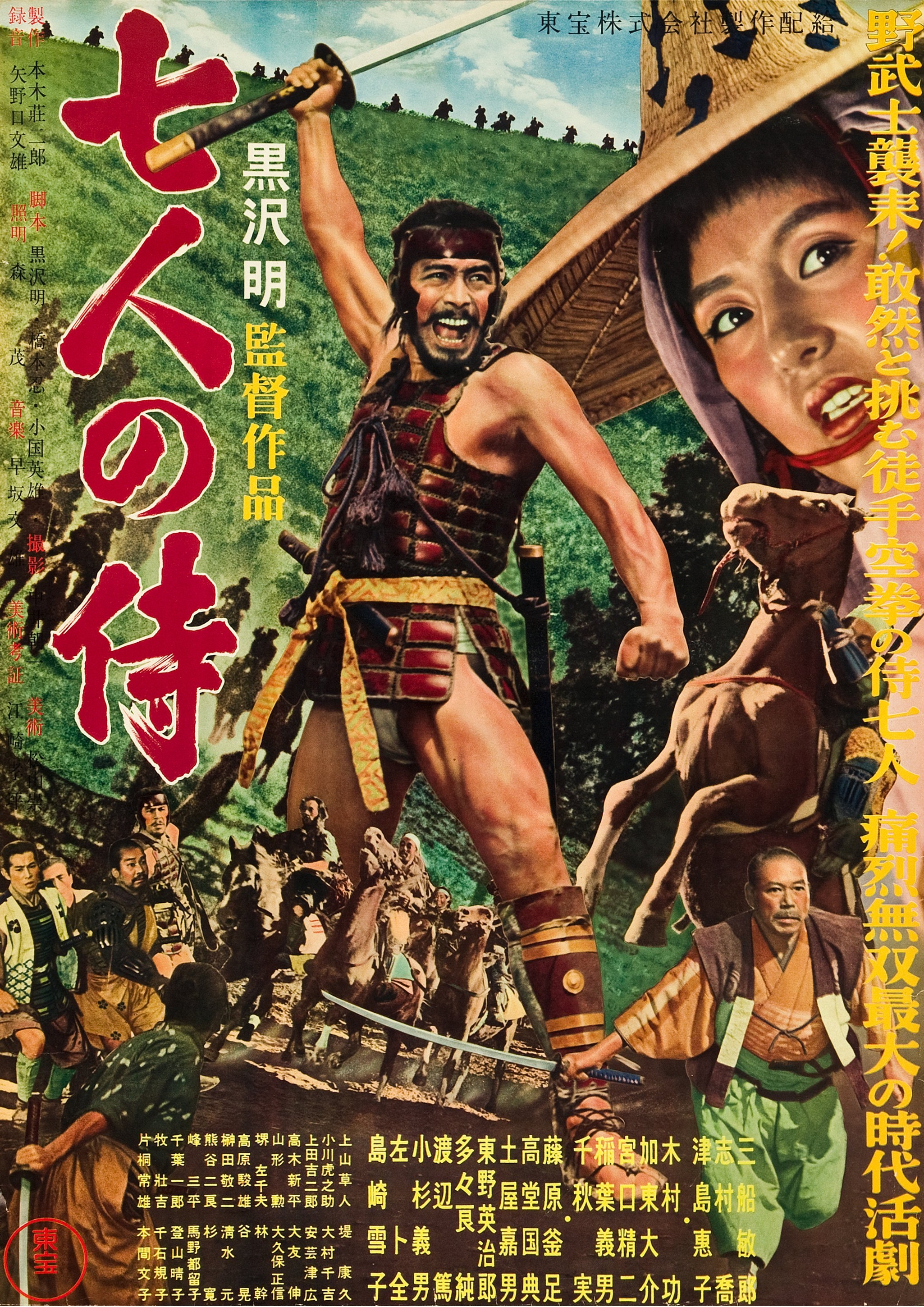
POSTERCool design, but it makes it look like the movie is "One Samurai".  The prominent display of Shino greatly exaggerates  her role.  It appears Japanese poster makers are under the same pressure to bring females into the theater as American artists are.  B

TRAILERIntroduces the scenario and the characters well.  Gives away that 4 of the 7 will die.  Promotes Mifune.  Highlights the romance.  Good job covering all the bases.  A