Recently I read an article about the ten best military movies of the last ten years. It was from a respected site and was a competent list. However, it was heavily inhabited by box office successes and overlooked more obscure movies. I had seen all of the movies and some of them are not good. None of them are terrible, either. You can see the article here. It got me to thinking about what my list would look like so I back and looked at list of all the significant war movies over the last ten years. Here is my take on the top ten.
10. Beneath Hill 60 - The story of a mining engineer and his unit that dig a mine under the German line in WWI. It is an Australian film that is well-acted, claustrophobic and suspenseful.
9. My Way - If you have never seen a South Korean war film, you are missing the best combat porn available. This is the gonzo tale of two rivals who fight in the Japanese army against the Soviets and end up in a Soviet prison camp and eventually in the German army in Normandy in time for D-Day. You heard that right, now see it to believe it.
8. 13 Hours - Speaking of combat porn, this American true tale of the Benghazi incident has plenty of ammo expenditure. It does not have a political agenda. It depicts the FUBAR of modern war well. It is pretty accurate, but of course the body count is inflated.
7. Good Kill - This shamefully overlooked movie deals with drone warfare. Ethan Hawke is excellent as the stressed out and conflicted push button warrior who kills terrorists from the air conditioned comfort of an air base outside Las Vegas. Learn about the modern war on terror and its collateral damage.
6. Eye in the Sky - This movie is similar to Good Kill, but it looks at drone warfare from the political and command level. It stars Helen Mirren as the Pattonesque Colonel who is obsessed with getting a high value target and is willing to risk civilian casualties. The movie is eye-opening about the incredible technology available to the "good guys" and the political decision-making behind the scenes.
5. 13 Assassins - This is the best samurai movie to come out of Japan in a long time. 13 ronin are hired to assassinate a very villainous shogun. In the process they must stop his army at a village. They set the village up in an extreme update of Seven Samurai. The action is incredible and will leave you exhausted, but smiling. If you've seen Seven Samurai, see where samurai films are now.
4. Rogue One - This may be a sci-fi movie, but it also has a lot of the elements of a WWII movie. It is the best Star Wars movie since The Empire Strikes Back. It has some of the best combat scenes in recent war movies, an intriguing plot, and appealing characters. And the special effects are incredible. It is a prequel to the first Star Wars.
3. '71 - Another criminally overlooked gem. The title refers to 1971. A British soldier, played outstandingly by Jack O'Donnell, gets separated from his unit in Belfast during "the Troubles" between the IRA, the Protestants, and the British. In one night he encounters all sorts of intrigue and action. It's an edge of your seat thriller.
2. Lone Survivor - Another tastefully done combat porn film. Based on a true story, four SEAL team members are sent to take out a Taliban leader and end up with his jihadists trying to wipe them out. The cast is great, with Mark Wahlberg and Ben Foster standing out. Historically accurate, but enhanced for the viewing pleasure of anyone wanting a high body count.
1. Zero Dark Thirty - How did this movie not make the other list? Perhaps it was not considered to be a military movie, but if you consider movies about the war on terror to be military movies, this is the best. It accurately tells (to the best of our knowledge) the story of the take-down of Bin Laden. Jessica Chastain is amazing as the CIA analyst who tracks him down which leads to the raid. It is well worth the wait, but the lead-up is great, too.
This is my attempt at a statistical analysis of the
greatest war movies.Here is the
methodology.I found four 100 Greatest
War Movies lists that I feel are knowledgeable on the subject.Two of those lists (Military History magazine
and Channel 4) rank the movies.The
others are Film Site and the book 101 War Movies You Must See Before You
Die. I also used three books that
rate war movies:Video Hound’s War
Movies, Brassey’s Guide to War Films, and The Belle and Blade Guide to
Classic War Videos.(Since I did my
research I received my copy of War Movies by Brock Garland.I did not redo the data, but I have included
its grade in the ratings list.)The
reason why the list is limited to only movies from the 20th Century
is because not all of the sources include 21st Century movies.
I won’t bore with the details, but basically I
used a combination of the average rating from the ratings books and a rating
based on the ranking from the two ranked lists (on a scale of 1-5).I grouped the movies based on how many lists
they made so only movies that were in both Military History magazine and
Channel 4 made the top 43.
I must
emphasize that this list does not reflect my opinions.In fact, I find some of the positions
ridiculous.I have seen and reviewed all
of the movies on the list.Some are not
war movies, in my opinion.Others are
very overrated.It is also apparent that
foreign movies got short-changed.
#100 – THE MANCHURIAN
CANDIDATE (1962)
SYNOPSIS: "The
Manchurian Candidate" is a Cold War thriller. An American patrol is
captured by the North Koreans and brainwashed. One of them (Laurence Harvey) is
the step-son of a rabid anti-Communist Senator. He becomes an unwitting sleeper
agent when he returns to America after the war.
His mother (Angela Lansbury) is part of a plot to use her
"hero" son to assassinate the President so his step father can take
over the Presidency. One of his brainwashed comrades (Frank Sinatra) is in a
race against time to foil the plot.
BACK-STORY: “The
Manchurian Candidate” is a political thriller released
in 1962 during the Cuban Missile Crisis which is appropriate because it taps
into the Red Scare hysteria of that time. It is based on a novel by Richard
Condon and is faithful to the book. It was directed by John Frankenheimer and
showcases his style of unusual camera angles and symbolism (notice all the
images of Lincoln). The movie was supposedly taken out of circulation because
of its proximity to the Kennedy assassination. There is also the possibility
that Oswald saw the film and was inspired by it. It was remade in 2004 starring Denzel
Washington in the Sinatra role.
TRIVIA - mentalfloss, imdb,
wikipedia
1. United Artists
did not want to make the film because of the political controversy. Frank Sinatra went to Pres. Kennedy who was a
big fan of the novel. Kennedy contacted
the studio head and got him to change his mind.
2. Angela Lansbury
was only three years older than her “son” Laurence Harvey.
3. The movie came
out in the midst of the Cuban Missile Crisis.
4. When Marco
visits Raymond in his hotel room towards the end of the film, Sinatra is filmed
out of focus. Critics lauded this
cinematography for showing Raymond’s distorted perspective. Actually, the assistant cameraman screwed up
the shot and director Frankenheimer was upset and wanted to reshoot it, but he
could not get Sinatra to duplicate the performance.
5. Sinatra wanted
Lucille Ball for the Angela Lansbury role.
6. Sinatra broke a
finger in the fight scene with Henry Silva.
Later, when he was up for “Dirty Harry”, he could not grip the pistol
properly and had to drop out.
7. When Laurence
Harvey jumped in the lake in Central Park, it was so cold that ice had to be
broken.
8. The myth that
the movie was pulled after the assassination of Kennedy was not true. It was shown, but rarely because there was
not a lot of interest in the film.
9. In the novel,
the relationship between Raymond and his mother is more incestuous and she even
seduces him. The movie could only go as
far as a kiss on the lips.
(Surprisingly, the 2004 remake does not even have the kiss.)
10. Mrs. Iselin is
#21 on AFI’s list of 100 Heroes and Villains.
11. It was
nominated for two Academy Awards:
Editing and Supporting Actress (Lansbury). She lost to Patty Duke in “The Miracle
Worker”.
Belle and Blade = 3
Brassey’s = 4
Video Hound = 5
War Movies = 4.4
Military History = 85
Channel 4 = not on list
Film Site =
yes
101 War Movies = no
OPINION: I am not
sure if “The Manchurian Candidate” is really a war movie. It certainly fits more comfortably in
the political thriller genre. As such, it has the usual unrealistic plot twists
and unbelievably fortuitous occurrences (e.g., Joycelyn showing up in the queen
of hearts costume). What would be faulted in a war movie is par for the course
in a thriller. As a political thriller it is cracking entertainment full of
suspense and great acting. As political satire, it is a devastating indictment
of McCarthyism.
“Seven
Samurai” is probably the most famous Japanese movie.It was directed by the acclaimed Akiro
Kurosawa and released in 1954.It was
the most expensive Japanese movie up to that time.Although Kurosawa was influenced by Westerns
like those of John Ford, “Seven Samurai” is more influencer than
influenced.Besides the obvious
influence on the remake “Magnificent Seven”, it established several conventions
that became common, especially in American Westerns.One of these is introducing the main
character in an early scene involving an action that will be unrelated to the
main activity dominating the rest of the plot.Think “Magnificent Seven’s"taking the body to the graveyard scene.Second, the reluctant heroes helping people they at first cannot relate
to.Third, one of the heroes falls in
love with a local girl.Lastly, the
wimpy villagers eventually learn to stand up for themselves.Most important, “Seven Samurai” is probably
the first significant movie to have a group of skilled killers recruited for a
suicide mission as in “Guns of Navarone” and “The Dirty Dozen”.
The movie is set in "Warring States" period of
Japan.Because of a lack of central
government and constant civil wars, life is very rough for the lower class.“Land taxes, forced labor, war, drought…
the gods want us farmers dead!”To make
matters worse,bandits are threateninga village.They will be coming back after the harvest.The village elder convinces the peasants
to defend their property and women by hiring some “hungry samurai”.Samurai were the knights of medieval
Japan.The hungry ones are called
“ronin”.They are unemployed because
their lords are dead or out of business.Some retained the bushido code of the warrior similar to the code of
chivalry, others became bandits.
Some villagers go to town to
find ronin who are willing to take on 40 bandits in exchange for a handful of
rice per day.Most laugh at them, but
they convince a veteran named Kambei to take up their cause.We first meet him cutting off his topknot (a
symbol of samurai status) and balding himself to disguise himself as a monk so
he can rescue a child and kill a child abductor.Here are the other six:
Gorobei –
second in command; smart and likable; expert archer
Shichiroji –
old friend of Kambei
Heihachi
-wood chopper, not a skilled swordsman;
charming
Kyuzo -very skilled swordsman; laconic loner
Katsushiro
-young samurai wannabe who wants to be
a disciple of Kambei
Kikuchiyo
(Toshiro Mifune) – crazy blowhard who insists on coming along
When they arrive, the timid
villagers are hiding, but when Kikuchiyo sounds the alarm they come swarming
out begging for protection from the bandits.Kikuchiyo lays into them for their hypocrisy and gains the respect of
the others.Later, Kikuchiyo takes up
for the peasants (he was one himself) when they find out the villagers had
killed wandering samurai in the past.He
shames the others by pointing out the buffeting common for peasants.
The samurai supervise
construction of defenses and training of the peasants to help in the
defense(another influential
motif).A romance develops between
Katsushiro and Shino.Her father is
anti-samurai, naturally.Discovery of
the affair results in use of the Japanese word for “slut”.It’s time for action after the leisurely
build-up and character development.First there is the raid on the bandit camp to cut down the odds.This results in the first subtraction from
the seven.
Soon after, the bandits make
their first attempt on the village.Although they have a technology advantage with their three muskets (all
the samurai deaths will be by gunfire), the defenses hold and the strategy of
luring bandits to their deaths is effective.During the night, Kyuzo sneaks off, kills two, returns with a musket and
promptly falls asleep.This dude is one
badass.
In the main attack, the strategy
is to let in one bandit at a time and allow the peasants to finish them with
spears.Even the women participate.Ever the glory-hound, Kikuchiyo infiltrates
the bandit camp and returns with a second musket.While he is gone some of the bandits get
through his position resulting in a crisis.Kambei scolds him:“There’s
nothing heroic about selfish grabbing of glory.”
Kikuchiyo and Kyuzo
Spoiler Alert: For the final assault, it is
decided to let all the remaining bandits in together.In a driving rainstorm, there is lots of
riding back and forth.Kambei shoots
several with a bow, but the bandit leader hides in a hut and proceeds to kill
numbers three and four before being stabbed to death.As usual in cinema, the death of the leading
villain brings the fighting to a close.The samurai have won the battle, but the peasants are the
beneficiaries.Kambei:“The victory belongs to the peasants, not to
us.”We leave the village with the
peasants in the fields – the men singing, the women planting.
“Seven Samurai” is justifiably
famous.It is a marvel of
film-making.The cinematography is
outstanding with Kurosawa choreographing multiple cameras. We also see one of the first uses of slow
motion violence.The sound effects are
noteworthy, especially the thundering hooves of horses.The music fits the scenes, but more importantly
there are different themes for the various characters and for the peasants and
the bandits.The acting is fine and each
of the seven has a distinct personality.You care about them.
The movie is not meant to be
historical, but it is an accurate depiction of the turmoil of the Warring
States period of Japanese history.The
year is 1587 which is in the middle of that long stretch.There were many unemployed samurai roaming
around and the peasantry did suffer greatly from the lack of law and
order.The rigid caste structure
remained which is evident in the gulf between the samurai and the
villagers.It is an uneasy
alliance.Ironically, the movie does not
make it clear that the bandits would have most likely been unemployed samurai
as well.Each of the main characters
(with the exception of Kikuchiyo – Kurosawa created him for comic relief and
told Mifune to run with it) was based on an actual person.
The movie fits well into the war
movie genre partly because of the combat, but also because it is strong on
strategy and tactics.The movie goes out
of its way to clearly outline the samurais’ plans.It is a good study in leadership.Kambei is a good role model.He is stoical in the face of crises.He keeps morale up with humorous jibes.He rubs his head when pondering problems (a
trait Lucas gave Yoda in homage).
The movie is not perfect.It is very long (the original cut was 3
hours, 27 minutes).There is a lot of
frenetic running around.The enemy are
not personified.We know nothing about
their leader, for instance.Some of the
acting is a bit hammy, especially by Mifune.The running and the acting are pretty typical of old Japanese
movies.The love story is left
unresolved.These weaknesses are some of
the reasons why I feel “The Magnificent Seven” is a superior movie.
Should you read it?If you are ever going to watch a Japanese
movie, this should be your first.It is
a must-see for all fans of cinema.
Grade = B+
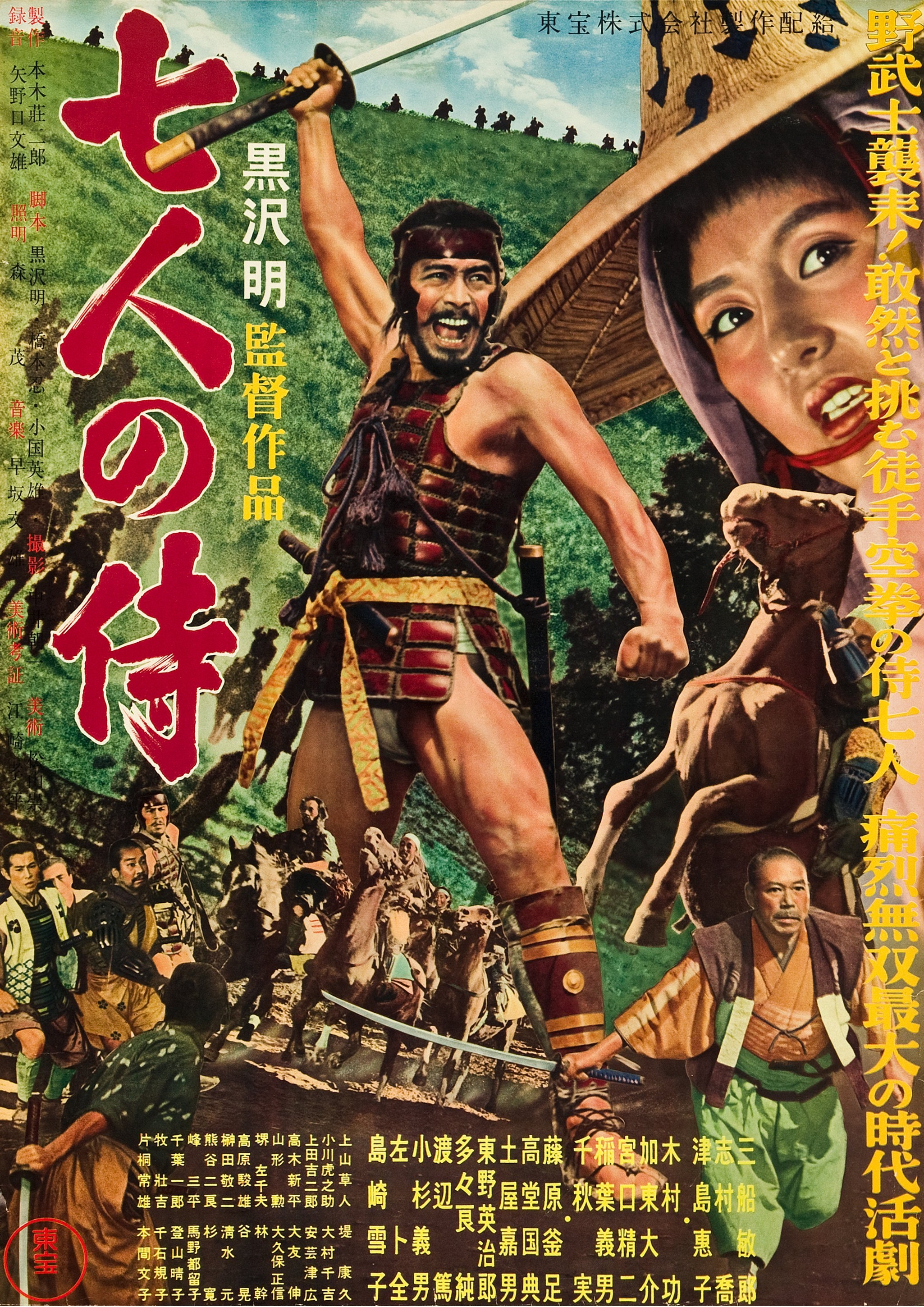
POSTER - Cool design, but it makes it look like the movie is "One Samurai". The prominent display of Shino greatly exaggerates her role. It appears Japanese poster makers are under the same pressure to bring females into the theater as American artists are. B
TRAILER - Introduces the scenario and the characters well. Gives away that 4 of the 7 will die. Promotes Mifune. Highlights the romance. Good job covering all the bases. A
BACK-STORY: “The Story of G.I. Joe” was released in 1945 and is based on the columns of war correspondent Ernie Pyle. It was directed by William Wellman who had been a pilot in the Lafayette Escadrille in WWI and at first refused to do a movie about the despised infantry until he met Pyle and saw the adoration the infantry had for him. Once on board, Wellman insisted on realism and convinced the Army to loan him 150 soldiers training near the production. The movie also used several actual war correspondents. So the actors would not look foolish alongside real soldiers, Wellman put them through the first actors’ boot camp. Sadly, Pyle was killed before the opening of the movie and many of the real soldiers were killed on Okinawa. For this reason, Wellman never watched the movie after its release. The movie was a hit and is considered one of the most realistic war films. It was nominated for four Oscars (Supporting Actor - Mitchum, Song, Score, and Screenplay).
OPENING: The 42 year old Pyle (Burgess Meredith) attaches himself to Company C, 18th Infantry as it prepares to go by truck into action in Tunisia. He meets Lt. Walker (Robert Mitchum) who agrees to let him accompany them all the way to the front. The men are rookies with a nervous bravado about them. The hound in the group named Dondaro (Wally Cassell) greets Pyle by saying: “Hey Pops, why wasn’t you born a beautiful dame? Or even an ugly one?” That night they lounge in their pup tents and listen to Artie Shaw as played by Axis Sally. Her taunting about their girls back home registers various facial reactions in a series of close-ups. The soldier talk is tame, but realistic.
SUMMARY: The first death occurs soon after as a plane strafes and one of the men dies off screen. Walker: “The first death is always the hardest.” The Company mascot, a cute little dog named Arab (“Squirt”), is passed on to one of the survivors.
Next thing we see is the unit facing defeat at Kasserine Pass (although not mentioned by name). The defeat is seen through Pyle’s eyes as he follows the degeneration at headquarters. A montage of columns follows. The film skips Sicily and has Pyle reuniting with the now seasoned unit in Italy. The men are genuinely glad to see Pyle and give him the typical gentle ribbing. At mail call, Sgt. Warnicki (Bobby Steele) receives a recording of his son “Junior”, but will spend the rest of the movie trying to listen to it.
The only battle scene has the men taking an Italian town house to house. The assault culminates with Walker and Sgt. Warnicki cat-and-mousing with German snipers in a bombed out church. The scene is bereft of dialogue, but has great sound effects (but no music). It really sounds like a WWII battle. The tactics of covering fire and maneuver are also realistically portrayed. After the liberation of the town, the men settle down for a while. The movie is true to the stop and go nature of war. During this interlude, Murphy (John Reilly) weds his nurse fiancé (played by Wellman’s wife Dorothy). In the honeymoon suite/ambulance, he falls asleep before the camera has to cut away.
The next big set piece involves the capture of a monastery on a hill (obviously meant to be Monte Cassino). This is one of the grubbiest scenes in war movie history. The men are dirty and unshaven and living in caves surrounded by a sea of mud due to the incessant rain. Patrols go out and return with less than they started with. One of the victims is Murphy. The men take the deaths in stride, but clearly the strain mounts. We see this attrition through Pyle (“The G.I. lives so miserably and dies so miserably”) and Walker (who agonizes over being a “murderer”). Everyone is weary, but they do what they have to do. “Every step forward is a step closer to home.” They maintain their sardonic G.I. humor throughout. After another vicious artillery barrage, a soldier says “Gee, a guy could get killed around here”. Warnicki snaps when he finally hears Junior’s voice. Finally, Eisenhower bombs the religious site and although the movie alludes to this making the monastery a tougher nut, the movie moves on after a brief final assault that includes actual war footage.
CLOSING: The last scene is a reenactment of Pyle’s most famous column “The Death of Captain Waskow”. The men are resting when a mule train arrives from the front carrying dead bodies. One of them is Capt. Walker. The men are stunned and their facial expressions reflect the love of soldiers for a well-respected officer. One by one members of the unit pay their last respects laconically. “I’m sorry, old man” is a typical eulogy. But the war must go on so they march past into the sunset. Pyle: “For those beneath the wooden crosses, there is nothing we can do except perhaps to pause and murmur “Thanks pal, thanks”.
As a post script, we see actual footage of Pyle interviewing a soldier. Cool.
the real Ernie Pyle
RATINGS:
Acting - 9
Action - 6
Accuracy - 6
Realism - 8
Plot - 8
Overall - 8
WOULD CHICKS DIG IT? Probably. It is bloodless and not graphic. There is a sweet wedding scene. The soldier language is toned down. The acting is stellar.
HISTORICAL ACCURACY: The movie starts with a disclaimer that the “characters and events are fictional”. Several of the main characters are based on soldiers that figured prominently in Pyle’s columns. Walker is based on Henry Waskow and sentiments voiced by Sgt. Frank Eversole. Warnicki was based on Sgt. Jack Peterson who had a son named “Junior”. There was a dog named "Squirt".
The main divergence from truth is the fact that although Pyle travelled with Company C, 18th Infantry in Tunisia, the unit did not fight in Italy. Pyle accompanied a different unit in Italy. This Hollywoodizing of the facts is totally justifiable for the continuity of the film. After all, the movie and Pyle were interested in boosting the G.I.s in general, not in particular.
The two battles – San Pietro and Monte Cassino – are simplified and not meant to accurately depict actual battles. This is not a movie about strategy and tactics. It does not give the big picture. A minor flub is having Eisenhower order the bombing of Monte Cassino when it was actually done by Gen. Harold Alexander.
The final scene is close to the famous column except that the incident actually occurred at night. It is well done and quietly poignant.
CRITIQUE: “The Story of G.I. Joe” has a reputation as one of the best of the circa-WWII movies. That reputation is well-deserved. It holds up well partly because it does not have to compete with the recent crop of hyper-realistic combat films started by “Saving Private Ryan”. It is a simpler soldier slice of life picture. As such, it is better than most modern attempts to depict soldier life. The dialogue is sparse and rings true. The only flaw being the language constraints of 1940s cinema. A remake would undoubtedly have a lot of f-words.
The acting stands out. Meredith is perfect as Pyle. He met Pyle before filming and spent time with him. He looks like the famed war correspondent, but more importantly he portrays Pyle’s ambiguous feelings about war and the men who had to fight it. Meredith was an Army Captain at the time of the filming and was given an honorable discharge by Gen. Marshall so he could do the movie. MItchum is superb in perhaps his best performance. He earned his only Academy Award nomination. Ex-boxer Bobby Steele is another who puts in his best effort as Warnicki. (His other recognizable role was in “Hail the Conquering Hero”, but he is more central in this one.) The rest of the cast is fine and “Squirt” is adorable.
The cinematography is outstanding. There are lots of close-ups of facial expressions. These are often more powerful than the dialogue they replaced. The landscapes are appropriately stark. The soundstage for the monastery scenes is one of the muddiest in movie history. The sound and soundtrack are very good.
The film is true to the reality of war being mostly downtime followed by brief periods of terrorizing violence. This makes it reminiscent of another great WWII film – "A Walk in the Sun". Like that film, it avoids dysfunctionality within the unit, but that was typical of that era’s war movies.
CONCLUSION: Dwight Eisenhower called “The Story of G.I. Joe” the best war film made on WWII. That is high praise and may have been true at the time. Although it does not stand up to modern films like “Saving Private Ryan” and “Enemy at the Gates”, it holds up better than most 1940s WWII films. The only real complaint I have is there is still a movie about Ernie Pyle waiting to be made. Watch it if you can find it – it ain’t easy.
It time to adjust the 100 Greatest list. After seeing 39 of the first 40 movies (still have not seen “Dunkirk”), it is obvious the Military History magazine’s panel of experts was off in its rankings. Here is how they should have been ranked:
99. Ben Hur (96) (not a war movie)
98. Foreign Correspondent (86) (not a war movie)
97. The Third Man (80) (not a war movie)
96. Castle Keep (66)
95. They Died With Their Boots On (68)
94. The Life and Times of Colonel Blimp (87)
93. Hail the Conquering Hero (70)
92. Braveheart (67)
91. To Hell and Back (77)
90. The Thin Red Line (100)
89. The Alamo (61)
88. Ballad of a Soldier (81)
87. Guadalcanal Diary (69)
86. Guns of Navarone (93)
85. Northwest Passage (97)
84. Henry V (75)
83. Run Silent, Run Deep (79)
82. Thirty Seconds Over Tokyo (98)
81. They Were Expendable (99)
80. Desert Rats (88)
79. The Desert Fox (78)
78. The Big Red One (71)
77. Battle of Britain (90)
76. Midway (92)
75. Manchurian Candidate (85)
74. Bridges at Toko-Ri (73)
73. Sahara (83)
72. El Cid (63)
71. Twelve O’Clock High (72)
70. Ran (76)
69. The Man Who Would Be King (77)
68. Cross of Iron (64)
67. A Walk in the Sun (82)
66. A Bridge Too Far (94)
65. Casablanca (65)
64. Dr. Strangelove (84)
63. The Train (62)
62. Breaker Morant (91)
61. Last of the Mohicans (95)
Based on what I have seen so far, I estimate that at least 20 movies on the 100 Greatest list will not make my 100 Best list. Here is a list of twenty that I feel will be worthy replacements. Feel free to suggest others.
Two of the best cat-and-mouse submarine movies were “The Enemy Below” and “The Bedford Incident”. They both feature a deadly duel between an American destroyer and an enemy submarine.
“The Enemy Below” was released in 1957. It stars Robert Mitchum as Capt. Murrell, the new captain of the escort destroyer USS Haynes. He has recently survived a sinking by a u-boat and the crew is skeptical about his seaworthiness and his command ability. When a u-boat is picked up on sonar, Murrell becomes obsessed with tracking and destroying it. There are some shades of “Moby Dick” in the plot.
The u-boat captain Von Stolberg (Curt Jergens) is not a fanatical Nazi (he’s the typical good German that you get in Cold War era movies). In fact, he is bitter and disillusioned (“They’ve taken the human out of war.”) Both captains are philosophical and good leaders. They are well-matched.
The movie does not break much new ground. We get the clichéd depth chargings and torpedo dodging. At one point the sub releases oil to throw off the destroyers sonar (wait, what?) The u-boat descends to hide on the bottom, well below its maximum depth (wait, can it do that?). It springs leaks – get the wrenches! The chase is a lengthy one and very stressful, but you can’t tell it from the spiffy garb and proper grooming of both sides. Also, that is one spacious and pristine u-boat!
The climatic showdown has the destroyer being torpedoed. Murrell lures the sub onto the surface by having mattresses set afire to give the impression the Haynes is a sitting duck. Von Stolberg takes the bait and surfaces resulting in the u-boat being rammed. In fact, the Haynes ends up on top of the sub. Both are mortally wounded. Which of the two captains, who have grown to respect each other, will survive?
“The Bedford Incident” was released in 1965 and is set in the Cold War. This time the duel is between the destroyer USS Bedford and a Soviet sub. The U.S. Captain Finlander (Richard Widmark) is tightly wound and chafing over a recent lack of promotion apparently for some jingoistic remarks. He considers his ship to be a hunter and a stalker. He says “there is something exciting about the hunt.” On board comes a reporter named Munsford (Sidney Poitier) who is determined to ferret out Finlander’s woodshed moment. They immediately butt heads and continue to. The ensemble includes former u-boat commander Schrepke (Eric Portman) who is an advisor from NATO. He is on our side now so he is the sanest and most stable person on board.
Off Greenland, the Bedford detects a Soviet sub and Finlander decides to force it to the surface even though NATO orders him to back off. Finlander is a Curtis Lemay disciple – we shouldn’t be coddling those commies. He goes after the sub in spite of it being in international waters. We get a lot of control room scenes and pinging noises. Finlander gradually descends into Ahab territory. The crew is loyal to their charismatic leader, but Munsford, Schrepke, and the doctor Potter (Martin Balsam) are aghast. Finlander is one hardass SOB who is not interested in the pansies’ opinions. The tension builds until mutually assured destruction comes true.
The movies have similarities beyond the cat-and-mouse plots. Both feature a “good German”. Both are claustrophobic. Both have a black characters (TEB has a messmate). The opponents are well-matched. They are both excellent studies in leadership – good and bad. Interestingly, the command arcs are the opposite. In TEB, new captain Murrell has to earn the respect of his skeptical crew. He does that through cool, efficient decisions. On the other hand, Finlander starts as a strict, but worshiped leader and turns into a tyrant. The acting is very good in both and both are anchored by strong performances by the American captains. Slight edge to Widmark.
They differ in themes. TEB is focused on the mutual respect that develops between worthy opponents. TBI is focused on the obsession of a Cold Warrior. It is also concerned with the effects of Cold War tensions and the big “what-if” – what if Mutually Assured Destruction is a flawed strategy? The movie definitely has a Dr. Strangelove (1964) feel to it. But none of the humor.
It’s a close call, but “The Bedford Incident” is the superior movie. The themes are more engaging and suspenseful. It’s scarier because a Cold War audience would have related directly to what they were seeing. It also is less orthodox and cliché-ridden. Ironically, although it came out eight years later, “The Bedford Incident” is in black and white and “The Enemy Below” is in color. TBE actually looks better as the black and white cinematography really brings vividness to the icebergs that are frequent backdrops. Another advantage is it has Wally Cox as a radarman, not to mention a very young Donald Sutherland as a scientist that examines trash from Soviet subs.
Watch both together like I did, they make a great doubleheader. Watch "The Enemy Below" first, you'll see why.
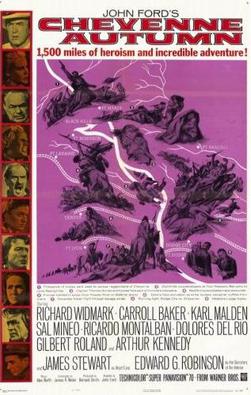
Cheyenne Autumn is an historical novel about the Northern Cheyenne Exodus from their reservation in Indian Territory back to their homes in Wyoming in 1878. Sandoz starts by describing the appalling conditions in the south and the mood of a people who had been repeatedly lied to by white authorities. When they finally have had enough, they leave on a perilous 1,500 mile trek through hostile territory with little food, weapons, horses, or hope. They start with 284 ragged Cheyenne with only 87 warriors. They are led by Little Wolf (carrier of the Sacred Bundle) and Dull Knife. Both chiefs want to avoid war with the whites, but have trouble constraining the young men who hope to count their first coups and hunger for revenge for white atrocities.
The Cheyenne are continually dogged by Army units. Even though they are short of guns and ammunition, they manage to beat off numerous attacks. In one battle, Little Wolf sets up a classic ambush and warns the young men to wait until the soldiers are completely in the trap before opening fire. Not surprisingly, one of the braves ruins it by firing an early shot. The white commander then flanks the Indians, but the Cheyenne avoid destruction when he is wounded and the soldiers retreat.
Sandoz fills the reader in on the previous battles involving the Cheyenne as background to explain the plight of the people and how innocent Cheyenne were killed in past encounters with the whites. It is clear that both sides were to blame for murders on this trek, however. Especially in travelling through Kansas, the Indians do some thieving and killing, most of it justified. These actions enrage the white frontier and it does not help that the media greatly exaggerates the depredations. Ironically, by the end of the trek, many whites have become sympathetic to the “noble red men”.
The tribe splits when it reaches the edge of their old hunting grounds. Dull Knife decides they have come far enough and the suffering is too great so he wants to go in to Red Cloud’s Agency. Unfortunately, the sympathetic Sioux leader is prevented from accepting them. During a blinding snow storm, Dull Knife’s band is blocked by an unbeatable military force and he surrenders. His people are led to Camp Robinson where they are at first given some freedom, but later the decision comes from the Great Father that they must return South. Dull Knife refuses to go and threatens suicide. “’We will never go back there; we will die first,’” Dull Knife said once more, the words already so worn from repetition they had no life, only the stench of something long dead. The answer they got was the same old, old admonitions to wait, more of the lifetime that they had waited on the Great Father.” Capt. Wessells, in command at Fort Robinson, has them locked in a barracks without food, water, or fire. One unfortunately moonlit night, the desperate Cheyenne break out with the few inadequate weapons they have hidden. A running battle occurs with many of the men, women, and children killed on the snow covered prairie. Many of them are murdered. This culminates in an assault on the last refuge of the last group of survivors in a pit (“The Last Hole”) at Warbonnet Creek. All of the men are killed along with most of the noncombatants. They go down fighting in a hopeless cause.
Meanwhile, Little Wolf and his band are miraculously moving undetected closer to their destination of the Yellowstone River. They spend over a month recuperating in a secluded valley. Eventually, they must move on and get surrounded by troops led by their friend Lt. Clark. “White Hat” Clark convinces Little Wolf to give up for the sake of the survivors and come in to Ft. Keogh. Little Wolf consents and the trek ends. As a post script, Little Wolf kills Thin Elk, who had been flirting with his youngest wife throughout the journey. Having killed another Cheyenne, Little Wolf gives up his position of carrier of the Sacred Bundle.
The movie “Cheyenne Autumn” directed by John Ford was “suggested” by the book. It covers the broad outlines of the novel. The movie starts with the Indians leaving the reservation because the last straw is the failure of a congressional delegation to arrive on time. They are led by Dull Knife (Gilbert Roland) and Little Wolf (Ricardo Montalban) carrying the Sacred Bundle. They are joined by a Quaker schoolmarm named Debra portrayed sanctimoniously by Carol Baker. Capt. Archer (Richard Widmark) is sympathetic, but gives chase. By the way, he is in love with Debra. It is unclear what he will do when he catches the Indians, but the arrival of his commanding officer (Maj. Brayton) with two cannons, results in a battle where the Indians are wantonly bombed, but strike back by running off the cavalry horses. Brayton, an obvious Indian hater, is killed thus avoiding the messy court-martial he had threatened Archer with.
Archer also has his own eager young men to deal with. They are personified by Lt. Scott (Patrick Wayne) who disobeys orders and launches a frontal attack that results in an ass kicking by the Indians who have set the prairie on fire. Later, of course, Scott becomes an admirer of the Cheyenne. The Indians continue on their way, but with little effort by the filmmakers to show the hardships heartbreakingly chronicled in the book. In fact, the Indians all seem to be well-armed with repeating rifles which is the exact opposite of the book.
The lover’s triangle makes it into the movie in the form of Red Shirt (Sal Mineo) wooing Little Wolf’s wife. To add conflict, Red Shirt is Dull Knife’s son. The movie introduces Secretary of the Interior Carl Schurz (Edward G. Robinson) as a friend of the Indians and defender of them from the machinations of the railroads and their allies, the Army.
Midway through the film, Ford inexplicably detours to Dodge City for comic relief centering around Wyatt Earp (James Stewart) playing cards and then leading a drunken posse (replete with a portable saloon) after the Indians. The expedition is brought to a chaotic halt when a lone Indian opens fire and a shot sets off the ammunition wagon like fireworks. This segment was mercifully removed from the film for its second and third runs. (It does have a hilarious line where Earp looks down at the crotch of a prone whore and finally remembers her from Wichita City).
The Indians break up with Dull Knife going in to Fort Robinson. Archer’s unit arrives soon after. Wessells (Karl Malden) is portrayed as an Indianophile who is just following orders by locking up the Indians. Archer is upset and leaves for Washington to plead the Indians’ case. Wessells goes overboard with the “no food, water, or fire” threat and gets the break-out which is shown as a brief, bloody escape. Next thing we see is Dull Knife reuniting with Little Wolf. There is nothing about all the deaths in the escape. Soon, Archer arrives with Secretary Schurz and they persuade Dull Knife and Little Wolf to take a gamble that Schurz will be able to get them fair treatment. The next scene implies that he does exactly that. In actuality, the real Schurz favored shipping them south. The movie closes with Little Wolf calling out Red Shirt and then gunning him down before he can fire a shot. Little Wolf hands over the Sacred Bundle to Dull Knife and rides off into the sunset.
The book is much better than the movie. Although a novel, Sandoz has written the definitive history of the Northern Cheyenne Exodus. Sandoz is able to write like the Cheyenne spoke which makes the novel different and intriguing. She uses the sparse Indian way of speaking. She intersperses Indian words like “veho” for whites and Indian similes. The book also is excellent on Indian life, containing many intimate details. It is at its best in putting the reader into the minds of the Native Americans. You clearly see how their way of thinking differed radically from the veho.
The book is heartbreaking, yet inspirational. I was constantly amazed at how this ragged band was able to survive under such harsh conditions. Not only are they lacking in guns, but some of their cartridges are lacking in gunpowder! They survive encounters with Army units that they had no chance against. Some of it is luck and some of it is moral superiority. You root for them even though you know they are doomed to fail. The chapters on Fort Robinson will bring tears.
The movie is a lame attempt by Ford to get into Heaven after all his other Westerns portrayed Indians as savages. It was his last Western. The scenery is awesome as usual with Ford sticking with Monument Valley even though it looks little like the terrain the Cheyenne actually crossed. The movie was nominated for an Oscar for cinematography. The acting is adequate with Widmark filling John Wayne’s shoes well. The use of Latino actors for the main Indian characters is a little offensive, but at least most of the extras were Navahos. Notably, the Indians speak their native tongue (actually Navajo) with no subtitles.
The movie is accurate in its general outline. There was no Debra, of course. That subplot was required by Hollywood. Archer appears to be a composite character, but is close enough to Clark. Wessells is accurately portrayed although the doctor putting him under arrest is b.s. The Indian love triangle is simplified, but is an acceptable rendering. The less excusable inaccuracies involve the virtual absence of depictions of the hardships the Indians went through. There are passing references to hunger, but no mention of diseases or exhaustion or freezing. You feel sorry for the Indians, but do not feel their pain. The military aspects of the story are terribly botched. The only accuracy is the Indian messing up the ambush.
Read the book. It is important. Shame is not always a negative thing. Only watch the movie as a companion to the book.
The special presentation of “Gettysburg” was executive produced by Ridley and Tony Scott. With that kind of pedigree, you can expect it to be more pop history than military history. You can also expect some Hollywood “bells and whistles”. You get what you pay for. The Scotts delivered a documentary made to the current standards of what modern war movies are supposed to look like. This is either a sacrilege or shrewd catering to the masses. Given the History Channels recent programming decisions, it fits their new philosophy and at least it was on an historical topic.
The program follows eight participants in the battle. They each get their segment, but several reappear at later stages of the battle. They are Rufus Dawes (an officer in the Iron Brigade), Amos Humistan (Union sgt.), Dr. Lagrande Wilson (CSA), Gen. William Barksdale (CSA), Gen. Dan Sickles (USA), Ridgely Howard (Confederate private who was a slaveholder from Md.), Col. James Wallace (Union officer who also owned slaves in Md.), and Joe Davis (officer form Miss.) Each gets a back story and most have some primary source narration. The actors (reenactors?) are okay and better than you could expect. Their stories are interesting, although not necessarily typical. The program is fairly balanced between the two sides.
The “bells and whistles” are entertaining. There is a lot of action and the modern style editing and quick cuts. Surprisingly, there was little use of CGI for the combat scenes. (They did use it for “flyovers” of the battlefield.) Of course, the deaths are in slow motion and shown several times. The program is very graphic for a documentary. At one point blood splatters on the camera lens. The wounds are also pretty gruesome. Too Hollywoodish, but a good balance to the staid old-school docs. The show is strongest in getting the sights and sounds of combat realistic. It’s not “Saving Private Ryan”, but not bad for a TV documentary.
The talking heads are a mixed bag. They do have James McPherson, but the others are B list. They add some interesting opinions, but many of their thoughts were apparently chosen to increase the suspense for rubes who know little of the battle. (“I can’t wait to find out who wins”) For instance, on Pickett’s Charge, one said it “had a reasonable chance of success” and another opined that it “almost cut the Union army in two. They almost did it.” These statements were made with straight faces! The trivia-type asides that are thrown in by the narrator are cool and informative. There are segments on how the rifles and cannons worked that are well done.
The biggest flaw is in its coverage of strategy and tactics. The decision to concentrate on eight participants and cover the battle was a poorly executed one. For instance, we launch into Dawes’ story before we get a map tutorial on Lee’s strategy. Also, Dawes minor victory was not typical of the first day’s fighting. There are shocking omissions. No mention of the actual start of the battle and unbelievably nothing on the fight for Little Round Top! Sickles’ decision to move forward is treated as a golden opportunity for the South to break the Union army in two rather than what it actually was – the chance to cut out a large body of troops. Stuart’s faux pas is mentioned, but he is not. As a tutorial on the battle, the doc falls short.
By far the greatest strength of the program was the reenactors. They are amazing. They will probably cringe at some of the stuff that appeared on the screen, but they did their usual outstanding job making sure all the little details were right. The uniforms and weapons were all authentic. We should have more movies set in the Civil War to take advantage of this awesome resource. I bet there was no Hollywood-style boot camp for the actors in this one. It was nice to see them honored (?) with one of the funniest commercials ever – the Geico cave man as a by-the-book reenactor spot.
There will be people who despise this program. I am not one of them. I have learned to lower my standards and accept the few crumbs the History Channel tosses history buffs. After all, can’t we all agree it was an improvement over “American Pickers”? It was a nice compromise between what the ignorant masses want for entertainment and what the purists would want in information. Let’s hope it gets good ratings so THC might decide to show some history programs. It is a dream I have.
BACK-STORY: “Cross of Iron” is a war movie set on the Eastern Front in World War II. It is told from a German point of view. The action takes place in the Taman Peninsula in the Caucasus in 1943. The Germans are in the midst of their retreat from Stalingrad. The film was Sam Peckinpah’s last great feature and his only war movie. He supposedly was heavily drinking during the shoot. The movie is based on the novel The Willing Flesh by Willi Heinrich. The movie follows the book fairly closely. The movie was filmed on location in Yugoslavia with the cooperation of the Yugoslavian army. Because the production ran out of money, the ending had to be improvised. The release met with mixed reviews and it did not do well at the box office. It’s reputation has been rising over the years, however.
OPENING: The opening credits roll over German war footage with a German children’s song in the background. Corporal Steiner (James Coburn) and his squad sneak up on a Russian mortar post and kill their opponents in the slow motion typical of a Peckinpah film. They capture a Russian boy and bring him back.
SUMMARY: Capt. Stransky (Maximilian Schell) arrives to take command of the battalion and meets with Gen. Brandt (James Mason) and Capt. Kiesel (David Warner). Stransky is an aristocratic Prussian who has requested a transfer from France specifically so he can win an Iron Cross. Brandt is disillusioned and points out that the German soldier is simply fighting for his life, not for medals. They recommend Stransky make use of Steiner. The cynical, embittered Keisel says “Steiner is a myth. Men like him are our last hope and in that sense he is truly a dangerous man.”
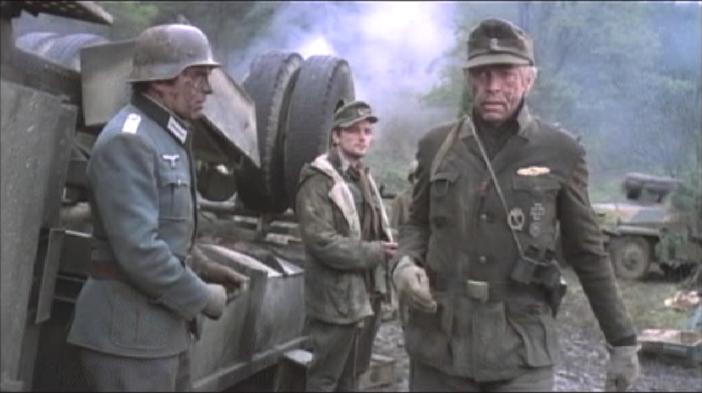
Stransky, Meyer, and Steiner
When Stransky meets Steiner, he is angered by Steiner’s lack of respect for his “superior” (in rank and social status) officer. Steiner simply tolerates Stransky as the latest in a long line of clueless officers. When Stransky insists the orders to take no prisoners be carried out by shooting the boy, Steiner refuses, but the confrontation is diffused when one of the squad members promises to do it. He lies and later Steiner releases the boy and points homeward. The boy is immediately killed by attacking Russians. Oh, the irony.
The attack is a major one with frantic battle action. There are more slow motion deaths and lots of explosions. There is hand-to-hand combat and Steiner is wounded. His respected platoon leader Lt. Meyer is killed leading a counterattack. Later, Stransky (who cowered in his bunker during the battle) claims he led the successful counterattack and deserves the Iron Cross.
Steiner ends up in a hospital which results in some surreal scenes as he hallucinates and sees old comrades. He has an affair with a nurse (Senta Berger). In a telling scene, a general arrives with propaganda film crew to show the wonderful treatment of the men, but once the shots are done the banquet is reserved for the visiting officers. When Steiner is recovered enough (in his opinion), he abandons the nurse in favor of a return to his unit (cliché alert).
When Steiner returns to the squad’s bunker, he finds some of his men are dead and they now have a Nazi Party member attached to them. In a great scene, Steiner is called before Brandt to verify Stransky’s leading the counterattack. Stransky has two eyewitnesses – Steiner and a homosexual adjutant named Treibig who he is blackmailing. Brandt suspects Stransky is lying and wants Steiner to confirm his suspicions. Steiner surprises him by asking for more time. Brandt peevishly points out that he has tolerated a lot of insubordination from Steiner, prompting an outburst from Steiner in which he proclaims that he does not care that Brandt is “enlightened”. He hates all officers and, in fact, the whole army.
The Germans are forced to retreat, but Stransky sees an opportunity to silence Steiner by not passing on the order. The Russians move in with tanks. The squad takes refuge in a factory, but a tank simply plows through the wall. They escape through a tunnel. The action is intense.
They are on the run and moving cross country to try to reach German lines. They reach a village and take a unit of Russian female soldiers captive. The Party worm attempts to rape one of the women, but gets his genitalia bitten off and kills her. The scene is unique in that the women are treated sympathetically. When they kill one of the Germans who was distracted, Steiner does not retaliate. They would have done the same, I suppose. Steiner even gives them the Party guy as a parting gift.
They reach the German lines but still have to cross no man’s land. They send a message warning the Germans not to shoot as they are coming in, but Stransky gets his toadie Treibig to open fire on these “Russians” coming through the wire. Several members are killed in graphic, slow motion deaths. Steiner guns down Treibig and goes looking for Stransky.
CLOSING: The Russians choose this moment to launch an attack. Lots of explosions and flying debris. It’s as though Peckinpah added an Indian attack to the showdown scene of a one of his westerns. Steiner tracks down Stransky amidst all the chaos, but decides not to kill him. Instead, they go out together to fight. Steiner has shamed Stransky into earning the Iron Cross. The movie ends with Stransky fumbling with reloading his machine gun and Steiner laughing at him.
RATINGS:
Action - 9
Acting - 9
Accuracy - 8
Realism - 8
Plot - 8
Overall – 8
WOULD CHICKS DIG IT? This is a very manly movie. It is unlikely your significant other will enjoy it. There is only one significant female character and she is treated like a piece of meat. The movie is very grimy and gritty. It pulls no punches. The scene with the Russian female soldiers is admirably nonsexist, but most women would find it discomforting. Besides, how many women are Sam Peckinpah fans?
ACCURACY: Willi Heinrich was a veteran of the Eastern Front and was wounded five times so he knew of which he wrote. The book is probably partly autobiographical. It is also claimed the book is based on the experiences of the decorated soldier Johannsch Werdfeger who won two Iron Crosses.
The movie does not claim to be a true story. The battles are generic and represent typical battles during the Taman Peninsula campaign. The fighting is realistic in a Hollywood sort of way. Peckinpah does stage chaos well. The sets are appropriately decimated. The deaths appropriately random.
The movie is helped in its realism by the authentic weapons. The Russian tanks are T34/85’s on loan from the Yugoslavian Army. I won’t quibble with the fact that that particular model was not in use in 1943. The small arms are accurate. One flaw is the use of F4U Corsairs to represent Russian fighter-bombers. Gull wings – did they think we would not notice?
The small unit dynamics of the squad, especially in the bunker scenes ring true. The soldier banter is realistic. The comradery is what you expect for a squad that had gone through all they went through. The attitudes of the enlisted and the officers in the German army circa 1943 are well displayed. The cynicism and defeatism is apparent.
CRITIQUE: “Cross of Iron” is a special movie. There is no other war movie quite like it. It has the Peckinpah touch throughout it – the trademark slow motion violence, the iconoclastic anti-hero, the lack of respect for authority. An American war movie concentrating on Germans on the Eastern Front is unique.
The movie is certainly action-packed with lots of explosions. It is a great combat movie and has several combat scenes that are among the best filmed. It does have its exposition parts (which are necessary to develop the conflict between Steiner and Stransky and to explain Brandt’s role in the triangle), but the movie is definitely not wordy.
The movie is an excellent depiction of small unit warfare, but it also gives a taste of command. Brandt is a sympathetic soldiers-general and Keisel represents another type – the cynical staff officer. Stransky is yet another type – the chicken-hearted glory hound. Steiner portrays the hardened NCO who cares more for the survival of his men than the “big picture”. The movie is refreshingly free of the stereotyped evil Nazis. Stransky is not a Nazi – he is an aristocrat who is fighting for his family honor, not Hitler.
The acting is outstanding. Coburn deserved an Academy Award nomination and has one of his best roles. He is perfect as Steiner. He is ably supported by Mason, Warner, and Schell. I especially enjoyed Warner’s cynical Keisel. He is riveting whenever he appears. Schell is appropriately loathsome. The unknown actors who make up the squad also do a good job.
The ending has drawn mixed reviews. I personally did not like it. I found it out of character that after killing Treibig, Steiner does not kill the more despicable Stransky. Why would he suddenly change his mind? Then Stransky in a character-flip does not kill Steiner when he turns his back on him. Either one of these character shifts would be hard to swallow, but both? I did not mind the abrupt halt to the movie.
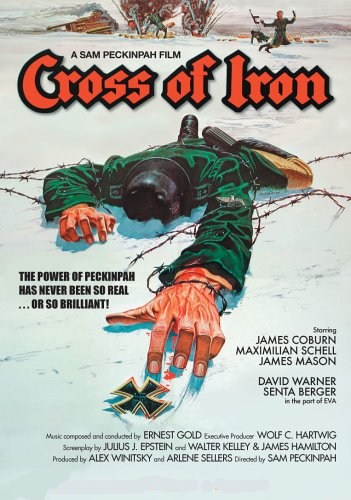
CONCLUSION: If you want a war movie that is adrenalin-fueled and well-acted, try “Cross of Iron”. It is not subtle, but it is not one-dimensional either. It is definitely underrated at #64. It seems incredible that it is only two places higher than “Castle Keep”! I feel confident it will be in the top fifty of my 100 Best War Movies list. By the way, that is a great movie poster.
COMING UP:I will be reviewing the History Channel special on "Gettysburg" on May 30 at 9 EST.
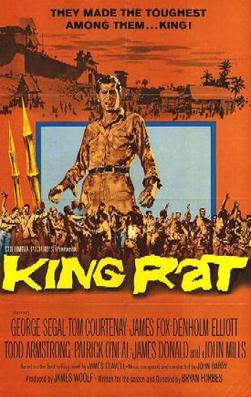
“King Rat” is a WWII prisoner of war movie released in 1965. It was based on the novel by James Clavell. The film is set in the infamous Changi Prison Camp on the island of Singapore in 1945. It is a tale of survival, not escape. The main character is an American in a mostly British camp. He is Corporal King (George Segal) and he unofficially runs the camp because he is the go-to guy for anything a prisoner might want – at a price. He is amoral and enjoys it. Because he has profited from his acquisition “skills” he looks spic and span and eats well. Most of the inmates resent him, especially the Provost Marshall, Lt. Grey (Thomas Courtney). Grey is an officious British officer who is obsessed with bringing King to justice. He is having a hard time catching the King red-handed, however.
King develops a dysfunctional relationship with the suave, upper class Brit Peter Marlowe (James Fox). He wants him to act as an interpreter (he speaks Malay) and tries to put him on the payroll by offering him an egg. Marlowe cannot be bribed, but he is intrigued by the charismatic King and takes the job.
King has a posse, which includes toady Sgt. Max (Patrick O’ Neal), that he lords over. They come up with a scheme to breed rats and sell the meat as mouse deer. Meanwhile, Grey discovers corruption in the food distribution. When he brings the accusation to Col. Smedley-Taylor (John Mills), he finds out the brass are involved and is told he should ignore it. He is incensed, but the offer of a promotion calms him down. So who is worse – King or the camp leaders?
King is a strange character. When he is almost caught with money gained from trading with the Japanese, he gets Marlowe to hide the evidence and then gets expensive medicine to save Marlowe’s gangrenous arm from being amputated. Is he doing this out of friendship or because only Marlowe knows where he buried the money? It is unclear because King is such a dislikable person.
The British officers are called in and the commandant shocks them with news that the war is over. Everyone in the camp celebrates except King who realizes that not only are his salad days over, but the sword of justice now hangs over his head. He barely survives a fit by the seething Max. When a single British paratrooper (Richard Dawson!) arrives to liberate the camp, he pointedly asks King why he looks a lot fitter than the other prisoners. The hand-writing is on the wall for King. Marlowe defends King’s actions to Grey by pointing out that hatred of King is what kept Grey alive. However, King turns his back on Marlowe’s attempt to part on good terms. Is King trying to save Marlowe from guilt by association?
At the end of the film, King is leaving with the other Americans in a truck. He stands in the back of the truck with his arms out like Christ on the crucifix – an image that, if planned by the director, does not fit his character at all.
This is a pretty bleak movie, although it has its moments of black humor. It does accurately reflect conditions in a Japanese prison camp. We can assume this because James Clavell spent three years in Chongi. The conditions are not exaggerated in part because Chongi was actually one of the better run Japanese camps. What’s bleak is the men themselves. The prisoners are gaunt and they sweat a lot. Only King is not a scarecrow. They also smoke cigarettes whenever they can get them which makes butts a type of currency in the camp. This is a movie that will make some non-smokers and all vegetarians sick. The camp brings out the worst in some men. There probably were men like King in every camp, but you do not see them in most POW movies.
Some of the movie strains credulity a bit. King does not hold sway because of physical intimidation. He is in the distinct minority as an American and is disliked by the vast majority, including members of his entourage. Realistically, he would have been killed for his stash (which his posse knows the location of).
The movie is well respected in the prisoner of war genre. It contrasts well with the more up-beat and optimistic ones like “The Great Escape” or “The Colditz Story”. It is interesting to note that TGE came out in 1963 before the 60s cynicism hit Hollywood and KR came out in 1965 about the time that cynicism begins to be felt. To see what I mean, compare the scrounger in TGE (Hendley – James Garner) to King. Being more realistically depressing does not make it a better movie than TGE and it is probably a bit overrated. But you have to give it credit for showing survival over escape. It came as a surprise to me that it was nominated for two Academy Awards (cinematography and art direction). The acting is good, especially Segal who has to be unlikable (Paul Newman and Steve McQueen turned down the role). Watch it if you want a different point of view on prison life.
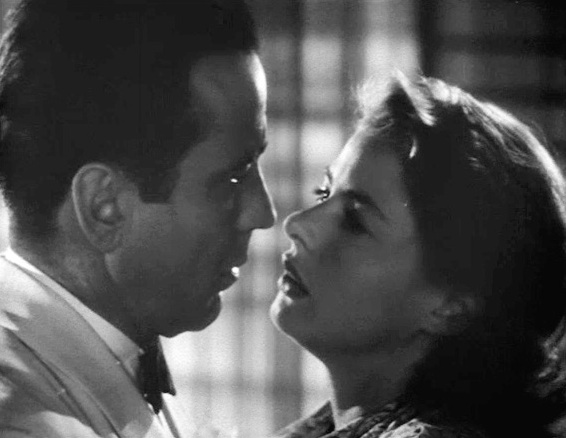
BACK-STORY: “Casablanca” is a war movie released in 1942 to coincide with Operation Torch and the liberation of Casablanca. It is based on an unproduced play entitled “Everybody Comes to Rick’s”. Shockingly, several writers adapted it which flies in the face of multi writers signaling problems. It was directed by Michael Curtiz. It was Bogart’s first romantic role. In spite of the chemistry between him and Ingrid Bergman, they never made another film together. Only three American actors have roles. Many of the extras were Jewish refugees. It was filmed at the studio. The Production Code Administration had all direct references to sex removed from the script. (Note to current television writers, it is possible to be sexy without beating the audience over the head.) It won three Oscars (Picture, Director, Screenplay) and was nominated for Actor (Bogart – robbed by Paul Lukas (who?) in “Watch on the Rhine”!!), Supporting Actor (Rains – robbed by Charles Coburn in “The More the Merrier”!), Cinematography (how did it lose that one?), Editing, and Music. There was only half-hearted talk of a sequel. Times change.
OPENING: A narrator explains the situation in Vichy-controlled Morocco. It is a transit point for refugees hoping to get to Portugal and then to safety in America. Most are stuck and waiting…waiting…waiting… The search is on for the murderer of two Nazi couriers. The criminal has taken two “letters of transit” which will fetch a great price. Capt. Renaud (the local Vichy police chief) is rounding up the usual suspects.
Henreid, Bergman, Rains, and Bogart
SUMMARY: At Rick’s Café Americain, the cynical expatriate Rick Blaine is visited by Ugarte (Peter Lorre) who is a petty criminal who has two letters of transit for sale. Czech Resistance leader Victor Laszlo (Paul Henreid) arrives in Casablanca. He has escaped from a concentration camp and is on the lam. He is accompanied by his wife Ilsa (Bergman). He needs the letters of transit. The typically loathsome Nazi Maj. Strasser (Conrad Veidt – an anti-Nazi who had fled Germany) of the Gestapo is in town to get Laszlo, but cannot simply arrest him in Vichy jurisdiction. When Ilsa asks the house piano player Sam (Dooley Wilson – a drummer who could not play the piano) to play “As Time Goes By”, Rick realizes his ex-lover is in town. He gleefully greets her like a lovelorn schoolboy. Not really.
A flashback reveals the reason for Rick’s bitterness. Rick and Ilsa had had a fling in Paris in 1940. They drove around in front of a movie screen and also boated in front of a screen (so much for 1940s special effects). We get a montage of romantic moments. We are left to wonder whether they had sex. It seems likely. They are scheduled to flee as Paris falls, but Ilsa does not show up at the train station. She leaves a note saying she loves him, but it’s over. She runs out of ink before she can explain why.
We find out that Rick was a gun runner to Ethiopians fighting the Italian invasion and then later he fought in the Spanish Civil War. These are his bona vides as a cynical fascist hater. In the café, “La Marseillaise” wins a duel with “Die Wacht am Rhein” (“Watch on the Rhine”). Movie audiences must have high-fived at this point.
Bergman preferred her left side
Ilsa visits Rick to beg for the letters. He refuses. She pulls a gun, then cries. (Not realizing if she had done the crying first, the gun would have been unnecessary.) He cracks (he may be Bogart, but even he cannot withstand the ultimate female weapon). She explains why she left him in Paris (in an amazing coincidence, her assumed-to-be-dead husband showed up the day of the train rendezvous. Better late than never.) They rekindle their love. He promises to help Laszlo escape with the understanding that she will stay.
Laszlo arrives to beg Rick to use the letters to escort Ilsa to safety. It turns out he figured out the love of Rick and Ilsa because of the steam. Laszlo is arrested on a trumped up charge before the conversation is over. Rick makes a deal with Renaud to entrap Laszlo on a more serious charge. Renaud releases Laszlo, and then Rick turns a gun on Renaud.
scenes from the satanic colorized version
CLOSING: Come on, if you don’t know what happens you would not have read up to this point because either you don’t know how to read or you are a teenager (or both). Anyway, at the airport, Rick insists Ilsa leave with Laszlo because if she doesn’t she will regret it. “Maybe not today, maybe not tomorrow, but soon and for the rest of your life. Plus, the motion picture code will not allow you to stay because you are married.” (That last sentence was cut from the final version.) Rick says “Here’s looking at you, kid” for the fourth and last time. He kills Strosser and goes walking off with Renaud (who has ordered the rounding up of “the usual suspects”) and they plan to join the Free French. “Louis, I think this is the beginning of a beautiful friendship”. A friendship based on cynicism and back-stabbing.
RATINGS:
Acting - 10
Action - 5
Accuracy - N/A
Realism - 8
Plot - 10
Overall - 9
WOULD CHICKS DIG IT? Are you kidding? Bogart and Bergman. As they said about the Kennedy’s, every woman would want to be with Bogart and every woman would want to be Bergman. The chemistry between the two is sizzling. The romance is heart-tugging and realistic. Watch out guys, the movie could prompt disillusionment in your significant other. However, this should be cancelled out by the props you get for watching it with her. Also, you won’t have to talk her into watching a war movie because she won’t recognize it as such.
ACCURACY: Accuracy is not really an issue. It does not claim to be based on a true story. The general outline is accurate. Morocco in 1941 was officially part of Vichy France and thus technically out of Nazi jurisdiction. Casablanca was a transit point for European refugees trying to get to Portugal and then to America. It seems likely that under real circumstances the Gestapo would have had less scruples about eliminating a resistance leader like Laszlo. The “letters of transit” were a fictitious plot device. In my opinion, one of the most accurate statements in the movie is made by Ferrari (Sidney Greenstreet) who is Rick’s shady-operator rival. He opines: “My dear Rick, when will you realize that in this world today, isolationism is no longer a practical policy?” The screenwriters obviously agreed with that sentiment, as did FDR who screened the movie in The White House (la casa blanca).
CRITIQUE: “Casablanca” is one of the top five movies of all time. It is one of the few “classics” that holds up for modern audiences. The dialogue is crackling. Numerous quotes are among the greatest in movie history. The acting is top notch. Bogart is at the top of his game and he is matched by Bergman. Rains is outstanding in the best performance of his career. The only downer is Henreid’s stiff performance, but that was partly due to the saintliness of the character. You throw in Strasser, Lorre, and Greenstreet and you have an amazing cast. The musical score keeps pace with the acting. The song “As Time Goes By” is justifiably one of the most memorable in cinema history. The cinematography is awesome. Bergman’s face is shot in such a way to highlight her conflicting emotions. The darkness and shadows give the film a film noir feel. The theme of sacrifice resonated in WWII America, but can be understood at any time. The cynic who does the right thing may be stereotypical, but Bogart set the template for it. This is an adult movie for adults.
CONCLUSION: “Casablanca” is one of the greatest movies of all time, but is it one of the greatest war movies? It certainly fits the 100 Greatest list better than "Foreign Correspondent" or “Notorious” (which incredibly is placed 8 slots higher than "Casablanca"!), for example. I am more comfortable with it being placed in that vague category of “movies set in war”. If you classify it as a war movie, how do you place it at only #65 when it is clearly superior as a movie to virtually every movie on the list? For that reason, although I love it, it will not be on my eventual 100 Best War Movies list. Watch it for the tenth time anyway.



.jpg)




.jpg)