Showing posts with label Battle of Hamburger Hill. Show all posts

Thursday, May 20, 2021

HISTORICAL ACCURACY: Hamburger Hill


Today is the 52nd anniversary of the ending of the Battle of Ap Bia.  I had already reviewed the movie "Hamburger Hill", so here is the analysis of the accuracy of the movie.

                Hamburger Hill” has a reputation of being one of the most accurate Vietnam War movies and this is justified, although the movie is not perfect, of course.  It chronicles the involvement of a 14-man platoon from B Company, 3rd Battalion, 187th Infantry Regiment, 101st Airborne Division in the Battle of Ap Bia Mountain in the A Shau Valley in S. Vietnam.  The battle was part of Operation Apache Snow which was basically a large-scale search and destroy operation to disrupt enemy control of the valley.  The most famous action in the operation was the assault on Hill 937 from May 11-20, 1969.  The 3/187 was tasked with taking the hill from the south.  It was expected to be a few hours of work. This was way off partly because of inadequate intelligence and the belief that the enemy was likely to put up a sharp fight and then retreat.  Maj. Gen. Melvin Zais was not expecting a repeat of Dak To where the enemy had put up a sustained fight for days. 

                Hill 937 refers to the height of the hill, which made it about 3,000 feet above sea level.  It was thickly jungled which made fire support difficult.  Lt. Col. Weldon Honeycutt, the commander of 3/187, was nicknamed Tiger and had a reputation for aggressive tactics.  His call signal was “Blackjack” which is how he is referred to in the movie.  The battle did start with a combat assault via helicopters on May 10, but B Company was not landed until May 13 and was originally tasked with taking Hill 916, which it did on May 15 with a minor amount of difficulty.  The rest of the battalion began the first of an estimate 11 assaults on May 14.  The movie is good at showing the difficulties encountered.  The enemy were dug in and used machine guns, grenades, and RPGs (not shown in the movie) to great effect.  American artillery and air bombardment were negated by bomb shelters.  Rain and the resulting mud made ascension of the steep hill very difficult.  To make matters worse, there were five separate friendly fire incidents, four by helicopters.  7 Americans were killed and 53 wounded.  The movie does a good job showing one of them. 

                The first reporters arrived on May 16, but at first they maintained the party line that the battle was going well.  However, on May 19, Jay Sharbutt interviewed grunts coming down from the mountain after another failed assault and his report awakened Americans to the true nature of the battle.  Sharbutt asked the question why infantry was being used to do what firepower could have accomplished.  For instance, B-52s were not used.  Most of the soldiers he talked to were disillusioned with the battle and several had harsh things to say about Honeycutt.  One of them described the battle as a meat grinder and the name “Hamburger Hill” was coined.

                On May 18, Zais planned an attack by 1/506 from the north to coordinate with 3/187 again attacking from the south.  Company D almost reached the summit before retreating with every officer either killed or wounded.  Zais decided to relieve 3/187 on May 19, but Honeycutt pitched a fit, demanding that his boys be allowed to finish the job.  You can imagine how that went over with the men.  The next day the final attack was successful.  A total of 72 Americans were killed and 372 were wounded.  Some companies lost 50-75% of their men, although the 79% of the movie seems a bit high.  (And if you count Beletsky, who was wounded and about to be evacuated, but somehow is in at the end, it would be 86%.)   But let’s not quibble, the movie does a good job of showing the high casualty rate.  However, it should be noted that at Dak To (a battle the soldiers refer to in the movie), the casualties were much worse. 

                The movie makes a point of criticizing the lack of support for the war from the home front.  In some ways the movie is more anti-anti-war than it is anti-war.  While the acts of people throwing dog feces on vets has been overblown, there is no doubt that by May, 1969 the American public had soured on the war.  In Feb., 1969 only 39% of Americans supported the war and 52% felt it had been a mistake to send troops.  The Battle of Ap Bia did not bring those percentages down.  It boosted the anti-war movement, especially since the hill was abandoned on June 5.  This played into the narrative of “what the hell are we doing over there?”  A question both doves and hawks could ask.  The reporter in the movie refers to Sen. Edward Kennedy questioning the battle.  He actually made the speech on May 20, but close enough.  Kennedy called it “senseless and irresponsible… madness”.  While the movie does question the frontal tactics, director John Irvin clearly disagrees with Kennedy’s assessment which is evident from his post script proclaiming the battle to have been a victory, but no reference to the biggest takeaway – the hill was not kept.  Clausewitz said that if the sacrifices made in a battle do not exceed the value of the outcome, you should not pursue the objective.  Hamburger Hill was a classic violation of this principle.          

Wednesday, April 16, 2014

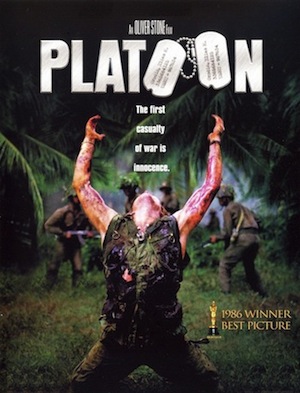
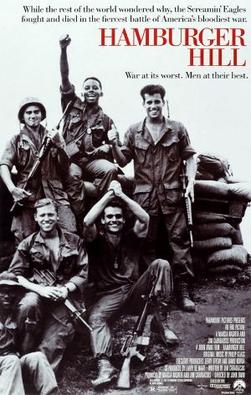
HAMBURGER HILL (1) vs. PLATOON (5)


VS.


CLICHES
“Hamburger Hill” has several classic war movie clichés. Some are particular to the Vietnam War. There is a scene that emphasizes the cluelessness of the media about the true nature of the war. The soldier who is short is doomed to die before he can enact the joyful homecoming that he brags about. Two standards are updated for the war. A character receives a “Dear John” letter, but his girl friend advances one of the film’s themes by explaining that she is jilting him because of her anti-war college friends. There is the trite appearance of “Hanoi Hannah” who makes the obligatory reference to their unit. We also get the guy who talks about the car he is going to buy back in “the world”. Even though the movie focuses on the five replacements, that does not stop it from killing them off. On the other hand, the unit is not overtly heterogeneous and the grunt who shows off his girl friend’s picture does not die. C

“Platoon” also has several classic war movie clichés. In fact almost immediately we get a double dose with the fat guy ensuring his doom by showing off a picture of his girl. The movie helped establish some uniquely Vietnam tropes. The LT is green and incompetent. The sergeants run the platoon. There is a psycho in the unit who enjoys the killing. The incompetent leader calls in the wrong coordinates, resulting in a friendly fire incident. In one refreshing twist, the short-timer (King) is evaced before the final battle. The unit is heterogeneous, but not in a barracks identification scene sort of way. C

FIRST QUARTER SCORE

Hamburger Hill = 7
Platoon = 7


DIALOGUE

The dialogue in HH could be described as stilted and it tries too hard to sound authentic to the way the grunts talked. I have read a lot of eye-witness accounts and found several of the lines and the sincerity with which they were uttered to be laughable. There is a monologue by Worchester about his experience back home that is painful to listen to because it is so melodramatic. On the positive side, for those who have not read a lot on the war, you do get the greatest slang hits. C

“Platoon” was written by a combat veteran and although Stone can be faulted for excesses in many of his movies, his dialogue is restrained in this film. He interweaves slang into the soldier speak in a natural way. There are some fine dialogue driven scenes like when Elias explains the evolution of his war view to Taylor. The companion scene with Barnes in the doper’s bunker nicely bookends this. There are some great lines and they are spread a out among the characters. Some are critical of Taylor’s narration, but I feel that although flowery at times, it does add to the theme of lost innocence. A

HALF TIME SCORE

Hamburger Hill = 14
Platoon = 16


IMPLAUSIBILITIES

HH does not have any glaring implausibilities. The most ridiculous moment is a key moment in the film. Worcester recounts his return to the states and the litany of abuses he encountered. It is a montage of urban myths about the treatment of returning vets. Hippies throw dog poop on him, a hippie is shacked up with his wife, and everyone he meets is hostile. This is gross exaggeration pushed by the anti-anti-war movement. The film fulfills the short-timer must die by putting McDaniel on point. This would have been highly unlikely in reality. Similarly, when Duffy takes a bullet in the shoulder, he is not sent back off the line. The movie offers a lame excuse for this. As is typical for most war movies, artillery fire support is called in much too close to the friendlies. B

Much of the implausibilities in “Platoon” are designed to advance the main plot theme of the dysfunctional platoon dynamics. The whole idea of a platoon divided not only between two sergeants, but divided into dopers and boozers is clearly a plot device. Resolving this with two fragging incidents is pure Hollywood. However, most of the incidents that develop the theme are plausible, including the atrocity. B

THIRD QUARTER SCORE

Hamburger Hill = 22
Platoon = 24


EDUCATIONAL VALUE

You can learn a few things from HH.
1. The Chieu Hoi program encouraged VC to defect to the ARVN. (In the movie, the defector is NVA and he is helping the U.S. Army.)
2. The NVA were nicknamed “Nathanael Victor” as opposed to “Charlie” for the VC.
3. The NVA were respected by the Americans and were worthy adversaries.
4. Contact with a single enemy would bring an American unit to ground.
5. New guys (FNGs) were not welcomed with open arms.
6. There were racial tensions in units, but the closer to the front line, the more the men put color behind them. There was an unofficial segregation of the races in the rear areas.
7. The Battle of Hamburger Hill is pretty accurately portrayed, but the movie flubs a teachable moment by not including a post script pointing out that the hill was abandoned soon after its bloody conquest. Probably purposefully because this historical fact clashed with the theme of flogging the anti-war movement. B

Although not based on an actual battle, Stone insists the incidents and characters in his film are based on his Vietnam experience. Taken as just a tutorial on the Vietnam experience, “Platoon” teaches a number of things to an audience not well-read on the subject.

1. Replacement soldiers (i.e. Cherries) were treated like dirt.
2. Sergeants ran the platoons in many cases.
3. Every soldier knew how many days that they had left in their tour.
4. If a Vietnamese civilian ran, it was assumed they were the enemy and you could shoot them.
5. Villages were burned if they were considered sympathetic to the Communists.
6. Some soldiers injured themselves to get out of combat.
7. Volunteers felt they were fighting for our society and freedom.
8. Latrine waste was burned using kerosene.
9. Drug and alcohol use was common in rear areas.
10. Young Americans sometimes committed atrocities due to stress or revenge.
11. The Vietnam War gave some sociopaths an outlet. A

FINAL SCORE

Hamburger Hill = 30
Platoon = 33


ANALYSIS

This is my fourth March Madness tournament and once again the #1 seed does not win. I suppose this is partly explained by using “Rotten Tomatoes” for the seeding. My theory is that generic movie critics look at war movies differently than I do. I’m a lot more specific to what makes a movie good within the genre. That is not to say that HH is not a very good movie. It deserved to be highly seeded. On the other hand, “Platoon” was criminally seeded at #5. Four Vietnam War movies better than “Platoon”? No way. I am aware that the film is polarizing and its victory will upset people, but I think that I am on firm ground here. Fire away.