Showing posts with label Hamburger Hill. Show all posts

Thursday, May 20, 2021

HISTORICAL ACCURACY: Hamburger Hill


Today is the 52nd anniversary of the ending of the Battle of Ap Bia.  I had already reviewed the movie "Hamburger Hill", so here is the analysis of the accuracy of the movie.

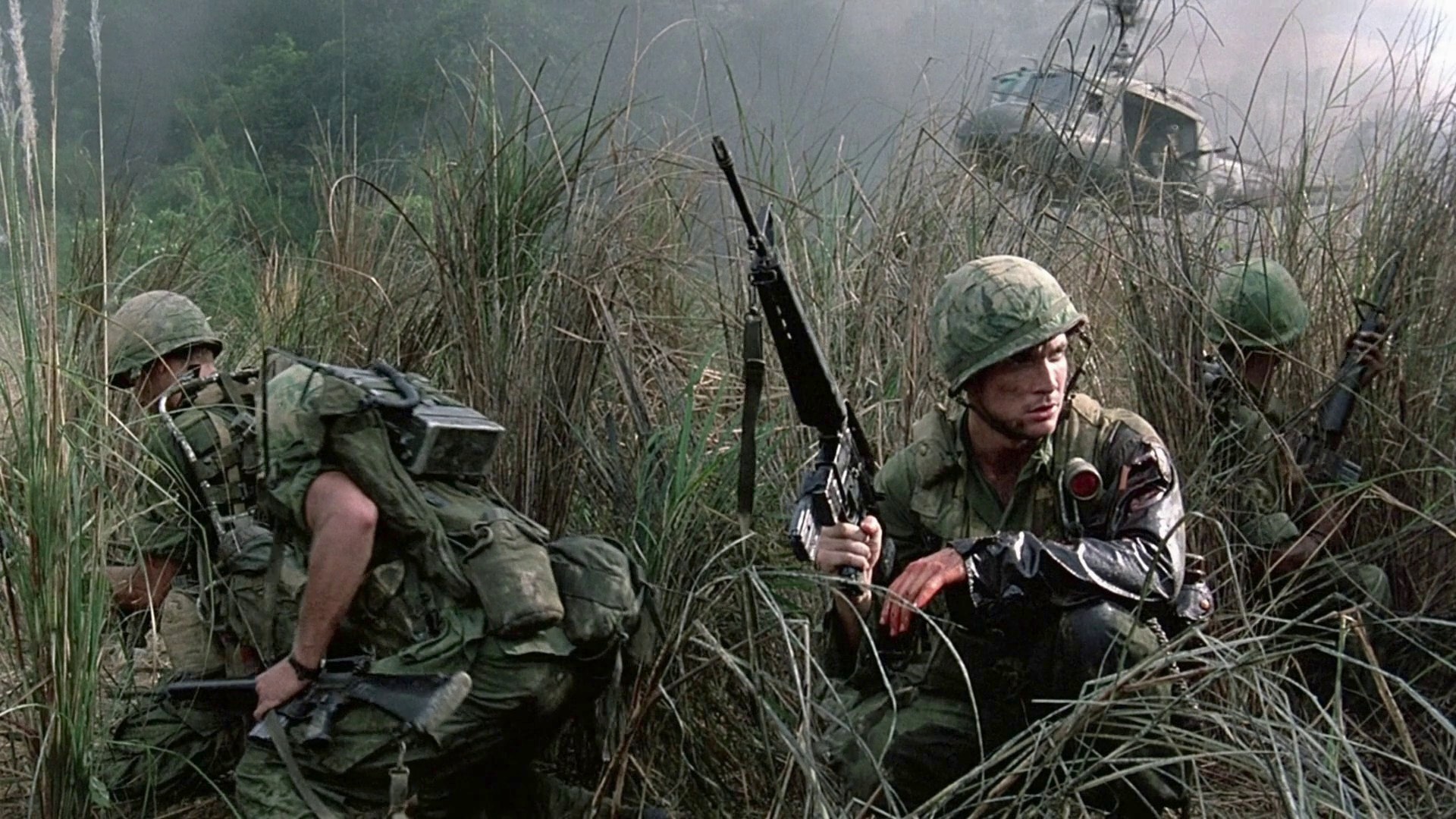
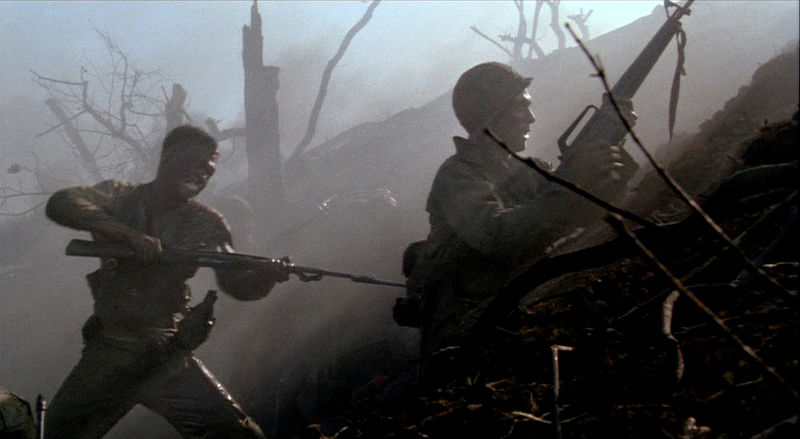
                Hamburger Hill” has a reputation of being one of the most accurate Vietnam War movies and this is justified, although the movie is not perfect, of course.  It chronicles the involvement of a 14-man platoon from B Company, 3rd Battalion, 187th Infantry Regiment, 101st Airborne Division in the Battle of Ap Bia Mountain in the A Shau Valley in S. Vietnam.  The battle was part of Operation Apache Snow which was basically a large-scale search and destroy operation to disrupt enemy control of the valley.  The most famous action in the operation was the assault on Hill 937 from May 11-20, 1969.  The 3/187 was tasked with taking the hill from the south.  It was expected to be a few hours of work. This was way off partly because of inadequate intelligence and the belief that the enemy was likely to put up a sharp fight and then retreat.  Maj. Gen. Melvin Zais was not expecting a repeat of Dak To where the enemy had put up a sustained fight for days. 

                Hill 937 refers to the height of the hill, which made it about 3,000 feet above sea level.  It was thickly jungled which made fire support difficult.  Lt. Col. Weldon Honeycutt, the commander of 3/187, was nicknamed Tiger and had a reputation for aggressive tactics.  His call signal was “Blackjack” which is how he is referred to in the movie.  The battle did start with a combat assault via helicopters on May 10, but B Company was not landed until May 13 and was originally tasked with taking Hill 916, which it did on May 15 with a minor amount of difficulty.  The rest of the battalion began the first of an estimate 11 assaults on May 14.  The movie is good at showing the difficulties encountered.  The enemy were dug in and used machine guns, grenades, and RPGs (not shown in the movie) to great effect.  American artillery and air bombardment were negated by bomb shelters.  Rain and the resulting mud made ascension of the steep hill very difficult.  To make matters worse, there were five separate friendly fire incidents, four by helicopters.  7 Americans were killed and 53 wounded.  The movie does a good job showing one of them. 

                The first reporters arrived on May 16, but at first they maintained the party line that the battle was going well.  However, on May 19, Jay Sharbutt interviewed grunts coming down from the mountain after another failed assault and his report awakened Americans to the true nature of the battle.  Sharbutt asked the question why infantry was being used to do what firepower could have accomplished.  For instance, B-52s were not used.  Most of the soldiers he talked to were disillusioned with the battle and several had harsh things to say about Honeycutt.  One of them described the battle as a meat grinder and the name “Hamburger Hill” was coined.

                On May 18, Zais planned an attack by 1/506 from the north to coordinate with 3/187 again attacking from the south.  Company D almost reached the summit before retreating with every officer either killed or wounded.  Zais decided to relieve 3/187 on May 19, but Honeycutt pitched a fit, demanding that his boys be allowed to finish the job.  You can imagine how that went over with the men.  The next day the final attack was successful.  A total of 72 Americans were killed and 372 were wounded.  Some companies lost 50-75% of their men, although the 79% of the movie seems a bit high.  (And if you count Beletsky, who was wounded and about to be evacuated, but somehow is in at the end, it would be 86%.)   But let’s not quibble, the movie does a good job of showing the high casualty rate.  However, it should be noted that at Dak To (a battle the soldiers refer to in the movie), the casualties were much worse. 

                The movie makes a point of criticizing the lack of support for the war from the home front.  In some ways the movie is more anti-anti-war than it is anti-war.  While the acts of people throwing dog feces on vets has been overblown, there is no doubt that by May, 1969 the American public had soured on the war.  In Feb., 1969 only 39% of Americans supported the war and 52% felt it had been a mistake to send troops.  The Battle of Ap Bia did not bring those percentages down.  It boosted the anti-war movement, especially since the hill was abandoned on June 5.  This played into the narrative of “what the hell are we doing over there?”  A question both doves and hawks could ask.  The reporter in the movie refers to Sen. Edward Kennedy questioning the battle.  He actually made the speech on May 20, but close enough.  Kennedy called it “senseless and irresponsible… madness”.  While the movie does question the frontal tactics, director John Irvin clearly disagrees with Kennedy’s assessment which is evident from his post script proclaiming the battle to have been a victory, but no reference to the biggest takeaway – the hill was not kept.  Clausewitz said that if the sacrifices made in a battle do not exceed the value of the outcome, you should not pursue the objective.  Hamburger Hill was a classic violation of this principle.          

Wednesday, April 16, 2014

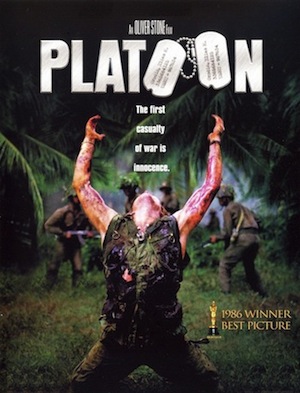
HAMBURGER HILL (1) vs. PLATOON (5)


VS.


CLICHES
“Hamburger Hill” has several classic war movie clichés. Some are particular to the Vietnam War. There is a scene that emphasizes the cluelessness of the media about the true nature of the war. The soldier who is short is doomed to die before he can enact the joyful homecoming that he brags about. Two standards are updated for the war. A character receives a “Dear John” letter, but his girl friend advances one of the film’s themes by explaining that she is jilting him because of her anti-war college friends. There is the trite appearance of “Hanoi Hannah” who makes the obligatory reference to their unit. We also get the guy who talks about the car he is going to buy back in “the world”. Even though the movie focuses on the five replacements, that does not stop it from killing them off. On the other hand, the unit is not overtly heterogeneous and the grunt who shows off his girl friend’s picture does not die. C

“Platoon” also has several classic war movie clichés. In fact almost immediately we get a double dose with the fat guy ensuring his doom by showing off a picture of his girl. The movie helped establish some uniquely Vietnam tropes. The LT is green and incompetent. The sergeants run the platoon. There is a psycho in the unit who enjoys the killing. The incompetent leader calls in the wrong coordinates, resulting in a friendly fire incident. In one refreshing twist, the short-timer (King) is evaced before the final battle. The unit is heterogeneous, but not in a barracks identification scene sort of way. C

FIRST QUARTER SCORE

Hamburger Hill = 7
Platoon = 7


DIALOGUE

The dialogue in HH could be described as stilted and it tries too hard to sound authentic to the way the grunts talked. I have read a lot of eye-witness accounts and found several of the lines and the sincerity with which they were uttered to be laughable. There is a monologue by Worchester about his experience back home that is painful to listen to because it is so melodramatic. On the positive side, for those who have not read a lot on the war, you do get the greatest slang hits. C

“Platoon” was written by a combat veteran and although Stone can be faulted for excesses in many of his movies, his dialogue is restrained in this film. He interweaves slang into the soldier speak in a natural way. There are some fine dialogue driven scenes like when Elias explains the evolution of his war view to Taylor. The companion scene with Barnes in the doper’s bunker nicely bookends this. There are some great lines and they are spread a out among the characters. Some are critical of Taylor’s narration, but I feel that although flowery at times, it does add to the theme of lost innocence. A

HALF TIME SCORE

Hamburger Hill = 14
Platoon = 16


IMPLAUSIBILITIES

HH does not have any glaring implausibilities. The most ridiculous moment is a key moment in the film. Worcester recounts his return to the states and the litany of abuses he encountered. It is a montage of urban myths about the treatment of returning vets. Hippies throw dog poop on him, a hippie is shacked up with his wife, and everyone he meets is hostile. This is gross exaggeration pushed by the anti-anti-war movement. The film fulfills the short-timer must die by putting McDaniel on point. This would have been highly unlikely in reality. Similarly, when Duffy takes a bullet in the shoulder, he is not sent back off the line. The movie offers a lame excuse for this. As is typical for most war movies, artillery fire support is called in much too close to the friendlies. B

Much of the implausibilities in “Platoon” are designed to advance the main plot theme of the dysfunctional platoon dynamics. The whole idea of a platoon divided not only between two sergeants, but divided into dopers and boozers is clearly a plot device. Resolving this with two fragging incidents is pure Hollywood. However, most of the incidents that develop the theme are plausible, including the atrocity. B

THIRD QUARTER SCORE

Hamburger Hill = 22
Platoon = 24


EDUCATIONAL VALUE

You can learn a few things from HH.
1. The Chieu Hoi program encouraged VC to defect to the ARVN. (In the movie, the defector is NVA and he is helping the U.S. Army.)
2. The NVA were nicknamed “Nathanael Victor” as opposed to “Charlie” for the VC.
3. The NVA were respected by the Americans and were worthy adversaries.
4. Contact with a single enemy would bring an American unit to ground.
5. New guys (FNGs) were not welcomed with open arms.
6. There were racial tensions in units, but the closer to the front line, the more the men put color behind them. There was an unofficial segregation of the races in the rear areas.
7. The Battle of Hamburger Hill is pretty accurately portrayed, but the movie flubs a teachable moment by not including a post script pointing out that the hill was abandoned soon after its bloody conquest. Probably purposefully because this historical fact clashed with the theme of flogging the anti-war movement. B

Although not based on an actual battle, Stone insists the incidents and characters in his film are based on his Vietnam experience. Taken as just a tutorial on the Vietnam experience, “Platoon” teaches a number of things to an audience not well-read on the subject.

1. Replacement soldiers (i.e. Cherries) were treated like dirt.
2. Sergeants ran the platoons in many cases.
3. Every soldier knew how many days that they had left in their tour.
4. If a Vietnamese civilian ran, it was assumed they were the enemy and you could shoot them.
5. Villages were burned if they were considered sympathetic to the Communists.
6. Some soldiers injured themselves to get out of combat.
7. Volunteers felt they were fighting for our society and freedom.
8. Latrine waste was burned using kerosene.
9. Drug and alcohol use was common in rear areas.
10. Young Americans sometimes committed atrocities due to stress or revenge.
11. The Vietnam War gave some sociopaths an outlet. A

FINAL SCORE

Hamburger Hill = 30
Platoon = 33


ANALYSIS

This is my fourth March Madness tournament and once again the #1 seed does not win. I suppose this is partly explained by using “Rotten Tomatoes” for the seeding. My theory is that generic movie critics look at war movies differently than I do. I’m a lot more specific to what makes a movie good within the genre. That is not to say that HH is not a very good movie. It deserved to be highly seeded. On the other hand, “Platoon” was criminally seeded at #5. Four Vietnam War movies better than “Platoon”? No way. I am aware that the film is polarizing and its victory will upset people, but I think that I am on firm ground here. Fire away.

Saturday, April 5, 2014

HAMBURGER HILL (1) vs. GO TELL THE SPARTANS (9)

          The first round is completed and we have 8 movies moving on. There were no major upsets, but the upcoming matchups look intriguing.

Hamburger Hill (1)
Go Tell the Spartans (9)

The Deer Hunter (4)
Platoon (5)

Apocalypse Now (2)
84 Charlie Mopic (7)

Full Metal Jacket (3)
Casualties of War (6)
 
 
vs.


CHARACTERS
“Hamburger Hill” is balanced in its characters. There is a good mix of whites and blacks, veterans and replacements. The unit is heterogeneous, but not in a blatantly clichéd way like you see in 1940s and 1950s WWII movIes. No one is from Brooklyn. The movie concentrates on the five cherries, but the rest of the men are developed fairly well. Sgt. Frantz (McDermott) exemplifies the leadership of most Vietnam War sergeants. Doc aptly represents the stressed out medics who had to contend with the horrors inflicted on their charges. Biletsky is the FNG who has to grow up fast tempered by the cauldron of combat. A

“Go Tell the Spartans” is also a small heterogeneous unit movie, but it is much more clichéd. Col. Barker (Lancaster) is one of the top ten Vietnam War characters. He is the grizzled colonel who is a great leader, but not adept at playing the promotion game. Courcey is an interesting figure. He starts off as an enigmatic intellectual who appears to be out of place, then he goes native, but turns out to be a competent warrior. The rest of the men are stereotypes and badly written ones at that. The green, gung-ho LT, the druggie medic, the burned out vet. The most intriguing character is Cowboy – an ARVN corporal who is ruthless in dealing with any Vietnamese he assumes are VC. The twist to this odious guy is he is usually right. He is a portent to how Americans will come to view VC suspects”. C

FIRST QUARTER SCORE
Hamburger Hill = 9
Go Tell the Spartans = 7


SOLDIER BEHAVIOR

HH tries hard to be realistic in its portrayal of soldier life. The movie uses the replacements to tutor the audience in Vietnam War 101. The dialogue tries too hard to jam slang into every conversation. The unit dynamics are a strength. The movie has a good feel for black/white relations in a combat unit. There is tension, but they realize they depend on each other in the bush. The men evidence a fatalism that is reflected in the unit’s pet phrase: “It don’t mean nothing.” The men are not enthusiastic about the war, but they do their jobs. B

GTS is a bit anachronistic. Set in 1964, the attitudes of most of the main characters are more appropriate for later in the war. Barker is too pessimistic about the war, for instance. It is also jarring to have a drug addict in the unit. Lt. Hamilton does behave like the typical shavetail who thinks what he was taught in Officers Training School actually could be applied to that unconventional war. The film does not overdo the slang. C

HALF TIME SCORE
Hamburger Hill = 17
Go Tell the Spartans = 14


WEAPONS AND TACTICS

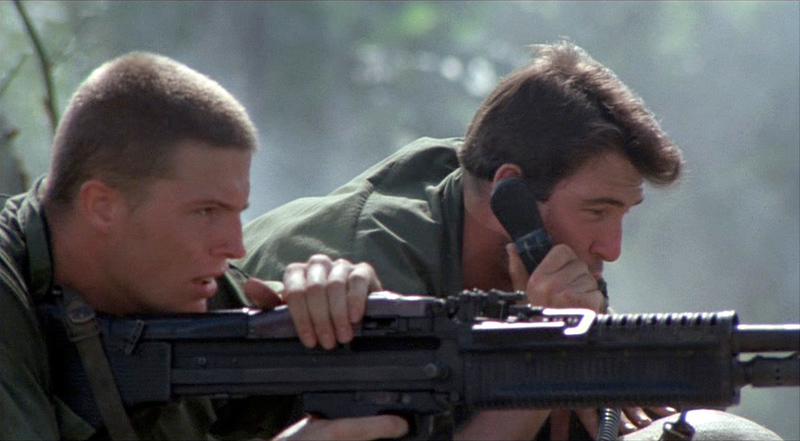
HH is based on an actual battle in Vietnam in 1969. The movie equips the actors with appropriate weapons, but several are armed with a later model of the M-16 than was available in the battle. Others are armed with M-60s and M-79 grenade launchers. The enemy are armed with AK-47s. There are no recoilless rifles even though in the actual battle they were keys to neutralizing the enemy bunkers. As far as tactics, the film is true to the frontal attacks that were forced by the American general that insisted on capturing the hill in spite of the fact that the terrain negated American mobility and fire support. B

GTS is not based on a real battle. The weaponry is circa 1964. Lt. Hamilton carries a Thompson, as do some of the ARVN. Barker is armed with a M3 grease gun. Most of the Americans have M1 Carbines and the ARVN mostly use M1 Garands. These weapons appear to be spot on (although I question the Thompsons in the hands of Vietnamese grunts). One discrepancy is the use of mortars to hit targets ten yards away. The movie makes a point of questioning American tactics explicitly (unlike the implicit criticism of HH). Barker is flummoxed by higher command’s desire to garrison an unimportant base in the middle of enemy controlled territory. The tactics used in defending the outpost are simplistically depicted, but not far off. Patrols are sent out and the enemy assault is a typical frontal attack at night that is defeated by firepower. C

THIRD QUARTER SCORE
Hamburger Hil =l 25
Go Tell the Spartans = 21


ACCURACY

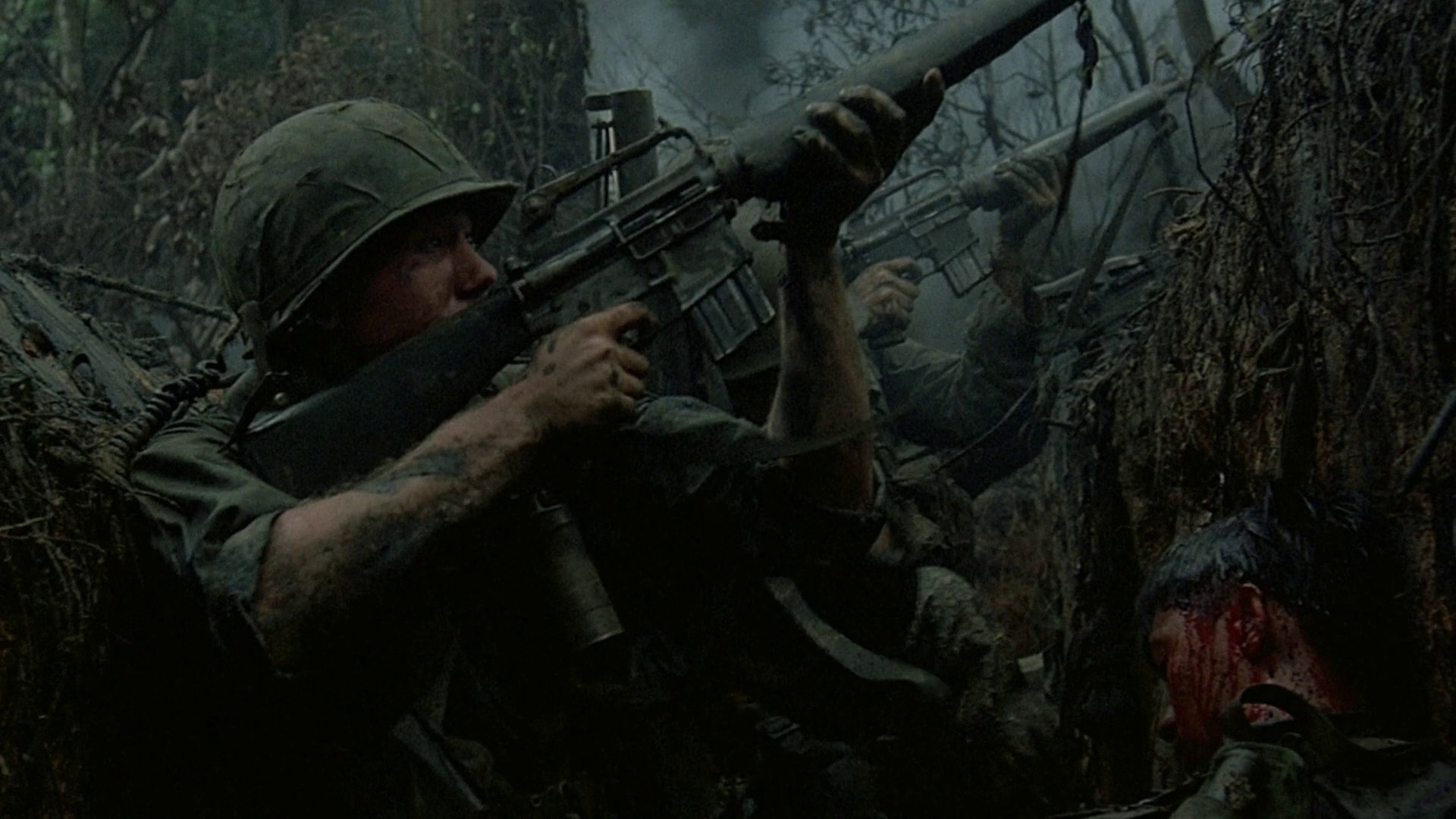
HH is a micro view of the Battle of Ap Bia Mountain (Hill 937). The movie does not try to give the big picture and the audience is left in the dark about the strategy necessitating what is depicted on the screen. The recreation of the battle is as close as you could ask for. It even has one (there were at least three) of the friendly fire by choppers incidents (although in reality the fire was rockets, not machine guns and less men were killed). Although the movie exaggerates the death rate (what war movie doesn’t?), the battle was actually very brutal and costly. One inaccuracy is between assaults, the men sit around in safety when in reality the battle was noted for having no front line and the enemy did a lot of infiltrating. B

GTS attempts to replicate the advisory period of U.S. involvement. It is based on a novel which was written by a war correspondent who was in S. Vietnam during the time period. He went on a mission to evacuate a village which was discovered to be abandoned and then imagined what it would have been like if the village had been converted into an outpost and had then come under enemy attack. One can question the accuracy of the attitudes at this stage of the war. The U.S. was arming and training the ARVN and local defense militias were incorporated. The corruption of S.V. high command is accurate as is the overconfidence of American leadership. The big problem is that the attitudes of most of the Americans is more appropriate for 1968 than 1964. C

FINAL SCORE

Hamburger Hill = 33
Go Tell the Spartans = 28


ANALYSIS

“Go Tell the Spartans” is a movie that was overshadowed by two other Vietnam War movies when it came out in 1978 (“The Deer Hunter” and “Coming Home”). It could definitely be argued that it is superior to those two bloated epics. It is hampered by its low budget and some shoddy acting, but its heart is in the right place and has a cogent comment to make about the quick sand that the war devolved into. “Hamburger Hill” is the better movie overall because of superior acting, action, and accuracy. Interestingly, HH is more graphic in its combat, but less anti-war than GTS. By going micro, it fails to illuminate the misguided strategy involved in the battle. In this respect, it fumbled the chance to be an “after” to GTS’s “before” perspective.


Saturday, August 13, 2011

CRACKER? Hamburger Hill


     “Hamburger Hill” is a war movie about the famous Vietnam War battle.  It was released in 1987 and chronicles the 101st Airborne’s assault on Hill 937 in the Ashau Valley in May, 1969. The script was written by a “Screaming Eagles” veteran who served in Vietnam in 1968-69. The director, John Irvin (who did the stylistically similar “When Trumpets Fade”) had done documentaries in Vietnam. He cast a group of unknown actors, some of whom have gone on to big careers.
Dylan McDermott playing army man

     The movie opens with Company B evacuating the Ashau Valley with their tail between their legs. Five replacements (FNGs) arrive to the typical cold shoulders, but they quickly blend in. The movie fits squarely in the who-will-survive sub-genre. It is also a typical small unit dynamics film. It displays some similarities to "Platoon" in this respect except that the unit is not divided. The squad has some black/white issues, but realistic to a front line unit they are tamped down by the more pressing need for group respect for survival purposes. There are two sergeants like in "Platoon", but they are not adversarial. One is gung-ho (Worcester – Steven Weber) and the other is cynical (Frantz – Dylan McDermott), but they are best friends. There is also a green LT, but he is not a worm and does not figure in the film.

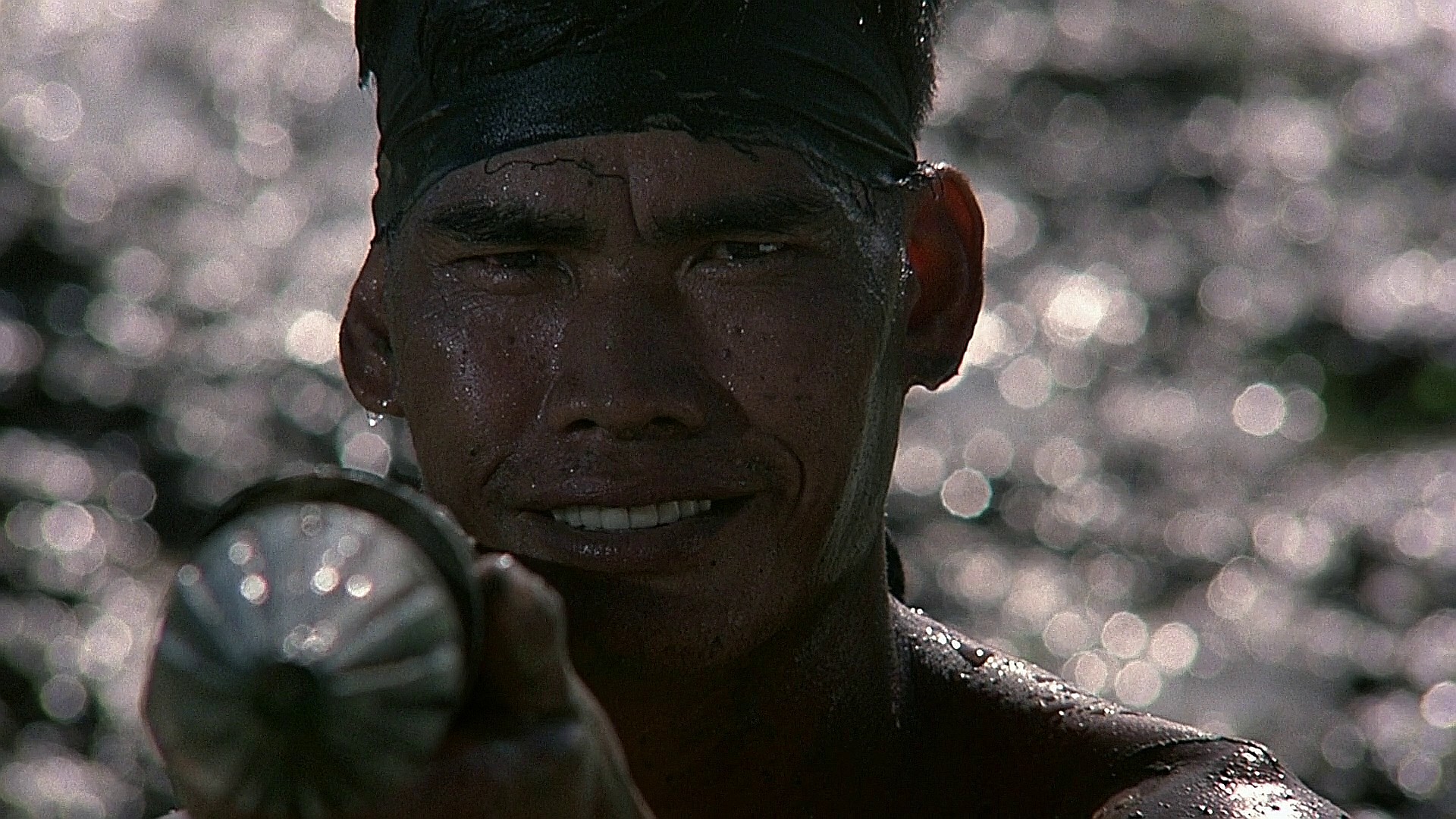
the face of "Nathaniel Victor"
     The first half of the film is basically a tutorial on the indoctrination of a “cherry”. The five FNGs are taught hygiene and to respect “Nathaniel Victor” (the North Vietnamese). They are taken to the local brothel. They quickly learn a second language – the grunt slang combined with Vietnamese phrases. The unit even has its own pet phrase – “It don’t mean nothin’”. (To be followed by “Not a thing”.) This phrase is said seventeen times in the movie. This dialogue includes most of the greatest hits of grunt slang. The movie should have captions for those who are not familiar with Vietnam War lingo, however.

one of these actors was ill-used, but had the last laugh
     The second half deals with the assaults up Hill 937. This is combat at its rawest followed by periods of down time for more camaraderie. Each post-assault scene has a defining moment. One of these is the tuning in to “Hanoi Hannah”. Another has Biletsky (Tim Quill) listening to a tape from his patriotic girlfriend (apparently the only pro-war civilian left in America). More typical of the film’s theme is a “Dear John” letter to Bienstock (Tommy Swerdlow) from an ex who has been brainwashed by hippies.  The film hammers away at the implication that the soldiers have been abandoned by the home front.


Frantz is bayoneted
     The battle begins on May 11 and it is obvious from the start that few in the squad will survive. The movie covers the battle by days. The fighting each day is tragically similar. Frontal attacks uphill against a fanatical enemy who has the advantage of the high ground and bunkers. Although the full force of American firepower is brought to bear in the form of aerial and artillery bombardment (this is a loud movie), every assault except the last is thrown back. The deaths are brutal and graphic. Heads blown off, etc. Most of them are random and quick, but the medic “Doc” (Courtney Vance) gets an old school send-off that is well played. One of the assaults is memorable for its slog up the muddy hillside and the subsequent sliding back downhill by the men. Finally, the hill is taken in an “I’ve had enough of this shit!” charge. Our surviving three main characters sit exhaustedly under what’s left of a tree.  One of the survivors is Biletsky who two days earlier had been evaced for a serious wound.


NVA in a bunker

     HH is considered by some to be the best Vietnam War movie. It isn’t, but it is certainly in the top five. It is also lauded by many as the most accurate Vietnam War movie. It has a stronger claim to that title. The recreation of the battle is as close as you could ask for. It even has one (there were at least three) of the friendly fire by choppers incidents (although in reality the fire was rockets, not machine guns). Although you might assume the high casualty rate was Hollywoodized, the battle was actually very brutal and costly. Read about it and wonder if we would accept a repeat in Afghanistan. Irvin gets the sights and sounds right. One flaw is you get none of the big picture. What is the plan? Why this hill? What are the other companies doing? The movie also does not put a face on the enemy. They are obviously tough and worthy opponents, but that is all we know.  Another similarity to "Platoon".

"Hello, I'm calling to confirm my 10 o'clock hair appointment"
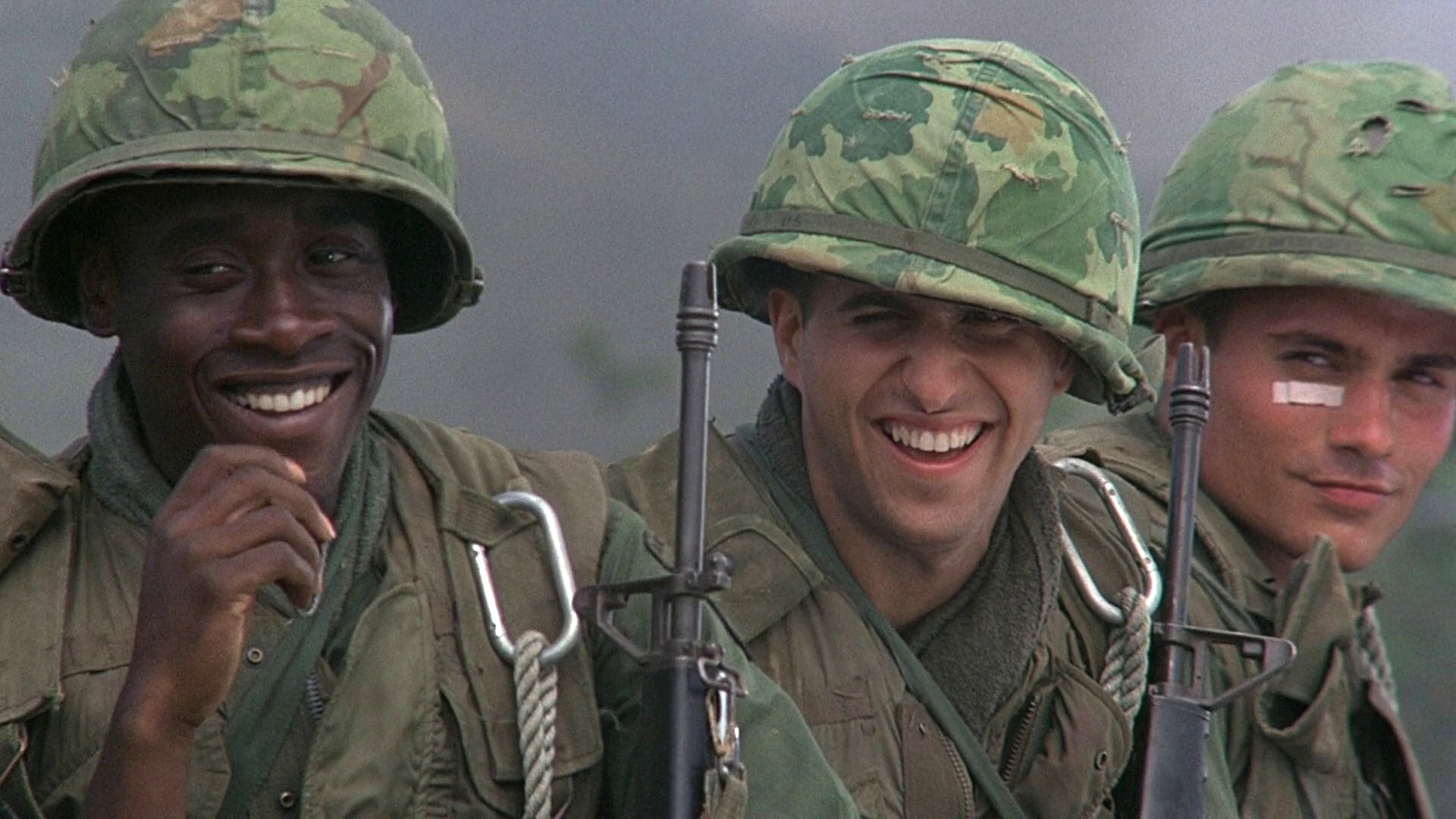
     The acting is satisfactory. One head-scratcher is the waste of the best actor in the group (Don Cheadle) in a small part. One thing you will notice is the compromise made on battlefield griminess. The men do sweat and have dirt on their faces, but nice hair. (Memo to the make-up artists: don’t touch the hair.) The actors relay what a screenwriter thinks a grunt would say, but you get the impression they do not understand all the phrases.  They're just mouthing phrases. The movie works best in this respect if you have not seen a lot of Vietnam War movies. I found some of the dialogue to be forced and cringe-inducing.

     There are some clichés as is to be expected from a movie of this type. We get the “a fight breaks out because a guy make’s a sexual remark about a girlfriend picture”. However, the guy who showed the picture does not end up dying so that cancels it out. Unfortunately, someone violates the rule about bragging about their future plans with predictably dire results.

war is a dirty business
     One thing that sets this movie apart from most other Vietnam War movies is it is anti-anti-war. There are several sledgehammer moments where the home front is crucified for not supporting the troops. In one piling on monologue, Worcester recounts a trip back home. 1. He had dog feces thrown on him by hippies. 2. His wife was screwing a pacifist. 3. His friendly bartender was being harassed as the father of a deceased “baby killer” and became a heroin addict. We get it! The proof of this thematic goal is the unbelievable lack of a post script explanation that after all the effort to take the hill, it was abandoned to the enemy. Since most of the audience would not have known this, the omission is a clear admission by Irvin of his political agenda. In this respect, it strays furthest from its cousin “Pork Chop Hill”.

     “Hamburger Hill” is a good movie. Unlike most of its competitors (Platoon, Apocalypse Now, Full Metal Jacket), it deals with an actual battle. This makes its main rival “We We Were Soldiers”. In that respect, it does a better job on grunt life. The combat is not as good, however.

Cracker?  Probably.  It is much better than some of the crap I have had to watch.

GRADE  =  B- 


"It don't mean nothin'"


Tuesday, December 21, 2010

CRACKER? "9th Company (9 Rota)"


     “9th Company” is a Russian movie released in 2005. It was “inspired” by events surrounding the defense of Hill 3234 in Afghanistan by 9th Company, 345th Guards Airborne Regiment in January, 1988. The movie was a big hit in Russia because it emphasized the heroic sacrifices made by Russian grunts in a forgotten war. The film won the Russian equivalent of the Best Picture Oscar. It could be described as Russia’s answer to “Platoon” and “Full Metal Jacket” with a dash of “Hamburger Hill” thrown in.

     The movie introduces us to a typical war movie squad which is heterogeneous including the sensitive artist and the psycho. They bond during boot camp which is similar to the cinematic American boot camp. The drill sergeant is mean and takes the approach that they are not human, they are s***, but he will make them into men. They go through the usual obstacle course (one even crushes his nuts on a beam ala “Stripes”), crawling under wire, bayonet drill, and the rifle range. There is no fat guy that everybody hates, but there is a sensitive guy who almost quits. The movie does a good job showing how soldiers bond. It may be cliché, but it’s realistic. The soldier talk rings true because no matter the nationality, soldiers talk about the same things.

     Before being shipped off to Afghanistan, they are lectured briefly on the conditions there. Muslims have different views on life and death, you are safe in the villages because of the rules of hospitality, and oh, by the way, no one has ever conquered Afghanistan. See ya!

     They arrive at Bagram Airfield in Afghanistan 153 days after induction. When they arrive, a departing veteran gives one of them his lucky amulet. Sucks for the other people on the plane because you can guess what happens next. Cliches cross borders, apparently.

     When they arrive at their outpost, their sergeant is like a clone of the boot camp DI. He beats up a soldier who falls asleep on guard duty. The men are “savages”, but of course our boys will not end up like them. The Afghani army are called “greenies” and remind you of the ARVN (our equally dependable allies in Vietnam). The mujahideen are called “muj” and remind you of the Viet Cong. In an interesting scene, they catch the local muj leader (who they actually respect as a fellow warrior) and as he is backing away he trips and one of them kills him. (I keep saying “one of them” because to tell the truth, it is hard to distinguish the characters.)

     The movie has several pyrotechnical, balls to the wall, combat scenes. One is a convoy ambush where much ammunition is expended. The squad chases the muj who disappear into tunnels (ala the Viet Cong). They follow underground into the village where one of them is killed by an innocent-looking child (like Vietnam). Rockets destroy the village (like Vietnam).

     The big set piece is the siege of the hill. They are choppered in to set up a position on a hill overlooking a road that the Soviet high command is determined to open up to friendly traffic. The mujahideen attacks in waves. There are lots of graphic hand-to-hand combat and shocking deaths. If you watch the movie with someone else, bet before hand on how many of our boys will survive. (Tip: do not bet that all of them will live happily ever after.) The testosterone level is very high. Americans will doubly enjoy this scene because we can enjoy all the killings! (Sorry, I forgot we are friends with the Russians now.) The movie ends with them winning, but abandoning the hill (ala “Hamburger Hill”) and being forgotten by the Russian public.

      This is an excellent war movie for certain guys. You know who you are. Unfortunately, the core audience for this type of film usually does not like to read, so the subtitling creates a dilemma. As a war movie aficionado, it is fun to see the elements that harken back to beloved Vietnam War movies. You get three for the price of one with this movie:

Platoon – camaraderie of the soldiers / drunken carrying on / human wave attacks / tunnels

Full Metal Jacket – boot camp

Hamburger Hill – victory thrown away / who will survive?

     As far as accuracy, the movie gets a B. There was a battle on a Hill 3234 and the strategic situation was as the movie implies. The enemy did make 12 human wave attacks (possibly under the influence of drugs). All of them were repulsed. Contrary to the movie, the unit was consistently resupplied and medevaced. Also, the movie (surprise!) amps up the casualties. It was bad enough in reality with 34 of the 39 either killed or wounded. The hill was abandoned after the battle. By the way, there apparently was a Snow White who “entertained” the troops before they left boot camp.

     The acting is okay. It is hard to follow who is who. (Maybe Russians say the same about “Platoon”.) The combat is intense, but kind of Hollywoodish. The soldier life is realistically portrayed which supports my theory that all soldiers are basically the same, no matter the nationality.

     Will it crack the 100 Best War Movies of All Time? Possibly. For now, watch it as a companion to “Charlie Wilson’s War” and “Restrepo” and you will understand the wars in Afghanistan better. Then e-mail your Congressman and urge him to do the same.

GRADE  =  B+