Showing posts with label Battle of Isandlwana. Show all posts

Friday, August 23, 2024

THE 100 BEST WAR MOVIES #43. Zulu Dawn (1979)

                “Zulu Dawn” is the prequel to “Zulu”.  It was released on the one hundredth anniversary of the Battle of Isandhlwana.  It covers the machinations leading up to the start of the Anglo-Zulu War and carries through the battle.   The screenplay was co-written by Cy Endfield who had written and directed the earlier film.  Douglas Hickox helmed this picture, but rumor has it he was incompetent and the second unit director had to bring the film home. The film was shot on location in South Africa.  It was not a box office success which is not surprising because it was one of the worst losses in the history of the British army..

            The movie intercuts between the Zulus and Brits.  It starts in the Zulu capital of Ulanti with some Zulu rituals. The slaughtering of a bull is a harbinger of what is to come with the bull symbolizing the British Empire.  Zulu courtship is depicted in the most breast-laden scene in war movie history.  Meanwhile, the British High Commissioner for South Africa Sir Henry Bartle Frere (John Mills) and his commanding general Lord Chelmsford (Peter O’Toole) are plotting to provoke a war with the Zulus as “the final solution to the Zulu problem”.  Zulu King Cethswayo’s reaction to the ultimatum reaches the two plotters during a party of the British upper class.  The cricket and tennis is contrasted to the duel to the death that served as entertainment in the Zulu village.  The quaint courtship flirtations of the Brits are compared to the very unVictorian dancing of the Zulus.

            The British army crosses the river bordering Zululand with the labor of Zulu porters who are treated like slaves.  A news correspondent named Norris-Newman (Ronald Lacy) is along to question Chelmsford’s strategy and tactics.  Upon crossing the river, there is immediate combat with Zulu scouts to tide us over until the big battle.  The column moves on to camp at Isandhlwana.  “What a marvelous spree” proclaims an overconfident British officer.  Three Zulu warriors allow themselves to be captured and tortured to give false information on the location of the Zulu army.  Water boarding is too subtle, the Brits simply beat it out of them.   Chelmsford chooses to believe their lies over the eye-witness report of a Boer rancher.  He takes half of the army on a wild goose chase leaving the bureaucratic Col. Pulleine (Denholm Elliott) in command of the rest.  Chelmsford orders Col. Durnford (Burt Lancaster) and his troop of native cavalry to reinforce the camp.  A patrol led by the Lt. Vereker (Simon Ward) runs into the Zulu army where it ain’t supposed to be.  The camp has little time to prepare for the human tidal wave heading its way.  If you are a Brit, you know what happens next.  If you are an American, watch and learn.

ACTING:                    A-

ACTION:                     A  (8/10)

ACCURACY:                A

PLOT:                            A

REALISM:                      A

CINEMATOGRAPHY:   B

SCORE:                          A

SCENE:  the battle

QUOTE:  Bloomfield:  One Zulu is only one man... and I'm afeared of no one man... but the Zulu, they come in the thousands... like a black wave of death... in the thousands... and them assegais... stabbing!

            “Zulu Dawn” must have been a contentious green light.  In many ways the circumstances are similar to the Battle of Little Big Horn.  It is commendable that the producers were willing to put so much effort into a depressing subject.  (Depressing from a British point of view, not a Zulu point of view.) Releasing it on the centennial anniversary shows their hearts were in the right place.  Unfortunately, they overestimated the public’s desire to watch one of their country’s worst ass-whippings.  The timing coming fifteen years after the uplifting “Zulu” was not conducive to the box office either.  I do not know how well it did in Great Britain, but it certainly was critical of the British Empire.

            “Zulu Dawn” is competently done.  The scale is impressive.  Filming in Africa helped with the verisimilitude.  The vistas are expansive and add to the geographical accuracy.  The cast is expansive as well and   the huge number of extras makes a grand impression.  Real humans trump CGI every time.  The professional actors are a strength of the movie.  There are a lot of familiar British faces and they all acquit themselves well.  Lancaster and O’Toole anchor the film, but it is definitely an ensemble effort.  Bob Hoskins is the standout as the gruff Colour Sergeant Williams.  Unlike other officer-centric battle films, “Zulu Dawn” spends some time with the enlisted.  Sgt. Williams has a father/son relationship with a sad sack also named Williams (David Bradley) who provides the only comic relief in an otherwise serious movie.  Although the movie is sympathetic to the Zulus and gives their perspective well, there is only one developed character (the leader of the tortured).  The music by Elmer Bernstein is excellent and fits the epic pretensions of the movie.  The river crossing scene relies totally on music as it avoids dialogue.  The cinematography is also stellar, especially in the climactic battle which features different angles, some slo-mo, and even some hand-held.

            The themes are well-developed.  British arrogance is embodied in the pompous Chelmsford, but virtually all the British are overconfident.  The movie does take pains to point out that not all of the colonials favored the war.  The news correspondent is useful in pointing out the egregious tactical errors made by Chelmsford.  There is a primitive versus modern vibe.  This is most obvious in the Martini-Henry rifles against the assegai.  Don’t bet on the more modern weapons. 

            “Zulu Dawn” is admirably accurate.  Frere and Chelmsford’s scheming is simplified, but gets the gist of how the British meant to provoke the war and then invade and conquer.  Cetshwayo’s position is given good coverage.  Chelmsford’s plan is not really clearly explained (a map would have been nice), but the march of his column is proper in miniature.  The events leading to the surprise attack on the British camp are shaky.  The biggest artistic license is in the captured/tortured prisoners.  The movie takes some liberties in the movements of the various units (or rather the actors) and compresses time as per a battle movie.  The battle itself is about as well done as one could ask for.  And it is one of the great combat scenes in war movie history.  The fighting is relentless (except for cuts to the clueless nondoomed) for a good twenty minutes and the non-CGI combatants make me nostalgic after recently seeing the last “Hobbit” movie.  British tactics are reenacted, but no allusion is made to the famed Zulu “buffalo horns”.  The chaos in the camp is realistic and the deaths of the principals are mostly accurate.  Speaking of which, the movie has some finely acted deaths in general.

            “Zulu Dawn” is an underrated war movie.  It is unfairly overshadowed by “Zulu” and one must assume part of the reason is that it is about a loss.  In this respect it reminds me of the relationship between “A Bridge Too Far” and “The Longest Day”.  In truth, it could be argued that it is a better movie than “Zulu”.  It is more accurate, but does not have the charisma.  Watching the two in chronological order is a must for war movie lovers.  To understand the achievement, try doing the same with “Gods and Generals” and “Gettysburg”.  Prequels aren’t easy.

Zulu  (1964)

             “Zulu” was released in 1964 and was so successful that it not only resurrected the Battle of Rorke’s Drift, but molded the modern image of it.  The film was a labor of love for Stanley Baker.  It was directed by the blacklisted Cy Endfield.  After The House Unamerican Activities Committee branded him a communist, he moved to England to continue his career.  The movie was filmed on location in South Africa.  700 blacks were used as extras.  Many of them were descendants of the Zulu who participated in the battle.   So many had never seen a movie that Endfield screened an old Gene Autrey film for them.  Because of apartheid, they could not be paid so Endfield let them keep the cattle.

The film opens with a  narrator (Richard Burton) reading a dispatch outlining the British defeat at Isandlwana on Jan. 23, 1879.  We see the aftermath of that disaster in the corpse-strewn British camp.  The scene shifts to a Zulu village where a missionary named Witt (Jack Hawkins) and his daughter Margareta (Ulla Jacobsson) witness a marriage ceremony.  It’s a fascinating slice of Zulu culture.  They leave for their mission at Rorke’s Drift when word of the Battle of Isandlwana arrives.

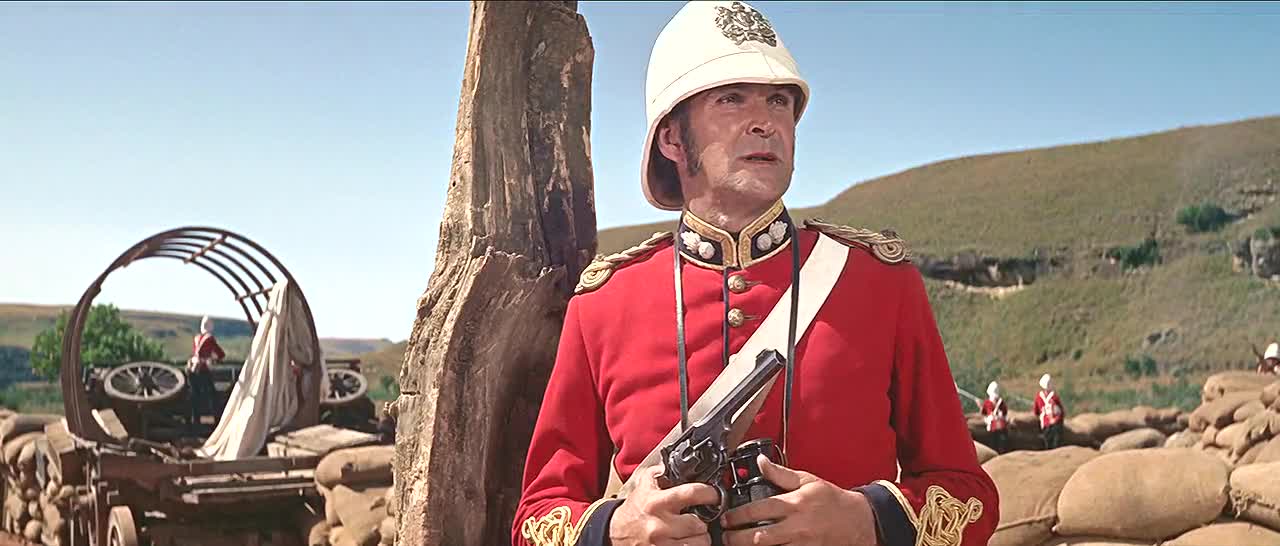
Back at Rorke’s Drift, Lt. Chard (Baker) is building a bridge.  He meets Lt. Bromhead (Michael Caine in his first major role) who has been left in command.  Bromhead is your typical upper class officer who is touchy about his status.  When they are alerted to the approach of a large force of Zulu warriors, Chard assumes command based on being commissioned three months earlier.  He orders the position be prepared for defense using mealy bags, crates, and overturned wagons.  He rejects Bromhead’s suggestion of evacuating the post.  He wants to go the Alamo route.

            We are introduced to some of the soldiers (especially the future Victoria Cross recipients).  The standouts include Colour Sergeant Bourne (Nigel Green) who stoically ramrods the enlisted.  Private Hook (James Booth) serves as the film’s anti-hero.  He is a malingering, petty thief, malcontent.  Will he find redemption as a real hero?  Duh!

            An eerie train-like droning noise heralds the approach of the enemy.  The suspense builds as they sneak up and then launch a frontal charge which comes to a surprise halt within rifle distance of the British line.  The slaughter begins as the Zulu launch several frontal attacks to wipe out the British. The only thing the British have going for them is their breech-loading rifles and the uncoordinated Zulu attacks. Will it be quantity or quality that decides this battle?  There are a series of attacks followed by lulls in the fighting.  The casualties mount, but none of the Brits panics.  They all have their upper lips stiff or their cheek on (as in the case of Hook).  Chard is growing into command and Bromhead proves an able second.  And Hooks gets his redemption.

ACTING:                    A-

ACTION:                     A  (8/10)

ACCURACY:                A

PLOT:                            A

REALISM:                      A

CINEMATOGRAPHY:   B

SCORE:                          A


SCENE:  the defense of the hospital

QUOTE:  Pvt. Cole:  Why is it us? Why us?  Colour Sergeant Bourne: Because we're here, lad. Nobody else. Just us.

CRITIQUE:  “Zulu” has many strong elements.  The set is authentic and the scenery is amazing.  The movie was filmed in a national park which, although hillier than the real locale, certainly added to the visuals.  The music by John Barry is used sparingly, but effectively.  Some scenes have little or no background music.  A good example is the opening attack which is allowed to build without music.  The cinematography is outstanding.  It’s old school without the modern pizazz, but you are in the thick of the fighting.  The acting is excellent.  Jack Hawkins chews the scenery a bit, but everyone else controls himself like a proper British soldier would.  Baker, Caine, Booth, and Green are standouts.  The most remarkable performances are by the Zulu extras.  They are naturals.  That Gene Autry movie must have really done the trick.

            The movie gets the small things right.  The soldier behavior is true to British soldiers of that era.  Their dialogue is not forced or cringe-worthy.  The cameraderie is evident.  There are several friendships that are highlighted.  The soldiers’ bond is apparent.  There is not a lot of humor, but then there is not a lot to laugh about.  There is also very little whining.  Hook is the only soldier who appears to be avoiding combat.  A bit unrealistic.  The movie does not play up the chasm between the upper class officers and the lower class enlisted which is often a theme in movies about the British army of that time period.

            The character development is well done.  The movie does a good job of fleshing out all of the VC winners and several more roles.  Each man is distinct (although name tags would have been nice).  The evolution of Chard from engineer building a bridge to combat leader is instructive.  There is a quiet moment when he goes from trembling hand while reloading his revolver to steadiness.  Of course, the most fascinating arc is that of Hook.  It’s a bit cliché, but it works.  He could have been a tedious character ( he reminded me of some of my students), but Booth does a good job making him a likeable rogue.  His swigging on the broken liquor bottle before fleeing the burning hospital is another nice touch.

            As a movie about a battle, “Zulu” is one of the best.  This is partly because it has few frills.  It concentrates almost totally on the battle and the men who fought it.  The tactics are realistic although some of them have a textbook feel to them.  In reality, it is doubtful the British used the variety the movie depicts.  That’s acceptable for entertainment purposes.  The action is intense and edge of your seat.  The deaths are swift and not melodramatic.  There are no death speeches.

            The movie is not without flaws.  It is overrated as a history lesson as it is surprisingly inaccurate. One good example is the treatment of Hook, who was actually not a malingerer and did not drink. His family was justifiably upset with the portrayal. One problem is the lack of background about what brought on the war.  The audience is treated to a fair treatment of the Zulu.  They are not demonized as the Indians were in most Westerns and they are shown as brave warriors, but it is not made clear that they were in the right.  We are manipulated to root for the Europeans instead of the natives fighting for their lands and liberty.  A related flaw is the lack of a Zulu perspective.  This is perplexing given that the movie opens in their village with an interesting take on their culture.

It is not a great war movie (as some claim), but it is certainly very good and accomplishes its mission effectively.  I am a little uncomfortable with this.  As a war movie lover, I really enjoyed the movie.  But as a military history buff, I can see how the movie used a different medium to do in the 1960s what the British government used the newspapers to do in the 1870s.  Think about it – 11 Victoria Cross winners!  Assuming a Victoria Cross is equivalent to the Medal of Honor, it should take extreme bravery to be awarded one.  Not taking away from the defenders, but it would appear the British government was looking for a civilian morale booster to soften the Isandlwana disaster.  The movie does a similar job in glamorizing the imperial days of England.  Unlike its most obvious equivalent (Wayne’s “The Alamo”), the film does not recreate the myths, but instead actually creates the myths.

Monday, November 26, 2012

#22 - Zulu (1964)


BACK-STORY:  “Zulu” was released in 1964 and was so successful that it not only resurrected the Battle of Rorke’s Drift, but molded the modern image of it.  The film was a labor of love for Stanley Baker.  It was directed by the blacklisted Cy Endfield.  After The House Unamerican Activities Committee branded him a communist, he moved to England to continue his career.  The movie was filmed on location in South Africa.  700 blacks were used as extras.  Many of them were descendants of the Zulu who participated in the battle.   So many had never seen a movie that Endfield screened an old Gene Autrey film for them.  Because of apartheid, they could not be paid so Endfield let them keep the cattle.
OPENING:  A narrator (Richard Burton) reads a dispatch outlining the British defeat at Isandlwana on Jan. 23, 1879.  We see the aftermath of that disaster in the corpse-strewn British camp.  The scene shifts to a Zulu village where a missionary named Witt (Jack Hawkins) and his daughter Margareta (Ulla Jacobsson) witness a marriage ceremony.  It’s a fascinating slice of Zulu culture.  They leave for their mission at Rorke’s Drift when word of Isandlwana arrives.
Chard is in command
SUMMARY:  Back at Rorke’s Drift, Lt. Chard (Baker) is building a bridge.  He meets Lt. Bromhead (Michael Caine in his first major role) who has been left in command.  Bromhead is your typical upper class officer who is touchy about his status.  When they are alerted to the approach of a large force of Zulu warriors, Chard assumes command based on being commissioned three months earlier.  He orders the position be prepared for defense using mealy bags, crates, and overturned wagons.  He rejects Bromhead’s suggestion of evacuating the post.  The decision to stay and not even evacuate the wounded sets off Witt who is a pacifist Bible-thumper who considers the Zulu king to be a member of his parish.  He is also a closet alcoholic who gets himself and his daughter kicked out of the camp while ranting that they are all going to die.  This sobers up the men, but they continue to prepare calmly for the onslaught.
                We are introduced to some of the soldiers (especially the future Victoria Cross recipients).  The standouts include Colour Sergeant Bourne (Nigel Green) who stoically ramrods the enlisted.  Private Hook (James Booth) serves as the film’s anti-hero.  He is a malingering, petty thief, malcontent.  Will he find redemption as a real hero?  Duh!
Bromhead joins in
                An eerie train-like droning noise heralds the approach of the enemy.  The suspense builds as they sneak up and then launch a frontal charge which comes to a surprise halt within rifle distance of the British line.  A Boer ally named Adendorff informs Chard that the strange tactic is not to allow for the standard Gunga Dinish wanton slaughtering of the natives, but in fact is the Zulu leader’s way of determining the fire power of the defenders.  Get your calculators out if you want to find out whether this movie will approach a “Where Eagles Dare” death count.
there is a Chinese laundry at the post
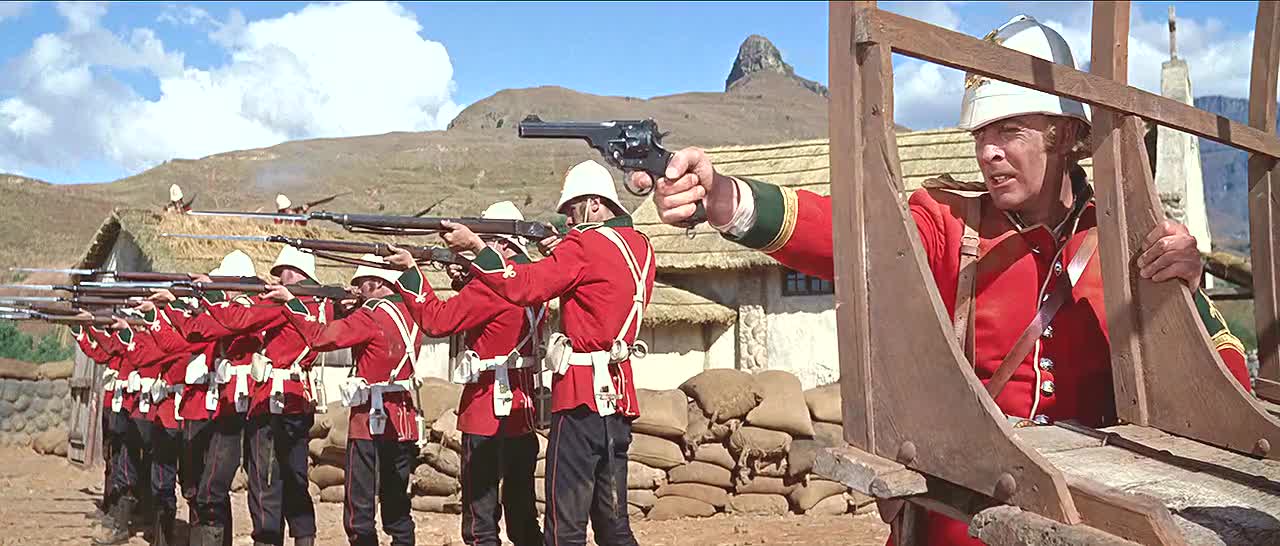
                As though things are not bleak enough, a unit of the enemy is positioned on a hill where they can use their newly acquired British rifles to harass the defenders.  When one soldier asks “why us?”, Bourne responds with “because we’re here”.  The second attack breaches part of the wall and leads to hand to hand (or bayonet to iklwa) combat.  There are a series of attacks followed by lulls in the fighting.  The casualties mount, but none of the Brits panics.  They all have their upper lips stiff or their cheek on (as in the case of Hook).  Chard is growing into command and Bromhead proves an able second.  At one point, Chard calls for firing by ranks in a mini-counterattack.  Discipline and firepower – how an empire was won.
                The fifth attack reaches the hospital.  Bromhead fights on the roof and Hook leads the interior defense.  The building catches fire to add to the chaos.  Hooks throws on the mantle of a hero, but wears it reluctantly as he stops to take a drink of medicinal alcohol before being the last to leave the burning building.  A cattle stampede breaks the momentum of the assault.  Attacks continue in the night, but we are swiftly in the broad daylight of the second day
CLOSING:  The Zulu serenade the British with a war song so the Brits respond with the regiment’s anthem, “Men of Harlech”.  “Keep these burning words before ye / Welshmen will never yield”.  Could this be a Hollywood moment?  The final assault is defeated with three lines of British riflemen using coordinated volleys.  Result:  a pile of black bodies.  A mad minute of European fire power ends the native dream of evicting the foreigners from their land.  Just when it looks like it’s over, the Zulus mass again on the hillside.  However, this time it’s to acknowledge respect for fellow warriors.  Richard Burton’s voice returns to check off the eleven VC winners.
RATINGS:
Acting -  B
Action – 9/10
Accuracy -  C+
Plot -  A
Realism -  B
 
Overall -   A-

WILL CHICKS DIG IT?    Very unlikely.  This movie is testosterone-fueled.  The one female character is not a positive one and disappears early in the film.  On the plus side, the movie is not particularly graphic.

HISTORICAL ACCURACY:  The Battle of Rorke’s Drift took place during the Anglo-Zulu War of 1879.  The war was brought about because of British desire to expand its South African colony into Zululand.  They manufactured a threat from the Zulus as their provocation and used it as justification for an invasion.  King Cetshwayo wanted peace, but could not meekly accept his own overthrow and annexation of his land.  The movie does not explain the background to the war possibly because the British did not want to mar the feel-good aspect of such a sterling battle. 
                The allusions to the Battle of Isandlwana are accurate.  The British central invading column did get wiped out by 20,000 Zulu warriors.  However, King Cetshwayo did not follow this up with the attack on Rorke’s Drift as the movie implies.   The attack was the idea of his glory-seeking half-brother whose unit had not gotten to Isandlwana in time to participate.  In fact, the King had forbidden his forces to go on the offensive into British territory.
                The recreation of the hospital/supply depot is accurate.  It was leased by the British government from the missionary Witt, but his depiction is way off.  The real Witt was married with two young kids.  He was not a pacifist, nor a drunkard.  He supported British policies.  The Zulu king was not a parishioner of his.  He was not drummed out of the camp, but left voluntarily to see after his family.  His is not the only mischaracterization.  The most egregious is Hook.  He was not the malingering malcontent depicted in the film.  He was actually a solid soldier and a teetotaler.  His portrayal was so offensive that his daughters walked out on the premiere.  Bourne was actually very young for a Colour Sergeant and also slight in stature.  The doctor was not cynically anti-war and earned his VC by leaving the hospital to tend the wounded on the front lines.  Not to mention the unit itself is misidentified.  In the movie it is identified as a Welsh regiment when in reality it was not predominately Welsh.
                Some of the incidents are close to reality.  The native levies did flee before the battle, but not because of the rantings of Witt.  They were actually led out by their British officer who was subsequently court-martialed.  The Boer cavalry that refuses to augment the defense actually stayed for the early festivities, but left after its cavalry carbine ammunition ran low.  Chard was actually appointed to command by the unit’s captain before he left.  This was partly based on seniority, but he was commissioned three years before Bromhead.  They did not disagree on strategy and Chard actually favored a withdrawal.  It was Acting Assistant Commissary Dalton who pointed out that a small column slowed by wounded would be easily caught and wiped out.
                Although Adendorf accurately describes the Zulu tactic described as “the horns of the beast”, the movie does not depict them using this tactic.  This might truly reflect the battle as the attacks are best described as piecemeal.  The Zulu spear called an iklwa (the sound it made when being pulled out of a wound) is authentic.  It was a variation of Shaka’s assegai.  They also carried the cow-hide shields shown in the film.  Unfortunately for realism, this force would not have had access to looted British rifles to snipe with.  Like most Zulu units, they would have had an assortment of inferior guns.  Five of the seventeen British deaths were from gunfire.  The British weaponry is accurate.
                The battle itself has some problems.  There is no evidence for the opening “cannon fodder as intelligence gathering” gambit.  The assaults were more consistent and not as easily differentiated as in the film.  The assault on the hospital, its defense led by Hook, and its subsequent burning are pretty close.  They did cut holes through the walls to go from room to room.  The last survivors exited from a window, not out the back door.  Strangely, the movie foregoes the suspense of the consistent night attacks which tapered off after midnight.  They ended around 2 A.M. and the subsequent gunfire was over by sunrise thus ending the battle.  There was no climatic charge after dawn.
                It will not surprise that there was no sing-off.  Plus the song would not be the unit anthem for another two years.  It goes without saying that the Zulus did not salute the courage of the Europeans.  As far as why they withdrew, a final decisive assault was abandoned with the approach of a relief force (“the cavalry was coming”).  By the way, the movie leaves out the post script of the British dispatching any wounded Zulu.  On a similar note, the British actually lost only 17 dead in the battle – the movie gives the impression it was quite a bit more.  
CRITIQUE:  “Zulu” has many strong elements.  The set is authentic and the scenery is amazing.  The movie was filmed in a national park which, although hillier than the real locale, certainly added to the visuals.  The music by John Barry is used sparingly, but effectively.  Some scenes have little or no background music.  A good example is the opening attack which is allowed to build without music.  The cinematography is outstanding.  It’s old school without the modern pizazz, but you are in the thick of the fighting.  The acting is excellent.  Jack Hawkins chews the scenery a bit, but everyone else controls himself like a proper British soldier would.  Baker, Caine, Booth, and Green are standouts.  The most remarkable performances are by the Zulu extras.  They are naturals.  That Gene Autry movie must have really done the trick.
                The movie gets the small things right.  The soldier behavior is true to British soldiers of that era.  Their dialogue is not forced or cringe-worthy.  The comroderie is evident.  There are several friendships that are highlighted.  The soldiers’ bond is apparent.  There is not a lot of humor, but then there is not a lot to laugh about.  There is also very little whining.  Hook is the only soldier who appears to be avoiding combat.  A bit unrealistic.  The movie does not play up the chasm between the upper class officers and the lower class enlisted which is often a theme in movies about the British army of that time period.
                The character development is well done.  The movie does a good job of fleshing out all of the VC winners and several more roles.  Each man is distinct (although name tags would have been nice).  The evolution of Chard from engineer building a bridge to combat leader is instructive.  There is a quiet moment when he goes from trembling hand while reloading his revolver to steadiness.  Of course, the most fascinating arc is that of Hook.  It’s a bit cliché, but it works.  He could have been a tedious character ( he reminded me of some of my students), but Booth does a good job making him a likeable rogue.  His swigging on the broken liquor bottle before fleeing the burning hospital is another nice touch.
                As a movie about a battle, “Zulu” is one of the best.  This is partly because it has few frills.  It concentrates almost totally on the battle and the men who fought it.  The tactics are realistic although some of them have a textbook feel to them.  In reality, it is doubtful the British used the variety the movie depicts.  That’s acceptable for entertainment purposes.  The action is intense and edge of your seat.  The deaths are swift and not melodramatic.  There are no death speeches.
                The movie is not without flaws.  I have already expounded on the historical inaccuracies.  One problem is the lack of background about what brought on the war.  The audience is treated to a fair treatment of the Zulu.  They are not demonized as the Indians were in most Westerns and they are shown as brave warriors, but it is not made clear that they were in the right.  We are manipulated to root for the Europeans instead of the natives fighting for their lands and liberty.  A related flaw is the lack of a Zulu perspective.  This is perplexing given that the movie opens in their village with an interesting take on their culture.
CONCLUSION:   The ranking of “Zulu” at #22 appears to be appropriate.  It is not a great war movie (as some claim), but it is certainly very good and accomplishes its mission effectively.  I am little uncomfortable with this.  As a war movie lover, I really enjoyed the movie.  But as a military history buff, I can see how the movie used a different medium to do in the 1960s what the British government used the newspapers to do in the 1870s.  Think about it – 11 Victoria Cross winners!  Assuming a Victoria Cross is equivalent to the Medal of Honor, it should take extreme bravery to be awarded one.  Not taking away from the defenders, but it would appear the British government was looking for a civilian morale booster to soften the Isandlwana disaster.  The movie does a similar job in glamorizing the imperial days of England.  Unlike its most obvious equivalent (Wayne’s “The Alamo”), the film does not recreate the myths, but instead actually creates the myths.
the trailer
 
the full movie
 
a neat battle scene
 
POSTER -  Outstanding.  A+

TRAILER -  Disorganized.  Doesn't give a clear picture of what the movie is about.  C