Showing posts with label Battle of Rorke's Drift. Show all posts

Thursday, February 12, 2015

HISTORY or HOLLYWOOD: Zulu (1964)


         "Zulu" is often mentioned when the most historically accurate war movie is discussed.  Let's see how it holds up to scrutiny.

1.       The Witts are visiting the village of Cetewayo and witness a mass marriage ceremony when word arrives about the Zulu victory at Isandhlwana.

2.       Chard is an engineer building a pont at Rorke’s Drift.

3.       Bromhead returns from a hunting trip and meets Chard for the first time.

4.       Word of the defeat at Isandhlwana arrives from a Boer named Adendorff.

5.       Rorke’s Drift is a supply depot/camp that is also the site of the Witts’ mission.

6.       Chard takes command because of his seniority of just two monthes.

7.       Witt claims Cetewayo is part of his parish and he wants to take the sick to safety.  Witt is an alcoholic.

8.       Adendorf describes the Zulu “buffalo horn” tactic.

9.       Bromhead suggests going into the hills and ambushing the Zulu.  Chard decides to defend the post by building walls out of mealy bags and wagons.

10.    A unit of Boer cavalry arrives, but refuses to stay and reinforce the garrison.

11.    Witt encourages the native troops to run away.  Chard arrests him and later sends him away.

12.    The Zulu sneak up and then stand clashing their spears on their shields.  They advance, but stop to take fire.  Adendorf explains that the Zulu leaders are determining the strength of the British garrison.  They then withdraw.  Adendorf estimates that there are 4,000 Zulu.

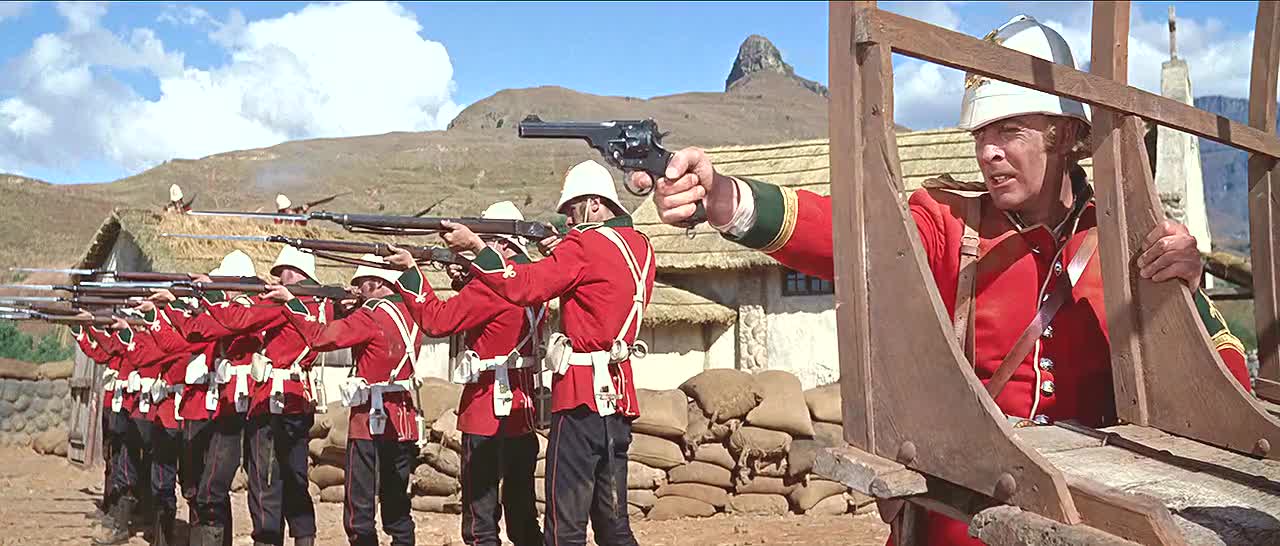
13.    A Zulu unit armed with rifles start firing from a ridge overlooking the camp.  It is implied that the Zulu are armed with Martini-Henrys taken at Isandhlwana.  The British return fire (including Chard with his pistol at 300 yards).

14.    The Zulu attack in waves.  Chard shifts men to hot spots.  Bromhead leads a reserve squad.  The fighting is bayonet to assegai.  Some of the Zulu break through the walls.

15.    Cpl. Schiess leaves the hospital to help and ends up saving Chard’s life.  Chard is wounded in the neck and is taken to the hospital where Surgeon-Major Reynolds is taking care of the wounded.

16.    The Zulu assault the hospital and set fire to the roof.  Bromhead climbs on the roof to fight.  The Zulu get into the hospital and the patients and soldiers cut holes in the walls to escape from room to room.

17.    Hooks is a malingerer, but becomes a hero in the defense of the hospital.

18.    At a crucial point in the battle, the cattle get loose from the kraal and blunt a Zulu attack.

19.    During the night, to the light of the burning hospital, the attacks continue.  The movie implies that the attacks are piecemeal and held off by gunfire.

20.    The next morning the two sides serenade each other.  The British sing “Men of Harlech”.

21.    The Zulu launch one last assault and the British retreat to the last wall.  Volleys end the attack.

22.    A calling of the roll leaves the impression that the percentage dead is high.

23.    The Zulu salute the British and then leave.


1.    The Witts are visiting the village of Cetewayo and witness a mass marriage ceremony when word arrives about the Zulu victory at Isandhlwana.  HOLLYWOOD  Otto Witt was a Swedish Lutheran pastor who had purchased Rorke’s Drift and established a mission.  His attempts to Christianize the Zulu’s on the other side of the border had been unsuccessful and he attributed this to the traditionalism of Cetewayo.  He actually favored the British invasion and would not have been a guest at a Zulu ritual on the eve of the battle.  Witt was at Rorke’s Drift the whole time and he had sent his family away.  He did not have an adult daughter.  The movie implies that when the King hears of the battle, he orders the attack on Rorke’s Drift.  Actually, Ceteswayo had given orders for the Zulu army to stay on its side of the border.

2.  Chard is an engineer building a pont at Rorke’s Drift.  HISTORY  Chard was assigned the task of constructing the pont and actually had been to the camp at Isandhlwana and returned the morning of the battle. 

3.  Bromhead returns from a hunting trip and meets Chard for the first time.  HOLLYWOOD  The two officers had met earlier and their relationship was not adversarial as depicted in the film.

4.  Word of the defeat at Isandhlwana arrives from a Boer named Adendorff.  HISTORY  Adendorf was one of several survivors who stopped at the camp and reported the disaster.  He was the only one to stay and was thus the only person to fight in both battles. 

5.  Rorke’s Drift is a supply depot/camp that is also the site of the Witts’ mission.  HISTORY

6.  Chard takes command because of his seniority of just two months.  HOLLYWOOD  Maj. Spalding         was in command and when he left to get reinforcements, he left Chard in command after checking who had seniority.  Chard was three years senior to Bromhead.

7.  Witt claims Cetewayo is part of his parish and he wants to take the sick to safety.  Witt is an alcoholic.   HOLLYWOOD  Witt left to go to his family after witnessing the Zulu army approaching from a hillside.  A Reverend Smith stayed for the battle.  He helped hand out ammunition and gave moral support.  There is no evidence Witt was an alcoholic.  

8.  Adendorf describes the Zulu “buffalo horn” tactic.  HISTORY  The Zulu’s are famous for using a tactic that involved double envelopment.  They did use this tactic at Isandhlwana, but the movie includes this scene to imply they used it at Rorke’s Drift when in reality it was mainly piecemeal frontal attacks.

9.  Bromhead suggests going into the hills and ambushing the Zulu.  Chard decides to defend the post by building walls out of mealy bags and wagons.  HISTYWOOD  Bromhead and Chard did consider evacuating the post, but it was Assistant Commissary Dalton who insisted that leaving in a column with the wounded would play into Zulu hands.  The British did construct walls out of mealie bags, biscuit boxes, and overturned wagons.  This process had already been started by Bromhead and Dalton by the time Chard returned from the pont.

10.  A unit of Boer cavalry arrives, but refuses to stay and reinforce the garrison.  HISTYWOOD  A unit of Durnford’s native cavalry (they would have been mostly black) did arrive and was posted forward, but they withdrew when the Zulu approached because they were low on ammunition and felt the situation was hopeless.  They were not led by Stephenson, he was the leader of the native infantry that runs away.

11.  Witt encourages the native troops to run away.  Chard arrests him and later sends him away.  HISTYWOOD  Witt had nothing to do with this incident.  They deserted soon after the cavalry left.  Two British officers (including Stephenson) went with them and one of them was shot in the back by a British soldier.  These soldiers would not have been in uniforms, by the way

12.  The Zulu sneak up and then stand clashing their spears on their shields.  They advance, but stop to take fire.  Adendorf explains that the Zulu leaders are determining the strength of the British garrison.  They then withdraw.  Adendorf estimates that there are 4,000 Zulu.  HOLLYWOOD  In the first attack, the Zulu did not attempt to surround the camp.  They came straight on and the British opened fire at 500 meters and the Zulu returned fire.  The Zulu were quiet.  They came on steady until about 50 meters out when they were enfiladed by volleys from wall by the storage building.   This blunted the attack and some of the Zulu regrouped and made a dash for the front of the hospital where some crossed the barricade and there was some bayonet to assegai contact.  This lasted only several minutes before the Zulu retreated to the brush.  Smaller attacks followed.  Adendorf’s estimate is a good one.

13.  A Zulu unit armed with rifles start firing from a ridge overlooking the camp.  It is implied that the Zulu are armed with Martini-Henrys taken at Isandhlwana.  The British return fire (including Chard with his pistol at 300 yards).  HISTYWOOD  The Zulu did fire from the hillside.  It was basically a nuisance due to the inaccuracy of the motley weapons the Zulu had.  They were not armed with captured Martini-Henrys.  The movie implies the Zulu were the army coming on after its success at Isandhlwana when actually the force was the Zulu reserve which had not tasted blood in that battle and wanted some glory of its own.

14.  The Zulu attack in waves.  Chard shifts men to hot spots.  Bromhead leads a reserve squad.  The fighting is bayonet to assegai.  Some of the Zulu break through the walls.  HISTYWOOD  The movie accurately reflects the intensity of the fighting, but exaggerates the number of bayonet and assegai wounds.  Most of the deaths were caused by bullets.  Eventually, Chard withdraws to the wall by the storage building abandoning the hospital.

15.  Cpl. Schiess leaves the hospital to help and ends up saving Chard’s life.  Chard is wounded in the neck and is taken to the hospital where Surgeon-Major Reynolds is taking care of the wounded.  HISTYWOOD  Schiess is one of the heroes of the battle.  He was in the hospital with blisters and was subsequently shot in the foot, but at one point he left the hospital to kill several Zulu who had approached the wall.  I found no evidence that he saved Chard’s life or that Chard was wounded and went to the hospital.  Reynolds did do great work with the wounded, but it is unlikely that he was not cynical as portrayed in the movie.  He even left the hospital area occasionally to deliver ammunition.  His fox terrier Dick was by his side throughout the fight. 

16.  The Zulu assault the hospital and set fire to the roof.  Bromhead climbs on the roof to fight.  The Zulu get into the hospital and the patients and soldiers cut holes in the walls to escape from room to room.  HISTORY  The Zulu did concentrate on the hospital and managed to capture it after several assaults.  Bromhead fighting on the roof is pure Hollywood, but the depiction of the chaotic fighting in the hospital is a strength of the movie.

17.  Hooks is a malingerer, but becomes a hero in the defense of the hospital.  HISTYWOOD  The character assassination of Hooks is the biggest canard in the movie.  He was actually a good soldier and a teetotaller.  He was assigned to help defend the hospital.  His family was incensed with his portrayal.  As far as his actions once the battle began, they are well done.  By the time Hook escaped from the building it was dark and Chard had withdrawn to the inner perimeter.

18.  At a crucial point in the battle, the cattle get loose from the kraal and blunt a Zulu attack.  HOLLYWOOD  The Zulu captured the kraal after several attempts, but I found no reference to patriotic cattle helping the Brits.

19.  During the night, to the light of the burning hospital, the attacks continue.  The movie implies that the attacks are piecemeal and held off by gunfire.  HISTORY  The movie downplays the numerous attacks during the night by the light of the burning hospital.  These assaults were held off by rifle fire.  The attacks died down after 2 A.M. and there were only desultory shots ceasing around 4 A.M.   

20.  The next morning the two sides serenade each other.  The British sing “Men of Harlech”.  HOLLYWOOD  Pure bull shit.  It was not even a Welsh regiment so they would not have sung that particular song.

21.  The Zulu launch one last assault and the British retreat to the last wall.  Volleys end the attack.  HOLLYWOOD  There was no fighting after 4 A.M.

22.  A calling of the roll leaves the impression that the percentage dead is high.  HOLLYWOOD  Out of 140 men, the British lost only 17 killed and 10 wounded.  The Zulu deaths were estimated at over 500. 

23.  The Zulu salute the British and then leave.  HISTYWOOD  A large force of Zulu (probably unrelated to the ones who participated in the battle) did appear on a hill and stayed for about an hour before moving on.  There was no equivalent of a salute.

RATING  =  .46
           I am aware that this rating will upset some people.  Many will be surprised that is much more inaccurate than "Zulu Dawn".  I am a fan of "Zulu" and think it is one of the great war movies, but too many people think that because it combines great entertainment with history that it is great history. It is not.  The treatment of Hooks alone eliminates it from any discussion of the most accurate war movie.  I did a lot of research on the battle, but  I am open to any corrections.

Sunday, August 4, 2013

JULY WAR MOVIE LEADERSHIP WATCHALONG: Pork Chop Hill and Zulu


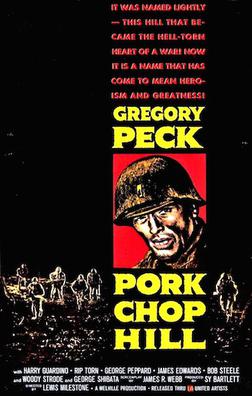
              "Pork Chop Hill" and "Zulu" are two of the greatest battle/small unit movies ever made. They have some interesting similarities. Both have an Alamo feel to them. Both have a small unit fighting against great odds. Both units have a strong, but inexperienced leader. Let's look at those two men.

1. PCH is based on the book by SLA Marshall about the fight for a hill in Korea near the end of the war. The hill had fallen to the Chinese and King Co., 31st Infantry, 7th Marines commanded by Lt. Clemons (Gregory Peck), was tasked with recapturing it. This was his first battle, but he tried hard not to show any doubts in front of his men. And doubts he had. It is obvious he is being a team player when his commanding officer outlined the mission. He doesn't let these doubts filter down to his men. Whenever he is asked "why?", he responds by saying that the higher ups must know what they are doing.

            He is a firm leader and no nonsense. He demands his men carry out orders (he leads by example on this) and does not coddle them. One soldier in particular (Franklen - Woody Strode) is a malingerer. Clemons forces him to go up the hill, but later when confronted by an armed Franklen he uses peer pressure. He adjusted to the situation. Clemons is willing to listen to his exec (O'Hashi), but he makes the final decisions. He leads by example and is in the thick of the fighting when necessary, but he also steps back to command from a central location.

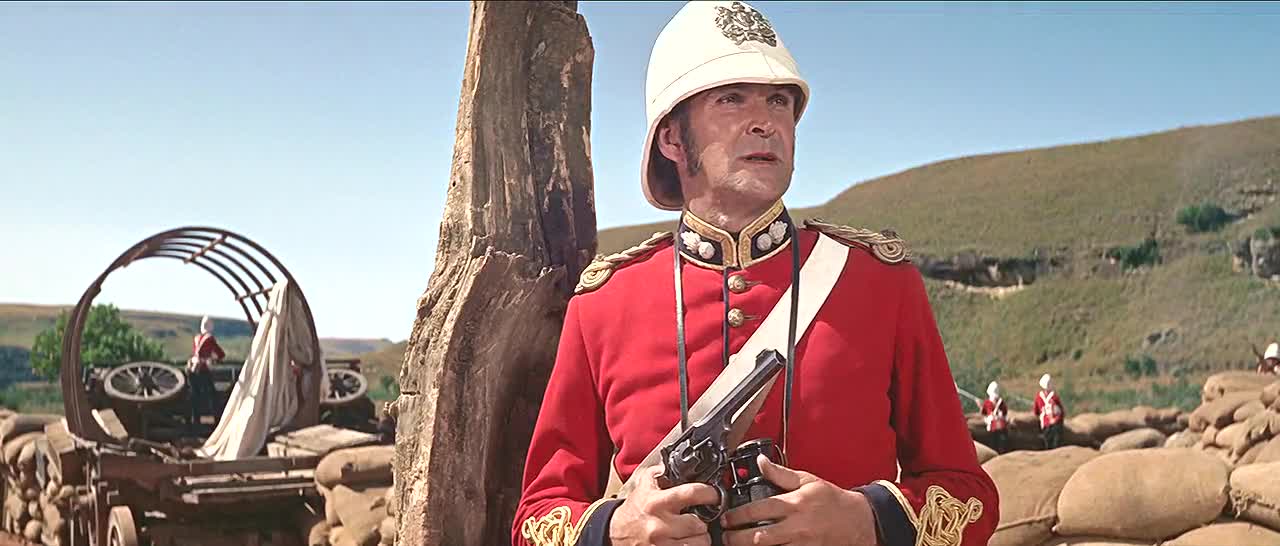
            "Zulu" is the story of the Battle of Rorke's Drift in the Zulu War. The small unit was B Company, 2nd Battalion, 24th (2nd Warwickshire) Regiment of Foot (2nd/24th). It was commanded by Lt. Chard (Stanley Baker) who was fighting his first battle. He is stoical, but laconic. He never loses his cool. He does not believe in inspirational speeches (neither does Clemons) and he also does not believe in discussing plans with his subordinate Bromhead. Similar to Clemons, he takes part in the fighting, but prefers to command from the rear. He has to make more decisions than Clemons (who is essentially following orders) and shows a knack for making the right tactical moves.

            Who is the better leader? I would have to choose Clemons, but they are both good leaders. They are very similar. However, Chard is too insulated from the men. He does not discuss plans with Bromhead. He does not explain why he does things.

2. The tactics depicted in PCH are standard for the modern U.S. Army. Clemons is ordered to retake the hill using a two platoon frontal assault with the third platoon held in reserve. The hill is prepped with an artillery barrage and King Co. pushes hard when it is lifted. Once in control, Clemons consolidated and used purely defensive tactics.

           Chard has a similar, yet different problem. He does not have to capture Rorke's Drift, but he does have to defend it. His defensive tactics include improving the position through ramparts with interior lines of defense. He establishes a reserve unit to plug holes. He uses volley firing by ranks to blunt some of the attacks.

           In PCH, the Americans were faced with horde frontal attacks by an enemy armed with bolt action rifles, burp guns, and potato masher style grenades. The Americans countered with M-1s, BARs, Browning M1919A4 machine guns, and pineapple grenades. Advantage Americans. What the movie does not clearly show is the use of artillery by both sides as the main weapon.

           In Zulu, the British are armed with Martini-Henry rifles. The Zulu warriors were armed with the iklwa (a short stabbing spear that was a cousin of the assegai). Some had a variety of rifles. These were notoriously inaccurate but did cause some of the British casualties. The British had a much bigger firepower edge than Clemons did. The Zulu used similar tactics to the Chinese.

           Both movies should be required viewing at West Point. Both leaders are good role models.

AUGUST WATCHALONG: Lawrence of Arabia

Monday, November 26, 2012

#22 - Zulu (1964)


BACK-STORY:  “Zulu” was released in 1964 and was so successful that it not only resurrected the Battle of Rorke’s Drift, but molded the modern image of it.  The film was a labor of love for Stanley Baker.  It was directed by the blacklisted Cy Endfield.  After The House Unamerican Activities Committee branded him a communist, he moved to England to continue his career.  The movie was filmed on location in South Africa.  700 blacks were used as extras.  Many of them were descendants of the Zulu who participated in the battle.   So many had never seen a movie that Endfield screened an old Gene Autrey film for them.  Because of apartheid, they could not be paid so Endfield let them keep the cattle.
OPENING:  A narrator (Richard Burton) reads a dispatch outlining the British defeat at Isandlwana on Jan. 23, 1879.  We see the aftermath of that disaster in the corpse-strewn British camp.  The scene shifts to a Zulu village where a missionary named Witt (Jack Hawkins) and his daughter Margareta (Ulla Jacobsson) witness a marriage ceremony.  It’s a fascinating slice of Zulu culture.  They leave for their mission at Rorke’s Drift when word of Isandlwana arrives.
Chard is in command
SUMMARY:  Back at Rorke’s Drift, Lt. Chard (Baker) is building a bridge.  He meets Lt. Bromhead (Michael Caine in his first major role) who has been left in command.  Bromhead is your typical upper class officer who is touchy about his status.  When they are alerted to the approach of a large force of Zulu warriors, Chard assumes command based on being commissioned three months earlier.  He orders the position be prepared for defense using mealy bags, crates, and overturned wagons.  He rejects Bromhead’s suggestion of evacuating the post.  The decision to stay and not even evacuate the wounded sets off Witt who is a pacifist Bible-thumper who considers the Zulu king to be a member of his parish.  He is also a closet alcoholic who gets himself and his daughter kicked out of the camp while ranting that they are all going to die.  This sobers up the men, but they continue to prepare calmly for the onslaught.
                We are introduced to some of the soldiers (especially the future Victoria Cross recipients).  The standouts include Colour Sergeant Bourne (Nigel Green) who stoically ramrods the enlisted.  Private Hook (James Booth) serves as the film’s anti-hero.  He is a malingering, petty thief, malcontent.  Will he find redemption as a real hero?  Duh!
Bromhead joins in
                An eerie train-like droning noise heralds the approach of the enemy.  The suspense builds as they sneak up and then launch a frontal charge which comes to a surprise halt within rifle distance of the British line.  A Boer ally named Adendorff informs Chard that the strange tactic is not to allow for the standard Gunga Dinish wanton slaughtering of the natives, but in fact is the Zulu leader’s way of determining the fire power of the defenders.  Get your calculators out if you want to find out whether this movie will approach a “Where Eagles Dare” death count.
there is a Chinese laundry at the post
                As though things are not bleak enough, a unit of the enemy is positioned on a hill where they can use their newly acquired British rifles to harass the defenders.  When one soldier asks “why us?”, Bourne responds with “because we’re here”.  The second attack breaches part of the wall and leads to hand to hand (or bayonet to iklwa) combat.  There are a series of attacks followed by lulls in the fighting.  The casualties mount, but none of the Brits panics.  They all have their upper lips stiff or their cheek on (as in the case of Hook).  Chard is growing into command and Bromhead proves an able second.  At one point, Chard calls for firing by ranks in a mini-counterattack.  Discipline and firepower – how an empire was won.
                The fifth attack reaches the hospital.  Bromhead fights on the roof and Hook leads the interior defense.  The building catches fire to add to the chaos.  Hooks throws on the mantle of a hero, but wears it reluctantly as he stops to take a drink of medicinal alcohol before being the last to leave the burning building.  A cattle stampede breaks the momentum of the assault.  Attacks continue in the night, but we are swiftly in the broad daylight of the second day
CLOSING:  The Zulu serenade the British with a war song so the Brits respond with the regiment’s anthem, “Men of Harlech”.  “Keep these burning words before ye / Welshmen will never yield”.  Could this be a Hollywood moment?  The final assault is defeated with three lines of British riflemen using coordinated volleys.  Result:  a pile of black bodies.  A mad minute of European fire power ends the native dream of evicting the foreigners from their land.  Just when it looks like it’s over, the Zulus mass again on the hillside.  However, this time it’s to acknowledge respect for fellow warriors.  Richard Burton’s voice returns to check off the eleven VC winners.
RATINGS:
Acting -  B
Action – 9/10
Accuracy -  C+
Plot -  A
Realism -  B
 
Overall -   A-

WILL CHICKS DIG IT?    Very unlikely.  This movie is testosterone-fueled.  The one female character is not a positive one and disappears early in the film.  On the plus side, the movie is not particularly graphic.

HISTORICAL ACCURACY:  The Battle of Rorke’s Drift took place during the Anglo-Zulu War of 1879.  The war was brought about because of British desire to expand its South African colony into Zululand.  They manufactured a threat from the Zulus as their provocation and used it as justification for an invasion.  King Cetshwayo wanted peace, but could not meekly accept his own overthrow and annexation of his land.  The movie does not explain the background to the war possibly because the British did not want to mar the feel-good aspect of such a sterling battle. 
                The allusions to the Battle of Isandlwana are accurate.  The British central invading column did get wiped out by 20,000 Zulu warriors.  However, King Cetshwayo did not follow this up with the attack on Rorke’s Drift as the movie implies.   The attack was the idea of his glory-seeking half-brother whose unit had not gotten to Isandlwana in time to participate.  In fact, the King had forbidden his forces to go on the offensive into British territory.
                The recreation of the hospital/supply depot is accurate.  It was leased by the British government from the missionary Witt, but his depiction is way off.  The real Witt was married with two young kids.  He was not a pacifist, nor a drunkard.  He supported British policies.  The Zulu king was not a parishioner of his.  He was not drummed out of the camp, but left voluntarily to see after his family.  His is not the only mischaracterization.  The most egregious is Hook.  He was not the malingering malcontent depicted in the film.  He was actually a solid soldier and a teetotaler.  His portrayal was so offensive that his daughters walked out on the premiere.  Bourne was actually very young for a Colour Sergeant and also slight in stature.  The doctor was not cynically anti-war and earned his VC by leaving the hospital to tend the wounded on the front lines.  Not to mention the unit itself is misidentified.  In the movie it is identified as a Welsh regiment when in reality it was not predominately Welsh.
                Some of the incidents are close to reality.  The native levies did flee before the battle, but not because of the rantings of Witt.  They were actually led out by their British officer who was subsequently court-martialed.  The Boer cavalry that refuses to augment the defense actually stayed for the early festivities, but left after its cavalry carbine ammunition ran low.  Chard was actually appointed to command by the unit’s captain before he left.  This was partly based on seniority, but he was commissioned three years before Bromhead.  They did not disagree on strategy and Chard actually favored a withdrawal.  It was Acting Assistant Commissary Dalton who pointed out that a small column slowed by wounded would be easily caught and wiped out.
                Although Adendorf accurately describes the Zulu tactic described as “the horns of the beast”, the movie does not depict them using this tactic.  This might truly reflect the battle as the attacks are best described as piecemeal.  The Zulu spear called an iklwa (the sound it made when being pulled out of a wound) is authentic.  It was a variation of Shaka’s assegai.  They also carried the cow-hide shields shown in the film.  Unfortunately for realism, this force would not have had access to looted British rifles to snipe with.  Like most Zulu units, they would have had an assortment of inferior guns.  Five of the seventeen British deaths were from gunfire.  The British weaponry is accurate.
                The battle itself has some problems.  There is no evidence for the opening “cannon fodder as intelligence gathering” gambit.  The assaults were more consistent and not as easily differentiated as in the film.  The assault on the hospital, its defense led by Hook, and its subsequent burning are pretty close.  They did cut holes through the walls to go from room to room.  The last survivors exited from a window, not out the back door.  Strangely, the movie foregoes the suspense of the consistent night attacks which tapered off after midnight.  They ended around 2 A.M. and the subsequent gunfire was over by sunrise thus ending the battle.  There was no climatic charge after dawn.
                It will not surprise that there was no sing-off.  Plus the song would not be the unit anthem for another two years.  It goes without saying that the Zulus did not salute the courage of the Europeans.  As far as why they withdrew, a final decisive assault was abandoned with the approach of a relief force (“the cavalry was coming”).  By the way, the movie leaves out the post script of the British dispatching any wounded Zulu.  On a similar note, the British actually lost only 17 dead in the battle – the movie gives the impression it was quite a bit more.  
CRITIQUE:  “Zulu” has many strong elements.  The set is authentic and the scenery is amazing.  The movie was filmed in a national park which, although hillier than the real locale, certainly added to the visuals.  The music by John Barry is used sparingly, but effectively.  Some scenes have little or no background music.  A good example is the opening attack which is allowed to build without music.  The cinematography is outstanding.  It’s old school without the modern pizazz, but you are in the thick of the fighting.  The acting is excellent.  Jack Hawkins chews the scenery a bit, but everyone else controls himself like a proper British soldier would.  Baker, Caine, Booth, and Green are standouts.  The most remarkable performances are by the Zulu extras.  They are naturals.  That Gene Autry movie must have really done the trick.
                The movie gets the small things right.  The soldier behavior is true to British soldiers of that era.  Their dialogue is not forced or cringe-worthy.  The comroderie is evident.  There are several friendships that are highlighted.  The soldiers’ bond is apparent.  There is not a lot of humor, but then there is not a lot to laugh about.  There is also very little whining.  Hook is the only soldier who appears to be avoiding combat.  A bit unrealistic.  The movie does not play up the chasm between the upper class officers and the lower class enlisted which is often a theme in movies about the British army of that time period.
                The character development is well done.  The movie does a good job of fleshing out all of the VC winners and several more roles.  Each man is distinct (although name tags would have been nice).  The evolution of Chard from engineer building a bridge to combat leader is instructive.  There is a quiet moment when he goes from trembling hand while reloading his revolver to steadiness.  Of course, the most fascinating arc is that of Hook.  It’s a bit cliché, but it works.  He could have been a tedious character ( he reminded me of some of my students), but Booth does a good job making him a likeable rogue.  His swigging on the broken liquor bottle before fleeing the burning hospital is another nice touch.
                As a movie about a battle, “Zulu” is one of the best.  This is partly because it has few frills.  It concentrates almost totally on the battle and the men who fought it.  The tactics are realistic although some of them have a textbook feel to them.  In reality, it is doubtful the British used the variety the movie depicts.  That’s acceptable for entertainment purposes.  The action is intense and edge of your seat.  The deaths are swift and not melodramatic.  There are no death speeches.
                The movie is not without flaws.  I have already expounded on the historical inaccuracies.  One problem is the lack of background about what brought on the war.  The audience is treated to a fair treatment of the Zulu.  They are not demonized as the Indians were in most Westerns and they are shown as brave warriors, but it is not made clear that they were in the right.  We are manipulated to root for the Europeans instead of the natives fighting for their lands and liberty.  A related flaw is the lack of a Zulu perspective.  This is perplexing given that the movie opens in their village with an interesting take on their culture.
CONCLUSION:   The ranking of “Zulu” at #22 appears to be appropriate.  It is not a great war movie (as some claim), but it is certainly very good and accomplishes its mission effectively.  I am little uncomfortable with this.  As a war movie lover, I really enjoyed the movie.  But as a military history buff, I can see how the movie used a different medium to do in the 1960s what the British government used the newspapers to do in the 1870s.  Think about it – 11 Victoria Cross winners!  Assuming a Victoria Cross is equivalent to the Medal of Honor, it should take extreme bravery to be awarded one.  Not taking away from the defenders, but it would appear the British government was looking for a civilian morale booster to soften the Isandlwana disaster.  The movie does a similar job in glamorizing the imperial days of England.  Unlike its most obvious equivalent (Wayne’s “The Alamo”), the film does not recreate the myths, but instead actually creates the myths.
the trailer
 
the full movie
 
a neat battle scene
 
POSTER -  Outstanding.  A+

TRAILER -  Disorganized.  Doesn't give a clear picture of what the movie is about.  C