Showing posts with label Battle of the Somme. Show all posts

Saturday, July 1, 2023

Line of Fire: The Somme (2005)


            July 1, 1916 was the worst day in the history of the British army.  It was the opening day of the Battle of the Somme.  On this day, 20,000 British soldiers died and another 37,000 were wounded.  An attack that was supposed to bring about the long-awaited breakthrough on the Western Front, instead became a battle of attrition that went on for 141 days.  At the end of the battle, the British were just 6 miles closer to Berlin.  The battle became an exemplar of the mindless slaughter associated with the Great War.  The battle was the subject of the first feature-length war documentary.  Amazingly, “The Battle of the Somme” was in British theaters before the battle was over.  The film was seen by 20 million Brits.  It gave them the first chance to see the war up close, including the realities of death.  The documentarians used actual footage and staged action.  It was a propaganda film, so it did not truthfully make clear the disaster the battle became.  However, paired with the 20,000 telegrams sent to loved ones, the British public got a eye-opening reality check about the war.  “Line of Fire:  The Somme” is a modern documentary on the battle.  Watching the two documentaries will give you an idea of how far war documentaries have come. 

            “Line of Fire:  The Somme” was produced by the BBC.  It is another outstanding effort of docudrama by the television network. I have never seen a BBC docudrama that has not been well done.  They feature actors portraying historical individuals as well as archival footage (when available).  A narrator is used to bridge scenes. The movie follows several characters who are portrayed by actors.  Some of the characters are German soldiers and there is an American nurse.  Much of the dialogue comes directly from diaries and letters.  The film eschews outlining the war going into July, 1916.  It’s enough to know there is a stalemate on the Western Front.  British Gen. Henry Rawlinson has an idea for a breakout near the river Somme.  A week-long artillery bombardment will soften the German trenches so the Brits can literally walk into and beyond them.  The movie takes us into a German dugout as the German soldiers withstand the bombardment.  It is clear that although seriously discomfited by the barrage, the Germans will be able to defend their trenches.  On the other side, we meet a variety of British soldiers who await the order to go over the top.  Some are officers, others are regular soldiers, including a 15-year-old.  The movie does a good job depicting the shaky confidence of the men.  No one questions the order to walk across no man’s land in tidy lines.  The whistling of machine gun bullets before they even leave their trenches is an ominous portend of what awaits them.  The randomness of death is hammered into the audience as men fall left and right.  Some of the featured soldiers do not survive.  We hear their last letters home or their last diary entries.  It’s more poignant than the 1916 documentary because we get to empathize with actual soldiers.  The movie also intercuts to headquarters so we can see Rawlinson deal with battle reports.  Ironically, the initial reports are positive, giving the general false optimism.  By the end of the day, he will be disabused of his dream of a great breakthrough.  The documentary ends with the first day and only post-scripts the rest of the battle, which ended with little territorial gain and over a million total casualties.

            “Line of Fire:  The Somme” could not have been better.  The blending of footage with reenactment works very well as entertainment.  In the case of this film, since the reenactments are in color, you don’t have to wonder what is footage and what is staged, unlike the 1916 film.  Another advantage of the film over the 1916 documentary is we have almost a hundred years of historical research available.  With that said, the movie does not take a stand on whether the attack should have been launched, although the viewer will certainly come away thinking it was a mistake.  The film does not flay the generals and commanding general Douglas Haig is not mentioned.  It is mainly a look at what the soldiers went through.  It is very good at putting you in the soldiers’ boots.  You can imagine what bravery it took to funnel through the few gaps in the barbed wire. Gaps that were targeted by German machine guns. The actors do a fine job and some of them are recognizable British television actors.  The trenches are recreated realistically, but the budget apparently did not cover an appropriately scarred no man’s land.  The soundtrack is excellent.

            The film is very informative and is the best place to get a good idea of what happened on the first day of the battle.  Maps are used as well as an airplane-eyed views of the front.  There are some nice details that will please any WWI buffs.  There is a scene where two British officers censor letters home.  A soldier complains about getting only three hours of sleep every night.  We learn that German reconnaissance aircraft warned the Germans of the British preparations for the attack.  At the same time, British air recon is used to prepare for the offensive.  And yet, Rawlinson never makes the connection that if we can spy on them, they can spy on us.  It is clear that the attack was doomed from the start.

            In 2018, Peter Jackson released an acclaimed documentary on WWI called “They Shall Not Grow Old”.  He used archival footage with post-war interviews.  It was well-done and won the BAFTA for Best Documentary.  In my opinion, “Line of Fire:  The Somme” is better because instead of just blending interviews and footage, it portrays the soldiers along with their words.  These types of docudramas are more entertaining than traditional documentaries.  Especially those that cover events before there was footage.  The goal of documentaries is to inform their audiences.  You can reach more viewers if the documentary looks like a movie.  “Line of Fire:  The Somme” is a good example of that fact.    

      GRADE  =  A

Friday, September 9, 2022

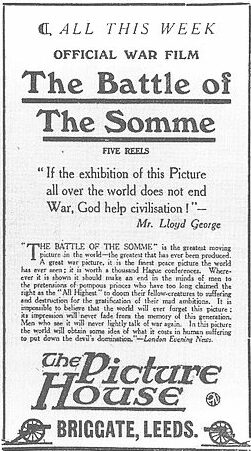
DOCUMENTARY: The Battle of the Somme (1916)


              “The Battle of the Somme” is a British documentary on the famous WWI battle.  It was entitled “Kitchener’s Great Army in the Battle of the Somme” in America.  It was directed by Geoffrey Malins and he used footage taken by himself and John McDowell.  The War Office insisted that the movie boost morale so it was edited to take out any images that might lower support for the war.  Although Malins and McDowell risked their lives to go into the trenches, the scene where the Tommies go over the top was staged.  The movie was a huge hit in Great Britain and sold 20 million tickets in its first six weeks.  The movie is 77 minutes long and is divided into five parts.

                Part 1 covers the preparatory actions before the battle.  Soldiers march past a stationary camera.   Caissons are loaded and artillery fires.  “The shells tearing up the enemy’s deep dugouts”.  Nope.  Part 2 is the battle.  The men eat chow.  A mine is blown up to facilitate the attack.  This is followed by the advance.  This includes the famous staged scene where a Brit is shot just as he tries to leave the trench.  Wounded are carried back.  German prisoners are treated well.  Dead bodies.  The another part is of the clearing of the battlefield.  Victorious British, defeated Germans.  The movie concludes with the devastation of the battle.  We see a destroyed French village.

                I can see why the movie was a big hit – in 1916.  It must have seemed amazing to audiences to be able to see what their boys were doing on the Western Front.  It certainly went beyond what they were getting from the newspapers and they may have been fooled into thinking they were seeing reality.  But they were seeing rose-colored reality.  How ironic that the subject used to boost morale was one of the most infamous battles in British history.  A truthful documentary of the battle would have been shocking to audiences and certainly would not have been good for recruitment.  Lt. Gen. Henry Rawlinson remarked that it “cut out many of the dead and the horrors”.  In fact, due to the limits of the photography, there are no shots of men in battle.  No shots of the slaughtering of the men crossing no man’s land to be mowed down by machine guns and artillery.  You would not have learned that the British lost almost 60,000 men on the first day of the battle.  This was the worst day in the history of the British army, but I don’t think the moviegoers got that.  Still, the movie is a must see for serious war movie fans and cinephiles in general.  The footage is crisp and clear.  The title cards are not propagandistic.  You can learn about preparation for battle and the use of artillery.  So it has value as a tutorial, but as entertainment, it is pretty boring.  For instance, there is a lot of redundancy.  We see many shots of soldiers marching.  Christ, I think every British soldier made it into the film. 

                I can only recommend “The Battle of the Somme” if you really love war movies and want to check it off your bucket list.  It will become, like for me, the oldest movie you have ever seen.  It is also a must-see for any fans of the battle.  It’s not as good as a book, but it serves as a supplement.  However, there are plenty of better documentaries if you don’t want to read a book.


GRADE  =  C                           

Saturday, April 25, 2020

ANZAC Day: Anzacs (1985)


                    Today is ANZAC Day, so I thought it would be appropriate to post a review of the miniseries “Anzacs”.  The acronym stands for Australian and New Zealand Army Corps which fought in WWI.  The series is specifically about the 8th Battalion of the Australian Imperial Force.  The series is considered to be part of the Australian New Wave cinema which includes “Breaker Morant” (1980), “Gallipoli” (1981), and “The Lighthorsemen” (1987).  The miniseries incorporates the very Australian themes of mateship and larrikinism.  “Mateship” refers to the Aussie traits of equality, loyalty, and friendship.  A “larrikin” is a mate who is mischievous, rowdy, and insubordinate. 

                    The series starts as a buddy picture reminiscent of Gallipoli.  Martin (Andrew Clarke) and Dick.  Martin is a rich kid who has a domineering father and Dick is a poor stockman.  Martin is romantically interested in Dick’s sister Kate (Megan Williams).  When WWI breaks out, Martin’s father wants him to go fight and arranges a commission in his old British unit.  Martin is not interested in the war, but when Dick and the other lads enlist, he goes too.  And so does Kate, as a nurse.  We are introduced to the other members of the platoon.  One of them is the classic larrikin Pat (Paul Hogan).  They are first deployed to Gallipoli where they bond and some die.  It’s not a good idea to get attached to anyone in the cast.  Most of their action is trench warfare against the Turks on a very limited scale.  The series occasionally leaves the cameraderie for some jabs at their superiors.  The series is firmly in the lions led by donkeys school.  A recurring character is a journalist named Murdoch who voices Australian resentment toward British treatment of the Australian “hooligans”.  From Gallipoli, the unit is shipped to the Western Front where they learn that the Germans are not the Turks.  Kate goes too so the romance can continue.  New characters are added as only six of the original forty are still around.  Gen. Haig makes an appearance as a pompous ass.  He makes a point of decrying the Australian ban on capital punishment for its soldiers (a by-product of previous British treatment of its Aussies).  Lloyd-George appears as a foil for Haig.  The home front gets a little coverage.  Martin’s father and the local priest represent the opposing views of the war.  A jingoistic politician browbeats his milquetoast son into volunteering.  The lads participate in the Battle of the Somme .  The “flesh and blood against machine guns” whittles men and morale.  And then comes Ypres.  They go through a series of commanders, some good and some bad.  Finally, the Yanks arrive and the tide turns.

                    “Anzacs” looks like it was made to be shown on ANZAC Day.  It is a fitting tribute to the Australian soldiers who fought in the Great War. The main characters are fictional, but many of the generals (like Monash) are the real people.  And the battles and campaigns are all associated with the 8th Battalion.  Unfortunately, the reenactments of the battles are simplistic and small scale.  The action tends to be tactically unsound and unrealistic, but the movie is more of a character study than an action film.  The characters are well-developed and represent a cross section of Australian men.  Unfortunately, the acting is just average.  Hogan steals the show as the class clownish Cleary.  The part was written with him in mind.  It was his first role after his TV show ended.  The rest of the cast is filled with familiar Australian actors.  They die well.  The series has some poignant deaths and they are not maudlin.  They are also very unpredictable.  

                    The trench sets are impressive with a passable effort on no man’s land.  The combat does not stack up, however.  And it gets worse as the series progresses.  It is often at night, probably to try to hide the low budget.  Many Australian servicemen were used as extras for verisimilitude.  Although, the series makes a point of showing the machinations of higher command, the big picture is usually hazy.  For instance, in the first episode they are scheduled to make a diversionary attack to support the landing at Sulva Bay.  Their general argues it will be suicidal, but it happens anyway.  And yet, we not only don’t see the attack, we don’t learn if it was very bad.  Although there is a clear attempt to emphasize the hardships the Aussies went through, what you mostly learn is the war killed a lot of Australian actors.  They gripe a lot, but it’s unclear why.  Other than the hammered fact that the British general were ass holes.  As opposed to the happy-go-lucky Aussies.  Well, they don’t stay happy.  But that was realistic.

                    If you want to celebrate Australian soldiers and want to hiss at the British, “Anzacs” may be for you.  Drink a Fosters every time a character dies.  It will help you get through them. 

GRADE  =  B-