THE TOP TEN
10. Lone Survivor - a balls to the wall "who will survive?" scenario set in Afghanistan involving a SEAL team behind enemy lines
9. Captain Blood- Errol Flynn swashbuckler with plenty of action and some nonmushy romance with Olivia DeHavilland
8. Go Tell the Spartans - early in the American phase of the Vietnam War, an outpost is defended against a Viet Cong attack while Burt Lancaster deals with the insanity of the war
7. The Dawns Here Are Quiet- Soviet film about a male sergeant and five female soldiers who take on German infiltrators in some woods
6. Das Boot- one ill-fated tour by a German u-boat in 1941 which is the best submarine movie ever made
5. Born on the 4th of July - the biopic about disabled Vietnam veteran Ron Kovic from gung-ho warrior to anti-war activist
4. All Quiet on the Western Front- the granddaddy of all war movies based on the greatest war novel
3. Paths of Glory- a drama about the trial of three French soldiers in WWI who are accused of not making a suicidal attack and must be sacrificed for unit morale/intimidation
2. Tropic Thunder- the funniest war movie comedy ever made which satirizes several famous war movies
BEST
MOVIE 2014: 84 Charlie MoPic (1989)
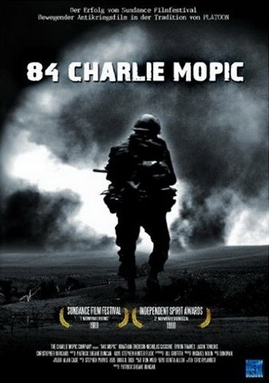
This
year the best war movie I saw was an old favorite – “84 Charlie MoPic”. It won my March Madness Tournament to
determine the best Vietnam War movie which means it beat some stiff
competition. Most of my readers may not
have heard of it, but it deserves to be better known. I go way back with this movie. I first saw it when it first came out. It was shown on PBS. (It was one of the first movies I taped with
my cutting edge new VCR. I showed it in
my American History class a few times.)
I don’t think it spent much time in theaters and made less than
$200,000. It was nominated for the Grand
Jury Prize at the Sundance Festival and Best First Feature for writer and
director Patrick Sheane Duncan (“Courage Under Fire”) at the Independent Spirit
awards. It was a “found footage” film
long before “Blair Witch Project” made that style popular. The movie was filmed in Southern California
on a very low budget with unknown actors.
84C is the military designation
for a movie cameraman. The premise of
the movie is that 84 Charlie (Byron Thames) is tagging along on a long range
patrol to chronicle what happens in the bush.
The entire movie is seen through MoPic’s lens and we only see him
briefly at the end of the movie. The
mission of the five man patrol is to locate a North Vietnamese Army base camp
in the Central Highlands of South Vietnam in August, 1969. The mission is being led by a green
lieutenant (Jonathan Emerson) who is called LT.
He is looking to get his combat ticket punched for promotion purposes
and sees the motion picture (to be called “Lessons Learned”) as a career
move. He is not exactly welcomed by the
veteran LRRP squad. In fact, the
sergeant who runs the unit (and continues to run it in spite of the LT) is
downright belligerent and disrespectful.
OD (Richard Brooks) is hard core and makes it clear he thinks the
presence of LT and MoPic will get his men killed. The rest of the unit is heterogeneous in the
classic tradition of small unit films.
Easy (Nicholas Cascone) is the radio operator who is close to the end of
his tour. He jokes around a lot. They are the kind of lame jokes soldiers
tell. “I wouldn’t shit you, you’re my
favorite turd” is typical. Pretty Boy
(Jason Tomlins) considers himself to be lucky, but is about to crack. Hammer (Christopher Bergard) is the cocky
M-60 gunner. Cracker (Glenn Morshower)
is a hillbilly who is a lifer. He’s the
guy who is usually called “Pop” in war movies.
His best friend is the African-American OD. The five are very tight knit in spite of
their various backgrounds. The mission
is pretty standard for a long-range patrol.
The men hump through the boonies until they reach the enemy camp. They call in artillery and then move to the
egress point. This is when things get
complicated and the movie becomes a “who will survive?” story.
Although the movie is called a
“found footage” movie, I prefer to refer to it as a movie that was filmed
completely in POV. This makes it unique
among Vietnam War movies. There are
several excellent movies set in the war, but none does as good a job of putting
you in the grunts’ boots. The movie is
as micro as you can get, but you will learn more about the soldier experience
than any other film. It is like a
tutorial on what a mission behind enemy lines would have been like. You are on the mission with the men. The movie is excellent on the details. There are many small touches that prove that
Duncan was a veteran of the war. For
instance, the men use C-4 to heat their rations. The uniforms, equipment, and weapons are
realistic. The dialogue is authentic and
not forced like in many Vietnam War movies.
Duncan throws in a lot of slang (“there it is”) and it helps if the
viewer is already versed in how the soldiers talked. Much of the dialogue is the unit members ribbing
each other. Few war movies are better at
portraying the unique comradeship of American soldiers. Part of the film involves interviews with
each of the men. This aides in character
development and gives various perspectives of typical soldiers. For example, Easy was “volunteered” for
service by a judge. You care about the
men and the dynamics in the unit are fascinating. Although there is some stereotyping, the
movie avoids the trope of the incompetent and/or frag-worthy officer. The conflict between LT and OD is not trite
or predictable. The acting is
surprisingly good for such a no-name cast.
Brooks (“Law and Order”) and Morshower (Lt. Col. Matthews in “Black Hawk
Down”) went on to respectable careers.
For “cherries”, the cast acts naturally and there are no
histrionics.
The movie is mostly talking and
marching, but so is war. It builds
nicely to the action-packed concluding act.
Easy stops joking as things get really serious and there are some
gut-wrenching deaths (including a great twist).
The movie does not pull its punches and can be quite emotional. Given the budget, the action is not up to
other Vietnam War movies, but the “fog of war” aspect of the jungle setting
ameliorates this. Besides, the object of the film is more drama than action.
Most lists of the best Vietnam
War movies overlook “84 Charlie MoPic”.
It can be argued that it is not the best, but there can be no argument
that it is in the top five. It is a
must-see for any fan of Vietnam War movies.
GRADE = A+
a trailer
the whole movie!
THE WORST MOVIES I SAW IN 2014
5. Heartbreak Ridge - Clint Eastwood wins the war in Grenada with a motley crew of post-Vietnam Marines
4. The Boys in Company C - a motley crew of draftees fights the establishment and plays soccer in Vietnam
3. The Inglorious Bastards- going behind German lines with a motley crew of misfits
2. Tank Battalion- a tank crewed by some motleys gets caught behind enemy lines in Korea
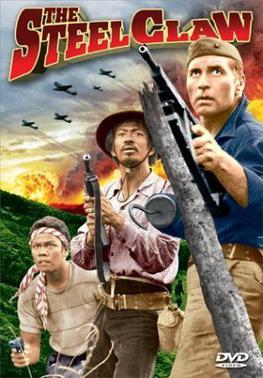
THE WORST: The Steel Claw (1961)
“The
Steel Claw” is a George Montgomery movie set in the Philippines around
Christmas time after the Japanese invasion.
That’s right, it’s a Christmas movie!
You couldn’t tell that from the title?
The movie was a labor of love for Montgomery and a gift for his
multitude of fans. He starred, co-wrote,
produced, and directed. The man was the
Da Vinci of B movies. Speaking of
producing, it looks like he emptied his wallet to pay for the movie. I mean literally. He did have a crate of pineapples that he was
able to use to hire some Filipino actors.
It’s
Christmas Day in 1941 in Manila. Capt.
Larsen (Montgomery) is visiting a brothel.
He’s a regular. He is not in a
Christmas spirit because he has recently lost a hand and has just a stump. Now that his playboy persona and disability
have been established, it’s off to a special mission. Larsen has to go into the jungle to hook up
with a rebel leader named Santana (Mario Barri). Larsen is to ransom a captured American
general for $5,000 (ironically, the same amount spent on the film). At the rebel camp he meets a tramp. Her name is Lolita (of course) and she is the
type of girl who feeds the chickens while wearing high heels. There is some painful to watch flirting
accompanied by sappy romantic music.
Before setting off into the wilds, Larsen fashions himself a steel claw
using the local blacksmith facilities.
Santana’s band joins a band led by the sexy Rosa (Carmen Austin). She and Santana have something going on which
makes four because Lolita insists on coming along in her high heels. She is almost eaten by a giant snake and gets
a spanking from Larsen. Frolicking then
ensues.
They
ambush a train using Rosa disguised as a sexy water buffalo herder. The train is used for an assault on the
Japanese base. This results in a wild
fire fight with some of the most hilarious deaths I have ever seen in a war
movie. (And that’s coming from a war
movie death aficionado.) As if the
action cannot get more intense, we are now treated to a train chase! The general is rescued, but he is not who he
appears to be. Lolita is wounded and may
not make it. They are in a race against
time to reach the rendezvous ship.
When
I saw that the movie starred George Montgomery I thought that since I had heard
of this actor, the movie might be a step above the kind of WWII movies you can
watch on You Tube. Wrong! The movie is incredibly bad, but does have
the guffaw factor. I laughed out loud several
times, mostly at some of the ludicrous deaths which included a shark
victim. You have to give the extras
credit for giving their all in their demises.
The movie appears to have been made without rehearsing and with only one
take for each scene. The acting is
wooden with the exception of Barri who brings some panache to his role as
Santana. He outacts the gringo
Montgomery. There is a modicum of homage
to the Filipino guerrillas and you do have the female rebel leader so there is
some homage there (although I think it was probably due to Montgomery sleeping
with Ms. Austin). The dialogue is what keeps the movie from being a
messterpiece. It is actually not
horrible. We do get the memorable line
when they are waiting for the ship:
“Keep listening and listen hard.”
Unfortunately there are not too many howlers like that one.
“The
Steel Claw” is a must see if you are the George Montgomery fan. Otherwise, avoid it like the plague.
GRADE = F-


