Showing posts with label Cold Mountain. Show all posts

Wednesday, January 4, 2012

BOOK / MOVIE: Cold Mountain


       I have already reviewed "Cold Mountain", the movie. This essay is on which is better – the book or the movie.


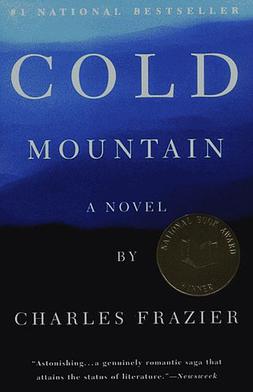
      Cold Mountain is an acclaimed novel by Charles Frazier which was a smash bestseller and multiple award winner. It is set in North Carolina during the Civil War. It tells the dual and parallel stories of an upper class woman named Ada and her farmer beau Inman. After a brief courtship that ends in a kiss that implies their future bliss, Inman is off to war. The book alternates chapters of Ada coping with adjusting to surviving without her preacher father and Inman’s Odyssey-like trek back to her. Her story is the story of a woman totally unprepared for rural life and running a farm who is transformed with the help of a women who is her opposite – Ruby. Meanwhile, Inman is encountering a series of eccentric characters and perilous incidents. They reunite at the end of the book.

      The book is wonderful. Frazier is a great writer. His prose is the kind that makes you savor every sentence. The alternating chapter approach really works because Ada and Inman’s stories are equally interesting and the end of each chapter brings anticipation of rejoining the other story line. The two leads are endearing in a non-schmaltzy way and the supporting characters are fascinating. It is not a flawless book, however. Given the bizarre nature of some of Inman’s adventures, there are some elements that strain credulity. In particular, two characters survive shootings that are nothing short of miraculous. Frazier also tends to throw in every variety of flora and fauna that existed in rural North Carolina. This is the perfect book for romantic botanists. These are minor criticisms, however.

      How does the movie compare? My provocative premise will be that any movie that does not improve on its literary source is either poorly made or trying to bring to screen a book that cannot be recreated. It would have taken incompetence to not have made a movie that was better than the book in this case. Considering the director (Anthony Minghella) and the star-studded cast and the amount of money that went into production, it should not be surprising the movie is better than the book. It is also no shame for the book that this is true.

       Think about it. Minghella starts with a great book which is ripe for film adaptation. The book has nothing in it that cannot be recreated on film (with the possible exception of the passage at Junior’s cabin). That cannot be said for all books. The director starts with a great “script” (the book) and can pick which scenes to incorporate into the movie and can change the scenes to improve them. He can use dialogue from the book and improve on the lines where he sees fit. Even a great book can be improved. The problem is when screenwriters and directors make poor decisions on changes they make, when they throw in elements that are not in the book, or they leave out key things from the book. These problems do not apply to the movie version of “Cold Mountain”.

       I know this will be an unpopular opinion, but the movie is better than the book. It is faithful to the book and even keeps the same structure. It does leave out some scenes, but none are crucial and it has all the key scenes and characters from the book. In significant ways, some of the scenes are improved and some of the characters are fleshed out. Here is a list of the improvements:

1. The book makes you wonder if Ada and Inman are really in love, the kiss in the film makes it obvious they are.

2. Teague and Boosie are much more integral to the plot and their malevolence makes Ada’s homefront experience more realistically fraught with peril than the book which limits her problems to running the farm.

3. The raid on the Swangers (in the book it is a raid on a different farm) personalizes the atrocities that occurred.

4. In the movie, Veasey’s death is not only more realistic, but implies that Inman’s obsession with getting home to Ada resulted in the deaths of the men.

5. In the movie, the scene with Sara (the widow with the baby) is much better. Having Sara shoot the soldier who was actually caring for the baby was a powerful comment on the war.

6. The Battle of the Crater gives a clearer picture of what Inman went through and why he is a different man who is worried about how Ada will feel towards him. Plus these scenes at Petersburg include Swimmer, Inman’s Cherokee Indian friend.

7. The final battle with Teague has Ada and Ruby heavily involved in defending themselves.

8. Ada and Inman’s “honeymoon” is much more romantic than in the book. Plus there’s some nudity.

      Some will argue that the movie is an aggravating hodgepodge of accents and nationalities of the actors (I’m talking about you, Caroline), but the acting in the movie is quite good (the worst actor got an Academy Award) and I do not care how the words sound as long as the sentences are good. I also don’t think most people care that Ada is a brunette in the book and a blonde in the movie.

      Most importantly, the movie has sound which means we can hear the music. Music plays a role in the book, but it is bumped to a higher level in the film. Minghella even adds a musician by fleshing out the role of Georgia (and then he puts Jack White into the role – genius). The score and two of the songs were nominated for Academy Awards.

       In conclusion, always read the book first because it will give you a fuller story and then the movie will probably improve on the basics.

Thursday, June 9, 2011

"Cold Mountain"


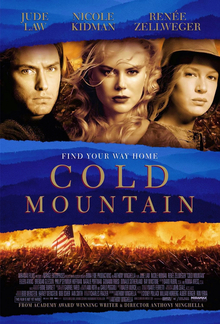
     “Cold Mountain” is a war romance set in rural North Carolina during the Civil War. It is closely based on the best-selling novel by Charles Frazier. The movie is a big budget film directed by Anthony Minghella with an all-star cast.


     The movie opens with a recreation of the famous Battle of the Crater during the siege of Petersburg in July, 1864. The horrors of war are accurately displayed as a huge explosion from a tunnel dug under the Confederate trenches creates a massive crater that Union troops pour into only to be trapped with the Rebels firing down upon them from the ramparts. Some Rebels are even throwing bayoneted rifles like spears. The carnage is hellish. There is hand-to-hand combat in the crater. It is a great battle scene. The trenches, uniforms, and equipment are authentic. However, there are some flaws in the battle itself. The battle is partly famous for the participation of black soldiers (some of whom were given no quarter) and yet the movie has only one brief glimpse of a black soldier. This is border line offensive and cannot be excused by the fact that the Romanian Army, which provided the extras, had no blacks in it. Other factual errors are that the battle lasted a lot longer and there was little hand-to-hand. It would have been foolish for the Rebels to give up the high ground to go into the Crater!

Ada and Inman
     After this dynamic opening, the movie leaves the war movie genre to become a modern version of the Odyssey. A Confederate soldier named Inman (Jude Law), after being wounded in a skirmish after his participation in the Crater, decides to heed the pleadings of his girlfriend Ada (Nicole Kidman) to return home. A flashback fills us in on the chaste beginnings of their relationship. They had barely met when secession fires the breasts of the men-folk of Cold Mountain. They part with a kiss and the unspoken understanding that they are meant for each other. The rest of the movie jumps back and forth to tell their separate stories.

     Inman’s trek home brings him into contact with a variety of memorable characters. He hooks up with a sinful preacher (Philip Seymour Hoffman) who he prevents from killing an impregnated slave. They help a dirt-farmer named Junior (Giovanni Ribisi) with a dead cow and then in his home are seduced by his sluttish women while he steps out. Junior returns with the Home Guard and Inman and the preacher are arrested. Later, Inman escapes when the Home Guard comes under attack from some Yankees. Later, he spends the night with a Confederate widow Sara (Natalie Portman) and her baby. She tells him, “Knock on just about any door – man dead, woman left.” A good summation of the effect of the war on Southern women. When three Yankee soldiers come to the farm house, Inman kills two of them before they can rape Sara and she murders the third who was actually watching over her baby. War is Hell, even away from the front.

     While Inman is on his odyssey, Ada is dealing with problems on the home front. Her father dies, leaving her with a farm to run. Being a cultured city girl, she is overwhelmed. To the rescue comes a salty, hardscrabble farm girl named Ruby (the scene-chewing Renee Zellwegger) who learns her bout farmin’. They develop a close relationship and make the farm productive. This is the least of their problems as they have encounters with the evil Home Guard led by Teague (Ray Winstone) and his psychopathic henchman Bosie (a chilling Charlie Hunman). The Home Guard uses its commission to hunt down deserters and conscription-avoiders to prey upon families. They kill a farmer friend of Ada’s and torture his wife to reveal her two deserter sons who they then kill.

     Things get more complicated when Ruby’s estranged father Stobrod (Brendan Gleason) returns and reconciles with the embittered Ruby. Stobord is hiding in the hills with two fellow deserters including Jack White of the White Stripes. They happen to be musicians which gives the filmmakers the excuse to include some live blue grass to go along with the background songs that are noteworthy for their excellent rendering of period music appropriate for the rural South of this time period. (The movie was nominated for its Original Score and two of its songs.) Unfortunately, Teague comes upon their camp site and Stobord is mortally wounded. Ruby and Ada are nursing him back to health when Inman comes walking up like an apparition. He and Ada do not embrace (?), but after some tentative reacquainting, they consummate their love and live happily ever after. Not! There has to be resolution of the fact that Teague/Bosie are still around. Watch the movie to find out what happens. Have some Kleenex handy, ladies (and some gentlemen).

     First let me dispense with the question of whether “Cold Mountain” deserves to crack the Greatest 100 list. No, because it is not a war movie. It is a romance and road picture set in a war. With that said, it does a good job bringing to light the situation on the home front in the South. This makes it a very good historical movie. It is the rural companion to the upper class “Gone with the Wind”.

      The movie does not claim to based on actual events. However, Frazier did have an ancestor named Inman who deserted and had a confrontation with the Home Guard. Desertions were certainly common by 1864. There was a Home Guard and there were some bad things that happened to innocent civilians who were just trying to survive. I must add here that although the Home Guard deserves its reputation of using its power to settle scores and terrorize some families, many of the deserters were far from saintly. There were numerous deserters who became backwoods outlaws and participated in guerrilla warfare. The rules of war were often blurred in rural areas especially in areas where secession may not have been popular. The movie tends to be one-sided in its depiction of good versus evil. For instance, the incident where the farm mother was tortured is based on an actual occurrence, but the Home Guard had reason to be riled because some of their children had been killed in a raid involving the deserter sons.

      The acting is stellar. The leads have been criticized for having no chemistry, but the characters, Inman and Ada, are not flighty teenagers. They are also not opposites who attract in a typical cinema cliché. They have spent little time together and yet feel a bond. Their's is not a passionate union, but it is mature and there are many strong marriages like this in the real world (but not in Hollywood movies). The supporting characters, including the villains, make the most of their screen time. Zellwegger won the Best Supporting Actress Oscar, which tends to show if you want to stand out in an all-star cast, you have to ham it up. The scenery is excellent and the movie was nominated for Cinematography. The music is similar to “Oh Brother, Where Art Thou?” in its mix of folk and blue grass.

      Definitely a very good movie that has elements to entertain both males and females. 

Rating – 8/10