Showing posts with label Daniel Day-Lewis. Show all posts

Sunday, November 19, 2017

Lincoln (2012)


                “Lincoln” is not a war movie, but it is a Civil War movie.  It was directed by Steven Spielberg and was under development for about ten years.  Based on the Doris Kearns Godwin book Team of Rivals, which was about Lincoln and his cabinet, Spielberg was actually working on the movie before the book came out.  The screenplay was by Tony Kirshner who spent years researching the topic.  He took some artistic license as is to be expected, but his heart was in the right place.  Spielberg’s first choice for Lincoln was Daniel Day-Lewis but he declined the role.  Liam Neeson was tabbed, but after the movie was slow getting off the ground, he dropped out claiming he was now too old.  Day-Lewis then reconsidered.  He was rewarded with the Best Actor Academy Award.  The film also won for Production Design.  It was nominated for ten other awards including Best Picture, Director, Supporting Actress (Sally Field), and Supporting Actor (Tommy Lee Jones).  “Lincoln” was a box office success and was critically acclaimed.  As a post script, one impact of the film was the final unanimous ratification of the 13th Amendment.  It seems that when Mississippi belatedly ratified it in 1995, the paperwork was not filed properly.  Prodding from two academicians caused the Mississippi Secretary of State to rectify the error in 2013.

                The movie covers the last four months of Lincoln’s life.  It concentrates on his quest to pass the 13th Amendment.  Although more famous for his Emancipation Proclamation, that Presidential edict did not actually end slavery.  It declared that the slaves in the Confederate-occupied South were free.  The 13th Amendment officially ended slavery, but it was not an easy sell to Congress.  Lincoln had to use all of his considerable political skills to get the amendment through the House of Representatives.  The film chronicles the machinations that led to the climactic vote.  Lincoln is a realpolitician who allows Secretary of State Seward (David Strathairn) to employ a trio of political operatives led by the earthy Bilbo (James Spader).  The trio prove that the “spoils system” was still alive and well in 1865.  Lincoln also allies with Republican Thaddeus Stevens (Tommy Lee Jones) who believes that blacks deserve equality along with freedom.  Not all his colleagues in the House agree with his enlightened philosophy, as the spirited debates in the chamber depict.  There is plenty of 19th Century trash-talking.  In the midst of all this political maneuvering, there is a back-stairs at the White House arc that portrays the dynamics of the Lincoln family.  The death of their son Tad weighs on Abe and Mary.   The aged look of Lincoln can be attributed to prosecuting the worst war in American History and being married to Mary.

                “Lincoln” finished #13 in box office in 2012, which was very good for a movie of its type.  It was the only movie in the top twenty that was non-fiction.  Three of the thirteen were superhero movies, two were teenage trilogy movies, and four were animated children’s movies.  “Lincoln” was the most popular adult drama and its success proves that you can make money with a movie that has a lot of talking in it.  Although I can imagine some audience members might have squirmed like Lincoln’s cabinet when he launched into one of his homespun stories.  The movie is dialogue driven and manages to be set in the Civil War and yet avoid the temptation to throw in explosions.  Kirshner’s script is entertaining in its blend of Lincoln’s brilliant wordsmanship and the political argot of the time.  Did you know they used the f-word back then?  They also used the term “fatuous nincompoop”.  That bon mot was uttered in one of the lively scenes in the House.  Jones gets the best lines as Stevens, but the rest of his distinguished colleagues make you wish C-SPAN had a Civil War archive.   Apparently, back then, they did not use the phrase “my dear friend” before they reamed them.

                The movie is almost flawless in its execution.  It is good Spielberg.  Although the start had me concerned with its lame Spielbergian recital of the “Gettysburg Address” by a white and then black soldier.  After that schmaltzy opening, the movie settles down to straightforward narrative of the events surrounding the passage of the amendment.   The narrative is extremely well-acted by a top-notch cast.  Day-Lewis richly deserved his Oscar and even shambles like Lincoln.  Fields is great (she gained twenty pounds for the role) and gets a scene where she sarcastically tears Stevens a new one.  (Sadly, this did not happen.)  Mary’s insanity is only alluded to.  Jones and Strathairn are strong and there are plenty of familiar character actors to flesh out the film.  The cinematography is showy with the appropriately dark interiors masterly lit.  There is some bravura camerawork, like a domestic scene where Lincoln can be seen in the foreground and in the background in a mirror.  Nicely done. The sets are authentic.

                As far as historical accuracy, I found varying opinions on this issue.  It depended on how nitpicky the historian wanted to be.  But, surprisingly, I also found that there is some disagreement about some of the key facts in the story.  For instance, one of the most provocative plot developments is Stevens shacking up with his black housekeeper.  This seemingly Hollywood invention is based on a well-known rumor/calumny of the time.  Some historians are convinced it was true.  I buy it.  Here is a list of some of the major “are you kidding me?” moments.

1.  Lincoln did have a recurring dream about being the captain of a ship.  The movie implies it was an analogy of the passage of the amendment, but most historians logically feel he was subconsciously associating the ship with the war effort.
2.  Lincoln did tell stories and the ones included in the movie, like the Ethan Allen story, were among his repertoire.
3.  By the time of the movie, Lincoln had culled his cabinet of naysayers, so the movie overplays their opposition.
4.  Seward did employ some shady dealers, but we don’t know whether they actually bribed Congressman.  Lincoln certainly did not meet with them.
5.  Congressmen would not have addressed each other directly in debates, but hurrah (huzzah?) for Hollywood on this one.  Also, the vote would have been by paper ballot.  Ditto.
6.  The Robert Lincoln arc is accurate.  He did insist on enlisting and Abe did get Grant to put him on his staff.  Abe would not have slapped him, even though their relationship was frosty.
7.  The peace delegation arc was accurate, but they would not have been met by black soldiers.
8.  There were blacks in the balcony for the final vote (one was Frederick Douglass’ son Charles), but they would not have entered en masse.  Mary did not attend.
9.  Tad was at a performance of “Aladdin” when his father’s shooting was announced.

                Overall, I consider the movie to be commendably accurate.  This, added to its excellent entertainment value, makes it an outstanding movie.  It is a must-see for every American.  Even if (especially if?) you are a Confederate statue defender.


GRADE  =  A


Sunday, August 15, 2010

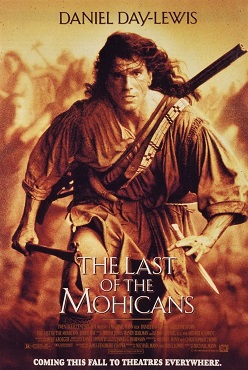
#95 - The Last of the Mohicans


BACK-STORY

“The Last of the Mohicans” was released in 1992. It was the first big budget feature from director Michael Mann. It was very loosely based on the John Fennimore Cooper novel, but actually is closer to the 1936 Randolph Scott film. The movie is set in 1757, three years into the French and Indian War. Although the action takes place in upstate New York, it was actually filmed mostly in North Carolina. The production used 1,000 Native American actors and extras. Mann had a 20 acre frontier farm, a Huron village, and a replica of a British fort built. The director’s obsessive quest for authenticity was matched by his star Daniel Day-Lewis who completely immersed himself in his role. Part of his preparation involved a “colonial boot camp” experience in the backwoods. Mann used a respected authority named Mark Baker to vet the film. Baker is an expert on frontier life, Indians, and weaponry. Mann provided him with a copy of the script and in most cases made changes suggested by Baker. The movie was a box office success and critically acclaimed. It was awarded an Oscar for Sound.

OPENING SCENE

Three men run through the woods, chasing who knows what. Hawkeye (Day-Lewis) stops, takes aim, and kills a deer, thus establishing that he is not only a frontiersman, but also a crack shot. His companions are his adopted father Chingachcook (played by the famous Indian activist Russell Means) and step-brother Uncas (Eric Schweig) of the Mohican tribe which means he is not your typical colonist. They stop at a frontier farm where they are welcomed warmly, implying that Hawkeye is living between two worlds. The opening also indicates that some Indians are “good”.

SUMMARY

 
The British authorities are recruiting colonial militia to reinforce Fort William Henry which is being threatened by the French and their Indian allies. The British are arrogant and insist that the colonists owe it to their king to serve. The militia get a promise that if their homes are in danger, they will be allowed to leave. Spoiler alert: they won’t.

Cora (Madeleine Stowe) and Alice Munro (Jodhi May) are being escorted to be reunited with their father Colonel Munro who is in command of Fort William Henry. They are chaperoned by a haughty British officer named Maj. Duncan Heyward (Steven Waddington). He has proposed to Cora, but she wants to remain just friends. They are led through the forest by an Indian scout named Magua (Wes Study wearing a face that tells you immediately that he is a villain). Hawkeye’s trio are heading to Kentucky when they pick up signs of a war party and on following it come upon the ambush of Duncan’s party. The scenery is awesome and the violence intense (but not graphic) as Hawkeye saves Cora from Magua and they rescue the significant characters (Duncan, Cora, and Alice) – too bad if you are just a common British soldier! The fighting realistically portrays what happened to Braddock in the Wilderness in that volley firing is not effective against an Indian ambush in the woods.

The survivors arrive at the frontier home from the opening scene to find it burned out and everyone dead. In a moment of authenticity, Hawkeye insists they leave the bodies unburied because burying them would give away that they had been there.

Next we have the standard campfire, getting to know you scene. Surprise, Cora dislikes Hawkeye. Spoiler alert: that will change. She asks him why anyone would want to live on a farm in the feral wilderness. He tells her that many backwoodsmen had been indentured servants who want to own their own land and not be beholding to anyone. A French-led war party approaches but turns away when they encounter a sacred Indian burial ground. It turns out that unlike other movies where passing through a burial ground is certain doom for whites, they can also protect you!

They arrived at the fort and it is under an 18th Century siege. Fort William Henry was reconstructed using historical documents and the effort shows. The scene accurately recreates the various elements of a siege-- the trenches, flares, fascines, even the little details like covering the touchhole of a cannon with sheepskin. They sneak into the fort at night. A great scene with Oscar winning sound effects.

Cora is reunited with her father and he is informed that Indians are raiding colonial farmsteads. He refuses to allow the militia to leave. ( A tough, but wise decision that is portrayed as an inhumane act of perfidy by the hissable British upper class twit. ) Meanwhile in French General Montcalm’s camp we learn that Magua has a grudge against Munro because of the destruction of his village, the killing of his children, and the loss of his wife. He vows to kill Munro and his daughters to wipe out their bloodline.

A courier needs to be sent to Albany for reinforcements so Duncan leads a diversion of a unit firing volleys while Hawkeye shows his mastery of the Kentucky rifle by picking off Indians trying to tomahawk the fleet-footed courier.

Hawkeye meets with Munro ( called George in the movie when actually named Edmund – why? ) He can not convince Munro to let the militia go home to defend their families. Munro threatens punishment for sedition. This accurately reflects the British army’s attitude toward colonial forces. Do as we say, no questions asked.

Cora and Hawkeye are now in love. In a nice touch their first kiss is accompanied by swirling music, but no dialogue. Some of the militia escape during the night so Hawkeye is arrested and sentenced to death. Cora defends him to her father showing she is not your typical British woman and she even sides with the colonial militia’s point of view. Munro agrees, apologizes and insists she marry the half-Indian frontiersman instead of the upper class British officer. Just kidding. The death sentence stands.

Munro and Montcalm meet to discuss surrender. After being assured no relief is coming and guaranteed safe passage to Albany, Munro agrees to abandon the fort the next day. That night Montcalm meets with Magua and assuages his anger at the terms by telling him “I can’t break the terms” (wink, wink)

On the march from the fort the foreboding is broken at first by several Indians preempting the ambush by rushing out to count coup. An accurate portrayal of a problem that is going to continue for well-planned Indian ambushes all the way through the Plains Indian Wars. When the ambush begins there is mass chaos, appropriately so. Cora shoots an Indian right between the eyes with a pistol. The trio race through the melee looking for the girls. There is lots of hacking. The atrocities are realistic for Indian warfare. Magua cuts out Munro’s heart, but Hawkeye rescues Cora and Alice and they escape in a canoe. They link up with a surly Duncan. Can you have a chase scene in a movie set in 1757? Of course! Could we throw in rapids and a waterfall? Done. They hide in a cave under the waterfall in a visually striking locale.

Magua is hot on their trail and it is obvious he will find them and their powder is wet meaning they will not be able to put up much of a fight so Hawkeye makes the tough decision to survive so he can rescue Cora. “You stay alive, no matter what occurs. I will find you”. He jumps into the waterfall. Cora, Alice, and Duncan are captured. You can guess what happens to the expendables who are with them.

The next scene is in the reconstructed Huron village. Magua is trying to convince the sachem to let him have his revenge. Hawkeye walks a gauntlet of angry Huron to approach the sachem. He argues that the sachem should not become greedy and “civilized” like the British. He wants to take Cora’s place on the stake, but Duncan mistranslates ( he speaks Huron? did they teach that at Eton? ) and gets himself staked. So the cad becomes a reformed martyr in the end. Hollywood loves redemption. Magua gets the consolation prize of Alice as his bride.  Although she is the ideal wife - she barely says a word in the movie - he is upset.   Hawkeye mercifully shoots Duncan from a far distance as he is being lit up.

Uncas chases after Magua to rescue Alice ( who he is ,of course, in love with ), but in a surprise to movie audiences everywhere, Magua kills him and throws his body over a cliff. In a poignant moment, the Bambi-like Alice jumps off the cliff joining him. The scene is made more powerful by the sparse dialogue. Actions do the talking. This has all been witnessed by Hawkeye and Chingachgook from afar. It’s revenge time! Chingachgook comes raging in like a charging grizzly bear as Hawkeye clears the path with his rifle. The penultimate battle is shockingly brief as the grieving father quickly dispatches one of the great villains of filmdom. Way to flout movie conventions!

THE FINAL SCENE

Chingachgook and Hawkeye lay Uncas to rest. Pop is now “the last of the Mohicans”. He predicts that “one day there will be no more frontier … , but once we were here.”

RATINGS

Action - 10

Acting - 10

Accuracy - 9

Realism -  10

Plot - 10

Overall - 10

WOULD CHICKS DIG IT?

Of course. Cora is a strong female character and something of an 18th Century feminist. She stands up to her father, finds true love, survives many perils, and looks lovely throughout! Then throw in Daniel Day-Lewis as the protagonist. What’s not to like?

ACCURACY

For a movie based on a novel, the movie is actually very accurate. Credit has to go to Mann for going beyond the call of duty in making the movie authentic right down to the moccasins. It was interesting to read Baker’s comments on the original script and see how Mann listened to him on most of his complaints. And the ones where Mann vetoed the suggestions were all sensible digressions from historical accuracy. Having an anal director may be hell on the actors and the financers, but it makes for a wonderful movie for us hard core war movie buffs.

The historical centerpiece of the movie is the siege of Fort William Henry and it is handled admirably. I know of no other movie that so accurately depicts 18th Century siege warfare. The reconstruction of the fort was well worth the time, effort, and funding. You will learn something from this movie unless you are already an expert. The best war movies take you back in time to experience what it was like from the safety of your theater seat or recliner. This also applies to the frontier farm and the Huron village.

The movie accurately portrays the interaction and customs of three groups – the frontiersmen, the Indians, and the British army. In particular, the Native Americans are not all “noble savages” or “bloodthirsty heathens”. A majority of them are anti-colonists, but that is as it should be. If you think about it, Magua has legitimate reasons for revenge. Portrayed by Mel Gibson in one of Hollywood’s many revenge pics, he would be the hero.

With that said, there are two major inaccuracies in the tale. First, Montcalm’s character is unfairly maligned by implying he condoned the ambush. Note the year the movie premiered and add the fact that he was French and you can figure no American would complain about his portrayal. Second, in reality only the rear of the retreating column was attacked. It consisted of mainly civilians. Between 70 and 180 were killed. None of them was Munro, who escaped in the forest. Obviously, the column was not attacked because one Indian wanted revenge for his family. In fact, the Indians were upset that the French lenient terms had deprived them of the anticipated spoils of the battle.

The rest of the plot is based on a novel, so there was no person named Nathaniel Poe (Hawkeye) and I doubt we will ever know who the last of the Mohican tribe was. Speaking of the source, Cooper’s book is justifiably famous, but does not hold up well as literature. Mann’s plot actually improves on the novel. That is something that cannot be said of most movies based on famous novels. All the changes Mann made are for the best. And he made a lot of changes! Many of the characters who died in the book, survive in the movie and vice versa. Some of the romantic attachments are different ( e.g. in the book, Hawkeye falls in love with Alice ). Students in American Literature class who are assigned this book - do not watch the movie instead!

CRITIQUE

This is a magnificent movie. It combines an interesting plot with great acting and a real concern for historical accuracy. Kudos to Michael Mann for getting the little details right. Let’s face it, even war movie nuts do not care if the moccasins are circa 1757. However, when a director insists on accuracy down to the ground and cares if anyone will notice, you get a better movie for purists.

Also commendatory was the tampering with the plot of the novel. I admit I get upset when a nonfiction source is changed to Hollywoodize a movie, but I do not think it is hypocritical to endorse what Mann and the screenwriters have done. Especially since most literary critics are not big fans of the novel. As long as you get the historical facts mostly right, why not make the tale batter?

The movie also looks good. The scenery is breathtaking. Parts of North Carolina really do look like the frontier of colonial America. The score is perfect. Interestingly, the music was done by two composers separately – Trevor Jones and Randy Edelman. That might have been a dysfunctional situation, but you can’t tell from the finished product.

CONCLUSION

So here we have a movie with great acting, a moving score, realistic sound, romance, action, suspense, violence, and historical accuracy. Why is it not ranked higher than #95? I cannot get into the minds of Armchair General’s panel of experts, but I can guess they may have the same problem I have with ranking it really high. Is it really a war movie? Certainly more than “Ben Hur” and it does fit my definition for a “war movie”, but since it fits better into other categories like historical epic or action romance, I cannot rank it as one of the great war movies. After all, would you ever find a copy of “Last of the Mohicans” in the war novels section of a book store? However, as a movie that could be described as a war movie, it is better than a vast majority of the movies on the list.

Up next:  #94 - "A Bridge Too Far"