Showing posts with label Douglas MacArthur. Show all posts

Tuesday, June 7, 2022

Emperor (2012)


            “Emperor” is a historical drama directed by Peter Webber.  It was his first film in 5 years.  He needs to get a better agent.  I’m not sure what motivated him to end his hiatus to make this film.  But I am much more perplexed as to what convinced the producers to make this film.  Don’t get me wrong, the more war films the better as far as I’m concerned.  But there are so many better topics that have not gotten off the bench, I wonder how a movie with virtually no potential box office gets put in the game.  For instance, how does this movie get made and “They Marched into Sunlight” sits in developmental hell.  Come on, Tom Hanks, get off your ass!  But I digress.  Let’s see if “Emperor” is a good movie even though no one was interested in seeing it. 


            After the Japanese surrender, Gen. MacArthur (Tommy Lee Jones) arrives in Japan to begin the occupation.  He brings Brigadier General Bonner Fellers (Matthew Fox) to handle the arresting of war criminals.  Fellers narrates the film and is clearly sympathetic toward the Japanese people and the Emperor in particular.  MacArthur gives him ten days to determine whether Hirohito should be charged.  Fellers interviews high Japanese officials like Tojo to see if they can provide exoneration for the Emperor.  Meanwhile, in a subplot, Fellers is trying to find out if his pre-war Japanese girl friend Aya is still alive.  Queue the flashbacks.  These two efforts interweave.  In the last reel, a mustache-twirler is thrown in who accuses Fellers of being a Jap-lover who steered a bombing raid away from Aya’s home town.  The suspense is supposed to be building towards a decision by MacArthur that anybody watching this movie would already know.


            I guess I’ve already telegraphed that I was not impressed with this movie.  I’m glad it was green-lit, but the script did not defy my premonition that it would be boring.  As I’ve said, any historically literate viewer already knows that Hirohito was not put on trial.  The movie tries to overcome the lack of suspense by giving us an insider’s view of how the process worked.  But even that is not suspenseful because it is clear MacArthur does not want to try the Emperor and he has appointed a man who is simpatico with that.  It is interesting to see the interviews with various Japanese officials, including Tojo, who was put on trial and executed.  However, the movie does not debate whether Hirohito was a war criminal.  Every witness exonerates him.  Perhaps this was done for Japanese box office. 


            The romance is there just to take up time and appeal to female moviegoers.  There is no heat as Fox gives an inexplicably wooden performance.  The flashbacks are mundane and the payoff is weak.  Jones is much better as MacArthur.  He’s got the personality down pat.  Unfortunately, he is a secondary character.  Jones does not have to do much heavy lifting as he often plays roles like MacArthur.


            How is the movie when it comes to accuracy?  It does not start well as it leads with footage of the bombing of Hiroshima.  Except that the footage is of “Fat Man”, the bomb dropped on Nagasaki.  What follows is acceptably true to the facts.  There was a Gen. Fellers who was in charge of exonerating the Emperor.  He is an interesting figure.  In 1940, he was in Egypt with the job of reporting on British efforts in the war with Rommel.  He had some ‘splainin to do as his reports were intercepted and deciphered by the Germans.  They got heads up about British forces and their movements.  It was a intelligence disaster and possibly cost many British lives.  In his defense, he was not a double agent and he did complain about using the less secure diplomatic code instead of the military one.  The British were not thrilled to learn that he was given the Distinguished Service Medal for his reports.  He ended up in the Pacific as MacArthur’s Chief of Psychological Operations.  He wrote a series of memoranda arguing against putting Hirohito on trial.  In Operation Blacklist, MacArthur put him in charge of getting witnesses to exonerate the Emperor.  The fix was in, but the movie is more ambiguous about that.  He did such a good job that in 1971, Hirohito presented him with the Second Order of the Sacred Treasure (the equivalent of the Presidential Medal of Freedom).  Do I need to tell you that the romance was fictional? Fellers had been happily married for twenty years at the time of the movie.


            I can only recommend “Emperor” to history buffs who want a behind-the-scenes look at the handling of the Emperor after WWII.  Although I feel it is definitely a war movie, it is not appealing to war movie fans.  Watch “Judgment at Nuremberg” or “Downfall” instead.


GRADE  =  C

Monday, February 7, 2022

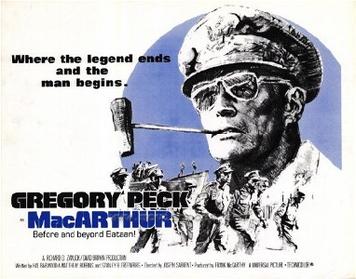
MacArthur (1977)


                    In 1970, 20th Century-Fox had a huge hit with “Patton”.  Naturally, other studios were determined to replicate the success.  Universal made the logical decision to make a movie about another controversial WWII general, hoping to catch lightning in a bottle, too.  John Sargent (The Hell With Heroes, Tribes) was tabbed to direct, but he was given a small budget.  Most of the film would be shot on the back lot.  He did get a big star in Gregory Peck (after John Wayne, George C. Scott, and Cary Grant turned down the role).  Peck was all in and really got into character, including negotiating the buying of a house dressed as the general (he got a good deal).  Peck enjoyed the role and although not a MacArthur fan before, he developed some empathy and respect for him as a result of the movie.  Peck always bemoaned the poor script and low production values of the film.  Although he was ignored by the Academy, he did get a Golden Globe nomination for his acting.  The score was by “Patton” composer Jerry Goldsmith.  The movie was not a box office success.

                    The movie signals its “Patton” vibe at the start by offering the question of whether MacArthur was a demagogue or a hero.  The opening scene has the elderly general giving his “Duty, Honor, Country” speech at West Point.  Starting with a speech, how original!  It then flashes back to Corregidor in 1942.  In his refuge in the tunnel, MacArthur is ordered by FDR to evacuate to Australia.  The movie invents an unsuspenseful encounter with a mine to make the PT-boat ride more interesting, but it does not embellish his “feat” of escaping to Medal of Honor-worthy.  MacArthur is upset with Wainwright’s surrender of his forces in the Philippines and ironically opposes the Medal of Honor for the hapless Wainwright.  The rest of the movie is a trip through Mac’s greatest hits.    He leap-frogs from New Guinea to the Philippines.  He meets with FDR (Dan O’Herlihy)) at Pearl Harbor.  He invades the Philippines.  He oversees the surrender on the USS Missouri.  He occupies Japan.  Then the Korean War breaks out.  Inchon is depicted with little combat.  The dysfunctional relationship with Pres. Truman (Ed Flanders) includes their meeting on Wake Island.  The movie concludes with his firing. 

                    The obvious thing to do is to compare the movie to “Patton”.  It begs you to do so.  The screenwriters used its template.  “MacArthur” even has a Steiger-like character in MacArthur’s press officer.  (That’s right, he was a general with a PR specialist.) “Patton” was a tough standard to meet and the movie just did not have the budget to give it a go.  Director Sargent did not have the resources to stage sweeping battle scenes.  But people forget that “Patton” did not have much combat either.  It’s the script that really separates the two.  Peck was right to complain about it.  It is quite talkative.  Thankfully, the speeches have some verve because MacArthur was a good orator.  The greatest hits format is instructive as the movie is accurate on the main events in MacArthur’s career.  Historian J. Clayton James was the technical adviser.  The plot contains no egregious historical errors.  It is surprisingly balanced on the question of whether MacArthur was a demagogue or a hero.  Although Peck portrays him as an ambitious prima donna, the film does not take on the question of whether he was a great general.  His strategy is high school textbook correct, but there is nothing on the questionable decisions like dividing his army in Korea.  On the other hand, it does a good job with the resulting conflict with Truman that came from that decision.  The movie does make a case for his firing.  However, fans and critics of the man will be disappointed.  If you don’t have a dog in that fight, the movie is a good biography of a famous American.

                    Peck was certainly the right choice for the role (partly because he looks like MacArthur) and it is hard to imagine John Wayne in the role.  He does not give a performance equal to Scott’s Patton, but he is the main draw for the film.  The supporting cast is familiar B-movie actors with Flanders especially good as Truman.  The cast is not given much to chew on.  Another difference with “Patton”.  It is curiously flat in tone.  Part of this is due to the lack of action.  Where we get some excellent behind the scenes coverage, the payoffs are a bit boring.  For instance, the USS Missouri signing shows every country signing.  That time could have been better spent at Inchon, but I guess the back lot at Universal didn’t suit that.  The combat is bland and relies on actual footage blended with old school deaths.  It is much less a war movie than “Patton”.

                    I took a while to watch this movie because I remember the bad press when it came out.  I am not a MacArthur fan and consider him one of the most overrated American generals.  His Medal of Honor is one of the most undeserved.  I expected the movie to be either laudatory or a hit-job and was surprised to find it neither.  It is basically a standard biopic.  MacArthur certainly deserved one.  He is a fascinating figure.  Perhaps a miniseries would have done a better job in showing his polarizing career.  As far as it’s duel with “Patton”, it is clearly inferior.  If you have seen “Patton” and not “MacArthur”, you owe it to yourself to see how Hollywood tends to copy itself, but seldom tops itself.

GRADE  =  B-

Thursday, July 21, 2016

“BASED ON A TRUE STORY”, REALLY? “In Pursuit of Honor” (1995)


                “In Pursuit of Honor” is a well-intentioned HBO film about the U.S. Army’s horse cavalry in the bleak days of the Depression.  It purports to tell the tale of the rescuing of a herd of cavalry horses scheduled to be exterminated as the Army makes the transition to mechanized units.  The movie claims to be “based on a true story” and seems reasonably believable upon viewing.  It was filmed in Australia and no horses were harmed in the production – just like in reality.

                The movie opens with the Bonus March in Washington, D.C. in 1932.  Hundreds of veterans were in the capital hoping to get their WWI bonuses early due to the Depression.  The doughboys had set up a shantytown and when Congress turned them down, the Army was ordered to clear them out.  A unit of cavalry was lined up to carry out Gen. Douglas MacArthur’s strong-arm tactics.  Sgt. Libbey (Don Johnson) and three of his comrades (all named after characters in John Ford’s “Fort Apache”) refuse to participate and they are relieved by Maj. Hardesty (Bob Gunton).  Flash forward to a dingy Western post where Libbey and his buddies are in limbo.  A new arrival is Lt. Buxton (Craig Sheffer) who is there for assaulting an officer.  The officer deserved it, of course.  It is not Hell until the Devil arrives in the form of Lt. Col. Hardesty.  Hardesty brings with him the new cavalry in the form of some tanks.  The hand-writing is on the stable wall.  The men are told to turn in their sabers and get rid of their excess horses, which means all the horses.  Libbey: “There’s nothing left.  No horses. No cavalry. No honor”.

                Hardesty twirls his mustache as he orders the horses herded to Mexico to be machine gunned in a pit.  You know those Mexicans and their love of horse carcasses.  After a horrific scene depicting the machine gunning of the first hundred horses, Buxton convinces Libbey and his buddies to abscond with the rest of the herd.  For some reason they decide to make a run for Canada instead of simply going deeper into Mexico.  Huh?  The villainous Hardesty is in luke-warm pursuit and manages to catch up with them right at the border.

                On first thought, the movie appears to be a nice little curio about a forgotten episode in American History.  The acting is good with Johnson dominating and Rod Steiger harrumphing in a slumming role.  The rest of the cast is B-movieish, but adequate.  Gunton is well cast as the cartoonish Hardesty.  Most nudge-worthy is an early career turn by Gabrielle Anwar of “Burn Notice” fame.  Her character has a lame romance with Buxton.  Someone has to love humans.  The movie has the inspirational music to match the theme. The scenery is not as awesome as one would expect and there is not a lot of action to compensate for it.  It’s just a nice little movie that is unfortunately marred by the fact that it has no facts.

                It will come as no surprise to history buffs that Hollywood sometimes stretches the truth with its “based on a true story” claim.  In this case, I would have to cry “shenanigans” on that claim for this movie.  Sometimes I am pleasantly surprised to find that seemingly unbelievable stories have some basis in fact.  This movie is the rare opposite.  It turns out virtually nothing that happens in the movie is true.  The Army did transition to tanks, but not as suddenly and not that early.  There is no evidence to support the events in the film.  No horses were killed to reduce the force.  That would have made no sense economically or humanely.  Also making no sense was taking the horses to Mexico to kill them and then all the way to Canada to save them.  If you are going to get your script ideas from a drunken retired cavalryman, you should be more circumspect.  Worse, the movie defames MacArthur.  Now I am not a big MacArthur fan, but I draw the line at accusing him of being a mass murderer of horses. 

                My research definitely colored my opinion of the movie.  It’s a C+ first impression and a D upon further review.  More importantly, I’ll never trust Hollywood again.

GRADE =  D