Showing posts with label Edgar Rice Burroughs. Show all posts

Saturday, January 24, 2026

THE LAND THAT TIME FORGOT (1975)


                       “The Land That Time Forgot” was based on Edgar Rice Burroughs’ novel of 1918.  It was produced by Amicus Productions which was a competitor of Hammer Films.  One difference is Amicus tended to set its films in the present day as opposed to the gothic world of Hammer movies.  Amicus was most famous for its portmanteau horror films (several short films with a single theme), but it did some science fiction films, including several based on Burroughs books.  One was a sequel to this -  “The People That Time Forgot” (1977).  “Land” was directed by Kevin Conner.  He also helmed the sequel and “At the Earth’s Core”.  The movie did surprisingly well at the box office, but was not a hit with critics.

                       The movie opens with a message being thrown in the ocean and then we flashback to 1916.  A German u-boat sinks an American ship.  The movie makes a point to specify that the ship is American.  Bowen Tyler (Doug McClure) and Lisa (Susan Penhaligon) are in a lifeboat.  They link up with a boat carrying several crewmen who also survived.  Before anyone can even dream of eating raw sea gull, up pops the sub.  Conveniently, none of the submariners bother to come on deck until Tyler leads his men onto the conning tower.  They take over the ship in a nifty action scene.  The Germans manage to sabotage the radio, but any attempts to bamboozle these Americans will be fruitless because it just so happens Tyler’s family built it!  Tyler’s acumen allows him to sink a German supply ship (actually a model through a periscope).  They head for a friendly port in a temperate zone, so why the ice bergs?  And what’s that uncharted land mass?  The u-boat captain (John McEnery) recalls the story of an explorer who discovered a continent he called Caprona.  They have no choice but to come ashore, even though the terra incognita is distinctly hostile.  Hostile as in populated by dinosaurs and primitive humans.  They have to battle and kill a plesiosaur which begins the whittling down of the men (no need to worry about Lisa).  The Americans and the Germans agree to work together to survive.  And refine Caprona’s oil for fuel.  They will be aided by a collaborating cave man named Ahm (Bobby Parr) and helped by the fact that guns can kill dinosaurs and the natives.   It may not be a war movie, but it certainly has a lost patrol feel to it. 

                       The Burroughs’ estate had power over the script, so it had approval of the finished product.  Apparently, his descendants cared more about the story than the effects.  The movie used puppets and stop motion for the dinosaurs.  They look pretty cool … until they move.  (Whoever decided to include pterodactyls should have been stranded on an uncharted continent.)  And God forbid the dinosaurs appear in the same shot as the actors.  The movie did not aim for camp, but the fights with the monsters cross the border.  As inferior as the dinosaur effects are, the movie could have used more dino action.  The man-on-dino action is certainly preferable to the fisticuffs.  Not that the actors deserved to be eaten.  The cast is fairly decent and keeps a straight face.  And nice hair.  Panhaligon is lovely and McClure is manly and imperturbable.  It’s like he knows the man-eaters are fake.  Compared to other pulpy stories, the implausibilities are kept below average.  Don’t spend too much time thinking about the oil-refining.  But you might want to wonder why after encountering the plesiosaur, they settle down to eat some dino steaks and no one seems amazed about what they have been through that day!

                       As far as whether the estate got a decent treatment, the script is fairly good in lieu of Cliff Notes.  The framing device of the message in the thermos is from the book.  The characters are basically the same with Burroughs getting the blame for having Tyler being a u-boat savant.  The romance between Tyler and Lys takes center stage in the book and it’s a rocky road.  Lys is more of the classic damsel in distress and Tyler is her knight in shining armor.  Surprisingly, for a Saturday matinee creature feature aimed at kids, the movie scraps Tyler’s dog Nobs.  The Germans are more vile in the book, reflecting the 1918 publishing date.  The u-boat shells women and children, for instance.  Given the target audience, the screenwriters dilute Burroughs’ mumbo-jumbo about the evolutionary cycles that are taking place on Caprona.  Apparently, Ahm is in the least developed tribe, but during his lifetime he will go through stages that lead to being a Galu.  There aren’t just dinosaurs in the book as there are animals all along the evolutionary scale.  The book is better literature than the movie is film-making.  However, the movie has the benefit of providing closure.  It may be predictable, but at least we find out what happens to all the characters and the sub.      

GRADE =  C

Saturday, December 27, 2025

JOHN CARTER (2012)


                   This is the latest in my series of reviews of movies based on books by Edgar Rice Burroughs and their comparison to the book.  “John Carter” (originally intended to be entitled “John Carter on Mars” until Disney ludicrously decided Mars in the title would turn off females) was the culmination of decades of interest in filming “A Princess of Mars” which was published in 1917.  The novel was the compilation of a series that ran in a pulp magazine named The All-Story in 1912 under the title “Under the Moons of Mars”.  Burroughs wrote the series under the pseudonym  Normal (accidentally changed to Norman) Bean (“normal human being”) because he was worried readers would find it silly.  In the 1930’s, Disney took a run at an animated version, but early samples were greeted with less than enthusiasm by theater owners.  Other attempts also fell through until Andrew Stanton took an interest in the project.  He had the cachet from having directed “Wall-E” and “Finding Nemo”, but had never directed a live-action film.  He was given a huge budget that reached $263 million, although Disney was skeptical from the start.  It had good reason to be.  The.movie was a huge bomb (although it did well in Russia). 

               The movie begins with a narrator giving background about conditions on Mars (Barsoom).  The planet is dying.  There are two rival cities.  Helium is the center of science and civilization.  Zodanga is intent on planetary dominance.  The uneasy balance is about to be broken because the leader of Zodanga, Sab Than (Dominic West), has been given a super weapon by a mysterious group of godlike men called Therns led by Matai Shang (Mark Strong).  Mars is going to need a savior.  Cut to New York City in 1881.  John Carter (Taylor Kitsch) has recently died and has left his journal to his nephew, Edgar Rice Burroughs.  The journal launches the flashback to how Carter ended up on Mars.

               Carter is a Civil War veteran in the West.  He is obsessed with finding gold.  When he escapes from being conscripted into the cavalry, he takes refuge in a cave and is attacked by a Thern.  Suddenly, he finds himself on Mars where the low gravity and his denser bones gives him great strength and the ability to leap far distances.  He is captured by green Martians called Tharks.  However, his special powers allow him to escape and he gains the respect of the Tharks.  He befriends the chief’s daughter Sola and acquires a “dog” because this is a Disney movie.  He manages to rescue the Princess Dejah of Helium (Lynn Collins).  They undertake a journey down a river to try to get him back to Earth.  Carter and Dejah don’t get along at first, so you can guess where their relationship is heading.  This will become awkward because Dejah is supposed to marry Sab to bring peace to the cities.  (Think “Princess Bride”.)     The movie is careening to a big set piece battle between Zadonga and Helium, with the Tharks siding with Helium.  Supervillain Shang is around to cause trouble.

               “John Carter” did not deserve the ridicule it got from the critics.  It is not a great movie, but it is also not a disaster.  If you did not have money invested in Disney, you might marvel at the special effects.  The huge budget shows.  The film is gorgeous.  The CGI is amazing and even the multi-limbed Tharks look real.  Unfortunately, the technology allows for the hordeish melees typical of modern battle scenes.  For instance, at one point, John Carter defeats an entire army of Green Martians, by himself.  The hyperbole of Carter’s prowess can be blamed both on Burrough’s imagination and modern cinemas penchant for overdoing every action scene.  While the land battles tend to be messy, the air battles are cool.  The airships are similar to Roman galleys and tactics include boarding.  They look like what a fantasy writer might have envisioned was the future of warfare. 

               Part of the reason for the failure of the movie at the box office must have been the lack of living Burroughs fans who would have flocked to see their muse’s imagination brought to the screen.  To everyone else, the pulpy nature of the story might seem quaint.  The story requires a love for the fantastic as opposed to the logical.  There are plenty of threads to be pulled at if you are of a mind.  For example, the objective of the Therns makes little sense.  More specifically, the super weapon should have made all challenges to Zadonga moot.  Setting the movie on Mars did not cut it off from Earthly clichés.  For a fantasy, it is pretty predictable.  Stranger rescues Princess, they fall in love, he wins battles for her.

               Disney assembled a worthy cast to the point where the supporting actors (Mark Strong, Bryan Cranston, Claran Hinds, James Purefoy) could give acting lessons to Kitsch and Collins.  (In my opinion, the movie would have been better if Purefoy had played Carter.)  Whether you are a child or not, Woola steals the show.  The soundtrack by Michael Giacchino lends some class.

               I am going to assume most readers of this are familiar with Burroughs’ novel and prefer it to the movie.  I have a theory that a movie should be able to exceed the source novel for entertainment value.  The screenwriters (Stanton, Mark Andrews, and Michael Chabon) did what they thought was right to update the story for a modern audience.  It is clear, they did not use Burroughs fans as a test audience.  Substantial changes were made to the narrative and to the characters.  They decided to make Carter a typical modern anti-hero.  He is not the knight of the book.  He is reluctant to get involved and is focused on getting home until he falls in love with Dejah.  He fights for no one until he fights for someone.  And he’s a dick, until his innate humanity comes out.  He is damaged goods as the movie gives him a back-story involving his family.  As far as Dejah, clearly you don’t attract females with a heroine who is a damsel in need of rescuing.  Watch any recent Disney animated movie.  Dejah is both a scientist and a kick-ass warrior.  In the book, she agrees to the marriage for the good of her city. In the movie, she selfishly refuses to get married.  The rest of the characters are essentially the same, with the exception of Shang, who does not appear in the first book.  The movie loses Tars Tarka’s back-story and omits most of his heroism.  Carter sucks up most of this.  On the other hand, Sab is bumped up to Lex Luther status.             

               The screenwriters decided that Carter would logically be focused on returning to Earth because so would the audience.  In the book, he assimilates enthusiastically into Martian culture.  He learns the language, but not via a ludicrous potion device. The book reads like a travelogue and tourist guide in parts.  Hell, there is a chapter on Martian sex!  The movie Carter is your standard fish out of water.

               The writers added elements so the movie could join the action/adventure club.  The movie adds the medallion as a McGuffin because Carter must have a way to get back to Earth.  (The book Carter is content with life on Mars because he has been reborn there.)  The villain is given tattoos and a super weapon.  Carter is not the virtuous knight of the book, but this makes him more interesting, if stereotypical.  He does not win all his fights easily, like in the book.  His arc with Dejah is also tropeish, but an improvement over the roller-coaster ride of the book.  But the biggest improvement is the movie ditches the racism and sexism of the book.  ERB could be excused for making the Tharks savages in the book because it was the early 20th Century, but this would not have flown in the 21st Century.  Finally, excuse the pun, the movie replaces the ridiculous ending of the book with a much better conclusion.

               ERB was wrong about the public finding the serial to be too outlandish when it was published in 1912.  It turned out to be very popular and launched the series of novels.  However, the movie was made one hundred years later and times have changed.  The “improvements” made by the screenwriters were considered necessary to attract a modern audience that grew up with “Star Wars”.  This resulted in a generic action film, but a competently made one that is entertaining.  If you are an ERB purist (which I am not), the changes made dumbed down the movie.  If you are not, the movie improves on some of the novel’s weaknesses.

GRADE  =  C 


Friday, October 27, 2023

THE LAND THAT TIME FORGOT (1975)


                        “The Land That Time Forgot” was based on Edgar Rice Burroughs’ novel of 1918.  It was produced by Amicus Productions which was a competitor of Hammer Films.  One difference is Amicus tended to set its films in the present day as opposed to the gothic world of Hammer movies.  Amicus was most famous for its portmanteau horror films (several short films with a single theme), but it did some science fiction films, including several based on Burroughs books.  One was a sequel to this -  “The People That Time Forgot” (1977).  “Land” was directed by Kevin Conner.  He also helmed the sequel and “At the Earth’s Core”.  The movie did surprisingly well at the box office, but was not a hit with critics.

                        The movie opens with a message being thrown in the ocean and then we flashback to 1916.  A German u-boat sinks an American ship.  The movie makes a point to specify that the ship is American.  Bowen Tyler (Doug McClure) and Lisa (Susan Penhaligon) are in a lifeboat.  They link up with a boat carrying several crewmen who also survived.  Before anyone can even dream of eating raw sea gull, up pops the sub.  Conveniently, none of the submariners bother to come on deck until Tyler leads his men onto the conning tower.  They take over the ship in a nifty action scene.  The Germans manage to sabotage the radio, but any attempts to bamboozle these Americans will be fruitless because it just so happens Tyler’s family built it!  Tyler’s acumen allows him to sink a German supply ship (actually a model through a periscope).  They head for a friendly port in a temperate zone, so why the ice bergs?  And what’s that uncharted land mass?  The u-boat captain (John McEnery) recalls the story of an explorer who discovered a continent he called Caprona.  They have no choice but to come ashore, even though the terra incognita is distinctly hostile.  Hostile as in populated by dinosaurs and primitive humans.  They have to battle and kill a plesiosaur which begins the whittling down of the men (no need to worry about Lisa).  The Americans and the Germans agree to work together to survive.  And refine Caprona’s oil for fuel.  They will be aided by a collaborating cave man named Ahm (Bobby Parr) and helped by the fact that guns can kill dinosaurs and the natives.   It may not be a war movie, but it certainly has a lost patrol feel to it. 

                        The Burroughs’ estate had power over the script, so it had approval of the finished product.  Apparently, his descendants cared more about the story than the effects.  The movie used puppets and stop motion for the dinosaurs.  They look pretty cool … until they move.  (Whoever decided to include pterodactyls should have been stranded on an uncharted continent.)  And God forbid the dinosaurs appear in the same shot as the actors.  The movie did not aim for camp, but the fights with the monsters cross the border.  As inferior as the dinosaur effects are, the movie could have used more dino action.  The man-on-dino action is certainly preferable to the fisticuffs.  Not that the actors deserved to be eaten.  The cast is fairly decent and keeps a straight face.  And nice hair.  Panhaligon is lovely and McClure is manly and imperturbable.  It’s like he knows the man-eaters are fake.  Compared to other pulpy stories, the implausibilities are kept below average.  Don’t spend too much time thinking about the oil-refining.  But you might want to wonder why after encountering the plesiosaur, they settle down to eat some dino steaks and no one seems amazed about what they have been through that day!

                        As far as whether the estate got a decent treatment, the script is fairly good in lieu of Cliff Notes.  The framing device of the message in the thermos is from the book.  The characters are basically the same with Burroughs getting the blame for having Tyler being a u-boat savant.  The romance between Tyler and Lys takes center stage in the book and it’s a rocky road.  Lys is more of the classic damsel in distress and Tyler is her knight in shining armor.  Surprisingly, for a Saturday matinee creature feature aimed at kids, the movie scraps Tyler’s dog Nobs.  The Germans are more vile in the book, reflecting the 1918 publishing date.  The u-boat shells women and children, for instance.  Given the target audience, the screenwriters dilute Burroughs’ mumbo-jumbo about the evolutionary cycles that are taking place on Caprona.  Apparently, Ahm is in the least developed tribe, but during his lifetime he will go through stages that lead to being a Galu.  There aren’t just dinosaurs in the book as there are animals all along the evolutionary scale.  The book is better literature than the movie is film-making.  However, the movie has the benefit of providing closure.  It may be predictable, but at least we find out what happens to all the characters and the sub.      

GRADE  =  C

Sunday, September 22, 2019

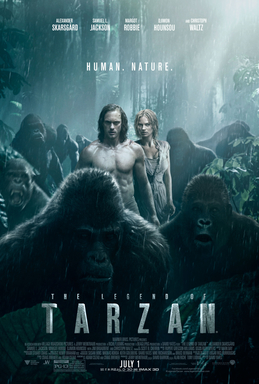
Tarzan Goes to War, Again: The Legend of Tarzan (2016)


                        Recently I watched an old Johnny Weismuller Tarzan movie entitled “Tarzan Triumphs” (1943).  Tarzan battles Nazis in that one, which makes it the rare Tarzan movie that is a war movie.  “The Legend of Tarzan” can be deemed a war movie too, if you stretch the definition a bit.  In this case, the apeman fights Belgian mercenaries.  Before you say this is a step down from Nazis, the Belgians are led by Christopher Waltz.   The movie was directed by David Yates, he of the last four Harry Potter movies and the Fantastic Beasts series, so you know there was no intention to make a retro Tarzan movie.  In fact, it is quite the opposite of “Tarzan Triumphs”.  For instance, the swinging Tarzan is CGI.  However, that body of Alexander Skarsgard is the real deal, ladies.  He trained and dieted for four months for the role.  The first choice, Michael Phelps, would not have had to do that, but his hosting stint on Saturday Night Live ended that thought of stunt casting.  Emma Stone was considered for the Jane role before Margot Robbie got it.  Sorry fellas, Skarsgard is the only one who takes his shirt off.  The screenplay started out being based on the Burrough’s books The Return of Tarzan and Tarzan and the Jewels of Opar.  However, the final screenplay bore little resemblance to those novels.  The film had a $180 million budget and made around $360 million worldwide, which in the wacky world of Hollywood accounting, was not enough to warrant a sequel.  Let’s see if the movie itself warranted a sequel. 

                        In 1884, at the Belgian Conference, the European powers divided up the Congo.  King Leopold of Belgium claimed the Congo basin with its abundant ivory, minerals, and apes.  Five years later, he was in debt and needed the legendary diamonds of Opar.  He sends his sinister agent Leon Rom (Waltz) to get them.  Rom and his mercenaries do the Tarzan movie trope of slaughtering natives, but since this is a 21st Century Tarzan movie, they get counter-slaughtered.  Rom survives for plot purposes and makes a deal with the Opar chief.  If Rom can seduce Tarzan to leave his cushy British life and get him back to Africa for a revenge killing, the diamonds are Belgium’s.  It seems the chief’s son was killed by Tarzan so he wants payback.  And the movie needs to get Skarsgard out of his clothes.  (By the way, ladies, you can fast forward to the 1:10 mark, if that’s what you came for.  Be aware, this Tarzan does not wear a loin cloth, but I don’t think you will be too disappointed.  Do the words “eight pack abs” intrigue you?)  The now totally civilized Lord Greystoke (he doesn’t grunt like in the movie “Greystoke”) is not falling for any free trip to Africa offer from the Belgians, but he does agree to accompany an American named George Washington Williams (Samuel L. Jackson) in order to save the slaves.  At this point the periodic flashbacks kick in.  These pretty much conform to the basic Tarzan biography.  The rest of the story does not.  Tarzan brings Jane along because Victorian ladies always got their way, right?  They get separated with Jane playing feisty damsel in distress (she’s captured twice!) and Tarzan (with help from his Azeem -  Robin Hood – Prince of Thieves) swinging and slinging.  Tarzan has to fight not only apes, but the natives.  (Both these groups stand in for Native Americans, like in Avatar.  To hammer the analogy in, Williams makes a point of mentioning his role in the conquest of the American West.)   For a hero, Tarzan sure has a lot of enemies.  This all culminates in the type of over the top set piece that you would expect from a 21st Century Tarzan movie.  (Note the wildebeest charge straight out of Avatar.)

                        These days rebooting does not mean going back to the basics.  It means reanimating Edgar Rice Burrough’s series and pumping it full of adrenaline.  And shrinking the brain.  This movie has more action and mayhem than five Weismuller movies combined.  But that’s what audiences want, right?  Few people today have seen even one of the old Tarzan movies.  If they had, they would have demanded a Cheetah!  In fact, there is little humor in this overly serious film.  It’s kind of hard to be light with slavery.  There is a wink-wink moment when Skarsgard does the Tarzan yell and Rom says:  “It’s rather different than I thought.”  Williams gets to say “Me Tarzan, you Jane” which is the first time that iconic line has been used in any Tarzan movie!   The actors are fine and Skarsgard makes a good Tarzan.  He certainly invested in the role and I’m guessing the ladies liked the choice.  Waltz is continuing to work on getting typecast.  He’s a suave Nazi, I mean Belgian.  The movie throws in a more cartoonish villain in the mercenary leader and then doesn’t bother to flesh him out or give him a cheer-worthy death.  The CGI is fine, especially for the apes.  Tarzan’s fight with his “brother” is amazing.  We have reached the point where Skarsgard did not have to swing on a vine.  That was CGI.  You wouldn’t know it, but the movie was filmed in England with only helicopter views of the gorgeous landscape of Gabon.  Unfortunately, the availability of CGI encourages directors to have silly, unrealistic set pieces like what swamps the movie at the end.

                        “The Legend of Tarzan” was not a misfire.  It is better than the last attempt to revive the series – 1984’s “Greystoke”.  The problem is that it is not as good as the better Weismuller entries.  More is not better.  Our modern penchant for adding more and more action scenes that defy reality and then topping them off with a showstopping and brain cell reducing set piece results in a movie that made $360 million, but barely turned a profit.  Considering the glut of superhero movies, it is hard to see Tarzan becoming a franchise.  Burrough’s novels might be too intellectual for today’s comic book weaned audiences.  When you aim your Tarzan movie at a comic book audience, you lose the quaint childlike wonder of the old Tarzan movies.  But no studio is going to make a movie like that, so watch one of the Weismuller movies.  Johnny didn’t have eight pack abs, but he did his own swinging and swimming.  And he had Cheetah.

GRADE  =  C+