Showing posts with label Ender's Game. Show all posts

Monday, July 9, 2018

EDGE OF TOMORROW (4) vs. ENDER'S GAME (13)


VS.


PLOT“Edge of Tomorrow” is about defense against an alien invasion. The Mimics have conquered Europe and are threatening Great Britain. A publicity agent for the United Defense Force named Cage is reluctant to embed with the invasion of France (he's a talker, not a fighter) so he is demoted and put in a squad that will be in the assault. The invasion is a disaster and Cage is killed, but ends up in a “Groundhog Day” situation where he dies and repeats the previous day. He hooks up with a woman warrior named Vrataski who had the same power, but lost it. They work together to get off the beach and destroy the alien brain. The plot is very inventive and yet maintains several tropes. Although it has some elements of the traditional squad war movie, there is little character development. After all, it is a Tom Cruise movie. But it is also a buddy movie with Cage and Vrataski saving mankind. There is some kick-ass combat which leads to the standard infiltration and decapitation scene. The movie is marred by a sappy ending. GRADE = A
“Ender’s Game” is based on a popular novel. The Earth is challenged by an alien race (think bugs from "Starship Troopers"). Humans were victorious, but the threat remains. To counter this threat the military is recruiting and training young people who have the ability to play a real-life video game that maneuvers the Earth fleet to victory. Ender is the chosen one. He goes through a young adult version of a war movie boot camp. He bonds with a feisty female and deals with a bully. He is pushed by a Machiavellian and mentored by a Jediesque figure. This leads to a climactic battle where Ender and his crew of teenagers attack the enemy planet. Unfortunately, the creative plot feels rushed and parts are not believable, even for a sci-fi movie. The character development is weak. In a nice twist, the movie shows some sympathy toward the aliens. GRADE = C

STRATEGY AND TACTICS
The Mimics apparently conquer Europe easily and seemingly are not content with that. One has to wonder what is stopping them. They are clearly superior to humans and a late scene indicates they can cross the Channel. They purposely lose a battle at Verdun to lure the UDF into a full-scale invasion of France. The Mimics can reset time to adjust strategy and tactics. As in most movies of this type, they are undefeatable if not for bad luck. The UDF strategy is to coordinate the invasion with the Eastern Front efforts of Russia and China. D-Day obviously influenced the script. The invasion is shows this as J Squad paradrops onto the beach and attempts to carve out a beachhead. There is no shore bombardment to speak of. There are no armored vehicles, although it is obvious that infantry are no match for the Mimic warriors. And, as usual, no use of nukes even though the movie makes it clear that Europe has been depopulated. The finale is a commando raid which is reminiscent of many traditional war movie suicide raids (think "Dirty Dozen"). GRADE = C

The movie, because it is aimed at a young adult audience, does not get deep into strategy and tactics. We know the enemy uses swarm tactics, as is common in sci-fi movies. Their strategy is unclear. The movie implies that the Earth leaders have demonized them and exaggerated their threat. On the other hand, in a nice twist, it appears the humans are determined on a pre-emptive attack to finish any threat the Formics might offer. Tactically, the book spent a lot of time on Ender's innovative tactics in the battle room, but the movie glosses over this. In the end, Ender is willing to sacrifice part of his fleet to infiltrate the enemy defenses. He controls the fleet as a gamer would, so most of the intended audience can relate to it.  GRADE = D

WEAPONRYEOT is set in 2015 (why?), but the movie provides the infantry with exoskeletons called “combat suits”. The suits are heavily armed. One arm has an assault rifle, another a triple barrel cannon. Above one shoulder is an autocannon and the other supports a 16 shot grenade/missile launcher. Overcompensation, fellas? The exoskeletons are realistic and cool. Rita uses an edged weapon because she is a bad-ass. The grunt Mimics are called drones and can fire explosive projectiles. They mainly kill by physical assault. GRADE = B

It is unclear what both sides armaments are. We are to assume they both have Star Wars type craft. Since Ender is not a pilot, but instead is something of an admiral, the movie does not dwell on the Device which is akin to the Star Wars’ Death Star beam. It’s a planet killer. GRADE = D

SPECIAL EFFECTS - The aliens are great and scary. The CGI is seamless and allows for realistic battles. The first invasion scene is one of the best combat scenes in a sci-fi war movie. There are some nifty explosions and general mayhem. The movie was nominated for a Saturn Award for Visual Effects and several awards at the Visual Effects Society Awards. GRADE = A

For a movie made in 2013 for over $100 million, the special effects are surprisingly lame. It is all CGI and has a video game look to it. The best effects are reserved for Ender’s mind game set in a fantasy world. The visuals are pretty amazing. Book readers will be disappointed in the depiction of the zero gravity “battle room”. Note no nominations for visual effects awards. GRADE = C

ANALYSIS
This was not much of a match. "Edge of Tomorrow" was one of the more inventive sci-fi offerings in a genre that is noted for imaginativeness. And the idea was carried out entertainingly with only a sappy ending marring it. "Ender's Game" also gets credit for being unique in its big plot device, but the finished product is missing the verve needed to leave the box and make an impression. As far as war movies, EOT is not an outstanding example of the genre. It is certainly more sci-fi than war, but strategy, tactics, and weaponry bear some semblance to a war movie. EG uses a military setting and situation to explore deeper themes and seems to give short shrift to military logic. The superior sci-fi movie and the superior war movie won this match.


EDGE OF TOMORROW = 33
ENDER'S GAME = 26

Thursday, November 7, 2013

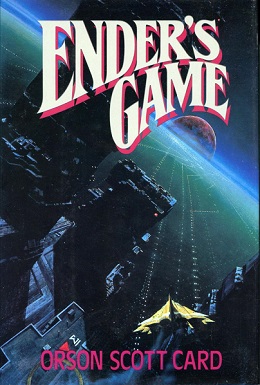
BOOK / MOVIE: Ender’s Game

 
VS.


                SPOILER ALERT:  This blog post is a comparison of the movie and the book and is mainly aimed at people who have already read the book.

                The acclaimed military science fiction novel Ender’s Game has been brought to the big screen by director Gavin Hood.  Hood also wrote the screenplay based on the book by Orson Scott Card.  The novel is beloved and there has been much trepidation about the movie adaptation.  I have read the book and I am concerned here with my theory that a movie should end up better than the novel it is based on.  I am familiar with the belief that movies seldom match their source, especially when we are talking about classic novels.  I swim upstream when it comes to this parroted philosophy.  Does “Ender’s Game” support the majority view or mine?

                For those unfamiliar with the novel’s plot, Ender Wiggin is a young boy who is a prodigy when it comes to military strategy and tactics.  He is groomed through tough love to become a fleet commander to lead Earth in the upcoming sequel to Earth versus the alien would-be conquerors.

                The movie briefly backgrounds the previous war in which the Borg-like Formics (the “Buggers” of the book) almost wiped out Earth.  Only the amazing performance by a Mazer Rackham saved the human race.  50 years later Earth is preparing a pre-emptive attack on the Formic planet.  Ender (Asa Butterfield) is taken from his parents to Battle School which is located in outer space.  The commander of battle school Col. Graff (Harrison Ford) feels Ender is “the one” and takes steps to harden him for command.  Ender makes friends and enemies among the cadets and quickly proves a natural in the Battle Room where the low gravity environment makes for interesting competitions and great special effects.  The movie does as good a job as could be expected in recreating the environment, but the competitions are pale reenactments of the vibrant book scenes.  Ender is the Battle School’s star pupil until his encounter with a jealous older boy causes him to drop out.  Graff uses Ender’s sister Valentine (Abigail Breslin) to convince him mankind needs him.

                Ender is taken by Graff to a secret outpost where he is introduced to the legendary Rackham (Ben Kingsley) and reunited with his best mates from Battle School.  They are told they are going to go through simulations of commanding the fleet assaulting the Formic planet.  Each simulation involves Ender directing his comrades as each controls a different part of the fleet.  This leads up to “graduation day”.

                The movie is not substantially different from the novel.  The main difference is what is left out, basically for time reasons.  The film jettisons the subplots of Valentine and Peter (Ender’s psychopath older brother) in their political guises as Demosthenes and Locke.  This is an improvement as that part of the book struck me as being highly unrealistic and mostly filler.  The movie also makes no reference at all to the situation on Earth.  In the book, Card makes the questionable decision to liken Earth in the distant future to Cold War Earth (even using the term Warsaw Pact).  This allows for the dubious inclusion of an Earthbound conflict that the movie thankfully avoids.

                The movie hits the highlights of Ender’s rise to commander status, but naturally cannot go into the details that were one of the highlights of the book.  The movie only hints at the struggles Ender has to go through in overcoming obstacles placed in front of him by Graff.  In order to compact the time frame (possibly for purposes of using only one actor to portray Ender), we get a much quicker progression in the Battle School.  The movie is particularly weak in depicting how Ender’s outside the box tactics were the keys to his success.  In fact, he wins his last match using a conventional formation which essentially dilutes what little effort the movie had made to hint at why he was brilliant.  There is also much less character development among the core group with Petra (Hailee Steinfeld) being bumped up to BFF (not surprisingly).  Bean, Alai, Dink, and Bernard are there only to bring back fond memories for fans of the book.

                The other highlight of the book (the “mind game”)  is given a prominent role and benefits from video game style graphics that should go over well with the core audience.  The movie places the emphasis on how the game got out of the control of Graff whereas in the book the emphasis was more on Ender’s problem solving abilities.  More would have been better, but again time constraints played a role in limiting these forays into Ender’s mind.  The scenes do play a pivotal role in setting up the ending of the movie.

                The biggest strength of the movie is pushing the theme that the war may have been unnecessary and was blatant genocide.  The movie downplays the evilness of the Formics (witness the omission of the term “buggers”).  Ender is more torn up by what he has done than in the book.  The movie also is able to be more visceral in portraying the sacrifices Ender has to call for from his fleet during the simulations.  The post script is simplified in a more satisfying way than in the book.

                Is the movie better than the book?  In advancing the overarching theme that Ender was being used by the military to preemptively destroy an alien species that perhaps was not deserving of extinction, the movie is more efficient than the book.   The excision of the subplots streamlines the plot, but the slimming down of Ender’s Battle School experience keeps the movie’s length under control at the expense of the most memorable moments and characters.

                In conclusion, the novel is on the Marine Corps’ recommended reading list.  It is highly unlikely the movie will be recommended viewing.  What this means is that if you prefer a plot that deals mainly with the stresses of command with a heavy dose of strategy and tactics, you would probably prefer the novel.  The movie is more a synopsis of the book – hitting the high spots without diving in too deep.  The film concentrates more on the moral dimensions of the war.  While the book erred in going into too much detail on periphery plots, the movie does not go into enough detail on the cherished elements of the book.  Is the movie better?  I would give it a slight nod, but it is not as clear a victory as for “Starship Troopers” the movie.

                P.S.  If you have not read the book, I strongly recommend you read it before watching the movie.  But be sure you stop reading the book before you get to the graduation simulation.