
“Gods and Generals” is the prequel to
“Gettysburg”. “Gettysburg” was financial
and critical success, but it took ten years to follow it up. Like that movie, “Gods and Generals” was
written and directed by Ronald Maxwell. He based his screenplay on Jeff Shaara’s
novel. (“Gettysburg” was based on Jeff’s
father’s novel Killer Angels.)
“Gods and Generals” was also produced by Ted Turner Pictures and Turner
has another cameo as Col. Weller Patton (“Old Blood and Guts” great
uncle). As with Ted, many actors
reprised their roles from the first film.
For instance, Jeff Daniels returned as Joshua Chamberlain (even though
he was ten years older, but playing the same age character – hooray for
Hollywood make-up artists!) Several
other key parts had new actors. Most
interestingly, Stephen Lang (who played Pickett in “Gettysburg”) now plays
Stonewall Jackson. Robert Duvall
replaced Martin Sheen as Lee. A similar
cast did not result in similar results.
The movie cost $56 million and made just $13. This does not bode well for the planned third
installment based on Shaara’s Last Full Measure.
“Gods
and Generals” covers the first half of the Civil War (or as Jackson calls it –
“The Second War of Independence”) in the eastern theater. The title card is a quote from George Eliot
about love of one’s homeland. This is
the first clue that the movie will take a Southern point of view. Robert E. Lee is offered command of the Union
Army, but declines because he cannot take up arms against his state. Meanwhile, Thomas Jackson is teaching at
Virginia Military Institute. He is a
terrible teacher who memorizes his lessons and threatens to repeat them from
the start if interrupted. Can’t some
alternative job come along that is more suited to his talents? (It would be a shame if 600,000 Americans
would have to die for him to fulfill his destiny.) Sure enough, along comes the Civil War and school
is out. Like summer vacation, the boys
are thrilled it has arrived. Two young
men leave home to join the Confederate Army.
Slave women kiss them goodbye.
This is the second clue. If you
are a Yankee, you might want to turn off the movie now.
The
religious theme is initiated early.
Rebels march off to war to reverential music that tells us they are
doomed, but God is on their side. This
theme is hammered throughout the movie through the Jackson character. He is very pious, but is a bit lenient on
that old “thou shalt not kill” commandment.
The first set piece battle is First Bull Run (which surprisingly, the
movie does not call “First Manassas”).
The battle concentrates on Jackson’s brigade and coverage of the battle
shows some flaws that Civil War experts will find irritating. Gen. Bee refers to Jackson himself, instead
of his brigade, when he uses the word “stonewall”. Jackson is wounded in the hand for dubious
cinematic reasons. More problematic,
considering the number of reenactors in the scene, Jackson orders his men to
“charge bayonets” and the order initiates a charge (instead of the proper
presenting of bayonets). The resulting
charge is loaded with action with lots of hand-to-hand and realistic
deaths. It is fairly graphic for a PG-13
movie. The charge wins the battle,
although in actuality it was not nearly that simple.
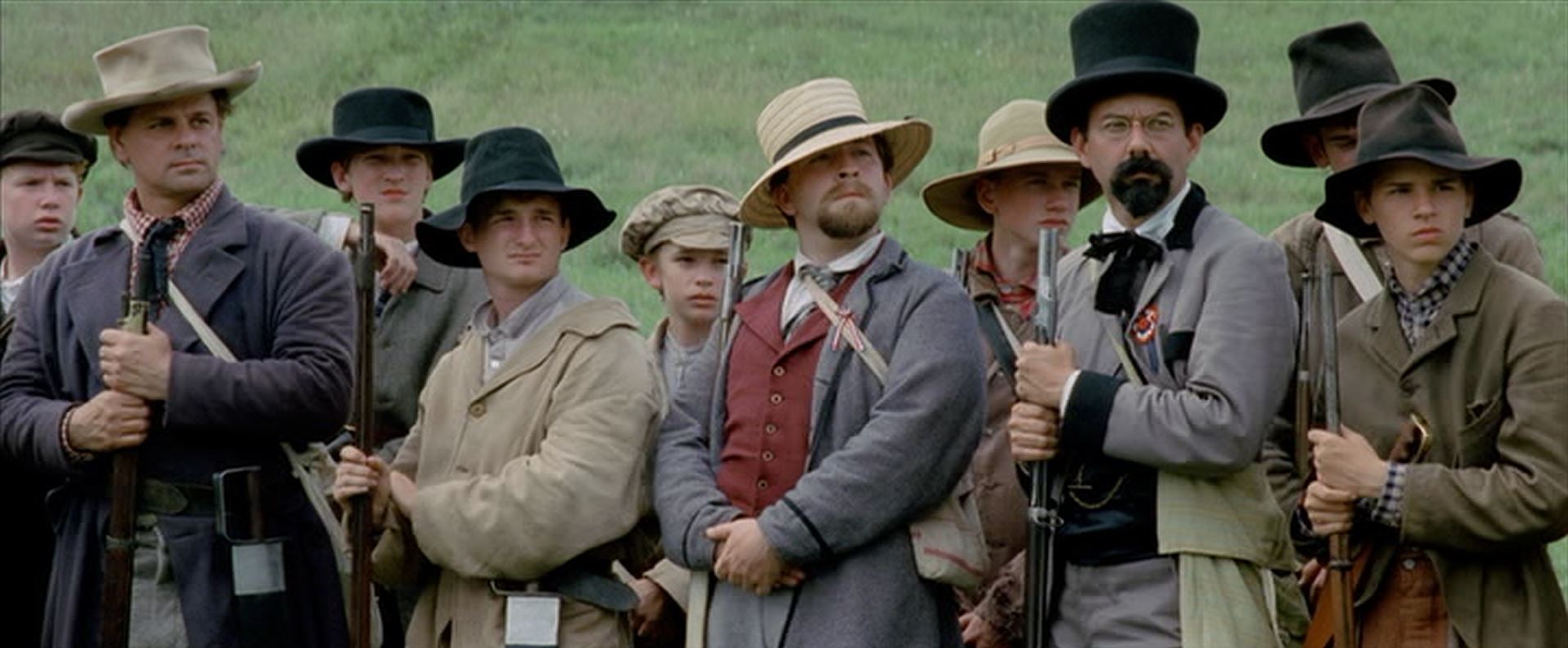 |
| "If our slaves did not want us to win, would they have dressed us so nicely?" |
In
between periods (to use a hockey analogy), Joshua Chamberlain leaves his
professorship after an intellectual debate (everyone speaks like an
intellectual in this movie) with his wife about his reasons for leaving. He presents the generic “a man’s gotta do
what a man’s gotta do” argument. Not the
preserve the Union view. The recently
canonized Jackson hires a black cook named Lewis. Lewis wants to defend his home! Jackson promises “Big Jim” that someday his
people will be free. Lewis will stand in
for all the “good blacks” of the “peculiar institution”. Jackson represents their benevolent
“employers”. Just as you are swallowing
what just came up in your mouth, a letter arrives from Jackson’s baby
daughter. Gag! Keep your puke bag handy, there is more to
come.
The
second period covers the Battle of Fredericksburg. (The movie conveniently skips the Battle of
Antietam and that awkward Emancipation Proclamation.) The movie covers the taking of the town after
a spirited Southern defense. The Yankees
loot like the barbarians that they are.
Martha, a slave, defends her master’s home. Lewis would be proud of her. The battle scene is a dandy. It concentrates on the futile attacks on the
stone wall. At one point it’s Irish
versus Irish (literally, as many of the reenactors are cinematically shooting
at themselves) in a schmaltzy scene. In
the mirror image of the first film’s Pickett’s Charge, the 20th
Maine assaults the stone wall and gets pinned down. Chamberlain spends hours
listening to bullets thunk into corpses he has piled for protection.
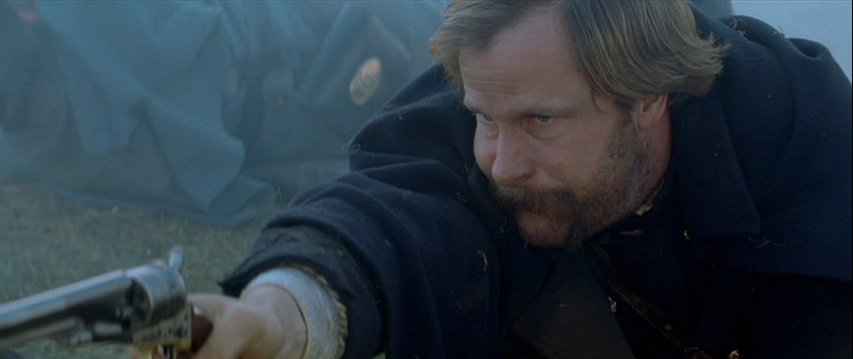 |
| Chamberlain wonders whether this is worth a governorship |
In
our second intermission, Jackson has a talk with a little girl. He tells her, “your daddy will come home, all
the daddies will come home”. Wait, what? There is a minstrel show featuring the song “Bonnie
Blue Flag” and a line by Ted Turner.
(Speaking roles pay more money.)
Joshua Chamberlain and his brother Tom (C. Thomas Howell again) discuss
emancipation in an obvious attempt by screenwriter Maxwell to make up for
Chamberlain’s wishy-washy comments in “Gettysburg”. Jackson befriends a cute little girl during a
plantation sojourn. As though the
schmaltz meter can’t go higher, it is turned up to 11 with the arrival of Mrs.
Jackson and their baby daughter.
Thankfully the intermission ends and we are on to the third period which
consists of the Battle of Chancellorsville.
We are heading for a happy ending, fellow Southerners. Except for the death of the saintly Jackson. Sorry, did you not notice he was not in
“Gettysburg”? That’s why I am not living
in the Confederate States of America.
I
was quite surprised and excited to learn that they had made a prequel to “Gettysburg”. I am a big fan of “Gettysburg”
and have read extensively on the Civil War, especially the war in the east. I have to admit that most of my reading was
of the Army of Northern Virginia. Being
a Southerner, I naturally found the Confederate Army more interesting. I guess you could say I rooted for Lee and
his men. However, I never lost sight of
the wrongness of their cause. While
“Gettysburg” had a Southern slant, that could be excused as an accurate
rendering of the source novel and the fact that the Confederate perspective was
more compelling than the Union. The
movie was well-received and the critics did not divide themselves between
Southerners who admired it and Northerners who despised it. The same cannot be said about “Gods and
Generals”.
The
problem is not with the history. The
movie is more accurate than most war movies.
I mentioned some minor flaws in the Battle of Bull Run, but for the most
part the movie does not make things up. The
three battles are instructional although you only get a small part of the
battlefield and it helps a lot if you are already familiar with the events in
the war. The combat itself is very
accurate. Credit must go to the
reenactors. The weapons are authentic
and unlike “Gettysburg”, the cannons recoil.
Unfortunately, there were less reenactors for the prequel so CGI had to
be used. The battle scenes for
Fredericksburg and Chancellorsville are among the best put on film. Lee’s famous quote “It is well that war is so
terrible or we should grow too fond of it” is borne out cinematically. After what Chamberlain undergoes in the field
in front of the stone wall at Fredericksburg, you wonder how he did not suffer
from debilitating PTSD. You watch scenes
like this and you wonder how our current public would respond to that scale of
bloodletting. Compare this to “Black
Hawk Down” which has the best take on modern American warfare. Have we gotten softer?
Sticking
with the hockey analogy, the problem is not with the game, it’s with the
intermissions. The expository scenes are
boring and infuriating. The movie would
have more accurately been titled “The Life and Death of Stonewall Jackson”. He totally dominates the movie. Stephen Lang is excellent as Jackson and gets
his personality right. (The rest of the
cast is average in their performances, although the facial hair is superior to
the original movie.) Jackson is a
fascinating figure and the movie accurately portrays his eccentricities and
beliefs. He was indeed very pious. The movie makes this painfully clear. The problem is not in his portrayal. The problem is that the movie is centered
around him. He is the living representation
of the “Lost Cause” and the states’ rights argument for preserving
slavery. His relationship with his slave
Lewis is apparently accurate, but that does not make it acceptable for a modern
movie. It was not even acceptable in
“Birth of a Nation” in 1915. That
“classic” shares a similar vibe with “Gods and Generals”. Both are loathsome to African-Americans. Both are pro-Southern.
It
is natural to compare “Gods and Generals” to “Gettysburg”. It does not come off well in comparison. The acting is inferior. Much of it is wooden. The score is worse. Randy Edelman had only small involvement this
time. The combat is good, but does not
rise to the level of the fight for Little Round Top and Pickett’s Charge. The dialogue is still mainly actors spouting
memoir quotes. This makes for accuracy, but with a heavy dose of
pretentiousness. Much of the dialogue is speeches and some of those speeches
are sermons. (I use the word “sermons”
because the movie is very religious.) And the words that originated with the
screenwriter (like Jackson’s discussions with Lewis) are cringe-worthy. As are the fictional characters like Martha
and the little girl Jackson befriends.
I
usually don’t let personal feelings creep into my reviews. Obviously, all reviews are opinions, but I
try to focus on how well the movie tells its story. This is one of the few movies that I have a
visceral reaction to due to the vibe of the movie. I mentioned that I rooted for Lee’s army in
my reading on the Civil War. However, I
never bought into the “lost cause” legend.
It would have been a disaster for the South if it had won the war. To release a movie in 2003 that makes the
case for states’ rights and slavery is untenable. For that reason, I cannot recommend it. If you can overlook its flaws, the movie is
admirably accurate as a history lesson. Just
don’t invite your African-American friends over to watch it.
GRADE
= D

