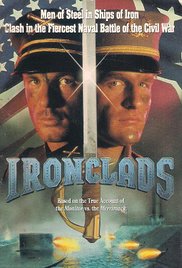
For a while in the 1990’s Ted Turner and TNT made a series of Civil War movies. When you are a millionaire like Turner, you can afford to satisfy your interest in the Civil War by making movies about it. Those movies included “Gettysburg” (1993), “Andersonville” (1996), and “The Hunley” (1999). “Ironclads” started this series. Turner got Delbert Mann (All Quiet on the Western Front (1979) and The Last Days of Patton) to direct. The naval combat scenes used 1/3 scale models filmed in a giant tank at Pinewood Studios in England. The movie had a large number of Civil War reenactors. It was nominated for Emmys for Special Visual Effects, Costume Design, and Sound Mixing.
“Ironclads” is a fictional tale set around the events surrounding the first battle of ironclads - the Battle of Hampton Roads. It tries to balance the scenes by having significant Union and Confederate characters. The movie opens with the Union setting fire to Hampton Roads Naval Base in Virginia. The Civil War had broken out recently and the Union wanted to deprive the fledgling Confederate navy of facilities and ships. One of those ships was the USS Merrimack, the best ship in the U.S. Navy. During the firing of the base, Quartermaster’s Mate Leslie Harmon (Reed Diamond) stops the blowing up of the dry dock for fear of civilian casualties. When he is returned to the North, he is threatened with court-martial but is given the option of pretending to be a traitor and switching sides so he can monitor developments involving the Merrimack. He is to make contact with a Southern belle named Betty (Virginia Madsden) who is a spy. The South accepts Harmon as a hero. Nobody suspects him! He sends word to the North about the conversion of the Merrimack into a new type of vessel that is clad with iron plates. The CSS Virginia will be a revolutionary ship that will be invulnerable to cannonballs fired by wooden warships. It could win the war for the Confederacy. What’s going to stop it?
In the North, eccentric inventor John Ericsson (Fritz Weaver) convinces Lincoln to build an ironclad from scratch. Lincoln, ever the open-minded genius, tells him to go for it. Thus was born the Monitor. There are parallel discussions of the thickness of the Virginia’s armor and the amount of gunpowder to be used in the Monitor’s guns. Meanwhile, Betty’s life gets complicated and we get a potential love triangle when her fiancé Lt. Catesby Jones (Alex Hyde-White) arrives. He is second-in-command of the Virginia. He is not aware that his lover is a spy and that she has passed on information that could get him killed. This all leads to the famous battle which is in two parts. On the first day, the Virginia takes on the blockading fleet of suddenly obsolete wooden warships. The next day changes naval warfare forever as the Monitor arrives to take on the supposedly invincible Virginia. Since the Monitor is also invincible, this should be interesting.
“Ironclads” is a worthy effort for a made-for-cable movie. The reenactment of the naval battle is great with the models eclipsing anything CGI would later be able to accomplish. The stunt work in the battle is stellar and the reenactors add verisimilitude to the action. Turner’s Civil War movies wisely took advantage of these weekend warriors who are obsessed with getting things right. The movie is strong historically. I would give it an 8/10 in that area. Kudos for including details like the 15 pounds versus 30 pounds of powder controversy. Unfortunately, to truly cover the historical significance of the battle, the movie needed to be much longer. As it is, 94 minutes is not enough to include the fascinating chronicle of the invention of the Monitor. Ericsson gets some screen time, but his story is barely touched on. The movie would have been wiser to concentrate on him rather than the fictional characters of Harmon and Betty.
The weakness of the movie is in the script. The espionage subplot is unrealistic. The acceptance of Harmon as a turncoat with no questioning is ridiculous. His flirting with Betty is clicheish and yet the love triangle does not develop. That is surprising, but Betty’s arc is refreshingly off kilter. That doesn’t make it any more believable. Virginia Madsden is the best performer in the film and looks good in petticoats. The movie deserved its Costume Design Emmy nomination. There is the requisite ball to show off those costumes. Points off for the egregious facial hair. People unfairly complain about the beards in “Gettysburg”, but its not unfair here. Aside from Madsden and Fritz Weaver, the cast makes no splashes. Diamond is in over his head as Harmon.
“Ironclads” is as good as we are going to get on one of the most important battles in military history. We deserve better, but since Civil War movies are few and far between, it is highly unlikely we’ll get a reboot. It does have its charms. Its short (although I have already argued that it should have been longer) and it is a good history lesson. To attract a female audience, it had to include an anachronistic female spy and a dashing fictional double agent. The movie could have done without the espionage subplot and should have stuck to just the historical aspects of the story. But then it wouldn’t have gotten that Costume Design nomination.
GRADE = C
HISTORICAL ACCURACY: On April 20,1861 the Hampton Roads Naval Base was burned by the U.S. Navy to destroy the dock facilities and the warships so the Confederacy could not use them. The USS Merrimack (often misspelled Merrimac) was burned to the water line. Luckily for its future refurbishing, the dry dock was not set aflame. This was not due to a Leslie Harmon. He is a fictional character who is not based on anyone. Confederate Secretary of the Navy Stephen Mallory decided to turn the Merrimack into an ironclad. 4-inch thick plates were placed on its sides. There was no trickery to make the North think they were only three inches thick. (That was just an excuse to give Betty some spying to do.) The ship was christened the Virginia. There was no Betty, but a Southern sympathizer did send a freed slave through enemy lines with a message that the ironclad was being constructed. John Ericsson was already building the Monitor. He had bypassed a special board set up to vet designs by going to Lincoln. Honest Abe overrode the board and the contract was given to Ericsson. He did suggest 30 pounds of powder for the guns, but the Navy was too traumatized by the explosion of the Peacemaker in 1844. The huge gun exploded on the USS Princeton and almost killed Pres. Tyler. (A disaster mentioned in the film.) The 15 pounds used in the battle turned out to be insufficient to penetrate the Virginia’s armor. Later, 30 pounds became the standard with no problems, so Ericsson had the last laugh.
The battle was well-depicted in the movie. On March 8, 1862 the Virginia forayed against the blockading squadron. Catesby ap Roger Jones was second in command to Franklin Buchanan. Obviously, Jones had no relationship with a spy. On the first day of the battle, the Virginia sailed by the Congress to ram the Cumberland. Both Union ships fired broadsides that did little damage to the ironclad. The ramming sank the Cumberland, but the ram got stuck and came off when the Union warship went down. The Virginia then approached the Congress, which had run aground. The Union ship was pummeled and struck its colors. When the crew was being rowed over to the Virginia, a Union shore battery opened fire wounding several sailors from both ships, including Buchanan. He retaliated by firing hot shot into the Congress to burn it. With night approaching, the Virginia backed off, planning to finish off the fleet the next day.
During the night, the Monitor arrived. On March 9, the Virginia was surprised to find a “cheesebox on a raft” awaiting it. The ships bounced balls off each other for hours. The nimble Monitor ran rings around the lumbering Virginia. Neither ship could hurt the other. An attempt by the Virginia to ram resulted in just a glancing blow. At one point, the Monitor’s pilot house was hit and its captain Lt. John Worden was temporarily blinded. Jones took command. By this time, the Monitor had moved into shallow water where the Virginia could not approach. The Monitor remained there as dusk approached. The Virginia called it a day and withdrew. The Union was saved and all the world’s warships were doomed.


