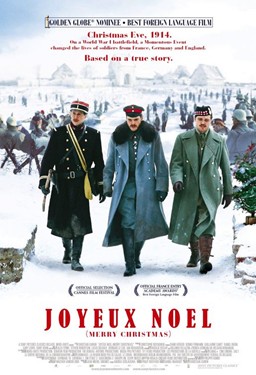
This is the first in my series of reviews of foreign-made and foreign-spoken war movies. The idea is to provide analysis that will help American war movie lovers decide if the movie is worth the effort of putting up with a movie with subtitles.
"Joyeux Noel" (Merry Christmas) is a French film released in 2005 that is based on the famous X-Mas Truce of 1914. It was nominated for an Oscar for Best Foriegn Language Film. Here is the historical background: On Christmas Eve on the Western Front spontaneous cease-fires broke out along parts of the front. They started in some cases with the Germans putting up Christmas trees and candles along their parapets and singing carols like "Silent Night". The British or French responded with their own songs and then the mood caused some brave souls to go into No Man's Land to fraternize. Gifts, food, and drinks were exchanged. In one case, a soccer (football) game was played between a Scottish unit and a German unit.
The movie tells a fictional story of one of the truces. It centers on characters in the French, British (Scots), and German armies. The five main characters are the French lieutenant Audebert, the German tenor Sprink and his soprano girlfriend Anna, a Scottish soldier named Jonathan and his parish priest Palmer.
The movie opens with schoolchildren from each of the main participants reciting jingoistic poems of hatred toward their foes. It is an effective way of reminding the audience of the nationalism that brought on the war and sets up the amazing pause in the hatred that the truce represents.
We get an early scene that shows the Allies going over the top with graphically violent results including the death of Jonathan's brother. Leaving his mortally wounded brother behind changes Jonathan and hardens him. This is really the only combat action in a movie that is basically about pacifism.
The film decides to have the truce begin with a stretch. The tenor and his girlfriend give an impromptu concert in the trench and when a Scottish bagpipe joins in, Sprink proceeds into No Man's Land to initiate the cease-fire which is agreed to by Audebert and the Scottish and German officers. The film recreates many of the incidents of fraternization associated with the truce. The Scottish priest even says a short mass.
The next day bodies are collected and buried and a soccer match breaks out. There is more comradeship which reflects that on some parts of the front the truce lasted up to a week. The movie gets a little off the historical path when on the second day, the Germans warn their foe/friends of an impending bombardment and offer to shelter them in the German trench. This is more than a bit far-fetched, but in for a penny... Naturally a counterbarrage is coming so the French/Scots return the favor! Since the trenches are about 50 yards apart, that's some extremely accurate artillery.
The movie accurately reflects the reactions of the higher ups to pacifist decisions made from the ground up. All three officers suffer the consequences of their terribly unpatriotic actions. Even the priest gets demoted by his bishop because he is not preaching the "sword and crusade" theme and pushing the idea that the Germans are not the children of God and we must kill them.
I liked the movie. It is a bit heavy-handed (I read criticisms of it being overly sentimental, but I did not find it so), but it is well-acted and takes acceptable liberties in bringing an interesting historical incident to light. I had heard of the Christmas Truce many years ago and tell it as an anecdote in my history classes. Of course, I emphasized the soccer match. It was neat to see the event recreated. There is so little positive to be found in the Great War that you have to take what you can get.
I do not think it will make my Top 100 list, but I do recommend it. Also, it's a great date movie. There are not too many war movies that qualify for that. Guys, get your significant other to read the sub-titles to you.