Showing posts with label Merry Christmas. Show all posts

Sunday, November 18, 2012

FORGOTTEN GEM? Merry Christmas, Mr. Lawrence


           “Merry Christmas, Mr. Lawrence” is a POW movie set in Java in 1942.  It was directed by Japanese director Nagise Oshima and has a multi-national cast.  The movie was based on the semi-autobiographical novel entitled The Seed and the Sower by Sir Laurens van der Post.  It is the rare POW movie that does not have an escape or escape attempt.

                Col. Lawrence (Tom Conti)  is bilingual and having lived in Japan before the war acts as a liaison between the British prisoners and the Japanese administration of the camp.  The movie opens with the seppuku of a Korean guard for homosexual acts with a Dutch prisoner.  Lawrence and other prisoners are forced to witness this  His paramour bites his tongue (literally) and chokes on it.  The scene establishes the theme of homosexuality that runs throughout the film and clues us in on the fact that this will be a different kind of POW movie.

                Maj. Jack Celliers (David Bowie) is a commando leader who had been parachuted into the Javan jungle to conduct guerrilla warfare.  He is captured and the commandant Capt. Yonai (Japanese pop star Ryuichi Sakamoto) inexplicably argues at his murder trial that he should be treated as a POW.  This does not prevent him going before a firing squad which proceeds to miss so he ends up in the camp.  I am not making this up.

                The camp features two intriguing relationships.  Lawrence is paired with the sadistic Sgt. Hara (Takeshi Kitano).  Yonai and Celliers are the other pair.  There is a definite homoerotic vibe in this which means Bowie can just play himself.  Yonai may be attracted to Celliers, but he sees him as an evil spirit (I guess because he stirs Yonai’s samurai loins).  Yonai throws Celliers and Lawrence into cells because of a contraband radio.  Yonai’s batman tries to kill Celliers on behalf of his boss, but Celliers beats him up and tries to rescue Lawrence.  Yonai foils this and challenges Celliers to a duel which Celliers refuses.  This demon is not going to go easy.

                A flashback attempts to provide Celliers with a back-story that explains his strangeness.  Unfortunately, the flashback to boarding school is so weird a normal person will have a WTF reaction.  Something about his younger brother being forced to sing (which he does like an angel).

Celliers at the beach
                Meanwhile, Hara plays Santa Claus by releasing Lawrence (“Merry Christmas, Mr. Lawrence”) and Celliers.  Apparently a sergeant can go over the head of the camp commandant in this camp.  Yonai orders all the prisoners assembled and is going to behead the British commander when Celliers walks up to him and kisses him.  Yonai knows he should use his katana on this insolent Englishman, but he’s just so attractive!  He collapses in homoerotic confusion.  The guards beat up Celliers instead.  The new camp commandant shows his heterosexuality by burying Celliers up to the neck.  Yonai comes to visit him and takes a lock of his hair.  It is unclear whether this is done post mortem.

                Suddenly the movie jumps four years to 1946.  Hara is to be executed for war crimes which seems appropriate considering what he does in the movie.  Lawrence comes to visit him.  He empathizes with this misunderstood man who routinely beat him in the camp.  Who’s to say who was right in the war, right?  They have a nice chat and reminisce about that special Christmas moment they shared.

                This movie is polarizing.  You either love it or hate it.  Not surprisingly I fall into the "hated it" group.  The characters are inconsistent.  Yonai and Hara are sometimes evil, sometimes humane.  Celliers is just plain weird.  Lawrence is bipolar (or suffering from Stockholm Syndrome).  The acting has been complemented by some critics, but is truthfully pedestrian.  Bowie is simply not a good actor.  A movie starring two pop stars has problems.

                The movie seems to revel in its unorthodoxy.  Even the sound track is new age.  It was composed by Sakamoto.  Put me down amongst those that do not want new age music in my war movies.  I also prefer for my plots to be coherent and for flashbacks to add to the understanding of the narrative instead of adding to the confusion.  Much of the actions of the main characters make no sense even under the circumstances they were put in.  Lawrence is supposed to be the sane center, but his relationship with Hara is infuriating.

                To speak of “Merry Christmas, Mr. Lawrence” as one of the best POW movies is foolish.  If you want to admire it for being different (albeit different bad), so be it.  I have seen many POW movie and this is the worst.

Rating – F


Friday, December 23, 2011

A CHRISTMAS WAR MOVIE: A Midnight Clear


     I thought with Christmas approaching I would suggest an X-Mas themed war flick. “A Midnight Clear” was released in 1992. Its cast consisted of several up and coming actors like Ethan Hawke, Peter Berg, Kevin Dillon, John McGinley, Frank Whaley, and Gary Sinise (his film debut). The ensemble cast is strong and the movie is a little gem that is not well-known. It cost less than $5 million to produce and made less than $2 million. It is based on the novel by William Wharton.


     The movie is set in the Ardennes Forest before the Battle of the Bulge. It is not a big picture movie. You get no idea how the battle is going. There is a “fog of war” surrounding the intelligence squad that is sent out to observe enemy movements from an abandoned mansion.  They are scared and unclear about what they are supposed to do. The mission is seemingly suicidal and their ex-mortician, current martinet Major Griffin (McGinley) has a habit of putting them in precarious positions. Speaking of a previous patrol, Will (the narrator Ethan Hawke) makes the following telling remark: “We lost half of our squad attempting one of [Griffin’s] map-inspired, ill-conceived recon patrols. When I say ‘lost’, I mean ‘killed’. Nobody in the Army ever admits that someone on our side is killed. They’re either ‘lost’ like Christopher Robin… ‘hit’, as in a batter hit by a pitched ball… or get ‘it’ like in hide and go seek. Or maybe they “get it”, as with an ambiguous joke.” Well said and true. In fact, much of the narration is cynical and critical of the Army.

     We get to know the squad well. They are typically heterogeneous except there is no country hick because this is an “intelligence” squad. They care about each other, but are not all BFFs. There is a flashback scene from boot camp as several of the boys attempt to lose their virginity with a good girl down on her luck. It is a sweet scene and tastefully done.

     The setting and mood of the movie could have easily fit a horror movie. On the way to the mansion, they come upon the corpses of a G.I. and a German in a death embrace. The chalet is eerie. It is empty except for a deer. The nights are particularly spooky. The first night Germans yell unintelligibly from the woods and the next day the Americans discover a German squad encamped in a hut nearby. That night the Germans come again to yell “Fuck Hitler” (later they insist they are not Nazis, just German soldiers – an accurate description of the dilemma of many German soldiers) and throw snow balls. The third night they rig up a Christmas tree and sing carols. Although fictional, the film harkens back to the famous Christmas Truce of WWI. (That reminds me to suggest "Joyeux Noel" as a companion to your Christmas viewing.) The perplexed Americans finally realize the Germans want to surrender, but they need for it to look like they put up a fight. Since “Mother” (Sinise) has recently suffered a breakdown, the guys decide to make him the “hero” of the skirmish so he can be sent home. Mother is to be kept in the dark about the whole affair. Nice plan, disastrous results. Watch the movie and see what happens.

     This is a remarkable movie. It is unlike any other war movie I have seen. It is spiritual (helped by the New Age musical score) and has a heart-tugging scene involving the bathing of a dead comrade that is hard to forget (and slightly homoerotic). It is also overtly religious in spots. Although a Christmas movie, there is also a strong reference to the Crucifixion. Some will not like this aspect of the movie, but I found it refreshing. Keep in mind that soldiers tend to be religious for obvious reasons, so why shouldn’t war movies occasionally have religious themes?

     The movie is very well acted. The squad is likeable and relateable. Each has a distinct personality. Each actor gets a chance to shine. No one dominates. The small unit dynamics are realistic. Their behavior rings true. McGinley is appropriately loathsome as the clichéd commanding officer. (By the way, McGinley and Dillon went on to appear in another great small unit movie – “Platoon”.) The Germans are shown in a sympathetic light. What happens to them is truly tragic.

     This is a very snowy movie. Watch it with a mug of hot chocolate by a fire place if you can. It was shot in Utah and the temperatures at night were frigid. The cinematography is crisp and clear like the locale.

     In conclusion, “A Midnight Clear” is one of the two greatest war movies set at Christmas. Are there others? Let me know. It will make my 100 Best War Movies list when I get done with my journey.


Tuesday, October 5, 2010

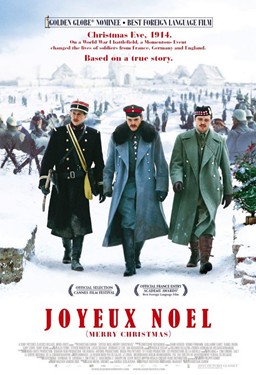
SHOULD I READ IT? "Joyeux Noel"

      This is the first in my series of reviews of foreign-made and foreign-spoken war movies.  The idea is to provide analysis that will help American war movie lovers decide if the movie is worth the effort of putting up with a movie with subtitles.
     "Joyeux Noel" (Merry Christmas) is a French film released in 2005 that is based on the famous X-Mas Truce of 1914.  It was nominated for an Oscar for Best Foriegn Language Film.  Here is the historical background:  On Christmas Eve on the Western Front spontaneous cease-fires broke out along parts of the front.  They started in some cases with the Germans putting up Christmas trees and candles along their parapets and singing carols like "Silent Night".  The British or French responded with their own songs and then the mood caused some brave souls to go into No Man's Land to fraternize.  Gifts, food, and drinks were exchanged.  In one case, a soccer (football) game was played between a Scottish unit and a German unit.
     The movie tells a fictional story of one of the truces.  It centers on characters in the French, British (Scots), and German armies.  The five main characters are the French lieutenant Audebert, the German tenor Sprink and his soprano girlfriend Anna, a Scottish soldier named Jonathan and his parish priest Palmer.
     The movie opens with schoolchildren from each of the main participants reciting jingoistic poems of hatred toward their foes.  It is an effective way of reminding the audience of the nationalism that brought on the war and sets up the amazing pause in the hatred that the truce represents.
     We get an early scene that shows the Allies going over the top with graphically violent results including the death of Jonathan's brother.  Leaving his mortally wounded brother behind changes Jonathan and hardens him.  This is really the only combat action in a movie that is basically about pacifism.
      The film decides to have the truce begin with a stretch.  The tenor and his girlfriend give an impromptu concert in the trench and when a Scottish bagpipe joins in, Sprink proceeds into No Man's Land to initiate the cease-fire which is agreed to by Audebert and the Scottish and German officers.  The film recreates many of the incidents of fraternization associated with the truce.  The Scottish priest even says a short mass.
     The next day bodies are collected and buried and a soccer match breaks out.  There is more comradeship which reflects that on some parts of the front the truce lasted up to a week.  The movie gets a little off the historical path when on the second day, the Germans warn their foe/friends of an impending bombardment and offer to shelter them in the German trench.  This is more than a bit far-fetched, but in for a penny... Naturally a counterbarrage is coming so the French/Scots return the favor!  Since the trenches are about 50 yards apart, that's some extremely accurate artillery.
      The movie accurately reflects the reactions of the higher ups to pacifist decisions made from the ground up.  All three officers suffer the consequences of their terribly unpatriotic actions.  Even the priest gets demoted by his bishop because he is not preaching the "sword and crusade" theme and pushing the idea that the Germans are not the children of God and we must kill them.
      I liked the movie.  It is a bit heavy-handed (I read criticisms of it being overly sentimental, but I did not find it so), but it is well-acted and takes acceptable liberties in bringing an interesting historical incident to light.  I had heard of the Christmas Truce many years ago and tell it as an anecdote in my history classes. Of course, I emphasized the soccer match.  It was neat to see the event recreated.  There is so little positive to be found in the Great War that you have to take what you can get.
      I do not think it will make my Top 100 list, but I do recommend it.  Also, it's a great date movie.  There are not too many war movies that qualify for that.  Guys, get your significant other to read the sub-titles to you.