Showing posts with label Korean War movie. Show all posts

Tuesday, October 1, 2019

Northern Limit Line (2015)


                “Northern Limit Line” is a South Korean film by Kim Hak-soon.  It took him seven years to get funding for the production.  Some of the funds came from a crowdfunding effort that included contributions from the South Korean national soccer team.  The movie was well-received and was nominated for best picture at the South Korean equivalent of the Academy Awards.  It is based on the novel by Choi Soon-jo.  It tells the story of the Second Battle of Yeonpyeong Island.

                The movie takes place in 2002.  South Korea is in the midst of patriot fervor over the third place World Cup match with Turkey.  Patrol boat 357 is assigned to patrol the sea border between the Koreas.  This line is called the Northern Limit Line.  It is disputed as the North Koreans claim it should be further south.  The boat has a new commander – Lt. Commander Yoon (Kim Mu-yeol).  Also new is a medic named Park (Lee Hyan-woo).  They join a tight-knit crew that has pictures of kids, wives, and girlfriends posted on a bulletin board.  Oh oh.  They are watching the soccer match when they get an emergency order to sail.  Yoon questions the Rules of Engagement that forbids them to open fire first.  357 picks up some “fishermen” who are obviously North Koreans.  They are told to release them.  Meanwhile, in Pyongyang, silent planning is taking place.

                On June 29, North Korean patrol boats cross the line.  They have T-34 tank turrets on them!  Waste not, want not.  Those turrets open fire and 357 catches hell.  The running battle is intense.  We get slo-mo, sound dilution, and graphic wounds including dismemberments. The bodies pile up.   In other words, it’s a South Korean war movie. 

                “Northern Limit Line” is a worthy addition to one of my favorite subgenres – the South Korean war film.  It takes a while to get to the balls to the wall battle scene.  There is some good character development.  Yoon, Park, and the helmsman Han (Jin Goo) get back-stories.  For example, Yoon’s father was a captain who was demoted for refusing to execute a spy.  There are some clichés.  Yoon is a martinet in need of humanizing.  He also has daddy issues.  Han needs redemption.  Park must earn respect under the pressure of combat.  The main actors perform well.  You care about these men and there is some heart-tugging.  There must have been some tears in South Korean movie theaters.  In fact, the families had been reluctant to sign off on the film until another incident occurred.  The movie definitely pushes patriotic buttons, but it also depicts some of the crew performing less than bravely.

                The film is well made.  The music is low key during the battle and then shifts to more pompous during the aftermath.  The post script includes actual footage of the funerals.  The movie is nothing special until the combat scene.  But is worth the wait.  The combat section takes up a big chunk of the film.  If you have seen any South Korean war movies, you know what to expect.  Basically it’s “Tae Guk Gi” on the water.  Since it is a naval combat movie, we get a good taste of South Korean naval culture.  Unlike “Tae Guk Gi”, this one is based on a true story.

GRADE  =  B

HISTORICAL ACCURACY:    The movie is based on the Second Battle of Yeonpyeong Island on June 29, 2002.  This battle was the most volatile encounter of many between the patrol forces of the two Koreas.  It began with an incursion by a North Korean boat.  That boat was warned by Chamsuri 357 with no effect and then a second joined it.  The two intruders attacked and a fire fight broke out with 357.  The boat was hit in the wheelhouse and Yoon was killed.  357 was joined by Chamsuri 358 and a ten minute fire fight broke out.  A total of six crewmen on the 357 were killed including Park.  Han’s body was found at sea.  The battle ended when reinforcements arrived and the North Koreans withdrew.  The North Koreans lost 13 killed in action.  The 357 sank while under tow.  

I classify "Northern Limit Line" as a Korean War movie.  After all, the war did not officially end.  Here is my ranking of the Korean Korean War movies:

1.  Tae Guk Gi
3.  Northern Limit Line

Saturday, July 20, 2019

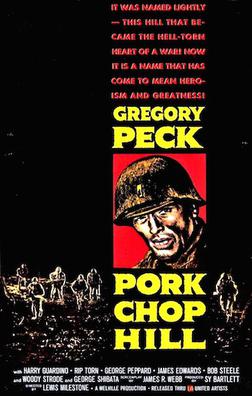
CONSENSUS #65. Pork Chop Hill


SYNOPSIS: "Pork Chop Hill" is a movie about the most famous battle in the Korean War. It takes place at the end of the war as the peace talks are winding down and both sides are fighting over real estate. One of those prime lots is an otherwise worthless hill. An American company is sent to keep and hold it. Gregory Peck plays the commander.  In some ways it is an update of the Alamo.

BACK-STORY: Pork Chop Hill is arguably the most famous and best movie about the Korean War. It was directed by Lewis Milestone of All Quiet…” fame. He also directed another Forgotten War film entitled Steel Helmet. PCH was his last war movie. It was released in 1959.  Gregory Pecks character, Joe Clemons, acted as technical adviser on the film. Clemons was awarded the Distinguished Service Cross for the battle. The movie is populated by many familiar actors from the 1960s and includes a small role by Barry McGuire of future Eve of Destruction one hit wonder fame.

TRIVIA:  Wikipedia, imdb, TCM, Guts and Glory
1.  It is based on a book by military historian S.L.A. Marshall.   Marshall later put forward the controversial theory that a large percentage of American soldiers never fired their weapons at an enemy.

2.  Director Lewis Milestone claimed that the movie was cut by 20 minutes because Gregory Peck’s wife was upset that he was not arriving on screen soon enough.

3.  Peck’s character Clemons does not fire a weapon in the movie because Peck was a committed pacifist and proponent of gun control.  Peck had also been against American involvement in the war.

4.  Producer Sy Bartlett intended for the movie to be very anti-war.  The Pentagon approved the script in spite of this because the movie shows men obeying orders and the movie refutes the image of American soldiers bugging out.

Belle and Blade  =  3.0
Brassey’s              =  4.0
Video Hound       =  3.8
War Movies         =  5.0
Military History  =  #39
Channel 4             =  no
Film Site                =  yes
101 War Movies  =  no
Rotten Tomatoes  =  no 

OPINION: Pork Chop Hill has been described as the best Korean War B-Movie. It is very good for what it is. The acting is solid. Not surprising considering the cast. Peck is Peck. Did he ever make a bad movie? Harry Guardino, Rip Torn, George Peppard, Robert Blake, the great Woody Strode. Nuf said. The cinematography is a crisp black and white. The dialogue is refreshingly cynical in its commentary on war.  It is gritty and authentic in its depiction of the randomness of death in combat. PCH is one of the best company level movies ever made. It is not a small unit dynamics movie ala Platoon. There is little dysfunctionality other than with Franklin (who is a fictional character). The biggest strength of the film is its historical accuracy. It is one of the best movies covering a battle. It reminds one of Hamburger Hill in its battles-can-be-futile theme. It also has a similar take on how command decisions based on political factors can result in unnecessary squandering of lives.

            Pork Chop Hill is underrated at #66.  It belongs in the top 50.   It is one of the most realistic battle films and one of the best small unit movies. Considering when it was made and the budget, it is clearly a classic. It also deserves credit for representing the Forgotten War well.

Thursday, August 24, 2017

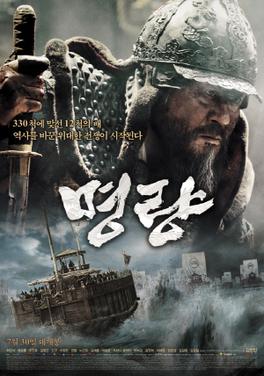
NAVAL COMBAT PORN: The Admiral: Roaring Currents (2014)


                “The Admiral:  Roaring Currents” is a South Korean war  movie that was directed and co-written by Kim Han-min (“War of the Arrows”).  It was titled “Battle of Myeongnyang, Whirlwind Sea” in South Korea.  It was a smash hit with 10 million viewers in the first twelve days.  It went  on to be the highest grossing South Korean film ever.  It won Best Picture at the Grand Bell Awards (like the Academy Awards).   It is based on the naval battle of Myeongnyang in 1597.  In the battle, the legendary Korean admiral Yi Sun-sin defeated a Japanese fleet of 300 warships with only 13 of his own.

                After a bad defeat, the recently imprisoned Yi Sun-sin is reinstated to command of the pitiful remnant of the Korean fleet.  Yi has been ordered to disband the fleet and join up with the army for a last stand against the invaders.  This seems like a good idea considering the morale of his sailors is rock-bottom and Yi is in ill health and seemingly apathetic.  Plus he has PTSD from his recent imprisonment.  On the other side, the Japanese commander in chief sends a pirate named Kurushima to light a fire under his admiral Todo.  Kurushima is a total bad-ass who has a grudge against Yi for killing his brother.  He also has a henchman named Haru who is a sharpshooter. 
                 At his camp, everyone is depressed and Yi is morose.  Things can’t get any worse. Except they do.  One of his subordinates, Bae Seol, is a traitor who attempts to assassinate Yi and successfully destroys the only Turtle boat.  Damn, I was really looking forward to seeing that Turtle boat win the battle by itself!  Plus, this was a pretty short movie with an unsatisfying conclusion.  But wait, this insane admiral does not know the word quit.  He does some recon and discovers a place where the current is as insane as he is.  Perhaps he can lure the overconfident (and how can they help but be?) Japanese into a roaring trap.  Before you say “how can only 13 ships beat 300?”, be aware that at first only Yi is willing to take on the entire Japanese fleet.  Well, not actually the whole fleet, because only Kurushima’s contingent advances.  It still should be way more than is needed except that they are facing a dude named Yi and incidentally, there is a whirlpool.  What ensues is typical Korean mayhem, only this time on water.  And it lasts 61 minutes!

                As my readers know (both of them), I am a big fan of South Korean war movies.  They are the greatest practitioners of combat porn on planet Earth.  This is the first one set on the water that I have seen, so I was a little skeptical.  The battle is epic.  Just when you think it cannot get anymore gonzo, Kim Han-min steps it up a notch.  So a scene that starts out at a 10 on the combat porn scale, ends up at a 15.  Kim films the action with a variety of cinematography including slo-mo, of course.  There is abundant use of CGI, but it is amazingly seamless.  Kim did have the use of eight ships that were very detailed recreations of the period warships. The violence is graphic and relentless.  The choreography of the melees is outstanding.  There are a wide variety of weapons used.  Muskets, fire arrows, cannons, even a rocket.  There is a fireship loaded with gunpowder which you can imagine the explosion.  But the movie is not just action.  The plot is fine with the theme of make the enemy fear you and turn your men’s fears into courage.  Yi does not manage this with the usual cinematic charisma.  Choi Min-sik plays him as damaged, but driven.  He’s a magnetic actor and won the South Korean equivalent of the Oscar for Best Actor.  Plus the movie has a great villain in Kurushima, “The Pirate King”.  He’s so bad, the other Japanese don’t like him.  All this with a Hans Zimmeresque epic score.  The movie is surprisingly accurate in a "300" kind of way.  Granted, it’s a Korean war movie version of the events.  Like how “Godzilla” was the retelling of a lizard being found in a Tokyo sewer.

GRADE  =  A

HISTORICAL ACCURACY:    The background information that leads off the movie is accurate.  In the 16th Century, Toyotomi Hideyoshi united Japan and then decided to conquer Korea and possibly China.  The movie is set in his second invasion of Korea which began in 1597.  The Japanese army advanced northward and had the objective of capturing the Korean capital.  Admiral Yi Sun-sin won numerous victories against the Japanese fleet, which had the effect of slowing down the Japanese advance by cutting its supply lines to Japan.  Unfortunately, Yi was removed from command due to Japanese espionage and court intrigue.  He was tortured and demoted to a common soldier.  He was replaced by a rival who subsequently got his ass whipped at the Battle of Chilchonryang.  This defeat cost the Josean Navy around 200 ships.  Yi was reinstated, but had only 12 ships under his command.  Those ships had been saved by a captain named Bae Seol.  As the movie shows, Yi had problems beyond the small size of his force.  His sailors and commanders were justly demoralized and not exactly keen on another confrontation.  In fact, the government strongly urged Yi to disband the fleet and take the crews to supplement the army.  Yi refused and many of his men thought he was nuts.  Bae Seol deserted, for instance.  Unlike in the movie, he did not try to assassinate Yi.  And there was no Turtle ship to set afire.  The inclusion of the Turtle ship was a nice nod the memory of Yi because he was credited with designing the iconic ships.   Bae was later caught and executed for desertion.

                Yi did scout out locations for the battle and decided on the Myeongryang Strait.  Besides the narrowness which would negate the size of the Japanese fleet, the current was ten knots.  Not only that but the current shifted around after three hours so at first the Japanese ships would be impelled forward into the Koreans and then would be forced rearward.  The strait was rife with eddies and whirlpools which would cause severe problems for maneuvering and swimming if any Japanese sailors went overboard or were on sinking ships.  In other words, it was the perfect location for what he had in mind.

                The Japanese fleet was actually about 130 warships (the movie’s number of 330 would have been arrived at by adding support vessels).  Kurushima was in command of the vanguard.  I found no evidence that he was considered to be a pirate and was not liked by the Japanese commander Todo Takatora.  Although the Japanese fleet included some sharpshooters, the Haru character is clearly fictional.  He would have been better placed in the Korean fleet because it relied on missile weapons and stand-off fighting whereas the Japanese tactic was to close in and board.

                As far as the battle itself, the movie gets the foundation right, but enhances the action in ways only a South Korean war movie can do.  On the day of the battle, Yi advanced his fleet and anchored at the northern end of the strait.  He then moved the flagship forward to provoke the battle.  This act of seeming suicide was probably due to the reluctance of the other twelve ships to accompany him.  Kurushima took the bait and accepted combat with his vanguard.  The rest of the Japanese warships held back, most likely because they were intimidated by the knowledge that it was Yi they were facing.  They had good reason to be awed as Yi’s ship was able to hold its own against numerous opponents by using it cannons, arrows, and larger size.  Seeing the flagship performing magnificently, the other ships gradually joined starting with An Wi.  Yi’s ship was not boarded, but An Wi did have to repel boarders.  The death of Kurushima did occur, but the circumstances are unclear.  The corpse of a Japanese general named Modashi was fished out of the water and decapitated.  His head was launched toward the enemy.  A second turning point occurred when the current shifted outward.  The Japanese ships lost headway and began to drift rearward.  They also began to collide with each other.  Cannon fire and ramming increased the panic of the Japanese.  There was no giant whirlpool.  Thirty ships were sunk in the melee.

                The result of the battle was morale was restored in the Korean navy and the military in general.  China’s navy came into the war to aid the Koreans.  Japan never did get to the capital.                

Thursday, May 15, 2014

SHOULD I READ IT? The Frontline (2011)


                Let me state from the start, I love South Korean war movies.  They are always entertaining.  Turn off your filters, sit back, shake your head, and enjoy.  These directors know how to film balls to the wall action that makes “Saving Private Ryan” look like a documentary.  Remarkably, I have yet to see one that does not treat the Korean War as a mess.  There is no patriotism in these films and a lot of sympathy for the enemy.  Compare this to Hollywood’s take on the war and remember that South Korea has a much better reason to pump up the patriotism and demonization of the enemy.  The  recent appearance of these types of movies starting with “Joint Security Area” (2000) clearly shows how far the country has come down the path of democracy.  It was not that long ago that the director of a movie like this would have been thrown in prison.  I read the other day that you could argue that in terms of positive results the Korean War was our most successful war.  That may be a stretch, but when you see where South Korea today (and specifically Korean cinema as an example of this), you can see where this theory comes from.

                “The Frontline” is set on the eastern front in the last month of the war.  The Alligator Company (named after the fact that baby alligators have a low survival rate) is tasked with capturing Aerok (look at it in a mirror) Hill before the Armistice locks in the border.  The hill has changed hands 30 times in 18 months.  The company is low in morale and has recently had a change in command via fragging.  The interim commander is a morphine addict.  Kang (Shin Ha-kyun) arrives from the C.I.C. (Counterintelligence Corps) to investigate the murder and suspicions of collaboration in the unit. (The C.I.C. was created to ferret out communists in the ranks.)  He is shocked to be reunited with his best friend Kim (Go Soo).  Kim had been taken captive early in the war and was presumed hors de combat.  Kim is now a cynical anti-hero.

                When the latest order to take the hill comes the unit reluctantly saddles up, shrugs, and sallies forth.  The result is SPRish with hand-held, quick cuts, close-ups pulling back, and even a tracking shot.  If you’ve seen Tae Guk Gi, you know the Korean style.  Kang takes part in the attack.  Did I mention Korean directors are not big on reality?  Being in the thick of it allows Kang to discover that there is a bunker in no man’s land that acts as fraternization central.  Whenever it changes hands, the dispossessed side has left “gifts”.  The South leaves America cigarettes and chocolate and the North leaves rice wine.  More significantly, the communists leave letters for relatives in the South.

Dammit!  They left us some mouth wash.
                There is a really cool montage of a few more assaults as seen by a stationary camera to push the time frame ahead.  A key subplot involves a North Korean sniper called “Two Seconds”.  A “Full Metal Jacket” type of “I dare you to rescue him” scene is followed by a FMJesque revelation.

                Another subplot involves the raw nerves of the platoon. Kang traces this back to an incident at Pohang early in the war.  Flashback time.  In an amphibious assault gone bad, the Alligators were attempting to withdraw when another platoon decided their Higgins boat could handle double capacity.  A .50 caliber machine gun ended the boarding attempt and the incident was covered up, but the mental scars did not heal.  Soldiers in Korean movies must suffer physically and psychologically.

Who else thinks this is sexy?
                Just when you think things could not get worse, here come the Chicoms.  A human wave attack in the driving rain results in Kim countermanding the new commander’s decision to follow orders and hold by putting a bullet in his head.  What the frag?!  Kang threatens court-martial.  He just does not get it.  Guess who doesn’t live to stand trial?  Kang carries the body back only to learn the war is over.  To emphasize this, Kang runs into the sniper’s band at a stream and they exchange nods and waves.  Good game.  Bittersweet and satisfying ending right?  But wait, most of the cast is still alive.  This violates Korean war cinema doctrine.

                It turns out there are 12 hours of war left.  Who really wants that moonscape of a hill?  The generals.  This actually accurately reflects the battle for the hills (ex. Pork Chop Hill) that closed the Korean War.  Who wants to stage a grand set piece to close his movie?  Jang Hoon.  Leave the kitchen sink in the trailer, but bring everything else.  Air bombardment by fighters that drop bombs they don’t have (learned from American war films).  Slo-mo.  Elegaic music.  Hand-to hand.  A stabbing death that reminds of Mellish’s from SPR.  Graphic wounds.  Intense violence. 

                “The Frontline” was a huge hit in South Korea.  Apparently South Koreans do not like their war movies coated with sugar.  (They don’t mind a whiff of bull shit, however.)  The movie was critically acclaimed and was awarded the Korean equivalent of the Best Picture Oscar and was nominated as South Korea’s representative for Best Foreign Film for the Academy Awards.  It may be a bit overrated relative to that.  However, it is undoubtedly entertaining in a macho male demographic way.  I don’t think females will be as enamored, but there is a significant female character which is something to commend it for.  Hint:  think “Enemy at the Gates”.

                The movie is very well acted.  The leads are good and typically sincere for Koreans.  There are some interesting plot devices like the bunker in no man’s land.  The themes of brotherhood, rivalry, and sympathy for the enemy (although a bit heavy-handed) are nicely laid out.   These themes have been explored before in Korean movies, so there is nothing new here.  Also not breaking new ground is the “it’s a small world” nature of many of the character arcs.  And the ending is on the trite side.

                If you have never seen a Korean war movie, this would be a good place to start.  Don’t start with “Tae Guk Gi” because then you may be let down by the others.  I would begin with “Joint Security Area”.  Regardless, pop some popcorn and dive in.

grade =  B-