Showing posts with label Nanking. Show all posts

Saturday, March 16, 2019

Empire of the Sun (1987)


                “Empire” was based on a biography by J.G. Ballard.  It was published in 1984.  Originally, Warner Brothers tapped Harold Becker to direct and when he dropped out, David Lean took over with Spielberg as producer.  Lean decided the source material was too much like a diary, so he turned directing over to Spielberg who was much more enamored with the book than he was.  Spielberg jumped at the chance because of his admiration for Lean’s films (especially “Bridge on the River Kwai”, which it resembles).  Spielberg also loved WWII topics.  This was his third WWII movie after “1941” and “Raiders of the Lost Ark”.  The movie was filmed at a studio in the United Kingdom and on location in Spain and Shanghai (the Chinese government allowed the first movie filming there since the 1940s).  5,000 Chinese extras were used.  The movie was not a box office success. 
                The movie opens in 1941.  Foreigners are living safely in the International Settlement in Shanghai.  Their lives are fairly unchanged even though the Japanese army occupies the rest of the city.  Jamie Graham (Christian Bale) is a spoiled rich kid living in a mansion where he is waited on by Chinese servants.  His family lives a Rolls Royce life in a rickshaw city.  After Pearl Harbor, the Japanese decide to occupy the International Settlement.  This catches the naïve and clueless foreigners by surprise.  In the chaos of trying to escape the city, Jamie is separated from his parents.  He returns home to a well-deserved slap and lack of concern from his former servants.  When he runs out of food, he hooks up with a pair of grifters.  Basie (John Malkovich) dominates his partner Frank (Joe Pantoliano), but he takes a liking to Jamie.  He becomes a Fagin-like figure in Jamie’s life.  He continues to mentor Jamie after they are captured and put in an internment camp.  Jamie is torn between the part of the camp where the families live and the part where Basie and the other single males bunk.  Basie runs his barracks like a King Rat figure.  The camp is like a summer camp to the crafty Jamie.  It is especially enjoyable because it is adjacent to a Japanese fighter base.  Jamie is obsessed with air craft and finds a kindred spirit in a young Japanese pilot wannabe.
                “Empire” incorporates common Spielberg themes.  Jamie is separated from his parents and has to survive through his wits.  Jamie will have to come of age in the years covered by the movie.  (This theme is a bit diluted as the movie makes a massive three-year jump while he is in the camp.)  Another theme is loss of innocence.  This is punctuated by the atomic bombing of Nagasaki which also serves as a loss of innocence for humanity.  The movie does not explore the theme of “war is hell” much.  This is not “Schindler’s List”.  The Japanese are not demonized and the life in the camp is not hellacious.  This lack of realism is troubling.  I’m sure Spielberg would argue that the events are being seen from the wide-eyes of a child.  Thankfully, the themes are explored without the usual Spielbergian excesses.  It is not a schmaltzy movie, like “War Horse”, for instance.
                The movie is most watchable for the performance by Christian Bale.  It’s a star-making turn.  He gets the wild-eyed innocence right.  Jamie is not a cherub.  In fact, he’s something of a little privileged asshole until the shit hits the fan.  He then becomes a survivor, but he doesn’t lose his sense of adventure even as he matures into a mini-Basie.  Speaking of whom, Basie is a fascinating character.  Malkovich is perfect in the role.  He is not quite an anti-hero and the closest equivalent would be Corporal King from “King Rat”.  (This would make Jamie the equivalent of Marlowe.) 
                Is it one of the 100 best war movies ever made?  No.  It could have been if it had been more realistic.  The three-year jump is problematical because it shifts the movie from a tale of survival against all odds to one of a child’s evolution in adversity.  That is still an entertaining arc and Spielberg is great at that sort of plot.  Plus, the movie is a true story, so it deserves credit for not enhancing the tale too much.  It just seems like Spielberg has sugar-coated it too much.  It’s well worth the watch, however.
GRADE  =  B-


Sunday, August 19, 2018

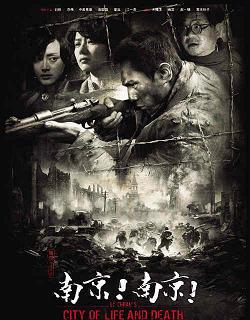
City of Life and Death (2009)


                “City of Life and Death” (also called “Nanking! Nanking!” or “Nanjing! Nanjing!”) is a Chinese movie about the Nanking Massacre (or as the Japanese called it – the Nanking Incident) of 1937.  It was written and directed by Lu Chuan.    He based it on The Rape of Nanking by Iris Chang.  He also used letters, diaries, and soldier interviews.    The film took four years from start to finish, including a year to be vetted by Chinese authorities.  It was a big box office hit.

                The movie is dedicated to “the 300,000 victims of the Nanking Massacre”.  Even before the credits roll there are some amazing visuals.  Japanese tanks attack the city walls.  Inside the city a mob of demoralized Chinese soldiers breaks through a human wall of their comrades to escape the city.  Refugees are also leaving the doomed city.  But not everyone gets out.  Some go to the Safety Zone created by a group of foreigners led by a German named John Rabe (John Pisley).  The Japanese have agreed to respect the Safety Zone as long as it contains no Chinese soldiers.  They apparently have not agreed to respect the Chinese women as their soldiers infiltrate to rape.  Minnie Vautrin (Beverly Pekous), an American missionary and head of the all-girl Ginling College, does her best to stop this.  Eventually, the Japanese demand 100 women to become “comfort women” (prostitutes in army brothels).  They also demand that all the disguised Chinese soldiers be turned over.  There are going to be a lot of executions.

                The movie covers both sides of the situation.  The main character is a Japanese soldier named Kadokawa (Nakaizumi Hideo).  He is greatly effected by what he witnesses and participates in.  He falls in love with a Japanese comfort woman named Yuriko (Miramoto Yuko).  He is counterbalanced by his commanding officer Ida (Khohata Ryu).  Their arcs will head in opposite directions.  The movie intercuts between Kadokawa, Ida, and their mates and  life in the Safety Zone.  Rabe, Vautrin, and other foreigners do their best to keep the refugees alive.  Rabe’s secretary Tang (Fan Wei) becomes a collaborator.  He is contrasted to the brave Miss Jiang (Gao Yuan Xuan) who risks her life to rescue Chinese soldiers.  The plight of the Chinese soldiers is represented by Shunzi (Zhao Yisui) and Xiaodouzi (Liu Bin).

                “City of Life and Death” is an amazing movie.  It has few flaws.  The acting is great and the characters are indelible.  They cover the gamut of people affected by the massacre.  Notably, there are some strong female characters.  They are not all victims.  Kadokawa has gotten the most press due to the perception that he is too sympathetic of a character given the actions of most Japanese soldiers.  Undoubtedly, there were some actual soldiers who responded to what they saw and participated in by having their humanity pricked, but to have the main character exemplify that small minority caused a lot of controversy.  Lu Chuan received death threats and there was talk of the movie being removed from theaters.  It was removed from consideration for Chinese movie awards.  I can see that point of view.  Kadokawa does dilute the horridness of what happened in Nanking.  But Lu does have a dastardly villain in Ida to represent the typical Japanese soldier.  If you look at post-war Japan, it could be argued that the movie’s depiction of the Japanese soldiers as succumbing to their based instincts is not unrealistic.  Lu claimed that he was influenced by “Schindler’s List” and I can see that. 
               
                Although not a combat movie, the film does have one outstanding combat scene in which Shunzi and Xiaodouzi’s unit ambushes a Japanese patrol.  The cinematography reminds of South Korean war movies.  Another memorable scene is when a prostitute named Xiaojiang (Jiang Yiyan) offers to be one of the 100 women the Japanese are “borrowing”.  The movie can be gut-wrenching and has a montage of a variety of executions (although the censors forbade inclusion of Japanese officers beheading civilians).  The rapes are more implied than graphic. 

                The script includes some historical persons like Rabe and Vautrin, but most of the characters are fictional.  Lu Chuan has done a good job of sticking to the historical facts.  It is not like there are no other movies on the Nanking Massacre.  “John Rabe” came out the same year and we have “The Flowers of War” from 2011.  This is the one to watch, however.  It tells the story in a very entertaining way.  As a history lesson, it is outstanding.

GRADE  =  A

HISTORICAL ACCURACY:  The Nanking Massacre took place in the Second Sino-Japanese War.  After capturing Shanghai, the Japanese army proceeded on to the Chinese capital.  The Chinese army put up little fight.  The walls were breached with artillery fire (not tank fire).  There were incidents where Chinese soldiers fought others trying to flee the city.  The movie is accurate in its depiction of the executions, looting, and rapes except that they were much worse.  The policy was known as the 3 Alls:  kill all, burn all, loot all.  It is estimated that between 40-300,000 Chinese were killed in six weeks.  The sets realistically depict the bombed out, deserted look to the city.  It downplays the looting, burning, and the corpses lying around.  15 of the 22 foreigners in the city set up the International Committee and created the Nanking Safety Zone.  Their leader was John Rabe.  Rabe was a German businessman and although a Nazi, he was against the Anti-Comintern Pact.  He was a Schindler-like figure.  The fact he was a German gave him cachet with the Japanese.  The International Committee agreed that no Chineses soldiers would be allowed in the zone.  They could not turn aside soldiers however and prayed that the fact they were unarmed would dissuade the Japanese. They were wrong.  As shown in the movie, the Japanese came in and checked hands for callouses. Undoubtedly some rickshaw drivers, carpenter, etc. were rounded up for execution.  The Japanese did allow family members to claim one arrestee each.  Many of the “soldiers” were executed along the banks of the Yangtze.  The Japanese did rape a lot of women in the safety zone and at one point came in to demand 100 comfort women.  Vautrin refused, but after 21 women volunteered, the Japanese were satisfied.  The films rendering of the comfort stations is accurate. 

Thursday, September 24, 2015

500th Post!!! City of Life and Death (2009)


               Believe it or not, this is my 500th post.  It is hard to believe I have reached this milestone.  It is especially hard to believe that there are still great war movies that I have not reviewed.  I would not bet against reaching my 1000th post at this rate.  Of course, that will mean watching a lot of crappy war movies.  I choose to post on a little known Chinese war movie because one of the most awesome facets of my blogging experience is it has forced me to broaden my cinema horizons.  I watched a lot of war movies since childhood, but never foreign ones and never ones with subtitles.   I had no idea what I was missing. 

            “City of Life and Death” is a Chinese war movie that is set in the Rape of Nanking during the Second Sino-Japanese War.  It was directed by Lu Chuan.  He also wrote the screenplay after reading many letters and diaries and interviewing Japanese veterans.  (He was surprised to find a lack of remorse as most of the soldiers excused their behavior as “everyone was doing it”.)  He was influenced by the book The Rape of Nanking by Iris Chang.  The movie had some trouble getting past Chinese censors and was heavily criticized by many in China for its sympathetic portrayal of its main Japanese character.

                A series of postcards gives background leading up to the Japanese assault on the capital city of Nanking in 1937.  The bombardment of the city walls and the subsequent entry of Japanese soldiers leads to widespread panic amongst the Chinese soldiers.  Thousands of refugees flee the city, but not everyone.  Private Kadokawa (Nakaizumi Hideo) is in a unit that encounters a large number of Chinese civilians in a church.  Kadokawa’s arc begins when he accidentally machine guns some Chinese women hiding in a confessional.  This will be the last accidental killing in this movie.

                Not all the Chinese soldiers behave like the modern Iraqi army.  A unit led by Lu Jianxiong ambushes Kadokawa and his mates.  The Chinese put up a desperate fight reminiscent of the British defense at the Arnhem bridge in “A Bridge Too Far”.  The combat is in the South Korean style as in “Tae Guk Gi” and it is a blast, literally.  Lu, Shunzi (Zhao Yisui) and a boy named Xiaodouzi (Liu Bin) are taken captive.  At this point the atrocities begin.  A montage depicts the variety employed by the Japanese – burying alive, machine gunning, burning alive in a building.  Chinese soldiers are herded to places of mass execution.  By pure luck Shunzi and Xiaodouzi survive and take refuge in the “Safety Zone”.

                The Safety Zone is an area of the city that the Japanese have reluctantly allowed the Chinese citizens to take refuge in.  The zone is run by the few foreigners still in the city.  They are led by a German businessman named John Rabe (John Paisley) and an American missionary named Minnie Vautrin (Beverly Peckous).  Rabe has some cachet with the Japanese authorities because he is a Nazi and the Japanese are in awe of their allies.  In spite of that, the Safety Zone is regularly visited by Japanese soldiers for raping.  When Rabe is recalled to Germany because of his politically incorrect humaneness, his secretary Tang (Fan Wei) makes a deal with the devil to save his family.  (Tang is another example of how war makes us do things out of character.)  This does not stop the Japanese from demanding women be provided for prostitution in “comfort stations”.  Not long after, the Japanese come to clean out the Chinese soldiers hiding in the zone.  This includes Shunzi and Xiaodouzi.
 
                The Rape of Nanking used to be a forgotten event in history.  In the last twenty years it has finally gotten its due coverage.  This was partly through Chang’s bestselling book, but also through movies like “John Rabe” (2009) and “The Flowers of War” (2011).  “City of Life and Death” is the culmination of this historical enlightening.  It is as good a tutorial as you will get without reading on the subject.  The Nanking Massacre was a six week period in 1937 after the city fell to the Japanese.  Chiang Kai-shek decided to withdraw most of the Chinese forces, leaving only a token defense force.  This force did not put up much of a fight and the city fell easily, although the campaign had been a surprisingly costly one for the Japanese army.  By the time the city succumbed, only about twenty foreigners remained in it.  Most of them became members of an International Committee that was put in charge of the Safety Zone which was in the western quarter of the city.  John Rabe was the acknowledged leader of the group.  The Japanese were led by Prince Asaka who had been assigned to Nanking by Hirohito to redeem himself for having a “poor attitude”.  He instituted a “kill the captives” policy.  (Asaka was exempted from war crimes trial after the war as part of MacArthur’s grant of immunity to the royal family.)  The Japanese agreed to stay out of the zone as long as there were no Chinese soldiers hiding there.  There were.  This does not excuse the frequent incursions to rape.  It is estimated that 20,000 Chinese women were raped during the time period.  Many of these rapes resulted in mutilations and death.  The movie brings some attention to the “comfort women” who were forced into sex slavery for the Japanese army.  Overall, it is estimated that between 40-300,000 Chinese were killed in Nanking.  Virtually every Chinese soldier that was captured was executed.  Most infamously, thousands were machine gunned along the banks of the Yangtze River.  The movie chronicles the variety of methods used.

                John Rabe and Minnie Vautrin are significant figures in the story.  Rabe has been likened to Oscar Schindler.  He is credited with saving as many as 250,000 Chinese.  Upon his recall to Germany, he tried to bring light to the inhumanity of the Japanese actions.  The Gestapo was having none of that and he was forced to keep silent.  Vautrin was a missionary/teacher who ran Ginling College which was within the Safety Zone.  She tirelessly worked to minimize the Japanese depredations on her students and Chinese civilians who took refuge there.  The stress was too much and she ended up committing suicide when she returned to America.  (Coincidentally, Chang also took her own life.)

                “City of Life and Death” is an amazing movie.  Don’t be scared away by its subtitles and black and white cinematography.  The black and white suits its bleak storyline.  Chuan felt the overabundance of the red from bloodshed would distract from the central theme.  That theme had to do with the dehumanizing nature of war.  Chuan came under much criticism for portraying the Japanese soldiers as regular joes corrupted by the stresses and stimuli of war.  When they are not committing atrocities, their behavior is normal.  Perhaps reflecting the nonremorseful attitudes Chuan discovered in his interviews.  Most of the backlash was related to the Kadokawa character.  He falls in love with a prostitute, shows empathy for a comfort woman, saves another from rape, and intervenes in the execution of Shunzi and Xiaodouzi.  He is the only Japanese character with a conscience, but as the framing device for the plot, one can understand the anger of some Chinese critics.  Chuan’s decision to blame the war for what motivated the Japanese soldiers is at odds with Chang’s take on the event.  She was criticized for the opposite.  Her book makes the case that the Japanese committed the atrocities because of their culture.  Based on my knowledge of military history, I lean towards Chang on this.  If I were Chinese, I would have been a little upset with the movie as well.  Chuan was being naïve and exculpatory.  Several armies went through more stressful and costly campaigns than the Japanese at Nanking without giving in to bestial passions on the unprecedented scale seen there.  This would be a good time to mention that the movie is harsh in its depiction of those atrocities and yet it comes nowhere near depicting them to their actual extent.

                As entertainment the film has no weaknesses.  The acting is outstanding by a great cast.  Most important, there are several strong female characters.  Most intriguing is the prostitute Xiaojiang (Jiang Yiyan) who refuses to cut her hair to hide her femininity and later is the first to volunteer to sacrifice herself as a comfort woman.  Hideo does a fine job as the conscience-stricken Kadokawa.  His transformation is subtle.  The cinematography is noteworthy.  There is some well-blended CGI in the opening assault on the city walls and the big battle scene is furious and exciting.  It comes early in the film, but there is no anti-climax in the rest of the story because there are several powerful scenes to come.  This is another similarity with “Schindler’s List”.  These scenes are allowed to take their time which is against recent trends in movies.  The score is understated, but effective.

                I have seen over two hundred war movies since starting this project.  When I finished reviewing the Greatest 100, people asked what I would do next.  I told them there were still many more movies to watch and I still had to compile my 100 Best list.  Currently I am reviewing movies that are worthy of consideration for that list.  I originally thought that if I had not seen the movie yet, it could not be that great.  I have been proven wrong several times already.  “City of Life and Death” is a good example.  It will definitely make my 100 Best War Movies.


GRADE  =  A