Showing posts with label Rape of Nanking. Show all posts

Wednesday, January 15, 2025

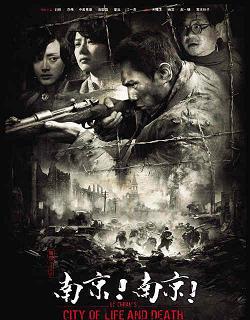
THE 100 BEST WAR MOVIES: 15. City of Life and Death (2009)


                “City of Life and Death” (also called “Nanking! Nanking!” or “Nanjing! Nanjing!”) is a Chinese movie about the Nanking Massacre (or as the Japanese called it – the Nanking Incident) of 1937.  It was written and directed by Lu Chuan.    He based it on The Rape of Nanking by Iris Chang.  He also used letters, diaries, and soldier interviews.    The film took four years from start to finish, including a year to be vetted by Chinese authorities.  It was a big box office hit.

            The movie is dedicated to “the 300,000 victims of the Nanking Massacre”.  Even before the credits roll there are some amazing visuals.  Japanese tanks attack the city walls.  Inside the city a mob of demoralized Chinese soldiers breaks through a human wall of their comrades to escape the city.  Refugees are also leaving the doomed city.  But not everyone gets out.  Some go to the Safety Zone created by a group of foreigners led by a German named John Rabe (John Pisley).  The Japanese have agreed to respect the Safety Zone as long as it contains no Chinese soldiers.  They apparently have not agreed to respect the Chinese women as their soldiers infiltrate to rape.  Minnie Vautrin (Beverly Pekous), an American missionary and head of the all-girl Ginling College, does her best to stop this.  Eventually, the Japanese demand 100 women to become “comfort women” (prostitutes in army brothels).  They also demand that all the disguised Chinese soldiers be turned over.  There are going to be a lot of executions.

            The movie covers both sides of the situation.  The main character is a Japanese soldier named Kadokawa (Nakaizumi Hideo).  He is greatly effected by what he witnesses and participates in.  He falls in love with a Japanese comfort woman named Yuriko (Miramoto Yuko).  He is counterbalanced by his commanding officer Ida (Khohata Ryu).  Their arcs will head in opposite directions.  The movie intercuts between Kadokawa, Ida, and their mates and  life in the Safety Zone.  Rabe, Vautrin, and other foreigners do their best to keep the refugees alive.  Rabe’s secretary Tang (Fan Wei) becomes a collaborator.  He is contrasted to the brave Miss Jiang (Gao Yuan Xuan) who risks her life to rescue Chinese soldiers.  The plight of the Chinese soldiers is represented by Shunzi (Zhao Yisui) and Xiaodouzi (Liu Bin).

ACTING:   A                

ACTION:   A+ (5/10) there’s just one scene but it is great

ACCURACY:  A

PLOT:  A                

REALISM:   A

CINEMATOGRAPHY:   A+

SCORE:   B

SCENE:  the combat scene

            “City of Life and Death” is an amazing movie.  It has few flaws.  The acting is great and the characters are indelible.  They cover the gamut of people effected by the massacre.  Notably, there are some strong female characters.  They are not all victims.  Kadokawa has gotten the most press due to the perception that he is too sympathetic of a character given the actions of most Japanese soldiers.  Undoubtedly, there were some actual soldiers who responded to what they saw and participated in by having their humanity pricked, but to have the main character exemplify that small minority caused a lot of controversy.  Lu Chuan received death threats and there was talk of the movie being removed from theaters.  It was removed from consideration for Chinese movie awards.  I can see that point of view.  Kadokawa is the only soldier who does not particapate in murder and rape.  Undoubtedly, there were some soldiers who retained their humanity, but as the movie shows, they were rare. The film shows how soldiers can be dehumanized by war. It also clearly depicts the power of peer pressure on young men. Lu Chuan includes scenes where the Japanese soldiers are not committing war crimes. Instead they are behaving like soldiers off the clock. The difference is jarring. How could these same men commit those atrocities. Lu does have a dastardly villain in Ida to represent the officers who not only condoned the actions, but encouraged them.  If you look at post-war Japan, you would think Kadokawa better represents Japan. The fact that Lu represented wartime Japan shows you how much the country changed after the war.            

            Although not a combat movie, the film does have one outstanding combat scene in which Shunzi and Xiaodouzi’s unit ambushes a Japanese patrol.  The cinematography reminds of South Korean war movies. Lu wisely filmed the movie in black and white. If a movie ever needed to be colorless, it’s this one. The camera puts us with the characters, which makes it even more impactful. The combat scene concludes the first 45 minutes which deal with the capture of the city. The rest of the movie focuses on the executions and the plight of those in the safety zoe.  Another memorable scene is when a prostitute named Xiaojiang (Jiang Yiyan) offers to be one of the 100 women the Japanese are “borrowing” as comfort women.  This is the best movie for learning about the women who were forced to be prostitutes. This did not happen just in Nanking. This policy has been swept under the rug in Japan. Sadly, many Japanese viewers would be learning of it for the first time. Not that many Japanese saw the movie. The movie can be gut-wrenching and has a montage of a variety of executions (although the censors forbade inclusion of Japanese officers beheading civilians).  The rapes are more implied than graphic. Believe it or not, the movie could have been more horrifying.   

            The script includes some historical persons like Rabe and Vautrin and several other characters are based on actual people, although they might be fictionalized in their portrayal.  Lu Chuan has done a good job of sticking to the historical facts.   It is not like there are no other movies on the Nanking Massacre.  “John Rabe” came out the same year and we have “The Flowers of War” from 2011.  This is the one to watch, however.  It tells the story in a very entertaining way.  As a history lesson, it is outstanding.

            I occasionally run across articles ranking the most horrific war movies. “Come and See” is on all those lists, but “City of Life and Death” is seldom included. I can make a case for it being harder to watch than “Come and See”. “City” has a similar scene to the church burning scene, plus much more killings. It also sacrifices several of the main characters. It has one individuals death that is shocking. More importantly, “C&S” ends with the satisfying decimation of the Nazi einsatzgruppen unit. There is no justice in “City”.

HISTORICAL ACCURACY:  The Nanking Massacre took place in the Second Sino-Japanese War.  After capturing Shanghai, the Japanese army pressed on to the Chinese capital.  The Chinese army put up little fight.  The walls were breached with artillery fire (not tank fire).  There were incidents where Chinese soldiers fought others trying to flee the city.  The movie is accurate in its depiction of the executions, looting, and rapes except that they were much worse.  The policy was known as the 3 Alls:  kill all, burn all, loot all.  It is estimated that between 40-300,000 Chinese were killed in six weeks.  The sets realistically depict the bombed out, deserted look to the city.  It downplays the looting, burning, and the corpses lying around.  15 of the 22 foreigners in the city set up the International Committee and created the Nanking Safety Zone.  Their leader was John Rabe.  Rabe was a German businessman and although a Nazi, he was against the Anti-Comintern Pact.  He was a Schindler-like figure.  The fact he was a German gave him cachet with the Japanese.  The International Committee agreed that no Chineses soldiers would be allowed in the zone.  They could not turn aside soldiers however and prayed that the fact they were unarmed would dissuade the Japanese. They were wrong.  As shown in the movie, the Japanese came in and checked hands for callouses. Undoubtedly some rickshaw drivers, carpenter, etc. were rounded up for execution.  The Japanese did allow family members to claim one arrestee each.  Many of the “soldiers” were executed along the banks of the Yangtze.  The Japanese did rape a lot of women in the safety zone and at one point came in to demand 100 comfort women.  Vautrin refused, but after 21 women volunteered, the Japanese were satisfied.  The films rendering of the comfort stations is accurate. 

Thursday, September 24, 2015

500th Post!!! City of Life and Death (2009)


               Believe it or not, this is my 500th post.  It is hard to believe I have reached this milestone.  It is especially hard to believe that there are still great war movies that I have not reviewed.  I would not bet against reaching my 1000th post at this rate.  Of course, that will mean watching a lot of crappy war movies.  I choose to post on a little known Chinese war movie because one of the most awesome facets of my blogging experience is it has forced me to broaden my cinema horizons.  I watched a lot of war movies since childhood, but never foreign ones and never ones with subtitles.   I had no idea what I was missing. 

            “City of Life and Death” is a Chinese war movie that is set in the Rape of Nanking during the Second Sino-Japanese War.  It was directed by Lu Chuan.  He also wrote the screenplay after reading many letters and diaries and interviewing Japanese veterans.  (He was surprised to find a lack of remorse as most of the soldiers excused their behavior as “everyone was doing it”.)  He was influenced by the book The Rape of Nanking by Iris Chang.  The movie had some trouble getting past Chinese censors and was heavily criticized by many in China for its sympathetic portrayal of its main Japanese character.

                A series of postcards gives background leading up to the Japanese assault on the capital city of Nanking in 1937.  The bombardment of the city walls and the subsequent entry of Japanese soldiers leads to widespread panic amongst the Chinese soldiers.  Thousands of refugees flee the city, but not everyone.  Private Kadokawa (Nakaizumi Hideo) is in a unit that encounters a large number of Chinese civilians in a church.  Kadokawa’s arc begins when he accidentally machine guns some Chinese women hiding in a confessional.  This will be the last accidental killing in this movie.

                Not all the Chinese soldiers behave like the modern Iraqi army.  A unit led by Lu Jianxiong ambushes Kadokawa and his mates.  The Chinese put up a desperate fight reminiscent of the British defense at the Arnhem bridge in “A Bridge Too Far”.  The combat is in the South Korean style as in “Tae Guk Gi” and it is a blast, literally.  Lu, Shunzi (Zhao Yisui) and a boy named Xiaodouzi (Liu Bin) are taken captive.  At this point the atrocities begin.  A montage depicts the variety employed by the Japanese – burying alive, machine gunning, burning alive in a building.  Chinese soldiers are herded to places of mass execution.  By pure luck Shunzi and Xiaodouzi survive and take refuge in the “Safety Zone”.

                The Safety Zone is an area of the city that the Japanese have reluctantly allowed the Chinese citizens to take refuge in.  The zone is run by the few foreigners still in the city.  They are led by a German businessman named John Rabe (John Paisley) and an American missionary named Minnie Vautrin (Beverly Peckous).  Rabe has some cachet with the Japanese authorities because he is a Nazi and the Japanese are in awe of their allies.  In spite of that, the Safety Zone is regularly visited by Japanese soldiers for raping.  When Rabe is recalled to Germany because of his politically incorrect humaneness, his secretary Tang (Fan Wei) makes a deal with the devil to save his family.  (Tang is another example of how war makes us do things out of character.)  This does not stop the Japanese from demanding women be provided for prostitution in “comfort stations”.  Not long after, the Japanese come to clean out the Chinese soldiers hiding in the zone.  This includes Shunzi and Xiaodouzi.
 
                The Rape of Nanking used to be a forgotten event in history.  In the last twenty years it has finally gotten its due coverage.  This was partly through Chang’s bestselling book, but also through movies like “John Rabe” (2009) and “The Flowers of War” (2011).  “City of Life and Death” is the culmination of this historical enlightening.  It is as good a tutorial as you will get without reading on the subject.  The Nanking Massacre was a six week period in 1937 after the city fell to the Japanese.  Chiang Kai-shek decided to withdraw most of the Chinese forces, leaving only a token defense force.  This force did not put up much of a fight and the city fell easily, although the campaign had been a surprisingly costly one for the Japanese army.  By the time the city succumbed, only about twenty foreigners remained in it.  Most of them became members of an International Committee that was put in charge of the Safety Zone which was in the western quarter of the city.  John Rabe was the acknowledged leader of the group.  The Japanese were led by Prince Asaka who had been assigned to Nanking by Hirohito to redeem himself for having a “poor attitude”.  He instituted a “kill the captives” policy.  (Asaka was exempted from war crimes trial after the war as part of MacArthur’s grant of immunity to the royal family.)  The Japanese agreed to stay out of the zone as long as there were no Chinese soldiers hiding there.  There were.  This does not excuse the frequent incursions to rape.  It is estimated that 20,000 Chinese women were raped during the time period.  Many of these rapes resulted in mutilations and death.  The movie brings some attention to the “comfort women” who were forced into sex slavery for the Japanese army.  Overall, it is estimated that between 40-300,000 Chinese were killed in Nanking.  Virtually every Chinese soldier that was captured was executed.  Most infamously, thousands were machine gunned along the banks of the Yangtze River.  The movie chronicles the variety of methods used.

                John Rabe and Minnie Vautrin are significant figures in the story.  Rabe has been likened to Oscar Schindler.  He is credited with saving as many as 250,000 Chinese.  Upon his recall to Germany, he tried to bring light to the inhumanity of the Japanese actions.  The Gestapo was having none of that and he was forced to keep silent.  Vautrin was a missionary/teacher who ran Ginling College which was within the Safety Zone.  She tirelessly worked to minimize the Japanese depredations on her students and Chinese civilians who took refuge there.  The stress was too much and she ended up committing suicide when she returned to America.  (Coincidentally, Chang also took her own life.)

                “City of Life and Death” is an amazing movie.  Don’t be scared away by its subtitles and black and white cinematography.  The black and white suits its bleak storyline.  Chuan felt the overabundance of the red from bloodshed would distract from the central theme.  That theme had to do with the dehumanizing nature of war.  Chuan came under much criticism for portraying the Japanese soldiers as regular joes corrupted by the stresses and stimuli of war.  When they are not committing atrocities, their behavior is normal.  Perhaps reflecting the nonremorseful attitudes Chuan discovered in his interviews.  Most of the backlash was related to the Kadokawa character.  He falls in love with a prostitute, shows empathy for a comfort woman, saves another from rape, and intervenes in the execution of Shunzi and Xiaodouzi.  He is the only Japanese character with a conscience, but as the framing device for the plot, one can understand the anger of some Chinese critics.  Chuan’s decision to blame the war for what motivated the Japanese soldiers is at odds with Chang’s take on the event.  She was criticized for the opposite.  Her book makes the case that the Japanese committed the atrocities because of their culture.  Based on my knowledge of military history, I lean towards Chang on this.  If I were Chinese, I would have been a little upset with the movie as well.  Chuan was being naïve and exculpatory.  Several armies went through more stressful and costly campaigns than the Japanese at Nanking without giving in to bestial passions on the unprecedented scale seen there.  This would be a good time to mention that the movie is harsh in its depiction of those atrocities and yet it comes nowhere near depicting them to their actual extent.

                As entertainment the film has no weaknesses.  The acting is outstanding by a great cast.  Most important, there are several strong female characters.  Most intriguing is the prostitute Xiaojiang (Jiang Yiyan) who refuses to cut her hair to hide her femininity and later is the first to volunteer to sacrifice herself as a comfort woman.  Hideo does a fine job as the conscience-stricken Kadokawa.  His transformation is subtle.  The cinematography is noteworthy.  There is some well-blended CGI in the opening assault on the city walls and the big battle scene is furious and exciting.  It comes early in the film, but there is no anti-climax in the rest of the story because there are several powerful scenes to come.  This is another similarity with “Schindler’s List”.  These scenes are allowed to take their time which is against recent trends in movies.  The score is understated, but effective.

                I have seen over two hundred war movies since starting this project.  When I finished reviewing the Greatest 100, people asked what I would do next.  I told them there were still many more movies to watch and I still had to compile my 100 Best list.  Currently I am reviewing movies that are worthy of consideration for that list.  I originally thought that if I had not seen the movie yet, it could not be that great.  I have been proven wrong several times already.  “City of Life and Death” is a good example.  It will definitely make my 100 Best War Movies.


GRADE  =  A

Wednesday, February 27, 2013

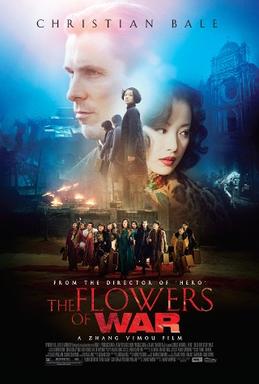
BOOK / MOVIE: The Flowers of War


                The Flowers of War is a novel by Geling Yan.  It is set in Nanking, China during the infamous “Rape of Nanking” in 1937.  Japanese soldiers have taken over the city and a multitude of atrocities are taking place.  The soldiers are killing, raping, and looting.  Thousands of Chinese civilians are targeted.  Corpses fill the streets.  No one is safe even in the “Safety Zone”.
                 Father Engelmann is an American priest who runs the St. Mary Magdalene mission.  He is sheltering around a dozen schoolgirls.  He is aided by his Deacon named Fabio.  His adopted “son” George is the simple-minded cook.  With gunshots ringing consistently on the outside, they pray that within the walls they will be safe.  Things get more complicated when they are joined by fourteen prostitutes and three Chinese soldiers.  The mission is now very dysfunctional.  The virginal, innocent girls are confronted by the crass sexuality of the whores.  There are several verbal and even physical confrontations between them.  Although some of the girls are orphans and from the lower class, part of the girl/whore dynamic involves culture clash.  The two groups are segregated with the girls in the attic and the whores in the cellar ( a bit heavy-handed in the symbolism ).  There is also the conflict between the pacifist Father Engelmann and the soldiers.  The Father insists the soldiers give up their arms in an attempt to keep the mission neutral, in case the Japanese come calling.
                The main character is one of the schoolgirls named Shujuan.  Her parents abandoned her and went to America.  She has issues.  The book develops several other characters.  The leader of the prostitutes is Yumo.  She is high-class and has the power to seduce any man.  She is the conscience of the whores and tries to keep them in line.  She becomes romantically involved with Major Dai – one of the soldiers who escaped the destruction of his command to take refuge in the mission.  The other two soldiers miraculously survived the mass slaughter of over 5,000 prisoners.  The flashback is one of the most memorable of the novel.
                It’s just a matter of time before the war finds them.  Meanwhile, there are problems with the lack of food and water.  As time passes, the girls and the prostitutes thaw toward each other.  Shujuan spends time watching them through a ventilation shaft.  It’s eye-opening, but even more ear-opening. 
                All good things must come to an end, however.  Japanese soldiers arrive and find the three soldiers.  The Japanese are thuggish and brutal.  Father Engelmann tries to stand up to them, but it is hopeless.  None of the trio survives, but the females are undiscovered.  For now.  Someone rats out the girls and the Japanese return for them.  Father Engelmann is told they are wanted for entertainment at a party.  He does not fall for that old one and manages to delay the abduction.  The solution is simple math and involves the suddenly altruistic prostitutes. 
                The novel is surprisingly good.  Yan writes well with few frills.  The plot is not complicated, but it is not predictable (except for the solution to the dilemma).  The back-stories are interesting.  The characters are appealingly drawn and you care about them.  Father Engelmann starts off as priestily naïve about the Japanese, but he evolves into a hero.  Yumo is the stereotypical prostitute with a heart of gold, but she balances the whores with mouths of potty.  Shujuan connects them together well.  Yan writes teenage girl realistically.  The main flaw is the implausibility of the conclusion.  Yan definitely stretches credulity, but I have to admit it was satisfying.
                The movie “The Flowers of War” was released in 2011 and was directed by Zhang Yimou with a huge budget.  He used part of the funds to hire Christian Bale to play the main character – American mortician John Miller.  A Chinese film with an American hero, imagine that.  The movie was a major hit in China and went on to become the top grossing movie in Chinese history.  It was nominated for several awards, but was not a favorite of critics.  Although Geling Yan helped with the screenplay, the plot is very different than the novel.
                In the movie, the schoolgirls and Miller arrive at the mission after running through the chaotic streets.  Father Engelmann is already dead and only George is there.  Miller is the stereotypical Yank – crass, money-hungry, alcohol-loving.  He is in need of redemption, naturally.  The prostitutes arrive soon after.  They are basically as depicted in the book.  Since the version I watched lacked subtitles, I can only assume their dialogue was similar to the book.  A stunning beauty named Ni Ni plays Yumo.  Miller hits on her in an embarrassing way.  “There’s no coffee. Let’s get liquored up”.  (A line not taken from the book.)  Major Li (the movie combines Major Dai and Sergeant Li) arrives with the wounded young soldier,  followed shortly by rampaging Japanese vermin who chase the girls all over the mission with rape on their minds.  The Japanese are distracted by a sniping Li and charge off to go 40 on 1.  Li is a Chinese Rambo and takes most (if not all) of them with him in a scene full of “Tae Guk Ri” spectacle with ridiculous explosions.  The scene is cathartic and officially makes the movie a war movie, but is nowhere in the book.
                Miller decides to assume the role of a priest.  He shaves his scraggly beard and hits the redemption road.  A new group of Japanese arrive led by the cultural (and seemingly human) Col. Hasegawa.  He apologizes for the previous group and promises to return to hear the girls sing.  He puts guards around the mission.  Two of the whores manage to sneak out to get some more pipa strings and to help advance the plot in two ways.  First, Miller meets a friend who encourages him to escape.  No thanks, I want to go to Heaven by continuing to masquerade as a priest.  Second, we get another frenetic chase scene culminating with a horrific glimpse at what will be in store for the girls if they fall into Japanese hands.  This scene was briefly mentioned in the epilogue of the book.
                After the girls sing angelically for Hasegawa, he “invites” them to perform at a military celebration.  Nothing to worry about.  And yet…  The girls climb to the top of the tower to commit suicide and are only dissuaded when Yumo and the other prostitutes offer to take their places.  Lucky thing Miller is a mortician who can make whores look like virginal thirteen year olds!  Unfortunately, there are thirteen girls and only twelve whores.  (This math problem does not appear in the novel.)  Someone needs to volunteer to become Georgette.
                I have posited in the past that movies based on books can and should be better than their source material.  And I would argue that a majority are.  This movie does not fit my theory.  One major inferiority is the Miller character.  If ever a character was shoe-horned into a movie, this one is.  He is nowhere to be found in the book and replaces the superior Father Engelmann.  The pre-redemption personality is cringe-worthy and the redemption is cliché.  The other huge flaw is the obvious attempt to add “explosions” literally and figuratively.  The director and screenwriter (the non-Yan one) must have found the book boring.  They added three action scenes and subtracted the mundane lack of food and water aspects.  The movie sacrifices realism for pizzaz.  Check out the prostitutes’ hair.
                Caroline (Beauty is a Sleeping Cat’s “Literature and War Readalong”) suggested that if we did not read the book, we could substitute the movie.  Not a good suggestion.  The movie is radically different from the book.  Where the book has an implausible ending, the movie is rife with implausibilities.  However, the movie does have its strengths.  The acting is good, except for pre-priest Bale.  The Shijuan and Yumo characters are well-played and accurately reflect the novel.  Both the girls and the prostitutes are fine (I guess, since I could not understand a word they were saying).  The movie is visually stunning.  The cinematography pulls out all the bells and whistles (hand-held, slo-mo, low angle, etc.)  The combat is reminiscent of Korean war films like “Tae Guk Ri”.  Watch out for flying debris!
                In conclusion, definitely read the book and if you get a chance and have Netflix Instant, watch the movie.  Make sure you do it in that order!
 
Book =  B+
Movie =  C+
 
the trailer
 
the full movie