SYNOPSIS:“Kagemusha” means “shadow warrior” and refers
to the practice of some Japanese daimyo of having doubles for security. The
movie is set in the same Sengoku (Warring States) period that “The Seven Samurai” was set
in. A shogun wannabe has a double who is a petty thief. When the daimyo
(Tatsuya Nakadai, who also plays the thief) is assassinated, the kagemusha
takes his place and has to deal with two lords who are at war with him.The movie climaxes in an epic battle.
BACK-STORY: Many feel that “Kagemusha” is Akira
Kurosawa’s greatest masterpiece. He certainly
meant for it to be. He got the idea for a samurai epic years before but career
setbacks (like being fired from “Tora! Tora!
Tora!”) and funding issues set things back and
the film almost did not get made.It
ended up being the biggest budget Japanese movie up until then.It was nominated for the Oscar for Best
Foreign Language Film (losing to “Moscow Does Not Believe in Tears”). Kurosawa
won the BAFTA for Direction.It won the
Palme D’Or at the 1980 Cannes Film Festival.
TRIVIA: Wikipedia, imdb
1. It is an example of a genre called
“jidaigeki”. These are period films set
in the Edo Period (1603-1868). These
types of movies usually concentrated on the lives of samurai, farmers,
craftsmen, and merchants. A subgenre is
called “chambara” which means “sword fight”.
Movies like “Kagemusha” have similar make-up, language, catch phrases
(e.g., “Fires and brawls are the flower of Edo”) and plotlines.
2. Technically, “Kagemusha” is pre-Edo, but it certainly
fits the genre.
3. George Lucas and Francis Ford Coppola were credited as
executive producers because when Toho Studios could not finish the funding for
the film, they convinced 20th Century Fox to put up the rest of the
money.Lucas and Coppola were big
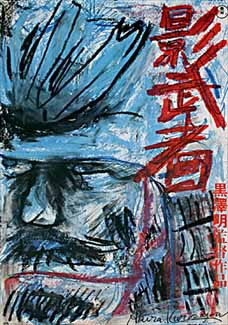
Kurosawa fans and were blown away by his personally painted story-boards for
the film.20th Century Fox
got the international distribution rights, which was the first time an American
studio distributed a Japanese film.
4. Part of the expense for the movie was Kurosawa bringing
in two hundred specially trained horses from America.Many of the horses were ridden by expert
female riders.
5. Originally Shintaro Katsu was to play the main role, but
he was fired when he showed up on set with a camera crew to film Kurosawa’s
methods for a film class he taught.Kurosawa brought in Nakadai because he had worked with him many
times.Nakadai took the role without even
reading the script.
6. Kurosawa used 5,000 extras in the final battle.
7. Much of the costumes and armor were borrowed from
museums.
8. The final battle is the Battle of Nagashino (1575).
9. No female
appears in the movie until the 73rd minute.
Belle and Blade=N/A
Brassey’s=4.0
Video Hound=N/A
War Movies=N/A
Military History=#34
Channel 4=no
Film Site=no
101 War Movies=yes
Rotten Tomatoes=no
CONCLUSION: Not being an American
director or professional movie critic, I feel I can impartially rule that “Kagemusha” is
overrated. I can see why they fawn over it, but as an average viewer it is
too long and boring. There is way too much talking (and yelling) and not enough
action. There are big buildups to the battles and then little pay-off. Even the
final battle is brief. It does not belong on this list and is inferior to “Seven Samurai” (which did
not make the list).
BACK-STORY:Many feel that “Kagemusha” is Akira
Kurosawa’s greatest masterpiece.He
certainly meant for it to be.He got the
idea for a samurai epic years before but career setbacks (like being fired from "Tora! Tora! Tora!") and funding issues set things back and the film almost did
not get made.In fact, it was only
intervention by fans Francis Ford Coppola and George Lucas that provided the
extra funding needed to put the movie over the top (and to help pay for stuff
like importing 200 American horses including numerous female equestrian riders).Those two incredibly hot directors were blown
away by the story board paintings Kurosawa did himself to outline the
film. It was nominated for the Oscar for Best Foreign Language Film.Kurosawa won the BAFTA for Direction.
OPENING:“Kagemusha” means “shadow warrior” and
refers to the practice of some Japanese daimyo of having doubles for
security.The movie is set in the same
Sengoku (Warring States) period that “The Seven Samurai” was set in.A shogun wannabe named Shingen (Tatsuya
Nakedai) who is the head of the Takeda clan is introduced to his new kagemusha by
his brother.The double is a petty thief
who is due to be crucified and he is a loose cannon, but he does look exactly
like Shingen so he gets the job.
SUMMARY:The year is 1574 and Shingen is in a
civil war with two other warlords – Tokugawa Ieyasu and Oda Nobunaga.He lays siege to Ieyasu’s castle and gets
shot by a sniper while listening to a flute player in the castle.The arquebusier reenacts the shooting for
Ieyasu, but it’s unclear who he hit.Shingen is badly wounded so he lifts the siege and withdraws.His subsequent death results in the council’s
risky decision to substitute the thief for him.
Ieyasu and
Oda send a trio of spies to confirm the rumors that Shingen is dead.When the thief discovers Shingen’s corpse, he
wants out and the council agrees to set him free.The thief witnesses the spies seeing the
burial of Shingen in a big jar in a foggy lake.He overhears them planning to return to their employers with the strong
circumstantial evidence that Shingen is dead.Because Shingen was a good boss and refrained from crucifying him, the
thief offers to masquerade as him.
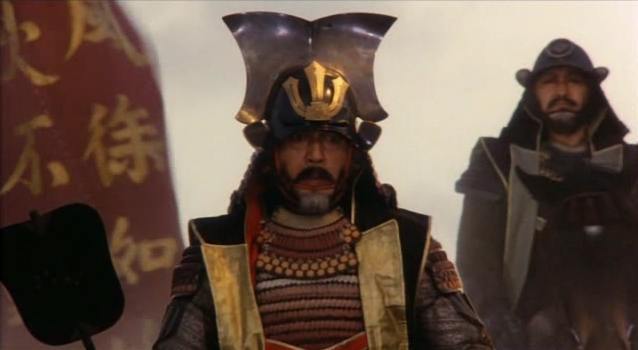
the kagemusha watches a battle
the dream
The first big
test will be whether the kagemusha can fool Shingen’s little grandson and his
concubines.Don’t even think about
fooling his horse!At first the grandson
smells a rat, but he is quickly convinced that people change.The five concubines should be a bigger
problem, but the shadow warrior convinces them he is now gay.Just kidding.Actually, he tells them the truth and they laugh it off (which happens
to be their response behind closed doors as well, just kidding).He begins to take on the persona of Shingen
and bonds with the grandson.All the intense dialogue (the
Japanese like to yell at each other) causes the shadow warrior to have a
surrealistic dream so Kurosawa can share his story boarding with the world.
Shingen’s son
Katsuyori wants to prove himself by expanding the Takeda holdings.He has daddy issues.For unclear reasons, Shingen had disinherited
him in favor of the grandson.Kurosawa
reenacts the Battle of Taketenjin Castle.There are lots of banners fluttering.This is a windy movie.There is
lots of musket firing.There is lots of
repetitive riding and running back and forth.There is not lots of fighting.The audience gets to experience the fog of war as Kurosawa presents it
as very confusing (and unfortunately boring).
The kagemusha gets cocky because he inspired his troops to victory (I assume it was a victory) by watching the battle from a stool and tries to
ride the horse with disastrous consequences. You can fool a concubine, but not a horse.Now the gig is up and he is expelled from the castle.
CLOSING:Katsuyori (against the council’s
blustery advice) decides to preempt his rivals by laying siege to a castle at
Nagashino.The kagemusha tags along.He has developed a loyalty to the Takeda clan
that is unrealistic.Ieyasu and Nobunaga
arrive with a relief army.Here comes
the big set piece!The enemy is behind a
palisade.Katsuyori’s cavalry
charges.The musketeers fire
volleys.Pikemen charge.Musketeers fire volleys.More cavalry.More musket fire.Based on the
reaction of the commanders and the shadow warrior, things are not going
well.A scan of the corpse strewn field
with its writhing horses confirms this assumption.The thief grabs a spear and charges to his
death.
RATINGS:
Acting
-7
Action
-6
Accuracy
-8
Realism
-7
Plot
-7
Overall -7
WOULD
CHICKS DIG IT?Possibly.It is not a hard core war flick.It’s more of a drama with some battle scenes
that leave much to the imagination.However, there are few female characters and none of importance.
HISTORICAL
ACCURACY:The
movie is set in the Sengoku (Warring States) period of Japanese history.Specifically the Azuchi-Momoyama period which
was the last stage.It began in 1568
when Nobunaga entered Kyoto (the imperial capital) to install Ashikaga Yoshiaki
as the last shogun of the Ashikaga shogunate.It ended with Ieyasu’s victory over the Yoyotomi clan at the Battle of
Sekigahara in 1600 and his subsequent establishment of the Tokugawa Shogunate
in 1603.
Takeda
Shingen was a daimyo who warred against Nobunaga and Ieyasu.He was one tough dude with a lot of charisma.The use of doubles was not unknown for
daimyos, but the story of the thief is pure fiction. His banner (which is featured in the movie)
had the symbols for wind, forest, fire, and mountain.This was based on a summary of Sun Tzu’s
advice in The Art of War.“Swift
as the wind, Silent as a Forest, Fierce as a Fire, Immovable as a Mountain”.His cavalry charges were famous and feared.Kurosawa opens the movie with one of the
theories on his death – shot by a sniper during a siege.The other possibilities were from an old war wound
or from pneumonia.Good choice,
Akira.He was buried in a temple, not in
a giant pot in a lake.
Katsuyori is
an historical figure.He was
disinherited by Shingen, but I could not find out why.He was accurately portrayed as desiring to
expand the Takeda lands with bad results which ended in his suicide and the end
of the Takeda clan.He was no Alexander
to Shingen’s Philip.
Oda Nobunaga
and Tokugawa Ieyasu were very famous daimyos.At the time of the movie, they are accurately depicted as allies.
The Battle of
Nagashino was one of the most famous battles in Japanese history.It has been called the first “modern” battle
in Japanese history.The movie gets the
general facts right.Katsuyori was
besieging Nagashino castle.Ieyasu and
Nobunaga sent a relief force of 38,000 which included 3,000 arquebusiers.Katsuyori had only 12,000 which was about 1/3
cavalry.He did have the vaunted Takeda
cavalry, however.Unfortunately,
Nobunaga was aware of that and ready.His army had a large number of arquebusiers armed with matchlock
muskets.He stationed them behind a
palisade and they were trained to fire in rotating rows of three.This type of volley firing predated similar
tactics in Europe by twenty five years.Kurosawa decided not to add the stream with steep banks to make the
charge even more futile.
Katsuyori, no
military genius, determined that a frontal charge by his cavalry would stampede
his opponents.He did not reckon with
the discipline of the enemy ashigaru (foot soldiers) or the rolling volleys.The gunfire was devastating.To cover the reloading intervals, Nobunaga
had archers raining arrows on Katsuyori’s forces.Subsequent charges produced similar
results.The battle resembled the Battle
of Crecy in its missile fire defeating shock aspects. Reversing centuries of military wisdom, he
then sent in his infantry.The pikemen
tried stabbing through the palisade, but also ate a lot of bullets.The samurai waded in with swords and
spears.The samurai did not make it into
the film which is odd considering Kurosawa’s association with samurai.Pity, that would have been some added action
in a film that could have used it.
The little
touches are accurate.The castle
interiors and costumery are realistic.There is a brief Noh performance so we get a taste of some Japanese
culture.At one point, one of the allies
breaks into a song when he hears of Shingen’s death. Only in Japan.
CRITIQUE:Kurosawa has a style that can be
mesmerizing.The interior scenes tend to
be static, the exterior scenes dynamic.The indoor shots are usually from a stationary camera.He uses windiness to add to the flow of the
exterior scenes.The wind also helps the
banners flutter.There are a lot of
banners in this movie.Kurosawa is also
preoccupied with colors.They are either
vibrant or bland.
The acting is
not as scene-chewing as most Japanese movies, but could be off-putting to
some.It may be part of their culture,
but there seems to be a lot of simmering outrage in the characters. They
commonly have a difficult time modulating their voices.Nakadei is no Toshiro Mifune, but he does a
good job in the dual roles.He can be
silly at times which is natural for a Japanese film of this type.The supporting cast is solid.
The plot is
linear.It is fairly standard in its arc.You do get the bizarre dream sequence, but
that is the only unorthodox scene.The
film does flesh out the basic outlines of a historical story with logical human
actions for the most part.After all
there were kagemusha.It’s a bit of a
stretch that a condemned thief would be chosen and then continued post mortem,
but it makes for good story telling.This aids the twin themes of identifying with your employer and you
can’t fool people forever.You have to
stretch your credulity to believe that an intellectually challenged thief could
pull off the impersonation and that he would remain loyal to the death after
being ignominiously ejected from his faux family.
CONCLUSION:Not being an American director or professional
movie critic I feel I can impartially rule that “Kagemusha” is overrated.I can see why the above fawn over it, but as
an average viewer it is too long and boring.There is way too much talking (and yelling) and not enough action.There are big buildups to the battles and
then little pay-off.Even the final
battle is brief.It does not belong on
the Greatest 100 list and is inferior to “Seven Samurai” ( which did not make
the list). It is also not as good as #76 "Ran". It is a must-see, however.
THE POSTER - This is a cool one because it is one of Kurosawa's drawings. Doesn't give you any idea what the movie is about. Grade - B
the trailer
THE TRAILER - Pretty good at showing the action, but not all the talking. Grade - C