Showing posts with label The Life and Death of Colonel Blimp. Show all posts

Thursday, November 5, 2020

CONSENSUS #19. The Life and Death of Colonel Blimp (1943)


SUMMARY: This very British film follows Clive Wynne-Candy (Roger Livesey) from dashing young British soldier through WWI-weary general to doddering old Home Guard commander in WWII Britain. Along the way he has significant relationships with a German officer and three consecutive women (all played by Deborah Kerr). His play fair philosophy becomes outdated when the British face the Nazi threat.

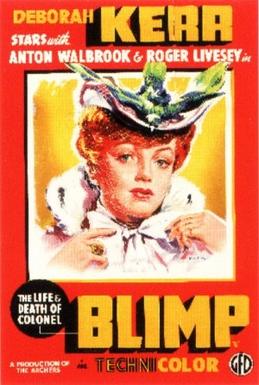
BACK-STORY: “The Life and Death of Colonel Blimp” was released in 1943 and was directed by the legendary team of Michael Powell and Emeric Pressburger (The Archers). They also directed the respected “49th Parallel”. It was the most expensive British movie made up until then. The movie was shot in vibrant Technicolor. It is about as British as you can get. Although the movie is usually said to be inspired by the comic strip character, in fact the idea came from a scene cut from The Archers’ previous film (“One of Our Aircraft is Missing”). A character says “You don’t know what it’s like to be old”. Film editor and future great director David Lean suggested a movie be constructed around that line.

Interestingly, Churchill tried to stop the film and did not allow the British military to cooperate. He felt it perpetuated the stereotype of Blimp-like British officers. Some suggest he was standing up for his peer group. The film went through anyway, but did not do well mainly because the British public in 1943 was not keen on a sympathetic German character.

TRIVIA:  Wikipedia


1.  The title comes from the comic strip, but the idea came from a line in Pressburger and Powell’s previous film, “One of Our Aircraft Is Missing”.  An old man says “You don’t know what it’s like to be old”.


2.  Winston Churchill hated the premise of the film and tried to get it stopped.  He may have seen Blimp as a parody of himself.  He loathed the idea of a movie perpetuating the image of a Blimp-style officer.  He prevented any kind of military cooperation, but Pressburger/Powell claimed that had enough connections to “steal” what they needed. 


3.  The producers wanted Laurence Olivier to play Candy, but Churchill caused the Fleet Air Arm to refuse to release him from active duty.


4.  The movie was not seen in the U.S. until 1945 because Churchill put an export ban on the film.


Belle and Blade  =  N/A

Brassey’s              =  5.0

Video Hound       =  N/A

War Movies         =  N/A

Military History  =  #87

Channel 4             =  #72

Film Site                =  yes

101 War Movies  =  no

Rotten Tomatoes  =  #29 


ACCURACY: The movie is fictional, so historical accuracy is not really an issue. The one possible inaccuracy that stands out is – would the Home Guard have been practicing to repel an invasion as late as 1943? I doubt it, but it is possible. There were Germans who fled because they disagreed with the direction the Nazis were taking Germany, so Theo’s immigration to England is plausible. I am sure there was a debate in England of how dirty to fight the Nazis. Obviously, the dirty-fighters won that argument as the movie implies by Candy’s fall from grace.

OPINION: This movie has caused me some soul-searching. As a war movie lover, I have assumed that I know a good war movie when I see one. Granted, I did not go to film school, but I am intelligent and have seen many war movies. So why don’t I “get” this movie? I actually read a critic saying this is the greatest British movie ever made.

This movie is not a
“masterpiece”. At least it would certainly not seem so to an American audience. I doubt many Englishmen under age 50 would argue that it is. It’s not really a war movie. It is more of a social satire. It is a period piece. Blimp represents the snobby, uppercrust British officer class. In fact, you need to be British to get a lot of the cultural references (and to understand some of the slang). Most Americans will not “get” this movie. Our officer class has not been traditionally from the nobility, so most would not recognize Blimp as a stereotype.

With that said, it is not a bad movie. It is interesting to see the evolution of Candy from a young, impetuous lieutenant to an old, moss-backed general. However, some of this character evolution does not seem realistic. His pre-WWII sentiments of fair play belie his apparent conduct in WWI. The movie is well-acted, especially by Walbrook, but even his character contradicts himself. The first half of the movie moves along briskly, but after the trio breaks up it goes downhill. It is also a good example of a propaganda film with the message being that England should not be required to fight fairly against the Nazis. Give "The Archers" credit for having a sympathetic main character argue for the opposite. (The city of Dresden can tell you which argument won.) There are references to German atrocities in WWI and the stated fact that the British were the good guys in the war, albeit naively good. There is some humor, but it is very British.

My main complaint is the flashing back and forward skips over what should have been the most interesting parts of the movie. I know critics will chastise me for wanting to see the duel, but who
’
s with me on this? We watch the negotiations for the duel, but not the duel itself? Are you kidding me?! I know you might want to leave something to the imagination, but when the actual scenes are action-free, why not substitute a scene that shows what Candy was doing from 1914-1917?

Oh, and by the way, for an alleged comedy, it ain't funny!

In conclusion, I don’t see why critics love this movie.  It is not a great movie and certainly is not a great war movie.  It infuriates me that it is ranked higher than a movie like “The Great Escape”.  But that is just one example of one movie.    There are many that are superior and yet ranked lower, or not at all.  Due to the methodology of this list, it is clearly overrated because the only book that reviews it gave it 5 stars.   It pains me that my system allowed it to get to #19, but it does prove beyond a shadow of a doubt that this list is not my opinion. 

Saturday, October 2, 2010

#87 - The Life and Death of Colonel Blimp


BACK-STORY: “The Life and Death of Colonel Blimp” was released in 1943 and was directed by the legendary team of Michael Powell and Emeric Pressburger (The Archers). They also directed the respected “49th Parallel”. It was the most expensive British movie made up until then. The movie was shot in vibrant Technicolor. It is about as British as you can get. Although the movie is usually said to be inspired by the comic strip character, in fact the idea came from a scene cut from The Archers’ previous film (“One of Our Aircraft is Missing”). A character says “You don’t know what it’s like to be old”. Film editor and future great director David Lean suggested a movie be constructed around that line.

            Interestingly, Churchill tried to stop the film and did not allow the British military to cooperate. He felt it perpetuated the stereotype of Blimp-like British officers. Some suggest he was standing up for his peer group. The film went through anyway, but did not do well mainly because the British public in 1943 was not keen on the sympathetic German character that appears in the film.

OPENING SCENE: The film opens with a motorcycle messenger arriving at headquarters. The orders are to prepare for a pre-invasion practice. The commander decides to pre-empt the defense by attacking early. The cheating leader captures the elderly Gen. Candy (Robert Livesey) at a steam-bath to make the point that the enemy does not play by the rules (a theme that will return later). Candy blubbers that “the war starts at midnight!” The young officer (a younger version of Candy) insults Candy for being old and orthodox. Candy punches him and they fall in the pool.

SUMMARY: The movie flashes back to 1902. Clive Candy has just returned from the Boer War with a Victoria’s Cross. He goes off to Berlin to confront a spy who is spreading lies about British atrocities in South Africa. He meets Edith Hunter (Deborah Kerr), whose letter had encouraged him to come to Berlin to confront the scoundrel. At a restaurant, Candy punches the villain and insults the German army resulting in a duel with a German officer named Theodor Kretschmar-Schuldorff (Anton Walbrook). But first the diplomats have to negotiate the rules of the duel using a handbook in a scene which reveals the ridiculous formality of dueling. We are all set up for a rousing sword fight when the movie inexplicably cuts away. Boo!! (Oops, bravo – leave it to our imagination. Genius!)

this is a s far as we get

Theo, Edith, and Clive

Candy ends up in a hospital along with Theodor. They become friends, naturally. Edith hangs out with them and Theodor falls in love with her. Candy gives his hearty approval, but later realizes he is in love with her. Too late. Time passes by (1903-1914) by way of the interesting technique of showing the accumulation of big game animal heads on the wall of Candy’s study.

Next we are in 1918 Flanders. Candy is a general, but we do not know what he has been doing thus far in the war. He arrives at headquarters in appropriately nasty weather. The sound stages are nicely done, but still fake looking. In a dugout, Candy looks the other way while his men mistreat German prisoners to get information. This contradicts his “fight fairly” philosophy.

We flash forward to Candy’s country estate after the war. He is married to Barbara, a woman with a remarkable resemblance to Edith (maybe because she is also played by Kerr). This comes off as a bit creepy. He and Mrs. Candy go to visit Theo in a prison camp, but Theo shuns them. Later, Theo apologizes and dines with them. They assure Theo that England will deal fairly with Germany. On his trip home, Theo gloats that the British are wimps and implies that Germany will come back because of British naivete. This emotion is out of character for him. It should have been played with head shaking, not lip curling.

The years pass by way of a flipping photo album. Barbara has passed away. How? Who cares, apparently. It is now 1935 and Theo is trying to enter England as a political refugee. (Edith has died, ditto.) Apparently when he gloated about the comeback of Germany, he thought it would be done by sophisticates like him, not by Nazis. Candy arrives to vouch for him and takes him home. Theo can’t help but notice that the portrait of Barbara (on the wall near his trophy heads – get it?) looks like his Edith. They now realize why Edith/Barbara would disappear every other week – just kidding. He is doubly amused by the fact that Candy’s driver Angela Cannon (who he picked from 700 potentials) looks like Edith and Barbara. She is also played by Kerr (who was chosen from 700 actresses to play Cannon).

General Candy of the Home Guard
Candy has a radio speech gig, but it is cancelled at the last minute because the powers that be find out his theme is going to be that England should fight fair. (Apparently he has forgotten his role in the prisoner interrogation.) Theo had tried to warn him by pointing out that England “lost” the Great War (huh?) because it behaved like gentlemen and allowed Germany to rise again. He is forced into retirement, but returns to command part of the Home Guard. He should have stayed retired .


FINAL SCENE: We come full circle to the opening. Candy humiliates himself in the Turkish bath and realizes that time has passed him by.  There is no room for good sports in this war.  He, Theo, and Angela salute a group of the Home Guard as it marches by. Clive and Theo then have wild sex with Edith/Barbara/Angela.

RATINGS:

Action - N/A

Acting - 8

Accuracy - 7

Realism – 5

Plot – 6

Overall – 5

WOULD CHICKS DIG IT? Some women might like this movie. (Not if they look like Deborah Kerr). Possibly even some non-British women. Kerr is a great actress and her characters are strong, although you have to wonder if Barbara knew about Edith when she married a man 20 years older than her. Discuss the creepiness factor with your significant other after viewing. The story is interesting and no need to worry about any graphic violence, or any other action, for that matter.

CRITIQUE: This movie has caused me some soul-searching. As a war movie lover, I have assumed that I know a good war movie when I see one. Granted, I did not go to film school, but I am intelligent and have seen many war movies. So why don’t I “get” this movie? I actually read a critic saying this is the greatest British movie ever made. If I believe he is right, I need to stop reviewing war films because I am embarrassing myself. Fortunately, I have high enough self-esteem to feel I can represent the layman war movie lover and speak to the average viewer. So here goes.

This movie is not a “masterpiece”. At least it would certainly not seem so to an American audience. I doubt many Englishmen under age 50 would argue that it is. It’s not really a war movie. It is more of a social satire. It is a period piece. Blimp represents the snobby, uppercrust British officer class. Our officer class has not been traditionally from the nobility, so most would not recognize Blimp as a stereotype. In fact, you need to be British to get a lot of the cultural references (and to understand some of the slang). Most Americans will not “get” this movie.  I could not get ten minutes into this film before my Military History class would be begging to be euthanized.

With that said, it is not a bad movie. It is interesting to see the evolution of Candy from a young, impetuous lieutenant to an old, moss-backed general. However some of this character evolution does not seem realistic. His pre-WWII sentiments of fair play belie his apparent conduct in WWI. The movie is well-acted, especially by Walbrook, but even his character contradicts himself. The first half of the movie moves along briskly, but after the trio breaks up it goes downhill. It is also a good example of a propaganda film with the message being that England should not be required to fight fairly against the Nazis. Give The Archers credit for having a sympathetic main character argue for the opposite. (The city of Dresden can tell you which argument won). There are references to German atrocities in WWI and the stated fact that the British were the good guys in the war, albeit naively good. There is some humor, but it is very British.

            My main complaint is the flashing back and forward skips over what should have been the most interesting parts of the movie. I know critics will chastise me for wanting to see the duel, but who’s with me on this? We watch the negotiations for the duel, but not the duel itself? Are you kidding me?! I know you might want to leave something to the imagination, but when the actual scenes are action-free, why not substitute a scene that shows what Candy was doing from 1914-1917?

ACCURACY: The movie is fictional, so historical accuracy is not really an issue. The one possible inaccuracy that stands out is – would the Home Guard have been practicing to repel an invasion as late as 1943? I doubt it, but it is possible. There were Germans who fled because they disagreed with the direction the Nazis were taking Germany, so Theo’s immigration to England is plausible. I am sure there was a debate in England of how dirty to fight the Nazis. Obviously, the dirty-fighters won that argument as the movie implies by Candy’s fall from grace.

CONCLUSION: It should be obvious that I do not think “Blimp” belongs in the Top 100. I just watched “In Which We Served”, another British WWII movie, which is much superior to it in every way and probably will make my 100. I am not an Anglophobe, quite the opposite, old chap. However, I feel compelled to point out that in the case of “The Life and Death of Colonel Blimp”, the emperor has little clothes.

Watch it for yourself and choose a sideline to be on – the professional critics or the common sense war movie lovers. See you on my side! You British viewers get a pass on this one. It’s okay for you to love it.