I
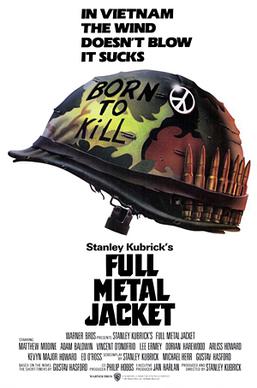
recently reviewed “Full Metal Jacket” and then read the book it’s based on
(again). The movie is based on The Short Timers by Gustav Harford. The book is amazing and is in some ways better than the movie. I highly recommend it as a companion to the movie, especially since it carries the story beyond the movie.
I thought others might like to
know how the movie differs from the book (especially because the book is hard
to find) and what happens in the book after the events in the movie.Spoiler
alert from here.The following are
differences in the book and my judgment of whether the movie or
book is better.
1.Leonard (Pyle) is a skinny red neck. Movie
2.DI Gerheim is less imaginative in his verbal
abuse, but Ermey did use many of his lines.Gerheim uses a lot more physical abuse.For example, Greheim almost drowns Pyle in a toilet that he had the squad
leaders pee in. Movie
3.On graduation day, Pyle is given the
outstanding recruit and marksmanship awards.
Movie
4.Pyle is in his bunk when the climactic moment
occurs.He is not malevolent, just
crazy.He is in love with his rifle.Gerheim does chew him a new one, but his last
words are that he is proud of the killing machine he has created. Movie
5.Joker first reunites with Cowboy in a movie
theater that is showing “The Green Berets”.Here is where the Joker / Animal Mother hatred begins.The dynamic between the two characters is
more involved in the book. Book
6.The book spends more time on how the Marines
manipulated the press coverage of the war.The author, Gustav Hasford, was a Combat Correspondent. Book
7.The book has a scene where Joker and the
other correspondents light some rats on fire in a game called “the rat
race”.The funeral is when they sing
“Mickey Mouse”. Book
8.There is no defense of the entrance to the
base. Movie
9.Animal Mother is more of a psychopath in the
book.He kills a platoon leader (Short
Round) in a fragging incident. Movie
10.There are two sniper incidents in the
book.The movie mashes them up.The first, set in Hue, involves a tank
blasting buildings as the squad goes house to house looking for the sniper that
killed T.H.E. Rock.Although the book
mentions that the sniper picks off a bunch of men that go after him.This story is told to Joker, not featured in
the book.The sniper is a girl and
Rafter Man does kill her with Joker finishing her off.The action takes place on a roof-top.Cowboy was wounded, but not killed.Animal Mother cuts her head off and waves it
around. Movie
Here
are some of the things that happen after the movie concludes.
1.Rafter Man (he got the name from drunkenly
falling from the rafters onto a general’s table during a show) is killed when
he is run over by a tank on the road out of Hue.
2.Joker gets busted to private because of his
peace symbol and is assigned to the Lust Hog Squad which is at Khe Sanh.Cowboy is still in command.Cowboy has developed into an excellent
leader.
3.The squad is sent out on a long patrol.During a rest break, Joker pulls a knife on
Animal Mother.Alice (black point man
similar to Eight Ball in the movie) gets hit by a sniper in a similar situation
to in the movie except it is set in the jungle.The Doc goes to him and gets wounded.The New Guy charges out and gets hit.At this point, Cowboy puts Joker in command and orders him to pull back
the squad.Cowboy runs out to put the
men out of their misery with his pistol and then Joker shoots him because the sniper prevents Cowboy from killing himself.The squad pulls back.
The sequel to "The Short Timers" is entitled "The Phantom Blooper". It
basically has three parts.
1. Joker is at Khe Sanh and the siege is coming to an end. He has become
hardened and cynical. He is in tight with the "bloods" who are heavily into
dope and bucking authority. There is rumor of an American who has switched
sides and uses his M-79 against the Marines in the base - the Phantom Blooper.
Joker gets captured.
2. Joker gets chummy with the Viet Cong holding him in a village. He plans
to escape, but meanwhile plays collaborator. We get a heavy dose of Viet Cong
culture. He goes on a mission with them. The village gets assaulted to rescue
him and he fights against the Americans. Joker is wounded and liberated.
3. Returning home, Joker has trouble transitioning. At the end he is planning to return to Vietnam.
This was supposed to be the second in a trilogy, but Hasford died.
BACK-STORY:“Full Metal Jacket” began its
long journey to the screen when director Stanley Kubrick (“Dr. Strangelove”,
“Paths of Glory”, “Spartacus”) read about Gustav Harford’s novel The Short
Timers.Kubrick convinced his good
friend Michael Herr to flesh out a screenplay.Herr had already written one of the great Vietnam War books – Dispatches.Harford was also involved in the adapted
screenplay that ended up with an Oscar nod (the only one the film
garnered!).The movie was filmed in
England because Kubrick hated to leave home.The shoot lasted an exhausting 17 months.Kubrick eschewed a big name cast.Matthew Modine was coming off of
“Birdie”.Vincent D’Onofrio was making
his debut.He set a record by gainingseventy pounds for the role (breaking De
Niro’s pigging out for “Raging Bull”).R. Lee Ermey was hired as the technical adviser and put the actors
through a boot camp that included him yelling at them for ten hours a day.He angled for the DI role by impressing
Kubrick with a fifteen minute profanity fueled rant while tennis balls were
being thrown at him.
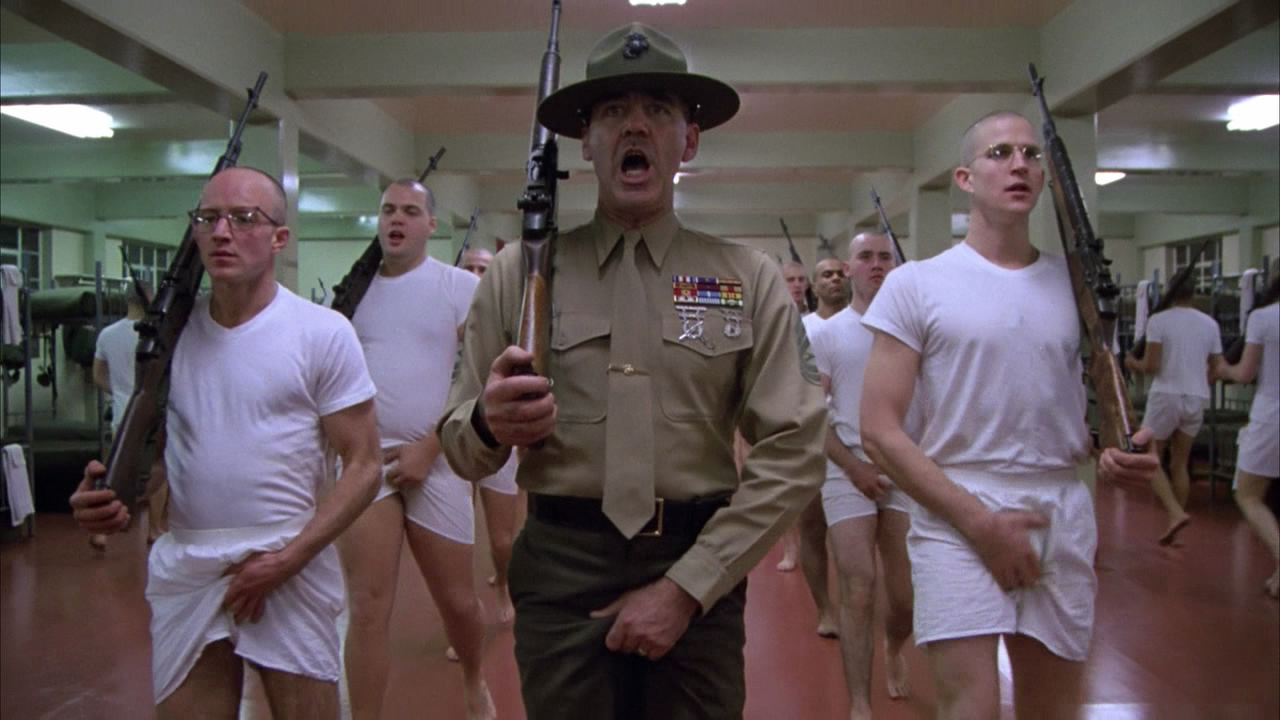
OPENING:Marine recruits have their
individuality removed via the scalping of their hair.The theme of dehumanization kicks in
early.If it’s not obvious enough we
transition to Drill Instructor Hartman (Ermey) declaring:“You’re not even human fucking beings”.Hartman quickly becomes one of the most
memorable war movie characters with his introductory emasculation of the
stunned ex-civilians.He substitutes
derogatory nicknames as their names are removed like their hair.“Joker” (Modine) earns his nickname (as well
as some physical abuse) for a John Wayne wise crack.But Hartman reserves his main animosity for
the chubby, intellectually challenged
Leonard (D’Onofrio).He has the grinning
recruit choke himself.Hartman
presciently labels him “Gomer Pyle”.
"this is my rifle, this is my gun"
SUMMARY:The first part of the film is set
on Parris Island for Marine boot camp.We’ve seen boot camps like this before in war movies, but never with the
focus so much on the DI.The movie skips
the usual backgrounding of the recruits and the bonding off base scene.We do get the training montages, but with
Hartman’s constant colorful berating. Most of the recruits remain undeveloped, but Joker makes froends with Cowboy (Arliss Howard).The main plot thread is the arc of the hapless Pyle whose incompetence
sets Hartman off.After Pyle proves
infuriatingly unsoldierlike, Hartman puts Joker in charge of shaping him
up.This arrangement seems to be working
and in a traditional war movie we would move on to the next plot point.This is not a traditional war movie.When Pyle is caught with a jelly donut,
Hartman commences a policy of punishing the whole platoon for his mistakes.Pyle continues to fuck up so his disgruntled
mates give him a “blanket party” which consists of beating him with bars of
soap.Even Joker participates and in
fact hits him the most, out of sheer frustration.
After
this “tough love”, it appears Pyle has turned the corner.He does very well on the rifle range and is
now being praised by Hartman.However,
the replacement of his goofy grin with a vacant stare proves he has
snapped.This leads to the iconic
bathroom scene.Joker encounters the
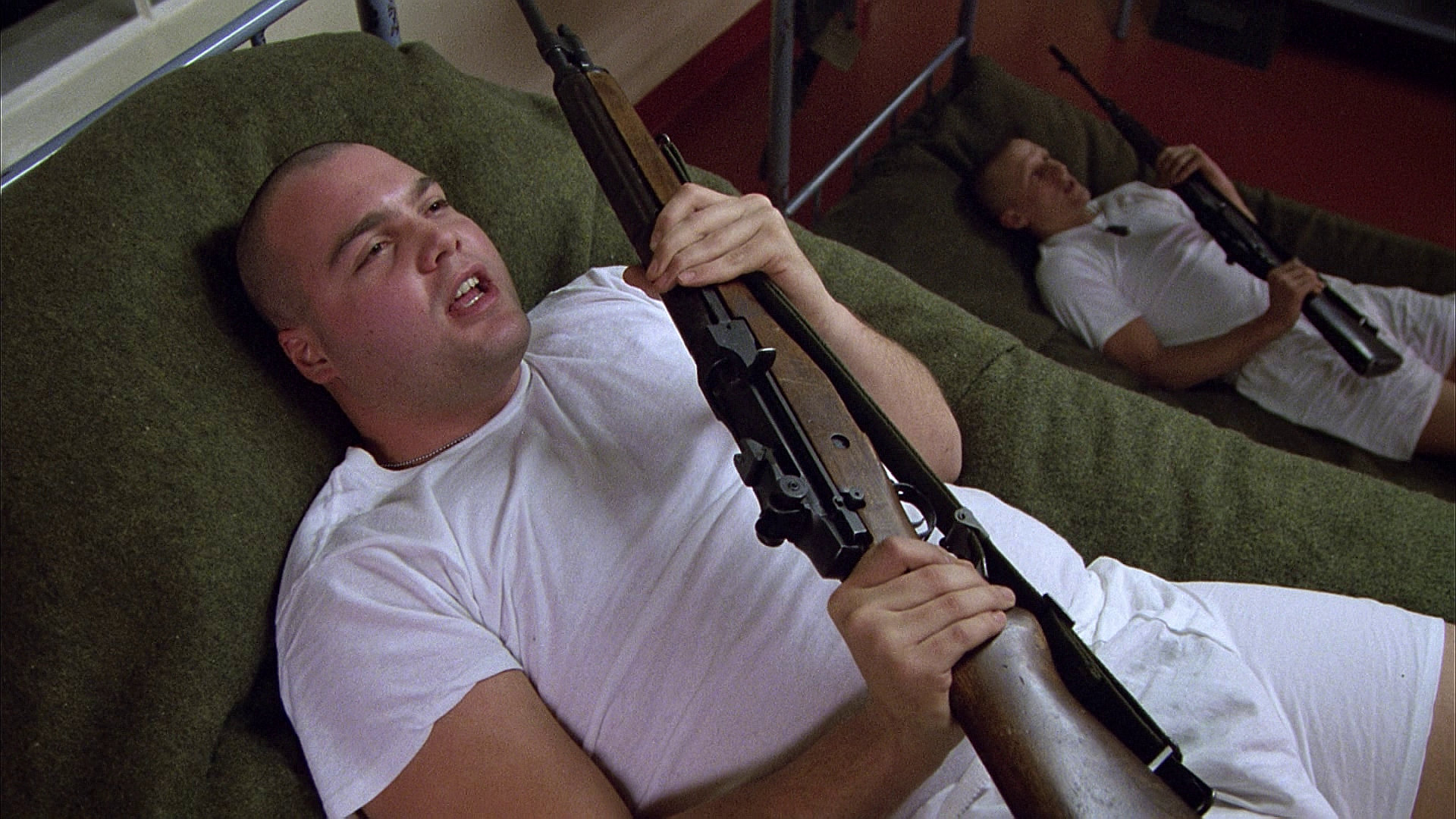
clearly demented Pyle on his nightly rounds.Pyle is caressing and talking to his girlfriend – his rifle “Vanessa”.Somehow he has obtained live rounds – “7-6-2
millimeter full – metal – jacket”.He is
in ”a world of shit”.Hartman’s attempt
to cow Pyle into giving up the M-14 does not go well.Create a killing machine for the Corps –
mission accomplished!
Pyle and Vanessa
After
that stunning resolution of the boot camp section, we are suddenly in Saigon
months later (to the tune of “These Boots Are Made For Walking”).Joker is a military journalist working for
“Stars and Stripes”.He and his friend
Rafterman (Kevyn Major Howard) are negotiating with a hooker.“Me so honny.[Why is my computer showing I have
a spelling and grammar problem here?]Me love you long time.”At a
staff meeting, it turns out Joker has grown into his nickname.This does not sit well with his editor who
insists on the war being reported in a manner conducive to the reputation of
the Corps.Truth is the first
casualty.Here’s a sample:“If we move Vietnamese - they are evacuees; if they come to us - they are refugees.”He edits “search and destroy” to “sweep and
clear”.There are two types of stories
“Stars and Stripes” covers:winning
“hearts and minds” and winning the war by killing bad guys.
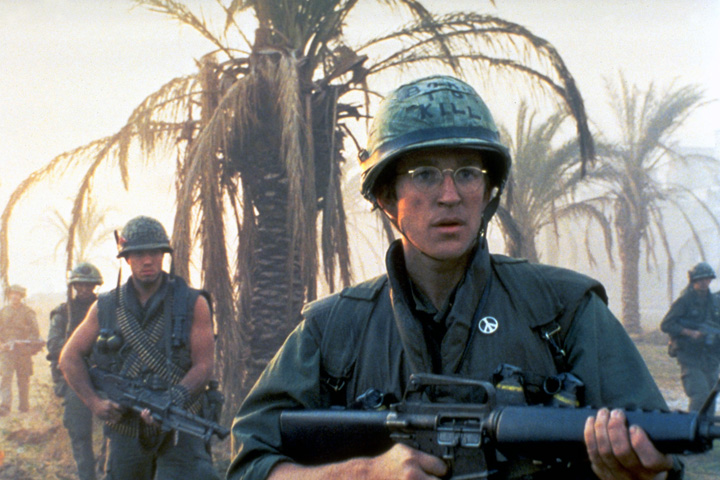
Private Joker with his peace button
The
Tet Offensive suddenly thrusts the Da Nang press corps into “the shit”.Joker helps defend the entrance from Viet
Cong sappers.After using an M-60 to get
some “confirmed kills”, Joker has a look of exultation on his face.War can be exhilarating.Joker and Rafterman head off to Hue to try to
acquire that “thousand yard stare”.On
the way, the helicopter door gunner (played by the actor who was supposed to be
Hartman) is gleefully shooting at civilians.“Anyone who runs is a VC, anyone who stands is a well-disciplined VC.”When Joker asks him how he can shoot women
and children, he responds that you simply “lead them less”.(This scene was lifted from Dispatches.)
Cowboy
In
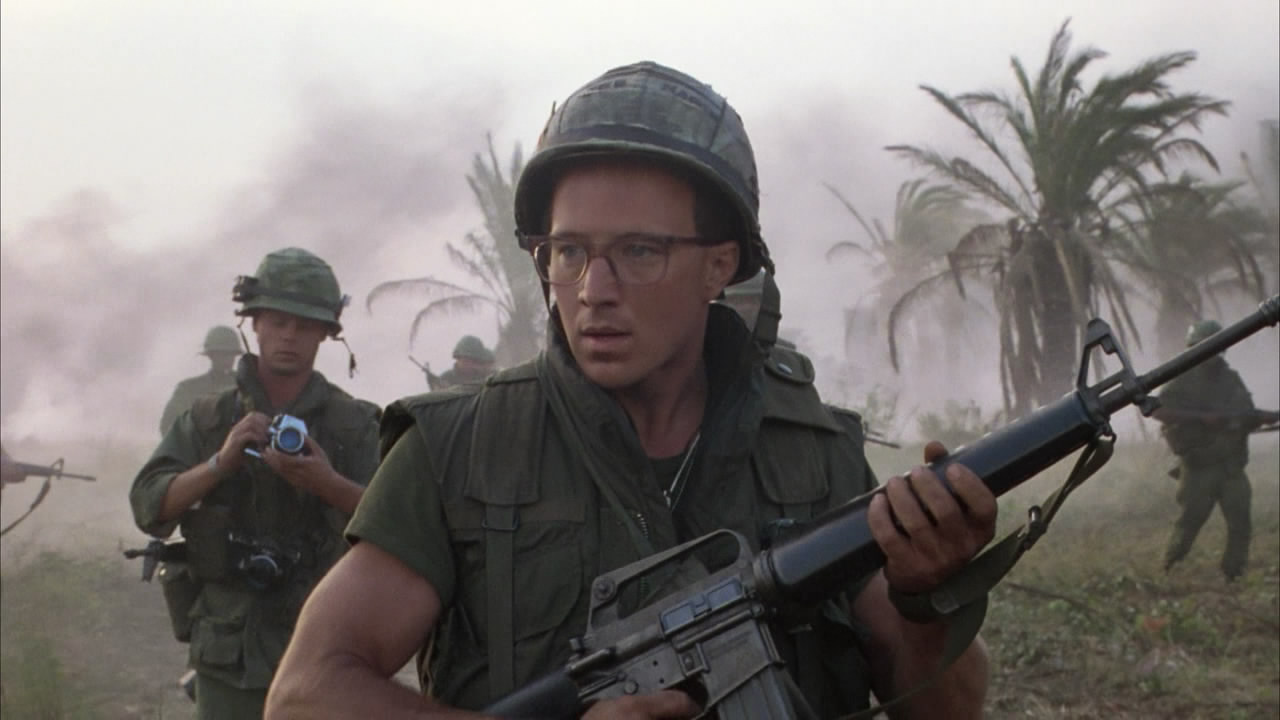
Hue, Joker and Rafterman hook up with Cowboy’s Lust Hog Squad.Joker has a confrontation with Animal Mother
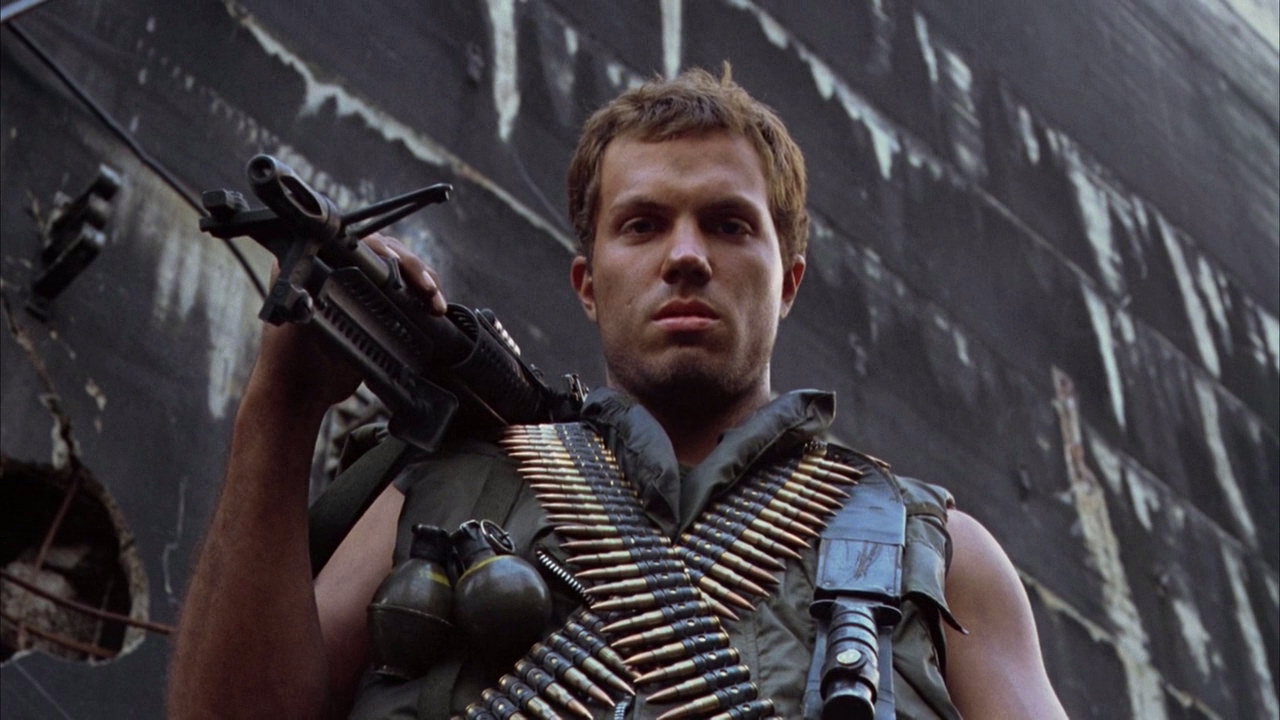
(Adam Baldwin).Animal Mother is the
soldier Pyle would have become.His
helmet is labeled “I am become death”.(Joker’s reads “Born to Kill”.)A
news crew comes by so the unit members can make wise cracks.Locker room type stuff.(The scene is reminiscent of “Apocalypse Now”
except Kubrick doesn’t do a Coppola.)Later, some of the characters are interviewed.There are several references to the opinion
that the South Vietnamese don’t appreciate what the Americans are doing for
them, but nothing overtly pacifist.Joker says he came to Vietnam because he “wanted to see exotic Vietnam,
meet interesting people, and kill them”.The reappearance of Miss Sucky-Sucky marks the end of the second part of
the film.
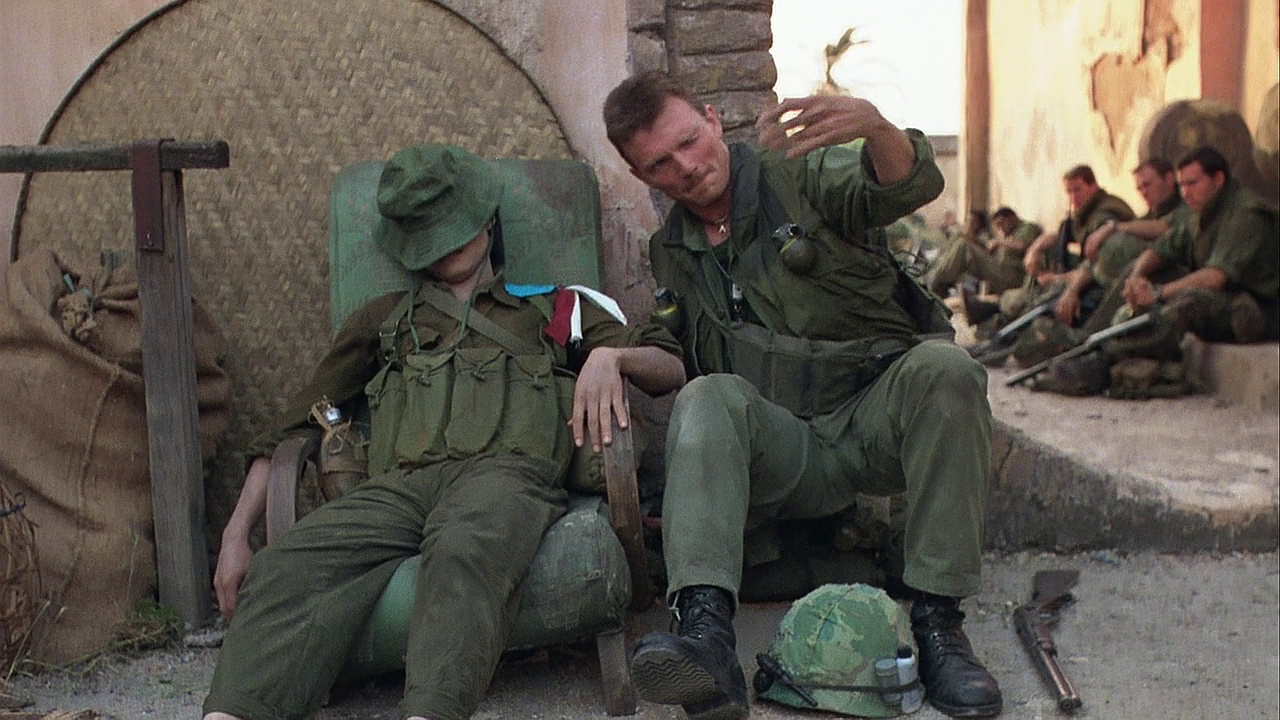
Crazy Earl with his BB gun and a VC
The
third part of the film is the sniper section.Cowboy becomes squad leader when Crazy Earl is killed by a booby trap.While moving through a wasted landscape, the
squad gets lost.Eight Ball (Dorian
Harewood) is on point when he is hit by a sniper, but left alive as rescue bait.Doc Jay goes to him and is also hit.Cowboy correctly recognizes the futility of a
rescue attempt, but Eight Ball’s BFF Animal Mother goes charging out thus
drawing the unit into a duel with the sniper.
CLOSING:While
assessing the situation, Cowboy gets hit and gets a great death scene. Now the remainder of the squad (and the males
in the audience) agree with Animal Mother that it’s time to “get some
payback”.The six (or is it eight?)
survivors use the sudden darkness and smoke grenades to enter the
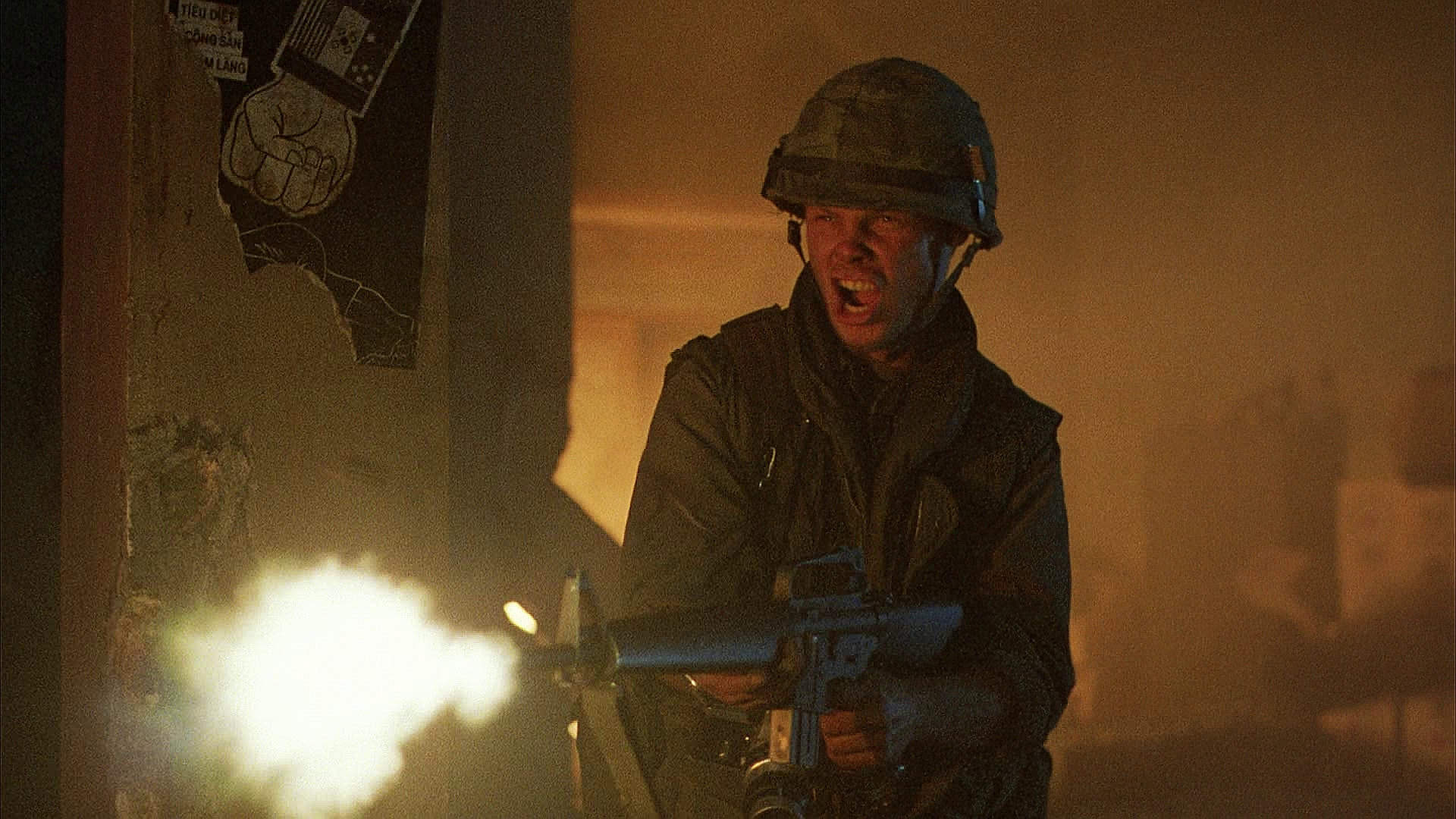
Stalingradesque factory where the sniper has his lair.Spoiler alert:he’s a she!Joker pulls an early Pyle and screws up the kill, but Rafterman blows
her away.Another great death scene ends
with Joker’s mercy killing of the sniper.He thus tenuously
clings to humanity.The movie closes
with American soldiers marching into (or out of) the combat zone singing the
“Mickey Mouse Club” song.War corrupts
youth.
the sniper
Rafterman blows away the sniper
RATINGS:
Acting =A
Action =7/10
Accuracy =B
Plot =A
Realism =B
Cliches =A
Overall =A
WOULD CHICKS DIG IT?They better like war movies.This is definitely a guy movie.Much of the dialogue is the type that has
guys taking notes and gals blushing.There is only one female character and she is not someone most American
women can relate to (although their boyfriends or husbands certainly would wish
for this!)There is also some graphic
violence.However, if you want to
understand the male psyche …
HISTORICAL ACCURACY:FMJ is not meant to be historically accurate.It is based on a novel, but Hasford was a
correspondent in Vietnam and supposedly based the book on personal
experiences. The Joker character is apparently based on him.The boot camp segment is
realistic as to Marine boot camp in 1967.If anything, the movie underplays the physical abuse.(The DI in the book is more brutal.)The “Stars and Stripes” reporting strategy
is accurate.Da Nang was one of the
targets for the opening Tet attacks (note the fireworks in the background –
nice touch).As far as Hue, civilians
were executed by the Communists.There
was a sniper problem as part of the urban house-to-house combat although the
movie does not refer to a specific incident.Last, but not least, there were hookers in Vietnam that offered to sucky
sucky for ten dollars.My only real problem
is I doubt the sniper could have been that accurate using a standard AK-47 from
that distance.
CRITIQUE:“Full Metal Jacket” is not a perfect film, but
parts of it approach perfection.The
acting is amazing, especially considering that the cast is far from
all-star.Modine does a good job as the
main character and he is likeable.It’s
an assured performance considering his star billing is undermined by
career-making turns by D’Onofrio, Ermey, and Baldwin.D’Onofrio owes his career to this movie
(which he readily admits).For a debut,
he knocks it out of the park.His
transition from grinning buffoon to malevolent nutcase is amazing.It was a travesty that he did not get an
Academy Award nomination.Although Ermey
had acted before (starting with 1978’s “Boys in Company C”), FMJ was his
breakthrough.He completely dominates
all his scenes and Kubrick’s lensing abets this.Watch him closely – the dude never
blinks!It is important to note that the
control freak Kubrick allowed Ermey to improvise his lines.(I must point out that many of his lines
appear in the novel.)In spite of all
this, I do need to remind everyone that Ermey was essentially playing
himself.(Sorry, R. Lee.)As far as Baldwin, he is perfect as Animal
Mother and should still be kissing his agent’s ass for getting him the
part.Go to IMDB and see his
resume.(Not counting “Firefly”.)
Animal Mother
The movie is
technically brilliant.Not surprising
since it’s a Kubrick film.He took years
to make it and the care is on the screen.The cinematography is masterful.The barracks scenes are especially noteworthy as the camera tracks Ermey
in his transits.There are several long
depth shots that are well-composed (e.g. when the men pray to their guns).When the film shifts to Vietnam, we get lots
of shots with action in the background.Watch the TV crew scene.They are
moving leftward, the Lust Hogs are stationary, and other soldiers move across
the frame rightward.Cool.
The score is used very
sparingly, but effectively.It was done
by Kubrick’s daughter Vivian and she uses some eerie music that fits the mood
well.Kubrick blends in some great
contemporary songs.The Hue set is
great.Kubrick used photos of Hue to
adapt an abandoned gas works in East London.(Modine claims they were exposed to toxins.)This contrasts to the pristine atmosphere of the
barracks.The editing has been
justifiably lauded.For instance,
Kubrick uses cadence runs to divide up the boot camp scenes.He bookends the middle section with the
hooker.However, it is perplexing how he
allowed the final assault on the sniper to go from six soldiers to eight back
to six then eight and finally the original six.WTF
The plotting is fine,
but not great.The movie is essentially
three parts with the boot camp segment dominant and hard to top.This cannot be helped and critics have been
too harsh on this.Kubrick explores the
themes of war destroys and war corrupts our young.It is also clear that when you reprogram
young men to kill you end up with killers that may not have a steady moral
compass.The movie surprisingly does not
take a clear stand against the war although it is clearly anti-war.The plot throws in some nice twists and
avoids cliches.Kubrick does include a
military funeral scene, but what the eulogizers say is distinctly iconoclastic.Animal Mother:“Better you than me”.The ending “Mickey Mouse” scene is an
effective close.Certainly better than
the original idea of having Animal Mother chopping off the sniper’s head and
them playing soccer with it.
CONCLUSION:FMJ is one of the great war films and deserves
consideration for the top ten of all time.It will be interesting to see how many of the movies ahead of it on the
Military History list are lesser films.Kubrick made a unique film.He
stood the boot camp trope on its head.He explored urban combat in Vietnam.He gave us three memorable characters.It was sadly underrated by The Academy.Who would argue today that it is not better than “Moonstruck” for
Christ’s sake?And would you have
guessed that the war movie nominated that year would be “Hope and Glory”?A good war film, but come on.
the trailer
Pyle and the jelly donut
In a couple of days I will post a comparison of the movie and the book, including what happened after the events depicted in the movie.

 The sequel to "The Short Timers" is entitled "The Phantom Blooper". It
basically has three parts.
The sequel to "The Short Timers" is entitled "The Phantom Blooper". It
basically has three parts.