“SPARTACUS” TRIVIA: I Am Spartacus! Making a Film, Breaking the Blacklist by Kirk Douglas
1. The screenwriter, Dalton Trumbo, was a member of the “Unfriendly Ten” which were nine screenwriters and one director (Edward Dmytryk) who were brought before the House Unamerican Activities Committee to testify about communists in the movie industry. Congressman J. Parnell Thomas headed the witchhunting committee which included Richard Nixon. Trumbo refused to answer the question: “Are you a member of the Communist Party?” and was sent to prison. Kirk Douglas was not enough of a star to be part of the Committee for the First Amendment which included Humphrey Bogart, Lauren Bacall, Gene Kelly, Danny Kaye, and John Huston. Stars that supported HUACs efforts included Gary Cooper, Robert Montgomery, George Murphy, and Adolphe Menjou (Douglas’ co-star in “Paths of Glory”). In an act of karma, Thomas ended up in prison himself for padding his payroll. He went to the same prison that two of the “Hollywood Ten” (Lester Cole and Ring Lardner, Jr.) were sentenced to.
2. Novelist Howard Fast wrote the source novel. He was a communist and went to prison for contempt of Congress. In prison, he began researching the life of Spartacus. Upon release, he was under surveillance from J. Edgar Hoover’s FBI. Hoover accumulated over one thousand pages in his file. When the novel was finished, Hoover put pressure on publishers to not publish it. Fast ended up self-publishing. Later, Fast broke with the Communist Party after Khrushchev revealed Stalin’s crimes. Douglas became interested in a film about Spartacus and optioned the book for just $100, but Fast insisted on writing the screenplay. Douglas agreed, but was skeptical of Fast’s ability to write a competent screenplay. Douglas was right. Fast’s first draft was terrible and Douglas secretly brought in Trumbo who was writing under the name Sam Jackson.
3. The movie almost did not get made because there was already a movie about Spartacus in production. It was to be based on the novel “The Gladiators” and was to star Yul Brynner.
4. Douglas approached Sir Lawrence Olivier while they were co-starring in “The Devil’s Disciple”. Olivier was interested in directing. In an awkward development, Olivier assumed he would be playing Spartacus. When Olivier decided not to direct, Douglas reluctantly turned to Anthony Mann. Douglas fired Mann (under pressure from Universal, but with Douglas’ agreement) because Mann was in over his head and had lost control of the cast, especially Peter Ustinov who was rewriting most of his lines.
5. The first choice for Varinia was Jeanne Moreau (Christine in “The Train”), but she turned it down. Jean Simmons (a friend of Douglas) pushed hard for the role, but Douglas insisted that he wanted an actress that did not have an English or American accent. He ended up settling on an unknown German beauty named Sabine Bethmann.
6. Douglas brought Stanley Kubrick in to replace Mann even though they had not enjoyed working together on “Paths of Glory”. Kubrick convinced Douglas to dump Bethmann by proving to him that she was incapable of showing emotion. (Her movie career collapsed after this.) Simmons got her chance and it worked out even though the production was set back when she had a health crisis that lasted five weeks.
7. Kubrick was a prick to work with. At one point, the horse-bound Douglas physically threatened him in order to get him to stop wearing the same clothes every day. They had several major disagreements on the script. For instance, Kubrick did not want to include the “I am Spartacus!” scene! Douglas insisted on it, thank God. Douglas was apoplectic when he learned that all his time on the crucifix ended up on the cutting room floor. He was not going to be seen in that final scene. Douglas won on that one also. On the other hand, Douglas was concerned about having to say the line: “I have never had a woman”. He felt it would result in giggles from the audience. It didn’t.
8. The biggest dispute was over the overarching theme of the movie. Douglas and Trumbo wanted the “Large Spartacus” – the slave revolt was a major threat to the Roman Republic and after winning several spectacular victories, was overwhelmed by three Roman armies. Kubrick and the studio wanted the “Small Spartacus” – Spartacus led a jail break that only had the goal of escaping from Italy, but was defeated by one Roman army. After the first underwhelming rough cut, Trumbo wrote a brilliant critique which steered the film back towards the Large Spartacus. However, Universal had the final cut and we ended up with Medium Spartacus.
9. Olivier agreed to play Crassus partly because the movie was to open with narration by Crassus. This was latter cut.
10. Trumbo threatened to quit over rewrites. He could not be on the set because not only was it a secret that he was writing the screenplay, but he literally could not come on the studio lot. Douglas mollified him by promising him screen credit using his real name and 5% of the profits. During a discussion about whether to credit Trumbo, Kubrick offered to take the credit! I told you he was a prick.
11. The movie was supposed to cost $5 million, but ended up at around $12 million. Part of the overrun was due to adding an expanded final battle scene. Franco provided 8,000 Spanish soldiers (at $8/day), but insisted that none of them being shown dying on screen!
12. John Gavin (Caesar) went to a Notre Dame at Michigan State football game and got the crowd to yell “I am Spartacus!” for his tape recorder and this is the sound that was used in the scene.
13. That’s Woody Strode, not a dummy, hanging upside down through numerous takes.
14. Douglas broke Charles McGraw’s (the trainer) jaw when filming the soup-drowning scene. The cut that appears in the movie involves a stunt double.
15. The actor who gets his arm cut off in the final battle was an amputee with a prosthetic arm. Douglas refused to do more than three takes.
16. Douglas had to talk the prudish Simmons into taking off her bra for the bathing scene.
17. Universal made 42 cuts to the movie before releasing it. These included: no severing pf an arm, we don’t see Gracchus’ suicide, no montage of other battles (not even the map and narration), and of course, no “snails and oysters” scene. In general, the studio cuts reduced Spartacus’ historical significance because the powers did not want the rebellion to appear to have had a chance to succeed. This might have inspired communists!
18. The “snails and oysters” scene was discovered years later, but the audio was so bad it had to be recreated. Tony Curtis came in to do his lines again, but Olivier had passed away so Anthony Hopkins did his voice, extremely well.
Showing posts with label Stanley Kubrick. Show all posts
Showing posts with label Stanley Kubrick. Show all posts
Friday, October 27, 2017


Sunday, July 19, 2015
Barry Lyndon (1975)
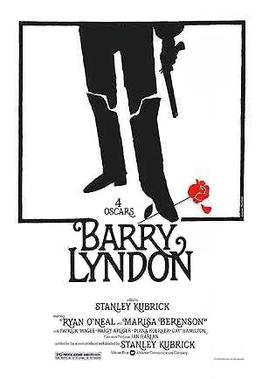
“Barry
Lyndon” was directed by Stanley Kubrick and it came after a string of
masterpieces that included “Paths of Glory”, “2001”, ‘’Spartacus”, and “Dr.
Strangelove”. The movie he made right
before it was “Clockwork Orange”.
Kubrick wanted to make a movie about Napoleon, but “Waterloo” beat him
to it. Instead he decided to make a film
based on William Thackeray’s The Luck of Barry Lyndon which was first
published in 1844. The movie was filmed
on location mostly in Ireland. The film
was not a hit and got mixed reviews. It has
gained stature over the years. It won
four Academy Awards: Art Direction,
Cinematography, Costume Design, and Musical Score (Leonard Rosenman). It was nominated for Best Picture, Director,
and Adapted Screenplay. Ryan O’Neal was
tabbed for the lead because Warner Brothers insisted on a Top Ten box office
star (this was the last time he was in the Top Ten) and the other choice
(Robert Redford) turned the role down.
Some
scholars refer to Barry Lyndon as the first anti-hero. Others simply consider him one of
literature’s great rogues. The movie
starts with the young, lower class Barry fighting a duel over his cousin when
she decides to marry a gentleman who has much better prospects. After this he has to flee and ends up in the
British Army during the Seven Years’ War.
He fights in a skirmish which is brief, but accurate other than the
French soldiers not reloading. In a
portent of action interruptus yet to come, Barry leaves the battle early. He then deserts and ends up in the Prussian
Army. Another battle ends prematurely,
but Barry saves his commanding officer and is promoted to espionage. Instead he becomes a gambler. After some success in this line of work, he
sets his sights on the social status that comes with marrying a rich
widow. Barry settles down to spendthrift
wastrelry with his dysfunctional family.
He does not live happily ever after.
 |
| don't blink or you'll miss any combat involving this dandy |
“Barry
Lyndon” has a 94% rating on Rotten Tomatoes and an 8.1 on IMDB. I have to beg to differ. If there ever was a movie that mesmerized
people with shiny baubles, this is it.
Critics love Kubrick and were willing to overlook the plot in favor of the
costumery and cinematography. They gush
over the way the movie was filmed. They
are particularly awed by the fact that John Alcott shot the interior scenes
without artificial lighting. As a
nonprofessional I would classify that as neat, but not very significant in
judging the movie. I agree that the
costumes and music are impressive. The
outdoor scenes are as pretty as a post card.
My
problem with the movie is it is excruciatingly boring. 184 minutes of boring. The pace is glacial. At one point the movie jumps eight years and
I literally cheered. To make matters
worse, the movie is predictable and the death of one character could not have
been telegraphed more if Samuel Morse was the director. When you do get to an action scene, it is
truncated and unfulfilling. Some refer
to it as a satire and even a black comedy, but I did not smile a single time
and in fact the movie was depressing to me.
It is also poorly acted. Ryan
O’Neal is wooden and not nearly roguish enough. Marisa Berenson is basically eye-candy. It is no surprise her career did not take off
after being in it.
 |
| they weren't big on camouflage in the Seven Years' War |
Movies
about the Seven Years’ War are very rare. Unfortunately, “Barry Lyndon” is not a war
movie in my opinion. You will learn
little about the war from it. It does
have some historical value as a period piece.
You learn about what asses the upper class were and how they dressed and
behaved. That is little payoff for
three hours of watching molasses flow.
Some will say that I just did not get it and I should rewatch it. To those people I say: not a chance in Hell! First impression will have to be only
impression.
GRADE = D
Saturday, August 23, 2014
4th ANNIVERSARY!!!
Has it been four years? Time flies. I went back to my first post and did not know whether to laugh or cry. My plan was to review one of the 100 Greatest per week and be done with my project in two years. Well, it has now been four years and I am still not done yet! In my defense, I did not originally plan to review other war movies as well. I certainly do not regret that decision. I like the variety I have managed on this blog. And truthfully, I think subconsciously I am reluctant for this amazing journey to end. However, one more to go. Then all I'll have left is all the war movies I have not reviewed yet and the compilation of my own 100 Best War Movies list. That should keep me occupied for another four years. I would like to thank all the people who have come along for the ride and I hope you will continue to frequent this site.
#2 - Paths of Glory (1957)

BACK-STORY: “Paths of Glory” was Stanley Kubrick’s first
great film. The fact that he also
directed several other movies on the 100 Greatest list (“Spartacus”, “Dr.
Strangelove”, “Full Metal Jacket”) makes a case for his being the greatest war
movie director. The movie was based on
the novel by Howard Cobb which was published in 1935. The teenage Kubrick had read the book in his
father’s study. Kubrick had trouble
getting funding because of the depressing nature of the plot. This problem was solved when Kirk Douglas was
brought on board. His production company
took on the task and Douglas was paid 1/3 of the approximately $1 million
budget. He was not in it for the money
as Douglas was committed to the project in principle. The movie was a critical smash, but only a
modest success at the box office and predictably did not do well in
Europe. In fact, it was banned in France
for two decades. Incredibly, the movie
received zero Academy Award nominations and is not on AFI’s 100 Greatest Movies
list!
OPENING: The movie is set on the Western Front in France
in 1916. A narrator summarizes the
futility of the war up to that point. It
is a stalemate. French Army Chief of
Staff Gen. Broulard (Adolphe Menjou) visits Gen. Mireau (George MacReady) at
his chateau. Broulard orders an attack
on an impregnable German position called the “Ant Hill”. Mireau is at first against the insane,
suicidal assault, but Broulard uses flattery and promotion bribery to bring him
around. He does not have to remind
MacReady that he will be safely witnessing the attack from a bunker.
SUMMARY: Mireau visits the trenches to get some face-time
with his beloved cannon fodder. In an
amazingly long tracking shot with no cuts, he buddies up to his men by
repetitively asking them “Hello, soldier, ready to kill more Germans?” When he encounters an obviously shell-shocked
soldier, MacReady huffs that there is “no such thing as shell-shocked” and he
slaps him ala Patton. Mireau meets the
regimental commander Col. Dax (Douglas) in his bunker. (Douglas gets his obligatory shirtless
scene.) He informs the skeptical Dax of
the attack. Mireau is optimistic that
the casualties will only be around 60%!
That figure is arrived at by adding 5% from their own barrage + 10% in
no man’s land + 20% through the German wire + 25% taking the position. The men will “absorb bullets and shrapnel and
by doing so make it possible for others to get through”. Dax explodes and quotes Samuel Johnson: “Patriotism is the last refuge of a
scoundrel.” When Mireau suggests that
Dax take a furlough, Dax backs down and promises to take the “Ant Hill”.
A night patrol is ordered to reconnoiter
the position. Lt. Roget (Wayne Morris)
takes two men with him and then proceeds to panic and kill one in a friendly
fire incident. The steaming dead body of
Lejuene is the only graphic shot in the movie.
Afterwards, Cpl. Paris (Ralph Meeker) confronts the drunken Roget, but
is apprised of the fact that officers hold all the cards. Roget:
“ Who’s word do you think they are going to believe- or accept?”
The attack the next day is one
of the great combat scenes in war movie history. It begins with another long tracking shot as
Dax moves through the trench like Mireau did, but without the faux
bravado. The assault is a tour de force
in battle cinematography as a camera on a dolly tracks Dax and the cannon
fodder through a hellish landscape. It
is obvious to everyone, except the spectating Mireau, that the attack has no
chance of success. Dax leads the men
across no man’s land. (It took 60 men,
eight cranes, and three weeks to turn a German farm into the scarred landscape
of trench warfare.) That 60% figure is
looking optimistic as men go down left and right. It is futile like many an attack in the war. Roget’s unit does not even leave the
trench. Mireau orders the French
artillery to open fire on them, but the battery commander refuses without a
written order. The incensed general vows
revenge for the failed assault. “If
those little sweethearts won’t face German bullets, they’ll face French ones!”
 |
| Follow this whistle, dogs |
At the chateau, Broulard, Mireau,
and Dax negotiate how many men need to be court-martialed for cowardice pour encourager les autres. Broulard:
“There are few things more stimulating than seeing someone else
die.” Mireau is talked into being
reasonable and accepting only three sacrificial lambs - one from each
company. Broulard is in a jocular mood
throughout and Dax is aghast. The scene
foreshadows “Catch-22” and “MASH”.
Roget tabs Paris to get rid of
the eyewitness to his cowardice. Arnaud
(Joe Turkel) is chosen by lottery. Ferol
(Timothy Carey) is chosen because he is a social misfit. Dax volunteers to be their defense
attorney. The trial is held in the
chateau. A no-nonsense general serves as
judge and it is apparent he is set on the end result with as little court room
theatrics as possible. Each patsy gets
his time on the stand, not that it will make any difference. Ironically, none
was a coward and even Paris (whose unit did not leave the trench) had wanted to
attack, but was knocked unconscious by a corpse falling on him. Dax gives an impassioned closing argument
which includes the line “miscarriage of justice”. Guess what the verdict is.
The trio now have doom hanging
over them like a muddy trench coat.
Paris ruminates about how a cockroach has a better future than him,
resulting in Ferol smashing it and deadpanning:
“Now you have the edge on him.”
When a priest comes to visit, Arnaud attacks him. Paris intervenes and
punches him, resulting in a skull fracture.
A doctor repairs Arnaud enough for him to be executed. After Dax is informed about Mireau’s attempt
to bombard his own men, he confronts Gen. Bourland to attempt blackmail. It is unclear whether this ploy will
work. Surely they won’t execute these
innocent men.
Sorry, happy ending
insisters, for the good of the war effort and to avoid future mutinies (mission
not accomplished!), these dudes must die.
The men are led to the posts.
Actually, the unconscious Arnaud is carried on a stretcher. If you ever have to stage an execution by
firing squad, this movie acts as a good tutorial.
In the afterglow of the
spectacle, Broulard and Mireau eat heartily in the chateau. Bourlard:
“This one had a certain splendor to it.”
Dax arrives. On cue, Broulard
brings up the bombardment order. There
will have to be an inquiry. Mireau
realizes he’s not heading for promotion after all. He insists that he is “the only completely
innocent man in this affair.” OMG someone please slap that man! When Mireau stomps off, Broulard offers the
promotion to Dax. Dax fumes and calls
him a “degenerate.” Broulard’s riposte
is that Dax is an “idealist”. Oh, snap!
CLOSING: Dax gets word that the battered unit is heading
up to the front again. He passes by a
cantina where a German girl (the future Mrs. Kubrick) sings “The Faithful
Hussar” to a crowd of soldiers. The
hoots and catcalls are transformed to tears as the men hum along. There is still some humanity in this inhumane
war.
WOULD CHICKS DIG IT? Yes. It is
not your typical war movie. There is
only the one graphic corpse and there is no blood. The acting is stellar and Kirk Douglas takes
off his shirt. There is only one female
character, but she is significant and closes out the film. If your significant other enjoys bravura
movie-making, she will enjoy the visual treats the movie.
HISTORICAL ACCURACY: Howard Cobb was inspired by a newspaper story
about an incident in the war where four French poilu were executed for unit
cowardice. After the war, their families
sued and two families were rewarded one franc each and the other two got
nothing. It was not uncommon in the
French army and others (not including the A.E.F.) to execute men to strengthen
the will of others. The scenario in the movie is only indirectly related to the famous mutinies by French soldiers in the war. The refusal to follow orders to continue wasteful attacks occurred wholesale in the army in 1917 after Nivelle's Chemins des Dames offensive to win the war came far short of the optimistic palaver fed to the troops. There were some executions initiated by Petain as part of his otherwise empathetic diffusing of the situation. It is safe to assume that among the 10% of men who were court-martialed and executed, there were undoubtedly some who did not deserve death. The French government would have agreed with Mireau that the tonic might be harsh for a few, but effective for the masses.
 |
| the three men held reponsible for not taking the untakeable |
CRITIQUE: This was only Kubrick’s fourth film, but you can
clearly see the style that made him one of the great directors. The cinematography by Georg Krause is
magnificent. “Bridge on the River Kwai”
took that Oscar, but you could argue that “Paths to Glory” is superior and
certainly deserved a nomination.
Speaking of which, although it could be argued that “Bridge” is the
overall better film, no one in their right mind would say today that the
nominees “Peyton Place”, “Sayanora”, “Witness for the Prosecution”, and “Twelve
Angry Men” were more deserving than “Paths”.
Especially those first two! The
movie is famous among film buffs for the long tracking shots (especially the
battle scene) and Kubrick’s abrupt cuts.
He is not big on fades in this movie.
The interior scenes with their baroque mise en scenes and the deep
focusing are a clinic. We also get a lot
of off centered shots. Disconcertingly
to modern war movie lovers, the film lacks the frenetic cutting used to add to
the fog of war. In “Paths of Glory”, you
know what is going on during a battle.
You are not lost or confused.
The
musical score is sparse, but Gerald Fried (who went on to score “Gilligan’s
Island”!) encouraged the use of snare drums in war movies. The closing song was of Napoleonic vintage
and ends with the lines: “Oh please
Mother, bring a light / My sweetheart is
going to die”. Coincidentally, Louis
Armstrong had a hit with a version of it one year before the movie was
released.
The acting is outstanding. Douglas is his usual charismatic self, even
more so because he was passionate about the project. His Dax is one of the great anti-authority figures
in war movie history and ahead of his time in the genre. He runs the gamut of that stereotype. Sarcasm, slow-burns, seething, and finally
snapping. The supporting cast is not
intimidated. MacReady and Menjou are
all-time slimy. Morris (who was a highly
decorated ace in WWII) creates one of the great cowards in war movie
history. Ralph Meeker does his best work
in an underrated career. The most
fascinating character is Ferol. The
eccentric Carey plays him to the hilt and his scene stealing aggravated the
rest of the cast. For instance, when he
is being led by the Father to the execution and he bites into his arm - that
was unscripted and almost got him punched in the face by the bemused Emile
Meyer. Carey was fired towards the end
of the 64 day shoot and a double had to be used for the confession scene.
 |
| Steal one more scene and maybe those won't be blanks |

The movie is not subtle in its themes. It has been described as an anti-war movie,
but it is more appropriately labeled as an anti-command movie. The battle scene is certainly horrific, but
it is only seven minutes and no major character is killed. The real focus of the plot is the machinations
of the generals. Broulard and Mireau are
loathsome, but fairly representative of high command in the war. Obviously, French high command in particular
(Broulard resembles Joffre), but all of the belligerents in general. It is no secret that the tactics used in the
war were pigheaded, but the script enlightens about the use of court-martials
to “motivate” the common soldiers. A
related theme is the dominance of the officer class over the enlisted. Not only are most officers motivated by
promotion (as opposed to the grunts just trying to survive), they use their
position to wriggle out of culpability.
The only caveat I have with the themes is the ending cantina scene tends
to dilute them. The movie would have
been better served ending with the executions.
However, considering the rumors that Douglas had to prevent Kubrick from
giving the men a reprieve, it could have been much worse. Having a tearful singalong by the cannon
fodder signals that war goes on. By the
way, contrast the females at the end of “Paths of Glory” and “Full Metal
Jacket”. ‘Nuff said. The songs have a similar vibe, though.
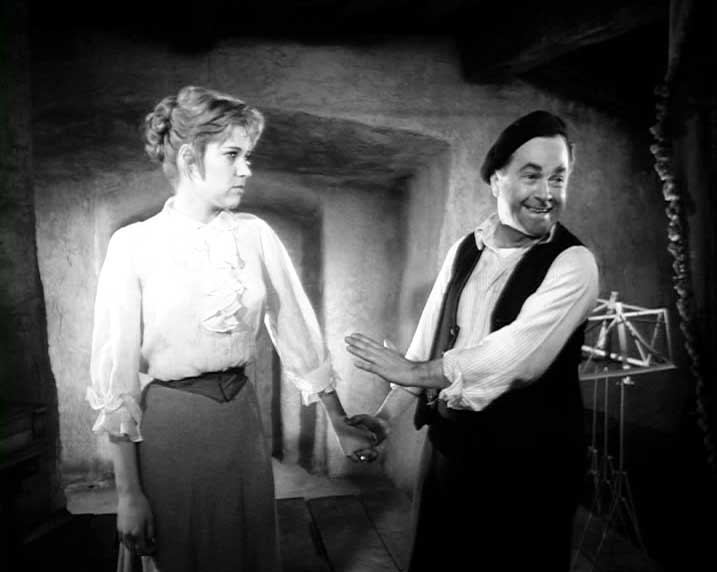 |
| Kubrick: Okay, if I can't have a happy ending, at least I want to end with a scene featuring this chick I want to go to bed with. |
How realistic is it in military matters? The trenches are a little too wide, but that
was to facilitate those awesome tracking shots so all is forgiven on that
score. The night patrol seems typical,
although fratricide by a cowardly leader was uncommon. The main battle sequence is so well done that
I show it in my American History class to prepare my students for their letter
from a soldier at the front assignment.
(The other clips are from “All Quiet”, “Sergeant York”, and “The Lost
Battalion”.) Special kudos to the German police officers who were the extras
and did some of the better dying in a war movie. The sound effects bear
mentioning. The whining of the artillery
shells and the resulting explosions add to the impression of Hell on Earth.
CONCLUSION: “Paths of Glory” is one of the great war movies
and definitely belongs in the top twenty.
I think #2 is a bit high, but I do not have a major problem with
it. It sets out to make an impression
and it succeeds perfectly. Kubrick plus
Douglas is a winning combination, as seen in “Spartacus”. It is more court room and behind the scenes
oriented than most war movies, but it does have one of the great combat scenes
to balance that. Considering some of the
laughable inclusions on the list, “Paths” is comfortably placed. I can see where it would be a movie that the
eclectic panel of military experts and cinema experts could agree on.
RATINGS:
Acting - A+
Action - 6/10
Accuracy - B
Realism - B
Plot – A
GRADE = A
the trailer
the battle scene
Thursday, June 6, 2013
BOOK / MOVIE: The Short Timers / Full Metal Jacket

I
recently reviewed “Full Metal Jacket” and then read the book it’s based on
(again). The movie is based on The Short Timers by Gustav Harford. The book is amazing and is in some ways better than the movie. I highly recommend it as a companion to the movie, especially since it carries the story beyond the movie.
I thought others might like to
know how the movie differs from the book (especially because the book is hard
to find) and what happens in the book after the events in the movie. Spoiler
alert from here. The following are
differences in the book and my judgment of whether the movie or
book is better.
1. Leonard (Pyle) is a skinny red neck. Movie
2. DI Gerheim is less imaginative in his verbal
abuse, but Ermey did use many of his lines.
Gerheim uses a lot more physical abuse.
For example, Greheim almost drowns Pyle in a toilet that he had the squad
leaders pee in. Movie
3. On graduation day, Pyle is given the
outstanding recruit and marksmanship awards.
Movie
4. Pyle is in his bunk when the climactic moment
occurs. He is not malevolent, just
crazy. He is in love with his rifle. Gerheim does chew him a new one, but his last
words are that he is proud of the killing machine he has created. Movie
5. Joker first reunites with Cowboy in a movie
theater that is showing “The Green Berets”.
Here is where the Joker / Animal Mother hatred begins. The dynamic between the two characters is
more involved in the book. Book
6. The book spends more time on how the Marines
manipulated the press coverage of the war.
The author, Gustav Hasford, was a Combat Correspondent. Book
7. The book has a scene where Joker and the
other correspondents light some rats on fire in a game called “the rat
race”. The funeral is when they sing
“Mickey Mouse”. Book
8. There is no defense of the entrance to the
base. Movie
9. Animal Mother is more of a psychopath in the
book. He kills a platoon leader (Short
Round) in a fragging incident. Movie
10. There are two sniper incidents in the
book. The movie mashes them up. The first, set in Hue, involves a tank
blasting buildings as the squad goes house to house looking for the sniper that
killed T.H.E. Rock. Although the book
mentions that the sniper picks off a bunch of men that go after him. This story is told to Joker, not featured in
the book. The sniper is a girl and
Rafter Man does kill her with Joker finishing her off. The action takes place on a roof-top. Cowboy was wounded, but not killed. Animal Mother cuts her head off and waves it
around. Movie
Here
are some of the things that happen after the movie concludes.
1. Rafter Man (he got the name from drunkenly
falling from the rafters onto a general’s table during a show) is killed when
he is run over by a tank on the road out of Hue.
2. Joker gets busted to private because of his
peace symbol and is assigned to the Lust Hog Squad which is at Khe Sanh. Cowboy is still in command. Cowboy has developed into an excellent
leader.
3. The squad is sent out on a long patrol. During a rest break, Joker pulls a knife on
Animal Mother. Alice (black point man
similar to Eight Ball in the movie) gets hit by a sniper in a similar situation
to in the movie except it is set in the jungle.
The Doc goes to him and gets wounded.
The New Guy charges out and gets hit.
At this point, Cowboy puts Joker in command and orders him to pull back
the squad. Cowboy runs out to put the
men out of their misery with his pistol and then Joker shoots him because the sniper prevents Cowboy from killing himself. The squad pulls back.
 The sequel to "The Short Timers" is entitled "The Phantom Blooper". It
basically has three parts.
1. Joker is at Khe Sanh and the siege is coming to an end. He has become hardened and cynical. He is in tight with the "bloods" who are heavily into dope and bucking authority. There is rumor of an American who has switched sides and uses his M-79 against the Marines in the base - the Phantom Blooper. Joker gets captured.
2. Joker gets chummy with the Viet Cong holding him in a village. He plans to escape, but meanwhile plays collaborator. We get a heavy dose of Viet Cong culture. He goes on a mission with them. The village gets assaulted to rescue him and he fights against the Americans. Joker is wounded and liberated.
3. Returning home, Joker has trouble transitioning. At the end he is planning to return to Vietnam.
This was supposed to be the second in a trilogy, but Hasford died.
Tuesday, June 4, 2013
#16 - Full Metal Jacket
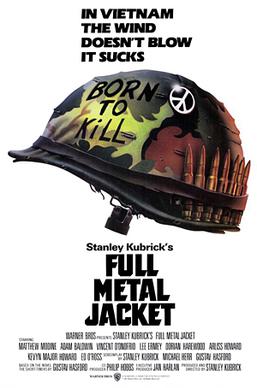
BACK-STORY: “Full Metal Jacket” began its
long journey to the screen when director Stanley Kubrick (“Dr. Strangelove”,
“Paths of Glory”, “Spartacus”) read about Gustav Harford’s novel The Short
Timers. Kubrick convinced his good
friend Michael Herr to flesh out a screenplay.
Herr had already written one of the great Vietnam War books – Dispatches. Harford was also involved in the adapted
screenplay that ended up with an Oscar nod (the only one the film
garnered!). The movie was filmed in
England because Kubrick hated to leave home.
The shoot lasted an exhausting 17 months. Kubrick eschewed a big name cast. Matthew Modine was coming off of
“Birdie”. Vincent D’Onofrio was making
his debut. He set a record by gaining seventy pounds for the role (breaking De
Niro’s pigging out for “Raging Bull”).
R. Lee Ermey was hired as the technical adviser and put the actors
through a boot camp that included him yelling at them for ten hours a day. He angled for the DI role by impressing
Kubrick with a fifteen minute profanity fueled rant while tennis balls were
being thrown at him.
OPENING: Marine recruits have their
individuality removed via the scalping of their hair. The theme of dehumanization kicks in
early. If it’s not obvious enough we
transition to Drill Instructor Hartman (Ermey) declaring: “You’re not even human fucking beings”. Hartman quickly becomes one of the most
memorable war movie characters with his introductory emasculation of the
stunned ex-civilians. He substitutes
derogatory nicknames as their names are removed like their hair. “Joker” (Modine) earns his nickname (as well
as some physical abuse) for a John Wayne wise crack. But Hartman reserves his main animosity for
the chubby, intellectually challenged
Leonard (D’Onofrio). He has the grinning
recruit choke himself. Hartman
presciently labels him “Gomer Pyle”.
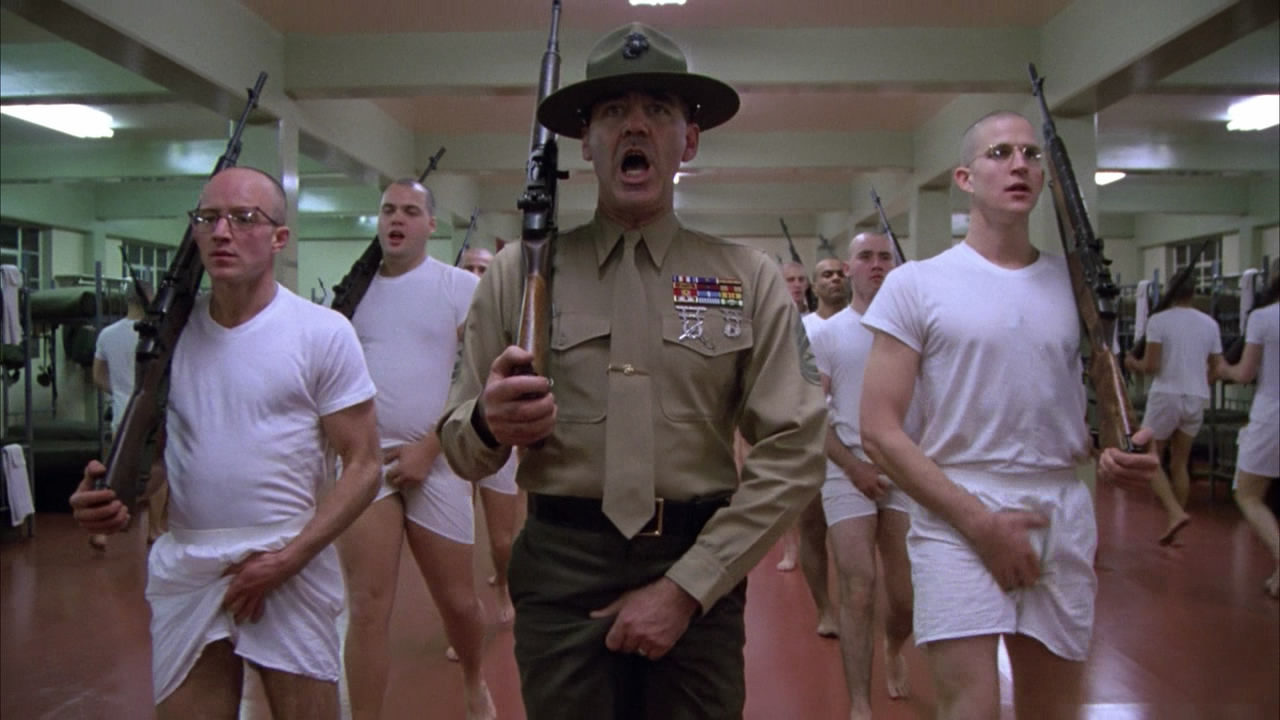 |
| "this is my rifle, this is my gun" |
SUMMARY: The first part of the film is set
on Parris Island for Marine boot camp.
We’ve seen boot camps like this before in war movies, but never with the
focus so much on the DI. The movie skips
the usual backgrounding of the recruits and the bonding off base scene. We do get the training montages, but with
Hartman’s constant colorful berating. Most of the recruits remain undeveloped, but Joker makes froends with Cowboy (Arliss Howard).
The main plot thread is the arc of the hapless Pyle whose incompetence
sets Hartman off. After Pyle proves
infuriatingly unsoldierlike, Hartman puts Joker in charge of shaping him
up. This arrangement seems to be working
and in a traditional war movie we would move on to the next plot point. This is not a traditional war movie. When Pyle is caught with a jelly donut,
Hartman commences a policy of punishing the whole platoon for his mistakes. Pyle continues to fuck up so his disgruntled
mates give him a “blanket party” which consists of beating him with bars of
soap. Even Joker participates and in
fact hits him the most, out of sheer frustration.
After
this “tough love”, it appears Pyle has turned the corner. He does very well on the rifle range and is
now being praised by Hartman. However,
the replacement of his goofy grin with a vacant stare proves he has
snapped. This leads to the iconic
bathroom scene. Joker encounters the
clearly demented Pyle on his nightly rounds.
Pyle is caressing and talking to his girlfriend – his rifle “Vanessa”. Somehow he has obtained live rounds – “7-6-2
millimeter full – metal – jacket”. He is
in ”a world of shit”. Hartman’s attempt
to cow Pyle into giving up the M-14 does not go well. Create a killing machine for the Corps –
mission accomplished!
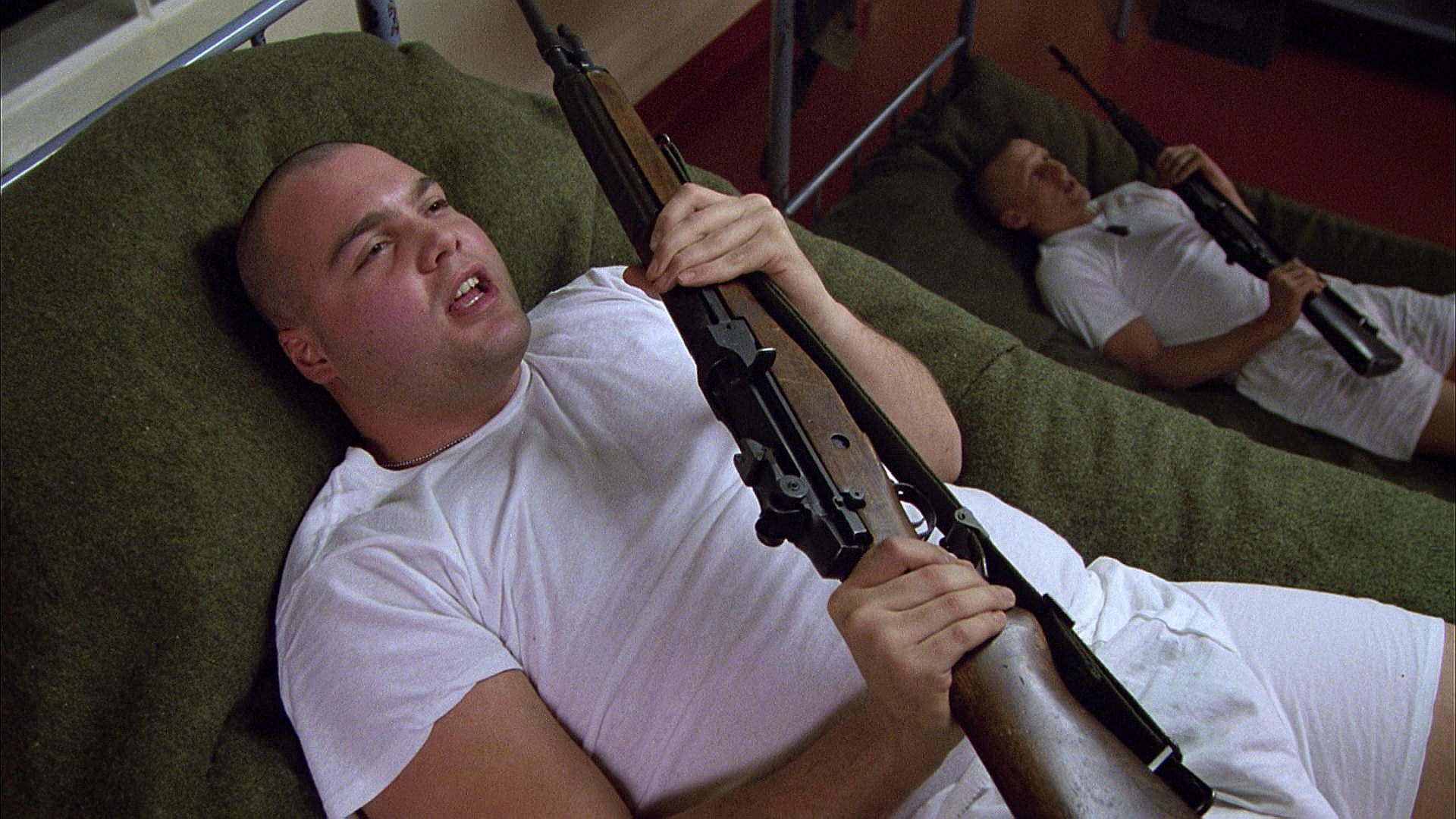 |
| Pyle and Vanessa |
After
that stunning resolution of the boot camp section, we are suddenly in Saigon
months later (to the tune of “These Boots Are Made For Walking”). Joker is a military journalist working for
“Stars and Stripes”. He and his friend
Rafterman (Kevyn Major Howard) are negotiating with a hooker. “Me so honny.
[Why is my computer showing I have
a spelling and grammar problem here?]
Me love you long time.” At a
staff meeting, it turns out Joker has grown into his nickname. This does not sit well with his editor who
insists on the war being reported in a manner conducive to the reputation of
the Corps. Truth is the first
casualty. Here’s a sample: “If we move Vietnamese - they are evacuees; if they come to us - they are refugees.” He edits “search and destroy” to “sweep and
clear”. There are two types of stories
“Stars and Stripes” covers: winning
“hearts and minds” and winning the war by killing bad guys.
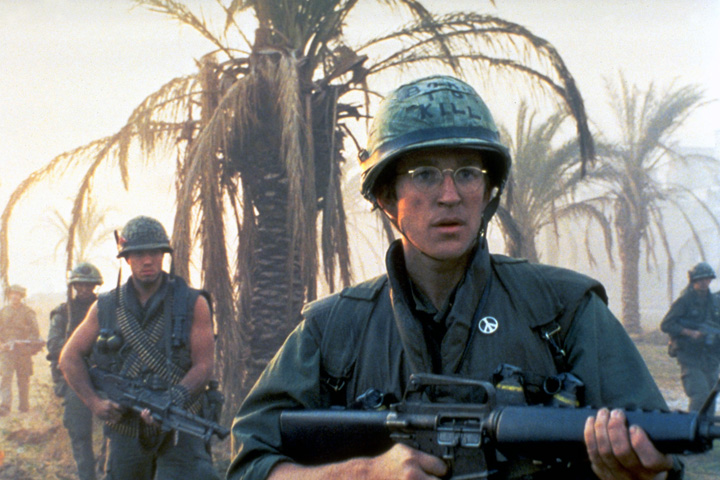 |
| Private Joker with his peace button |
The
Tet Offensive suddenly thrusts the Da Nang press corps into “the shit”. Joker helps defend the entrance from Viet
Cong sappers. After using an M-60 to get
some “confirmed kills”, Joker has a look of exultation on his face. War can be exhilarating. Joker and Rafterman head off to Hue to try to
acquire that “thousand yard stare”. On
the way, the helicopter door gunner (played by the actor who was supposed to be
Hartman) is gleefully shooting at civilians.
“Anyone who runs is a VC, anyone who stands is a well-disciplined VC.” When Joker asks him how he can shoot women
and children, he responds that you simply “lead them less”. (This scene was lifted from Dispatches.)
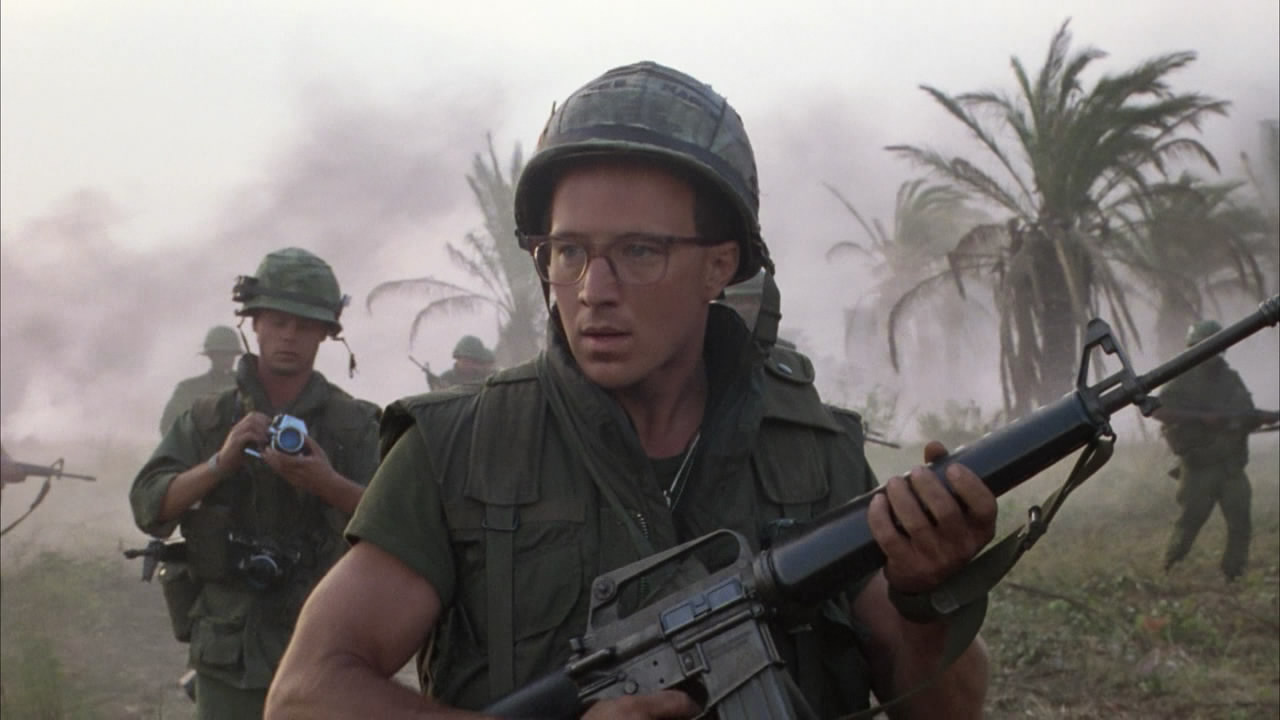 |
| Cowboy |
In
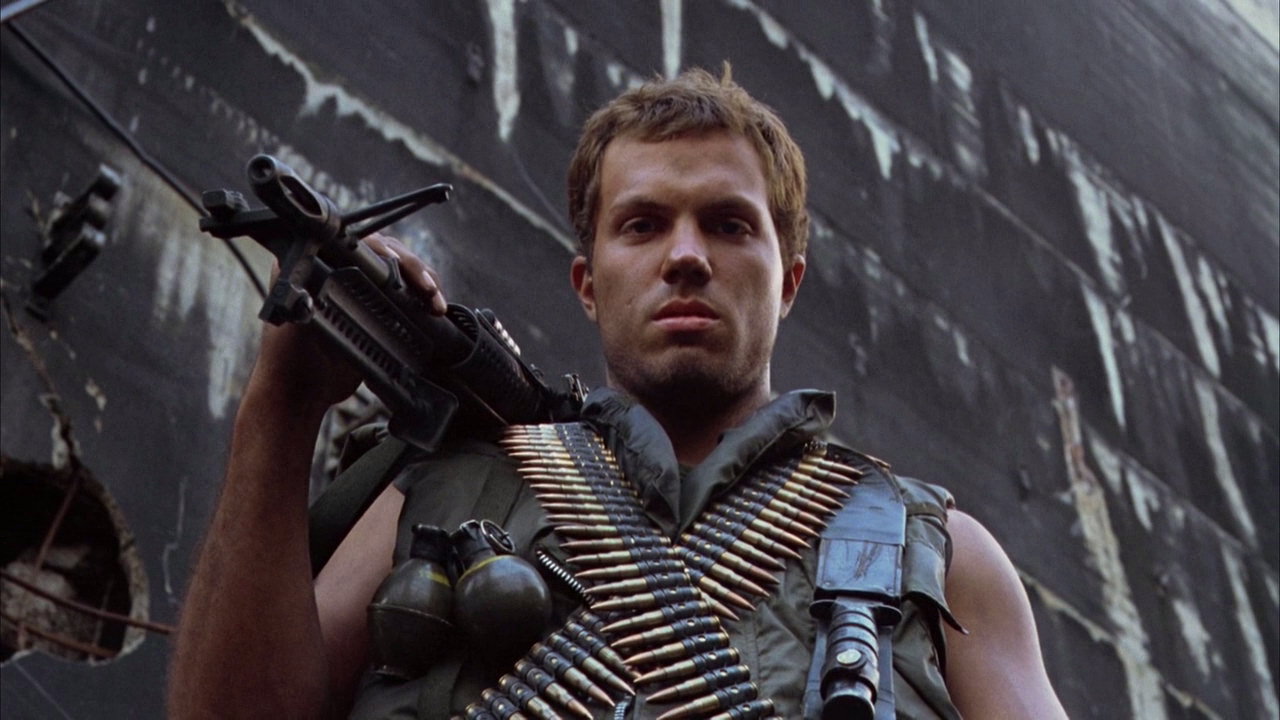
Hue, Joker and Rafterman hook up with Cowboy’s Lust Hog Squad. Joker has a confrontation with Animal Mother
(Adam Baldwin). Animal Mother is the
soldier Pyle would have become. His
helmet is labeled “I am become death”.
(Joker’s reads “Born to Kill”.) A
news crew comes by so the unit members can make wise cracks. Locker room type stuff. (The scene is reminiscent of “Apocalypse Now”
except Kubrick doesn’t do a Coppola.)
Later, some of the characters are interviewed. There are several references to the opinion
that the South Vietnamese don’t appreciate what the Americans are doing for
them, but nothing overtly pacifist.
Joker says he came to Vietnam because he “wanted to see exotic Vietnam,
meet interesting people, and kill them”.
The reappearance of Miss Sucky-Sucky marks the end of the second part of
the film.
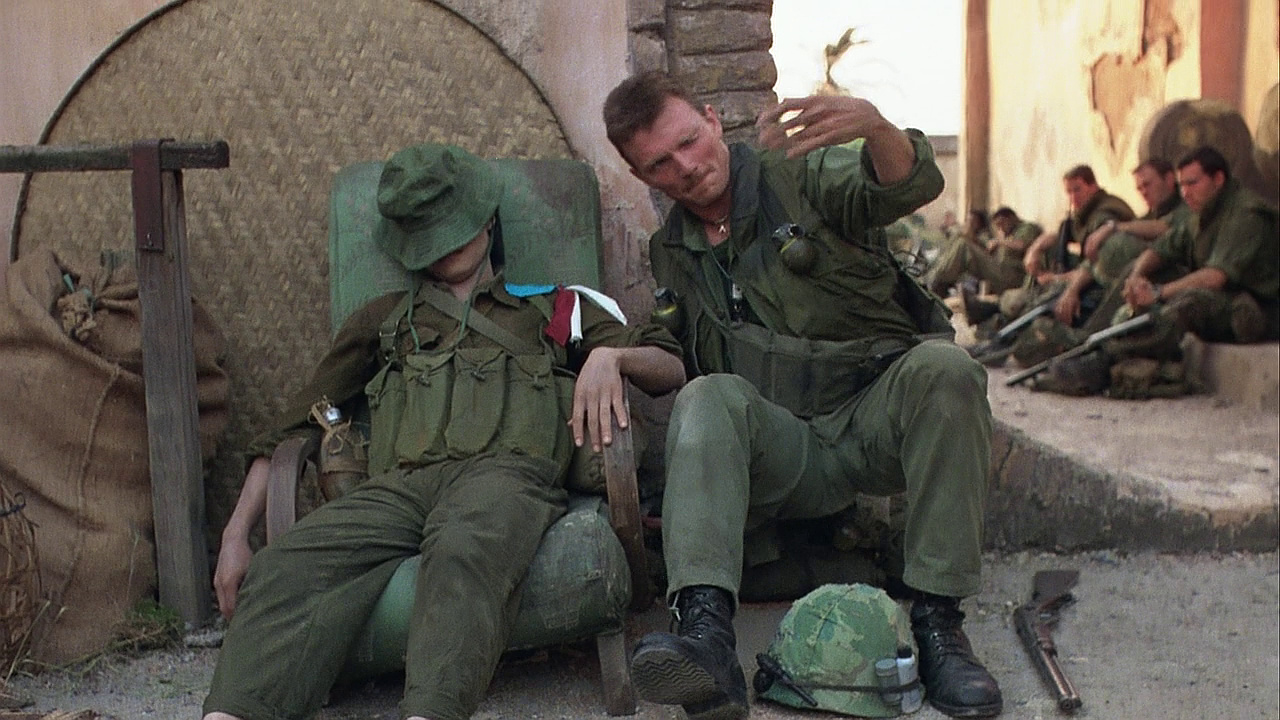 |
| Crazy Earl with his BB gun and a VC |
The
third part of the film is the sniper section.
Cowboy becomes squad leader when Crazy Earl is killed by a booby trap. While moving through a wasted landscape, the
squad gets lost. Eight Ball (Dorian
Harewood) is on point when he is hit by a sniper, but left alive as rescue bait. Doc Jay goes to him and is also hit. Cowboy correctly recognizes the futility of a
rescue attempt, but Eight Ball’s BFF Animal Mother goes charging out thus
drawing the unit into a duel with the sniper.
CLOSING: While
assessing the situation, Cowboy gets hit and gets a great death scene. Now the remainder of the squad (and the males
in the audience) agree with Animal Mother that it’s time to “get some
payback”. The six (or is it eight?)
survivors use the sudden darkness and smoke grenades to enter the
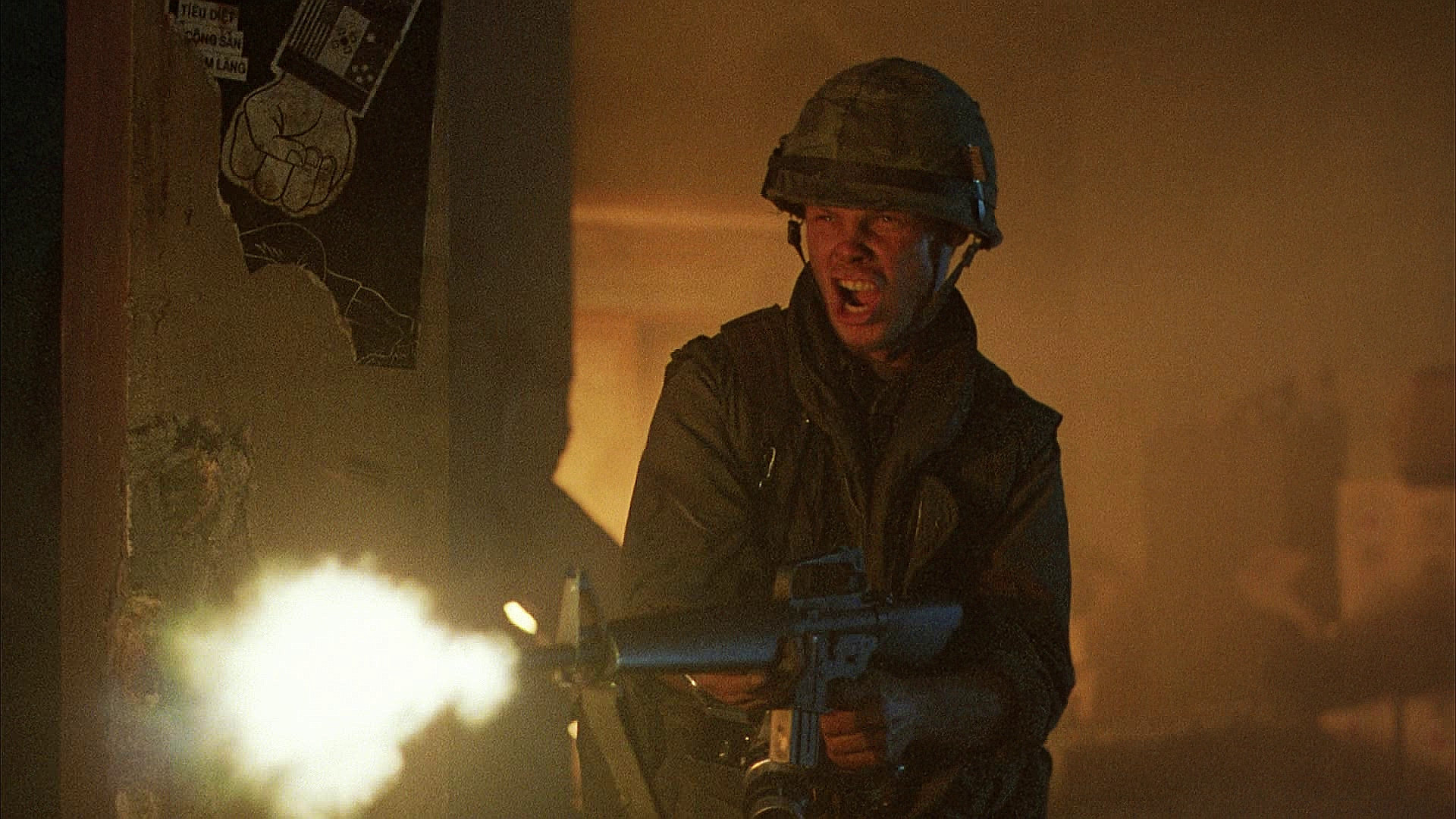
Stalingradesque factory where the sniper has his lair. Spoiler alert: he’s a she!
Joker pulls an early Pyle and screws up the kill, but Rafterman blows
her away. Another great death scene ends
with Joker’s mercy killing of the sniper. He thus tenuously
clings to humanity. The movie closes
with American soldiers marching into (or out of) the combat zone singing the
“Mickey Mouse Club” song. War corrupts
youth.
 |
| the sniper |
 |
| Rafterman blows away the sniper |
RATINGS:
Acting = A
Action = 7/10
Accuracy = B
Plot = A
Realism = B
Cliches = A
Overall = A
WOULD CHICKS DIG IT? They better like war movies. This is definitely a guy movie. Much of the dialogue is the type that has
guys taking notes and gals blushing.
There is only one female character and she is not someone most American
women can relate to (although their boyfriends or husbands certainly would wish
for this!) There is also some graphic
violence. However, if you want to
understand the male psyche …
HISTORICAL ACCURACY: FMJ is not meant to be historically accurate. It is based on a novel, but Hasford was a
correspondent in Vietnam and supposedly based the book on personal
experiences. The Joker character is apparently based on him. The boot camp segment is
realistic as to Marine boot camp in 1967.
If anything, the movie underplays the physical abuse. (The DI in the book is more brutal.) The “Stars and Stripes” reporting strategy
is accurate. Da Nang was one of the
targets for the opening Tet attacks (note the fireworks in the background –
nice touch). As far as Hue, civilians
were executed by the Communists. There
was a sniper problem as part of the urban house-to-house combat although the
movie does not refer to a specific incident.
Last, but not least, there were hookers in Vietnam that offered to sucky
sucky for ten dollars. My only real problem
is I doubt the sniper could have been that accurate using a standard AK-47 from
that distance.
CRITIQUE: “Full Metal Jacket” is not a perfect film, but
parts of it approach perfection. The
acting is amazing, especially considering that the cast is far from
all-star. Modine does a good job as the
main character and he is likeable. It’s
an assured performance considering his star billing is undermined by
career-making turns by D’Onofrio, Ermey, and Baldwin. D’Onofrio owes his career to this movie
(which he readily admits). For a debut,
he knocks it out of the park. His
transition from grinning buffoon to malevolent nutcase is amazing. It was a travesty that he did not get an
Academy Award nomination. Although Ermey
had acted before (starting with 1978’s “Boys in Company C”), FMJ was his
breakthrough. He completely dominates
all his scenes and Kubrick’s lensing abets this. Watch him closely – the dude never
blinks! It is important to note that the
control freak Kubrick allowed Ermey to improvise his lines. (I must point out that many of his lines
appear in the novel.) In spite of all
this, I do need to remind everyone that Ermey was essentially playing
himself. (Sorry, R. Lee.) As far as Baldwin, he is perfect as Animal
Mother and should still be kissing his agent’s ass for getting him the
part. Go to IMDB and see his
resume. (Not counting “Firefly”.)
 |
| Animal Mother |
The movie is
technically brilliant. Not surprising
since it’s a Kubrick film. He took years
to make it and the care is on the screen.
The cinematography is masterful.
The barracks scenes are especially noteworthy as the camera tracks Ermey
in his transits. There are several long
depth shots that are well-composed (e.g. when the men pray to their guns). When the film shifts to Vietnam, we get lots
of shots with action in the background.
Watch the TV crew scene. They are
moving leftward, the Lust Hogs are stationary, and other soldiers move across
the frame rightward. Cool.
The score is used very
sparingly, but effectively. It was done
by Kubrick’s daughter Vivian and she uses some eerie music that fits the mood
well. Kubrick blends in some great
contemporary songs. The Hue set is
great. Kubrick used photos of Hue to
adapt an abandoned gas works in East London.
(Modine claims they were exposed to toxins.) This contrasts to the pristine atmosphere of the
barracks. The editing has been
justifiably lauded. For instance,
Kubrick uses cadence runs to divide up the boot camp scenes. He bookends the middle section with the
hooker. However, it is perplexing how he
allowed the final assault on the sniper to go from six soldiers to eight back
to six then eight and finally the original six.
WTF
The plotting is fine,
but not great. The movie is essentially
three parts with the boot camp segment dominant and hard to top. This cannot be helped and critics have been
too harsh on this. Kubrick explores the
themes of war destroys and war corrupts our young. It is also clear that when you reprogram
young men to kill you end up with killers that may not have a steady moral
compass. The movie surprisingly does not
take a clear stand against the war although it is clearly anti-war. The plot throws in some nice twists and
avoids cliches. Kubrick does include a
military funeral scene, but what the eulogizers say is distinctly iconoclastic. Animal Mother: “Better you than me”. The ending “Mickey Mouse” scene is an
effective close. Certainly better than
the original idea of having Animal Mother chopping off the sniper’s head and
them playing soccer with it.
CONCLUSION: FMJ is one of the great war films and deserves
consideration for the top ten of all time.
It will be interesting to see how many of the movies ahead of it on the
Military History list are lesser films.
Kubrick made a unique film. He
stood the boot camp trope on its head.
He explored urban combat in Vietnam.
He gave us three memorable characters.
It was sadly underrated by The Academy.
Who would argue today that it is not better than “Moonstruck” for
Christ’s sake? And would you have
guessed that the war movie nominated that year would be “Hope and Glory”? A good war film, but come on.
the trailer
Pyle and the jelly donut
In a couple of days I will post a comparison of the movie and the book, including what happened after the events depicted in the movie.
Subscribe to:
Posts (Atom)