“Summer
of My German Soldier” was based on the best selling novel by Bette Greene.The novel was turned into a made-for-tv
special.It was well received and was
nominated for Outstanding Drama or Comedy Special and Outstanding Writing.Esther Rolle won an Emmy for Outstanding
Supporting Actress.
The movie is set in a small town in
Georgia in WWII.The town is roiled by
the arrival of German prisoners headed for a nearby prison camp.The men are allowed to shop in town when they
pass through.13 -year-old Patty is
intrigued by these exotic strangers.She’s Jewish, so her empathy is pretty naïve.She makes the acquaintance of the only German
who speaks English.Anton (Bruce
Davison) is not a Nazi, of course.Someone must have given him some false information about American prison
camps because he escapes and Patty finds him.She hides him in an empty house and brings him food.She is a young woman who has a rough home
life with an abusive father and an uncaring mother.It's no surprise that she falls in love with
Anton.They are helped by the family
cook Ruth (Rolle).It’s a dangerous game
Patty and the reluctant Ruth are playing.After all, this is a small Southern town.They were not exactly noted for understanding
situations like that.But were the
townsfolk wrong?You decide.
This is not a war movie
romance.It is a war movie puppy
love.It has an odd vibe to it.The characters behave unrealistically,
although if you accept that they are just plain stupid in their
decision-making, you can see their motivation.Peggy deserves some slack because she’s a preteen girl that is starved
for love.The movie pushes her into the
arms of Anton, but does not make clear why her father and mother hate her.She seems to be a normal girl.We don’t know what motivates Anton.He has not even been to the camp before he
escapes.When he tries to hitch a train,
he allows Patty to talk him out of it.His accepting her help puts her in great danger, so he is something of a
jerk.Although we are not supposed to
think that way about their relationship.Thankfully, and surprisingly, the movie does not make the relationship a
romance.Anton is an idiot, not a child
molester.Ruth is a stereotype.She’s the black mammy who loves the white
children and is a mother figure to them.We are supposed to feel she is a good person for helping Patty, but she
is an adult that abets a foolish crime.She should have known better.
The movie is entertaining in a
made-for-tv morality play sort of way.The acting is fine.Davison is
charming and even manages a fairly good German accent.McNichol is satisfactory.She was five years into her career at this
point.Rolle deserved her Emmy, although
she might have gotten it out of love for her as an actress.Their characters may be stereotypes and the
town is a standard conservative southern burg, but it is hard not to feel that
the townspeople are right about the hiding of a German soldier.I know I am being unsympathetic and I admit I
am not a big romance movie fan.I
definitely give the film credit for having an unpredictable conclusion.It is highly unlikely that I will read the
book and since I have been aware of this movie since it debuted, it did give me
the plot of the book.
“Mrs.
Miniver” (1942) and “Since You Went Away” (1944) are the two most celebrated
home front war movies produced during WWII.“Miniver” is set in England during the Fall of France, 1940.“Since” is set in the USA in 1943.Both cover “typical” families and depict the
war’s impact on them.There are many
similar elements and characters.Both
have romances ending in tragedy, crusty upper class curmudgeons, religious
motifs, and a sturdy matron at the center.Both are propaganda masterpieces aimed squarely at American audiences.
“Mrs. Miniver” was directed by
William Wyler ("The Best Years of Our Lives").He had been born in Germany and meant for the film to shake the American
public out of its isolationist feelings.By the time the movie came out, Pearl Harbor happened.The movie still had the effect of boosting
the war effort and served as a “why are we supporting England?”
explanation.Churchill supposedly
praised it as “propaganda worth a hundred battleships”.It was nominated for 12 Academy Awards and
won for Best Picture, Best Director, Best Actress, Best Supporting Actor, Best
Cinematography, and Best Screenplay.It
was a huge box office success.
“Mrs. Miniver” starts in 1939
before England has declared war.It is
set in a village outside of London.The
Miniver’s are an upper class family who are leading an idyllic life.Kay (Greer Garson) is the heart of the
family.Clem (Walter Pidgeon) is stout
and dependable.They are comfortably
married (with their separate beds).No
dysfunction here.They have a live-in
maid and cook.Their house has a
name.Not exactly the Rowans in "Hope and Glory".
Mrs. M and some roses
The local vicar announces the
outbreak of war.He points out they are
fighting for freedom and cannot and shall not fail.The sermon must have had a great effect
because Mr. Miniver takes their motorboat to help evacuate Dunkirk and their
son Vin (Richard Ney) joins the RAF.Before Vin goes off, he starts a relationship with the granddaughter of
society maven and village snoot Mrs. Beldon (Dame May Whitty).It’s your typical opposite philosophies
attract scenario.Vin spouts off about
class inequalities and Carol (Teresa Wright) humors him.
the Minivers at church
While Clem is off boating, Kay
has to deal with a downed Luftwaffe pilot.He is arrogant and predicts the terror bombing of cities.She slaps him.(This scene was refilmed harsher after Pearl
Harbor.)Being British, she pluckily
takes him captive.
As though a Nazi with a pistol
was not enough, Kay gets a visit from Mrs. Beldon.She tries to derail the marriage of Vin and
Carol.His blood is not blue enough.Kay smoothes things over, a little too
easily.There is a great scene with the
Miniver family riding out a bombardment in their basement.They have their upper lips stiff.The sound and fury are actually superior to
“Hope and Glory”.
the air raid
There is a running story line
involving a rose competition.Every year
Mrs. Beldon wins, but this year she has a challenge from the train station
master Mr. Bellard (Henry Travers – Clarence the angel from “It’s a Wonderful
Life”).For some reason, Mrs. B gets to
announce the winner and she suddenly grows a heart and gives the award to
Bellard (even though her rose actually won).Sniff, sniff.
the rose winner
If you are fighting for freedom,
then someone has to die for freedom, right?The death occurs in a strafing attack.A great special effect of a bomber crashing is followed immediately by a
ridiculously unrealistic random bullet.The funeral takes place in the bombed out church.The vicar bookends the film with a stirring
sermon focusing on “why we fight”.It is
a war of all the people and must be fought in the cities, farms, factories, and
hearts.“This is the peoples’ war”.Queue “Onward Christian Soldiers”.Big finish – a V-shaped flyover by the RAF.The end.“Buy War Bonds!”
“Since You Went Away” was
released in 1944 and was David O. Selznick’s attempt to replicate the success
of his “Gone With the Wind”.It did not
reach that level, but it was a big hit and garnered numerous Academy Award
nominations (winning only for Max Steiner’s score).It was the longest and most expensive MGM
production since GWTW.Selznick based his
screenplay on a novel entitled Since You Went Away:Letters to a Soldier from His Wife by
Margaret Buell Wilder.
two bull dogs and Shirley Temple
The movie is set in a typical
American town in 1943.It is the story
of “the unconquerable fortress – the American home”.The star in the window and the empty chair
clue us that the man of the house is off to war.We find out later that he joined to protect
“home, sweet home” (queue music).The
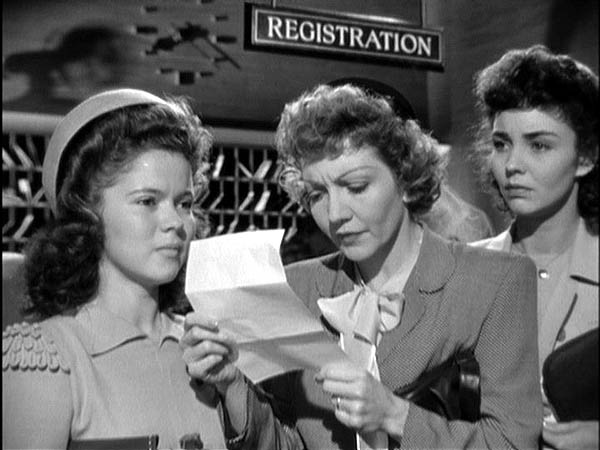
wife is Anne Hilton (Claudette Colbert).She has a teenage daughter nicknamed Brig (Shirley Temple – lured out of
retirement) and a bachelorette named Jane (Jennifer Jones).Brig is perky and Jane is looking for
love.They take in a boarder, the crusty
and irascible Col. Smollett (Monty Woolley).He eventually bonds with their comic relief bull dog Soda (who has his
own theme music!).The movie starts off
unexceptionally until “Uncle Tony” (Joseph Cotton) shows up to liven things
up.Cotton hams it up as the playboy who
flirts openly with his best friend’s wife – Anne.Meanwhile, Jane is mooning all over him.Some of it is pretty creepy (especially with
the numerous close-ups).This is fodder
for a 1970s soap opera (or 1980s porn), except this is 1944.This means both Tony and Jane have zero
chance.
your husband is MIA
When Tony returns to the Navy (and the movie goes flat again), Jane gets a job as a nurse in a rehabilitation
hospital.(See that, ladies in the
audience?)The war comes home when Anne
receives a telegram telling her that her husband is MIA.She faints.That Sunday (in the non-bombed out church) hymns are followed by a
sermon that quotes from the last
stanza of the “Star Spangled Banner”.“And conquer we must, when our cause is just /and this be our motto – in God is our
trust.”Kudos!
the Walkers acting like they are in love
Jane falls in love with the sad
sack grandson of the Colonel.They are
estranged because Bill (Robert Walker – Jones’ real life soon to not be
husband) washed out of West Point.He
has enlisted in the Army because redemption is a powerful Hollywood force.At one point, they take romantic refuge in a
barn during a rain storm.How
original!They are to be married when
(oops, if) he returns from the war.Their parting at the train station is iconic (and parodied in
“Airplane!”)The running alongside the
train is preceded by a montage of conversations intended to typify the home
front. “Now go honey,and don’t look
back”.“Suits me if they tax me
100%.”Guess who dies at Salerno.
Jane works with a wounded,
embittered vet.Could he end up filling
the hole in her heart?The kindly
psychiatrist tells Jane (and the audience) that they “must not live in the
past.There is a whole wide broken world
to be mended.”All these noble
characters need balance, right?Serving
this role is Anne’s friend Emily Hawkins (Agnes Moorehead).She represents the members of the public who
want to ignore the harsh realities of the war and avoid sacrifices.Anne gets to have a cathartic “get out of my
house” moment which is crowd-pleasing.
the wolf and his prey
Anne gets a job as a welder,
naturally.This is necessary so she can
meet a Polish woman who proceeds to give us her back-story of coming to the “fairy
land across the sea”.She ups the
treacle by quoting from the poem on the Statue of Liberty.Gag!This movie gets the Star Spangled Banner and the Statue of Liberty into the script.Can you say propagandistic patriotism?The film closes with one of the great
tear-jerking conclusions.They are
tears of joy.In a sense, Bill died so Tim could live.I did mention he was declared MIA, not KIA, right?
“Mrs. Miniver” is the superior
movie.It was surprisingly good.It is not overly patriotic or
propagandistic.The dialogue is crisp.The acting is very good.Noone embarrasses themselves.The family dynamic is realistic, if
prosaic.The death twist is a nice touch
considering someone had to die.The plot
is very old school.The subplot of the
rose competition is positively quaint.The themes are simplistic:the
effects of the war on families and civilians are in it, too.It does its job admirably.It is no wonder the anti-isolationist
Franklin Roosevelt ordered it rushed into the theaters.
“Since You Went Away” tries too
hard.It is an average home front movie
which for God knows what reason got way more respect than it deserved.Some of its accolades are
head-scratching.Max Steiner certainly
did not deserve an Oscar for his trite, string-pulling music.In fact, the movie opens with sappy music and
never goes beyond that.Even more
perplexing was the Academy Award nomination for Jennifer Jones.Her performance is nothing short of
laughable.Some of the other
performances are strong (Woolley, Cotton, Moorehead, the bull dog), but overall
this is not a well-acted film.The movie
spends a lot of effort bludgeoning the audience with messages and they are not
subliminal.Here are a few:don’t give up hope/women can help in the war effort/someone needs to help with
rehabilitation/women should remain loyal to their soldier
men/we all have to make sacrifices.These probably struck a chord during the war, but they seem simplistic
today.The movie is also highly
predictable and clicheish.For instance,
when Smollett misses Bill’s send-off, Bill is dead meat.Smollett coming to terms with Soda is also
high on the cliché meter.