Showing posts with label dueling movies. Show all posts

Tuesday, June 24, 2014

DUELING MOVIES: Gung Ho! (1943) vs. Darby’s Rangers (1958)


VS.

                I like small unit movies, especially when they bring light to actual units that performed ably in war.  “Gung Ho!” and “Darby’s Rangers” are two of those types of movies.  Each covers the formation, training, and combat involvement of two storied World War II units.  “Gung Ho!” is the story of the Second Marine Raider Battalion led by Lt. Col. Evans Carlson and its raid on Makin Island.  “Darby’s Rangers” is the tale of the 1st Ranger Battalion led by Maj. William Darby and its involvement in the Battle of Cisterna in Italy.

                “Gung Ho!” is based on a magazine article written by one of the participants in the raid.  One of the technical advisers was Carlson.  It was directed by Ray Enright.  The Marine Corps cooperated with the film, but insisted that Carlson not be singled out.  The main character is Col. Thorwald (Randolph Scott).  His call for volunteers results in the usual Hollywoodized heterogeneous unit that includes a hick, a Brooklynite, a minister, and two dysfunctional brothers in love with the same girl.  It also is multi-ethnic with a Greek, an Irishman, an Hispanic, and a Chinesese-American.  Each volunteer is asked “why do you want to kill Japs?”  One of the correct answers in the montage is: “I just don’t like Japs”.  Carlson adopts the Chinese motto of “gung ho” which means “work in harmony”.  He is a “players’ coach” who cares about his men and listens to them.


                The training montage has Chet Huntley (if you know who that is - hail, fellow baby boomer) as its narrator and sounds like an instructional film as he describes why they are learning certain things.  The men are taught unsporting methods that feature dirty tricks like spitting in your opponents face.  Thorwald counsels his men that they will have an advantage because the Japs lack initiative.  (Actually true.)  The training on Hawaii allows the film to remind the audience of the destruction of Pearl Harbor with some actual footage.  They are assigned a mission to raid a Japanese held island.  They get there via two submarines. The assault is action-packed.


                The movie is as accurate as could be hoped for.  Thorwald is pretty close to Carlson in personality and tactics.  Carlson had learned guerrilla tactics while serving in China.  He did adopt his slogan from the Chinese.  None of the other characters in the film are based on real people.  This was a dubious decision as one of the Raiders was Sgt. Clyde Thompson whose valor in the battle resulted in him becoming the first Marine to earn the Medal of Honor in WWII.  The final assault on Butaritari (one of the Makin Islands) is highly fictionalized.  They did get there via submarines, but there was no depth charging.  The ridiculous painting of the American flag to lure the Japanese aircraft to fratricide was obvious bull crap.  The movie was not interested in portraying the fact that nine men were accidentally left behind and the difficulties with the egress in high seas. The movie ends with the impression that the raid was an unqualified success.  In reality,  the goals of acquiring intelligence and bringing back prisoners were unfulfilled.  Not surprisingly, the movie makers were not interested in surmising that the raid actually had the unintended consequence of waking the Japanese up to the weaknesses of their island defenses.      


RANDOLPH SCOTT!
                “Gung Ho!” is surprisingly good.  There is lots of action and if you like stabbings, this movie is for you.  The acting is fine, if a bit earnest.  Randolph Scott is his usual stolid self and Robert Mitchum makes the last of his seventeen acting credits for 1943.  There’s nothing special about the cinematography, but what would you expect from a standard 1940s war movie?  Similar could be said about the unexceptional score.  The sound effects are good, however.  The screenplay does avoid clichés which is refreshing and the linear plot flows well.  Also refreshing is there is only one romance and it is minor (just enough for the movie poster).  It is propagandistic and patriotic, but not cloyingly.  Although the movie does close with Thorwald giving another speech about the fight for freedom as patriotic music swells.  The themes of teamwork, showing initiative, and fighting for American values are clearly advanced.

                “Darby’s Rangers” was released in 1958.  William Wellman (“The Story of G.I. Joe” / “Battleground”) supposedly made it in exchange for studio funding for his pet “Lafayette Escadrille”.  The studio insisted on a movie similar to the wildly popular “Battle Cry”.  The screenplay was “suggested” by the eponymous book by Maj. James Attieri.  The movie was bizarringly titled “The Young Invaders” in the United Kingdom.    The choice of black and white was done to help with the blending of archival footage.

                The movie opens with Maj. Darby (James Garner in a role originally meant for Charleston Heston) taking command of a new unit intended as an American version of the British Commandoes.  He describes the Rangers as the “tip of the javelin”.  On his wall are slogans like “Danger to a Ranger is no stranger”.  He picks a heterogeneous unit and then makes the head-scratching decision to billet the men with British families.  How this will toughen them for suicide missions is perplexing.  It does put them is in contact with British females for some truly gag-worthy romantic subplots.  One of these has a recruit courting the daughter of their crusty British drill instructor.  The highlight is when the designated unit villain leers at a British wife and says “I hope I can fit in” while holding a phallic symbol!  The training montage features the most pratfalls I have ever seen in a war movie and this is not even supposed to be a comedy.  Good drinking game – take a drink every time someone falls. 
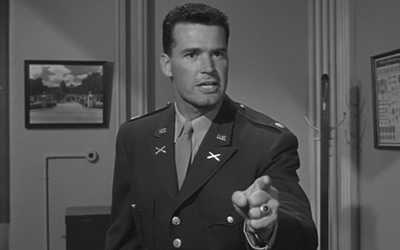

"To be an effective fighting force, my men must
have a lot of sex!"
                One hour into the movie we get our first taste of combat in North Africa and it lasts two minutes.  That’s right, we sat through an hour of lame-ass romantic subplots and this is our reward!  From there it’s on to Italy for an extended battle with a sniper and some laugh out loud deaths.  Again, I had to check to make sure this was not a comedy.  We get the clichéd appearance of Axis Sally:  “Don’t get caught, Chicago gangsters.  You’ll be shot.”  A Lt. Dittman (Edd Byrnes – if that name does not cause a flutter, you were not a teenage girl in the 50s) to be a book-following foil to the lenient Darby.  And to show that just because you are fighting in Italy does not mean you can’t have great hair.  This also allows the movie to add one more romantic subplot.  Arrrgh!  Join the Rangers – get a dame.  The film “builds” to the big set piece which is the Battle of Cisterna (part of the Anzio campaign).  If you think this is going to pull the movie out of the trash can, think again.


                The First Ranger Battalion deserved an historically accurate movie.  This movie is not it.  The reason for its creation is accurate, but not the specifics of how it was Gen. Truscott’s idea.  The training was intense, but it was highly unlikely they had a lot of time for wooing British birds in their own homes.  The movie skips over the unit’s involvement in Dieppe, Algeria, and Tunisia.  It was noted for raids behind enemy lines.  Then it was sent to Italy and its mission changed.  Similar to the 1st Special Service Force (The Devil's Brigade), which also fought at Anzio, Darby’s Rangers were improperly used as shock troops.  Its mission at Cisterna was to capture the town and hold it until the main force arrived.  Seventeen Panzer IVs had something to say about that.  The battle lasted seven hours and only 6 of 767 members survived and the unit was disbanded soon afterward.  The disaster had no silver lining as the movie claims. 


                This is a terrible movie.  One of the worst I have seen.  It is also very disappointing because the 1st Ranger Battalion did not get the recognition it should have.  The ridiculous plot is degrading.  The acting is poor.  It has the usual pompous Max Steiner score.  (Is there anything in war movie history that has stood the test of time worse than Max Steiner scores?)  The sets are back lots and decidedly fake looking.  The movie is tedious and the action is anemic and very unrealistic.  All ten minutes of it.  At one point, they attack an 88 and the Germans leave their trenches to make a banzai attack.  Dittman uses a mortar like a grenade launcher.  Wellman clearly did not have his heart in the movie and sadly his “Lafayette Escadrille” was not the career capper that he hoped for.  Wellman stopped making movies in 1958 and when you look at this 1940s crap stuck in the late 50s when war movies were making the transition to cynicism, you can see that he had overstayed.  Most of the blame must go to the studio who insisted that audiences wanted war soap operas.
                  In conclusion, although "Gung Ho!" is an average WWII film, it is superior to the lame-ass "Darby's Rangers".


GRADES:
Gung Ho!  =  C
Darby’s Rangers  =  F-

Gung Ho! trailer


Wednesday, May 28, 2014

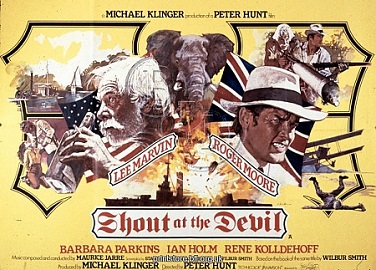
DUELING MOVIES: Shout at the Devil / Murphy’s War


vs.


                In the 1970s a pair of action movies came out that dealt with obsessions to destroy a German warship.  One is set in WWI Africa and the other is set in WWII South America.  Both are buddy films. 
“Shout at the Devil” was released in 1976 and is a typical 1970s action/adventure with comedy infused to match the tastes of that decade.  It’s a British film directed by Peter R. Hunt.  It purports to be based on a remarkable true story.  It is set in Zanzibar in 1913.  It’s basically a buddy film starring Lee Marvin and Roger Moore.
                A British nobleman named Sebastian Oldsmith (Moore) meets up with a hard-drinking American named Flynn O’Flynn (Marvin) in tropical Africa.  Their relationship starts off rocky as O’Flynn steals all of Sebastian’s money.  O’Flynn is an ivory poacher who is on the outs with the local German forces led by a commander named Fleischer.  When O’Flynn is ambushed by the Germans, Sebastian rescues him from a crocodile.  Yes, it’s that kind of movie.  Later, O’Flynn’s boat is rammed by a German warship named the Blucher.  The two buddies wash ashore and eventually reach O’Flynn’s daughter’s home.  Rosa (Barbara Parkins) nurses the malaria-suffering Sebastian back to health and they fall in love.  Naturally, O’Flynn is opposed to the relationship and a comical fistfight ensues.  O’Flynn is often drunk in the movie and one has to wonder if Marvin was “acting” drunk.  He is unable to prevent the marriage and subsequently the Oldsmiths have a child.
 
Sebastian and Flynn discussing the
white man's burden
 
                After raiding Fleischer’s camp, the German retaliates by burning O’Flynn’s home while the men are away.  The Germans kill the baby, but strangely leave Rosa alive and vengeful.  The trio decide to aid the British Admiralty by sinking the Blucher.  They hatch a plan to blow up the ship, but complications arise.  The movie builds to a rousing finale.
                “Shout at the Devil” is all over the place.  It has action, violence, romance, humor, fistfights, explosions, villains, etc.  Unfortunately, none of these elements are special and the blend is uneven.  The movie does not know what it wants to be.  The first half is a farce, then the baby gets killed and it becomes a revenge flick.  Neither half is strong.  The whole movie has a large amount of silliness, mostly in the form of Marvin chewing the scenery (the movie does have some awesome scenery, by the way).  I am a big Lee Marvin fan, but he looks like he did not take the production seriously.  You will enjoy the movie more if you do like Marvin apparently did, drink heavily during it.
                As far as the claim that it is based on a true story, you better take that with a grain of salt.  There was a Battle of Rufiji Delta in which a German light cruiser the SMD Konigsberg was blockaded and then sunk by two British monitors.  This does not sound anything like what happens in the movie.
                “Murphy’s War” is a Peter Yates film (his only war movie) and was released in 1971.  It was set and filmed in Venezuela on the Orinoco River.  It stars Peter O’Toole  (three years after “The Lion in Winter”).  Murphy was a crewman on a British freighter that is sunk on the river by a German u-boat (actually an American sub sold to the Venezuelan Navy).  He was the sole survivor as the Germans machine-gunned the crew.  He recovers at a nearby missionary settlement where he makes the acquaintance of a female Quaker doctor named Hayden (Sien Phillips - O’Toole’s then wife).  The pilot of a floatplane that had been shot down by the sub washes ashore and is murdered by the u-boat captain when his men raid the settlement.  Murphy vows revenge with the help of a handy man named Louis (Phillippe Noiret).  They recover the plane and Murphy learns to fly it.  His plan is to drop some rather large Molotov cocktails on the sub.
                “Murphy’s War” is well made.  The cinematography is showy.  The opening scene of the sinking of the ship is very busy with quick cuts and some distorted POV from Murphy’s perspective (O’Toole did his own stunts amidst the burning oil, explosions, and machine gun bullets).  The scene is quite effective in establishing that the Nazis are evil and deserve vengeance.  Another bravura scene is the one where Murphy learns to fly the plane.  I doubt he did the stunt flying because it is pretty hairy.  It is an extended scene which is typical of a movie that takes its time getting where it’s going.  It is also typical of the implausible nature of much of what happens in the plot.  Cinematic baubles can only partly mask the lack of reality evidenced in the movie.  To advance the obsessive revenge angle (and to get the movie to feature length), the film has several plot developments that defy logic.  Starting with what the hell is a u-boat doing up a South American river in the last weeks of WWI?  So turn your logic off and enjoy.  There are some entertaining action sequences that will leave war movie fans smiling (and shaking their heads).  Accuracy is not a factor as it is obviously not based on a true story.  In order to add the irony that the war is nearing an end and yet both the u-boat captain and Murphy are pursuing hostilities with avengeance, the movie has a u-boat operating in Venezuela.  This would have been extremely unlikely since the u-boat fleet had been pulled back long before April, 1945. 
a shot from the O'Toole's wedding album

                O’Toole has a fun time and reminds of Marvin (partly because I would not be surprised if his performance was not alcohol-enhanced as well).  An interesting dimension to his character is there is an allusion to his having been a poor crewman so his motivation is a bit puzzling.  His wife is the rare strong female character in a war movie.  She is not in the movie to be a bimbo.  She represents sanity and refers to the charming Murphy as a “mindless bastard”.  Noiret is appealing as Murphy’s Sancho Panza.  The Germans are bland and the captain is straight out of central casting – handsome, blond, and malevolent.  (He reminded me of the u-boat captain from “The McKenzie Break”.)  The reason to see the movie is not for the acting, it's for the three attempts on the sub.  Each is as delirious as Murphy himself. 
                Which is the better movie?  Clearly “Murphy’s War”.   Sometimes one star is better than two.
Shout at the Devil  =  D+
Murphy’s War  =  B- 

Monday, May 13, 2013

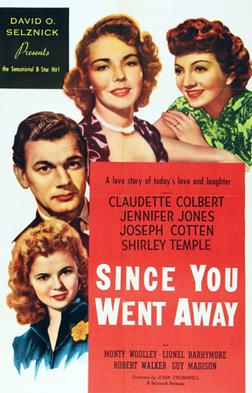
DUELING MOVIES: Mrs. Miniver vs. Since You Went Away


VS.


             “Mrs. Miniver” (1942) and “Since You Went Away” (1944) are the two most celebrated home front war movies produced during WWII.  “Miniver” is set in England during the Fall of France, 1940.  “Since” is set in the USA in 1943.  Both cover “typical” families and depict the war’s impact on them.  There are many similar elements and characters.  Both have romances ending in tragedy, crusty upper class curmudgeons, religious motifs, and a sturdy matron at the center.  Both are propaganda masterpieces aimed squarely at American audiences.
                “Mrs. Miniver” was directed by William Wyler ("The Best Years of Our Lives").  He had been born in Germany and meant for the film to shake the American public out of its isolationist feelings.  By the time the movie came out, Pearl Harbor happened.  The movie still had the effect of boosting the war effort and served as a “why are we supporting England?” explanation.  Churchill supposedly praised it as “propaganda worth a hundred battleships”.  It was nominated for 12 Academy Awards and won for Best Picture, Best Director, Best Actress, Best Supporting Actor, Best Cinematography, and Best Screenplay.  It was a huge box office success.

                “Mrs. Miniver” starts in 1939 before England has declared war.  It is set in a village outside of London.  The Miniver’s are an upper class family who are leading an idyllic life.  Kay (Greer Garson) is the heart of the family.  Clem (Walter Pidgeon) is stout and dependable.  They are comfortably married (with their separate beds).  No dysfunction here.  They have a live-in maid and cook.  Their house has a name.  Not exactly the Rowans in "Hope and Glory".
Mrs. M and some roses
 
                The local vicar announces the outbreak of war.  He points out they are fighting for freedom and cannot and shall not fail.  The sermon must have had a great effect because Mr. Miniver takes their motorboat to help evacuate Dunkirk and their son Vin (Richard Ney) joins the RAF.  Before Vin goes off, he starts a relationship with the granddaughter of society maven and village snoot Mrs. Beldon (Dame May Whitty).  It’s your typical opposite philosophies attract scenario.  Vin spouts off about class inequalities and Carol (Teresa Wright) humors him.

the Minivers at church
 
                While Clem is off boating, Kay has to deal with a downed Luftwaffe pilot.  He is arrogant and predicts the terror bombing of cities.  She slaps him.  (This scene was refilmed harsher after Pearl Harbor.)  Being British, she pluckily takes him captive. 
                As though a Nazi with a pistol was not enough, Kay gets a visit from Mrs. Beldon.  She tries to derail the marriage of Vin and Carol.  His blood is not blue enough.  Kay smoothes things over, a little too easily.  There is a great scene with the Miniver family riding out a bombardment in their basement.  They have their upper lips stiff.  The sound and fury are actually superior to “Hope and Glory”.
the air raid
 
                There is a running story line involving a rose competition.  Every year Mrs. Beldon wins, but this year she has a challenge from the train station master Mr. Bellard (Henry Travers – Clarence the angel from “It’s a Wonderful Life”).   For some reason, Mrs. B gets to announce the winner and she suddenly grows a heart and gives the award to Bellard (even though her rose actually won).  Sniff, sniff.

the rose winner
 
                If you are fighting for freedom, then someone has to die for freedom, right?  The death occurs in a strafing attack.  A great special effect of a bomber crashing is followed immediately by a ridiculously unrealistic random bullet.  The funeral takes place in the bombed out church.  The vicar bookends the film with a stirring sermon focusing on “why we fight”.  It is a war of all the people and must be fought in the cities, farms, factories, and hearts.  “This is the peoples’ war”.  Queue “Onward Christian Soldiers”.  Big finish – a V-shaped flyover by the RAF.  The end.  “Buy War Bonds!”
                “Since You Went Away” was released in 1944 and was David O. Selznick’s attempt to replicate the success of his “Gone With the Wind”.   It did not reach that level, but it was a big hit and garnered numerous Academy Award nominations (winning only for Max Steiner’s score).  It was the longest and most expensive MGM production since GWTW.  Selznick based his screenplay on a novel entitled Since You Went Away:  Letters to a Soldier from His Wife by Margaret Buell Wilder.
two bull dogs and Shirley Temple

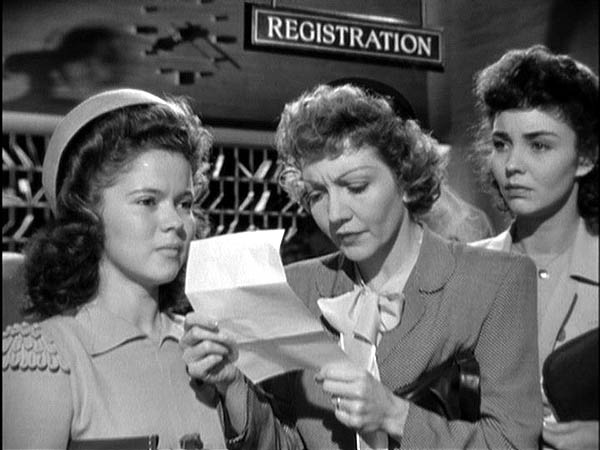
                The movie is set in a typical American town in 1943.  It is the story of “the unconquerable fortress – the American home”.  The star in the window and the empty chair clue us that the man of the house is off to war.  We find out later that he joined to protect “home, sweet home” (queue music).  The wife is Anne Hilton (Claudette Colbert).  She has a teenage daughter nicknamed Brig (Shirley Temple – lured out of retirement) and a bachelorette named Jane (Jennifer Jones).  Brig is perky and Jane is looking for love.  They take in a boarder, the crusty and irascible Col. Smollett (Monty Woolley).  He eventually bonds with their comic relief bull dog Soda (who has his own theme music!).  The movie starts off unexceptionally until “Uncle Tony” (Joseph Cotton) shows up to liven things up.  Cotton hams it up as the playboy who flirts openly with his best friend’s wife – Anne.  Meanwhile, Jane is mooning all over him.  Some of it is pretty creepy (especially with the numerous close-ups).  This is fodder for a 1970s soap opera (or 1980s porn), except this is 1944.  This means both Tony and Jane have zero chance.
your husband is MIA

                When Tony returns to the Navy (and the movie goes flat again), Jane gets a job as a nurse in a rehabilitation hospital.  (See that, ladies in the audience?)  The war comes home when Anne receives a telegram telling her that her husband is MIA.  She faints.  That Sunday (in the non-bombed out church) hymns are followed by a sermon that quotes from the last stanza of the “Star Spangled Banner”.  “And conquer we must, when our cause is just /  and this be our motto – in God is our trust.”  Kudos!
the Walkers acting like they are in love

                Jane falls in love with the sad sack grandson of the Colonel.  They are estranged because Bill (Robert Walker – Jones’ real life soon to not be husband) washed out of West Point.  He has enlisted in the Army because redemption is a powerful Hollywood force.  At one point, they take romantic refuge in a barn during a rain storm.  How original!  They are to be married when (oops, if) he returns from the war.  Their parting at the train station is iconic (and parodied in “Airplane!”)  The running alongside the train is preceded by a montage of conversations intended to typify the home front. “Now go honey,  and don’t look back”.  “Suits me if they tax me 100%.”  Guess who dies at Salerno.
                Jane works with a wounded, embittered vet.  Could he end up filling the hole in her heart?  The kindly psychiatrist tells Jane (and the audience) that they “must not live in the past.  There is a whole wide broken world to be mended.”  All these noble characters need balance, right?  Serving this role is Anne’s friend Emily Hawkins (Agnes Moorehead).  She represents the members of the public who want to ignore the harsh realities of the war and avoid sacrifices.  Anne gets to have a cathartic “get out of my house” moment which is crowd-pleasing. 
the wolf and his prey
 

                Anne gets a job as a welder, naturally.  This is necessary so she can meet a Polish woman who proceeds to give us her back-story of coming to the “fairy land across the sea”.  She ups the treacle by quoting from the poem on the Statue of Liberty.  Gag!  This movie gets the Star Spangled Banner and the Statue of Liberty into the script.  Can you say propagandistic patriotism?  The film closes with one of the great tear-jerking conclusions.  They are
tears of joy.  In a sense, Bill died so Tim could live.  I did mention he was declared MIA, not KIA, right?

                “Mrs. Miniver” is the superior movie.  It was surprisingly good.  It is not overly patriotic or propagandistic.  The dialogue is crisp.  The acting is very good.  Noone embarrasses themselves.  The family dynamic is realistic, if prosaic.  The death twist is a nice touch considering someone had to die.  The plot is very old school.  The subplot of the rose competition is positively quaint.  The themes are simplistic:  the effects of the war on families and civilians are in it, too.  It does its job admirably.  It is no wonder the anti-isolationist Franklin Roosevelt ordered it rushed into the theaters.
                “Since You Went Away” tries too hard.  It is an average home front movie which for God knows what reason got way more respect than it deserved.  Some of its accolades are head-scratching.  Max Steiner certainly did not deserve an Oscar for his trite, string-pulling music.  In fact, the movie opens with sappy music and never goes beyond that.  Even more perplexing was the Academy Award nomination for Jennifer Jones.  Her performance is nothing short of laughable.  Some of the other performances are strong (Woolley, Cotton, Moorehead, the bull dog), but overall this is not a well-acted film.  The movie spends a lot of effort bludgeoning the audience with messages and they are not subliminal.  Here are a few:  don’t give up hope  /  women can help in the war effort  /  someone needs to help with rehabilitation  /  women should remain loyal to their soldier men  /  we all have to make sacrifices.  These probably struck a chord during the war, but they seem simplistic today.  The movie is also highly predictable and clicheish.  For instance, when Smollett misses Bill’s send-off, Bill is dead meat.  Smollett coming to terms with Soda is also high on the cliché meter.

        Mrs. Miniver =  B+
     Since You Went Away =  C


Sunday, December 9, 2012

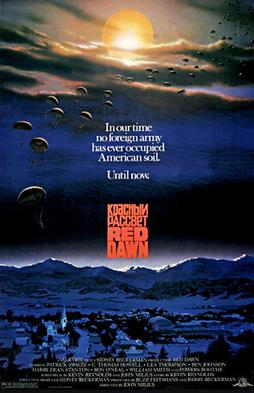
DUELING MOVIES: Red Dawn (1984) vs. Red Dawn (2012)


                Oh, the things a war movie blogger has to do.  One of them is going to see the rare war movie release realizing that it will most likely be terrible (ex. “Battleship”).  I had put off seeing the new “Red Dawn” because it seems a useless remake of a bad film and I have been very busy with soccer.  However, I could not let my public down so I bit the bullet and headed for the theater.  Being a masochist, I also watched the original (which I have to admit I had not seen due to the terrible reviews it got when it came out).  What a day!  I have cemented my place in war movie heaven by spending some time in war movie hell.

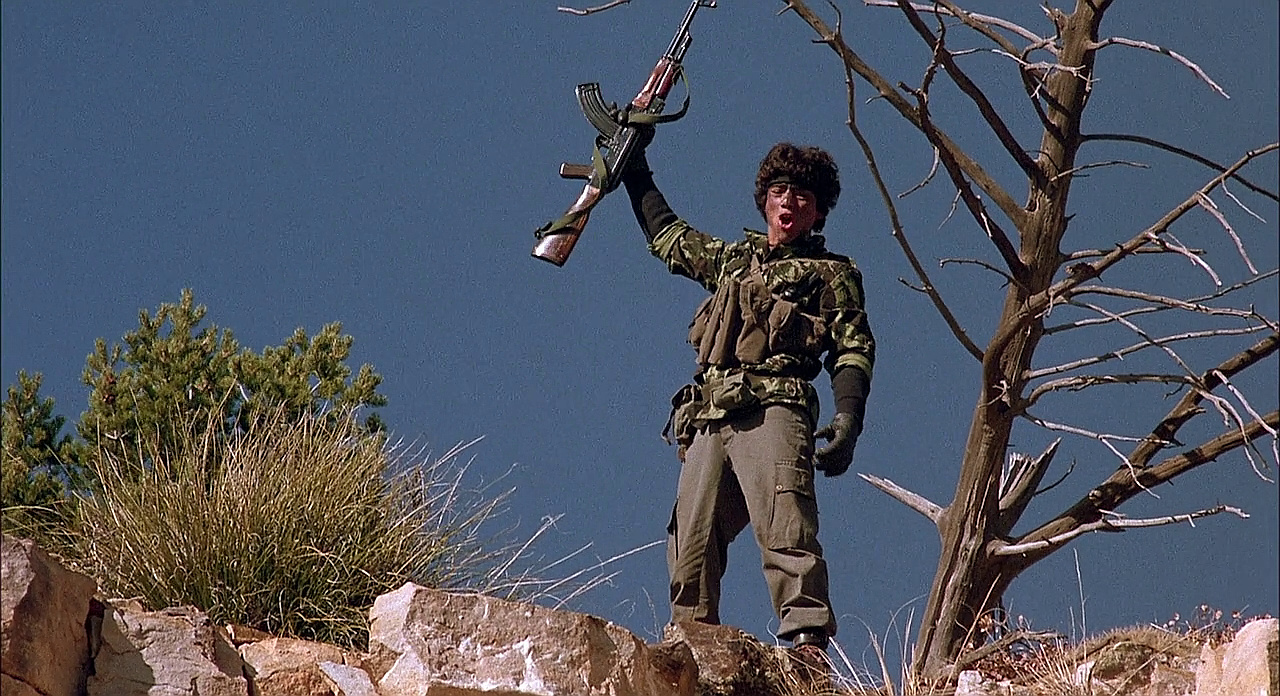
"Wolverines!"
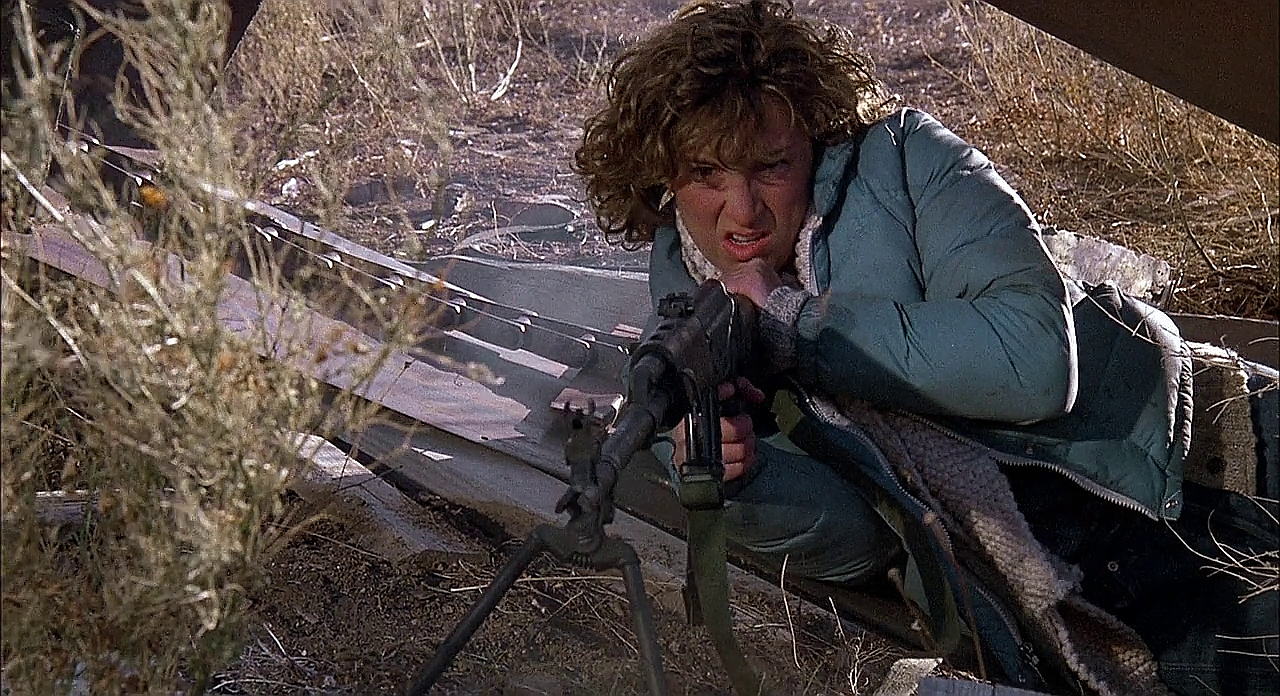
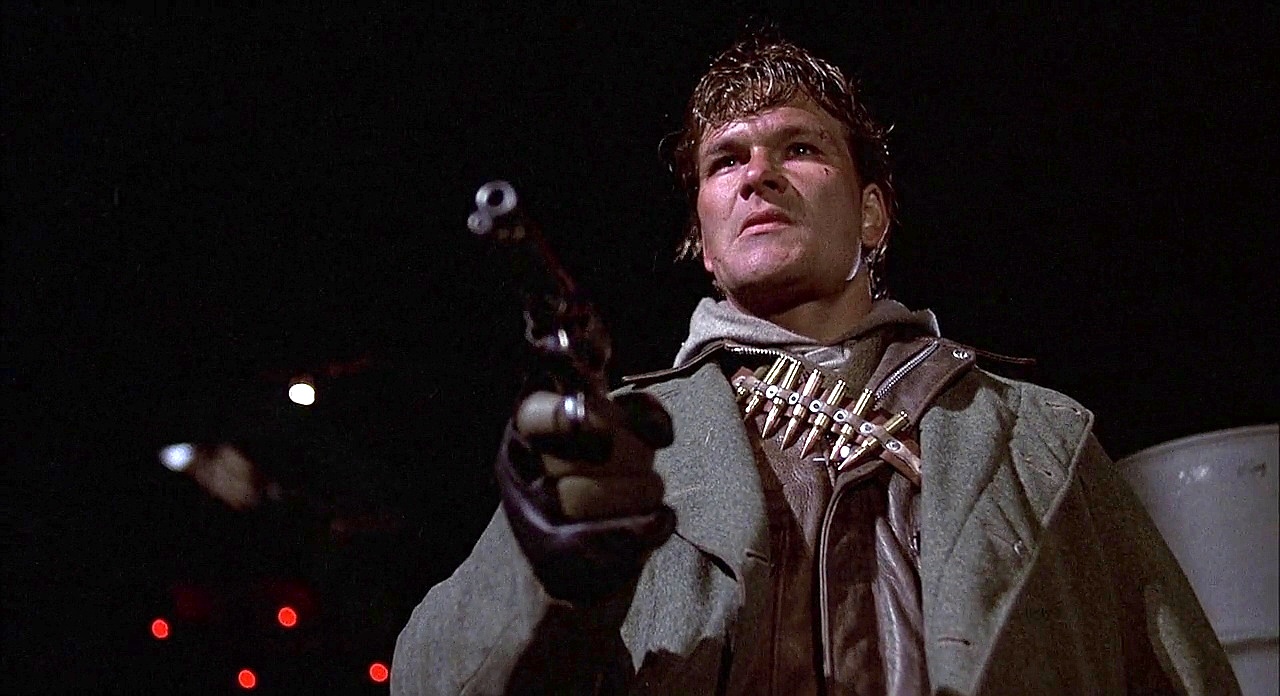
                “Red Dawn” (1984) actually has a pretty good reputation.  Apparently there were a large number of high school boys who saw it in 1984 and there are a lot of conservatives today that remember it fondly since it fit their fantasy of World War III.  It is definitely a curio from the Cold War days.  Specifically, the Russians in Afghanistan days.  The opening scrawl confusingly explains that NATO has dissolved, Mexico has gone communist, and the Warsaw Pact is on the move.  Before you know it, Cuban paratroopers are landing in Calumet, Colorado.  An idyllically all-American town that is of great strategic importance, I suppose.  A few high school boys join the slightly older Jed (Patrick Swayse) in the outdoors.  The crew includes his brother Matt (Charlie Sheen).  After some hand-wringing (and crying), they decide to become survivalists.  The movie is probably required viewing for militias.
Dirty Dance with this you commie bastard
                The town is under occupation and any adults (like Jed and Matt’s father) with balls are in a re-education camp.  Books are being burned.  The weasely mayor is collaborating (he is a liberal).  There are three villains:  the Cuban Col. Bella (who is now on the receiving end of insurgency), a Soviet adviser (who believes in several eyes for an eye), and a counterterrorist expert Col. Strelnikov (the menacing William Smith) brought in to hunt down the insurgents.  When the gang (called the “Wolverines”) kills three Soviets, the commies react by executing civilians including Jed and Matt’s father.  It’s on now.  They are joined by two girls (Lea Thompson and Jennifer Gray) who insist on being treated equally and refuse to do the dishes as teenage boys in the audience snicker.  There is a montage of attacks (including on a Soviet tank crew that stops at a gas station to fill up with regular).
Jed draws down on Strelnikov
                The director brings in Powers Boothe as a downed pilot to provide acting lessons and fill in the audience with how all this conquest came about.  Coming from him it almost seems plausible.  There are some bloody fire fights with old school deaths.  The movie supposedly set a record for body counts, especially for the first PG-13 rated film.  They keep getting whittled down, including the execution of one of their own (the mayor’s son) for swallowing a homing bug.  A couple more go in a surprise attack by vicious looking Soviet choppers straight out of Afghanistan.  The final set piece is Jed and Matt’s two man assault on enemy headquarters as cover for the escape of Danny and Erica to Free America.  Would you believe there is a duel between Jed and Strelnikov?  And an encounter with Bella?  
Jed ambushs some Orientals
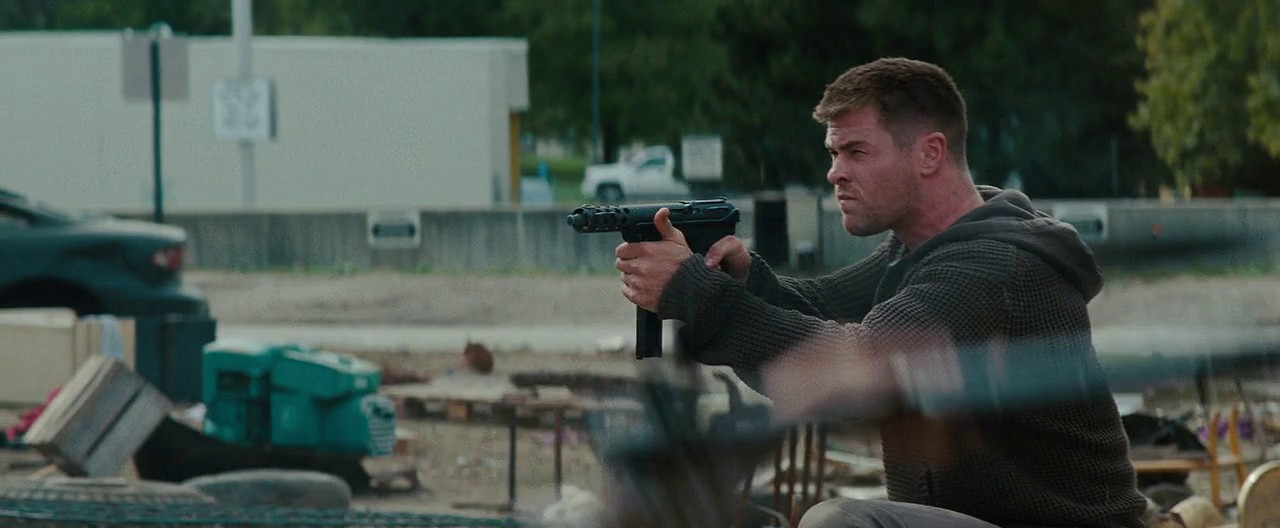
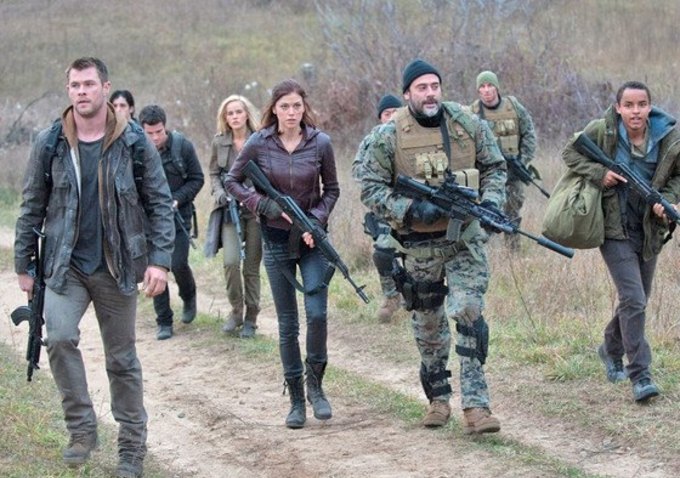
             “Red Dawn” (2012) has the same basic premise and some familiar elements, but differs in many ways, including tone.  The causes of the war are even more WTFish.  Something about all American forces being abroad putting out conflicts and this allows the North Koreans (with their fourth largest army in the world) to swoop in.  Their secret weapon is an electro-magnetic pulse thingy.  Who cares?  Not 14 year old boys.  The brothers are fleshed out a lot more.  Jed (Chris Hemsworth) is a Marine on leave.  Matt (Josh Peck) is the starting high school quarterback.  They are at odds with each other, naturally.  Matt is not a team player.  Each is also given a love interest.  Matt’s is the head cheerleader, surprise!  All he cares about is rescuing her and she isn’t even Megan Fox.  The gang is more heterogeneous and the girls are treated equally from the start.  We get a montage of training  instead of attacks.  Five minutes of montage can transform high schoolers into killing machines.
Wolverines + Special Forces
                The main villain is a Col. Cho.  He is your typical inscrutable oriental villain.  The kind you can’t wait to see die in a nasty way.  The movie also throws in a Russian spetsnaz and a slimy collaborating teen.  Don’t look forward to their cathartic deaths.  Instead of one downed airman, this version drops in three crusty Special Forces types to teach and learn from the Wolverines.
                The big finale also involves an assault on the headquarters, but with the purpose of acquiring a black box that will change the course of the war.  Or so we are vaguely informed.  There is a massive expenditure of ammo and the grand entrance of a tank through the wall of the headquarters.  Hey, it could happen.  There is a much cooler confrontation between Jed and Cho than between Jed and Strelnikov in the original.  
                How to compare the movies?  1984 has more explosions than 2012 (30-23) which is surprising.  2012 has many more crash-crazy car chases.  1984 drowns 2012 in tears.  It is one of the weepiest movies I have ever seen.  Even after they become tough warriors, they still bawl at the drop of a hat.  And I’m not talking about the girls.  There is a scene where Swayse and Sheen cry as they see their father for the last time that is hilarious!  
 
                1984 has many more terrible acting performances.  You can argue that Swayse and Sheen became good actors, but they certainly are not there yet.  The movie is one of the most poorly acted films I have ever seen.  The dialogue does not help.  At one point one of the gang actually says “Things are different now”.  You think?  The acting in 2012 is tolerable.  Hemsworth dominates every scene.  He is charismatic.  The rest of the cast does not stand out, but does not embarrass itself (except Peck who is wooden).  The dialogue has some groaners.  They are told “you made a difference”.  One of the special forces stoically states “it’s a good day to die”.  There’s the usual “I’m not going to leave you” altruism and the “you fucked with the wrong family” epithet for a villain.  You also get several talkie dysfunctional brothers’ dialogues.  Kudos to 2012 for one unexpected death similar to Samuel Jackson’s in “Deep Blue Sea”.

                Cinematography goes to 2012 unless you get sick watching hand-held, quick cutting, video gamesque camerawork.  1984 is fairly tame in that respect.  It doesn’t even have the slo-mo the 1980s are noted for.  The score duel goes to 2012 also.  It is revved up and surprisingly does not have a slew of soundtrack worthy hits.  1984 is more cheesily backed.
 
                As far as realism, why argue whether dog shit or cat poop smells worse?  With that said, no plot could top North f***ing Korea invading the U.S.  And you put clips of Obama to imply this could happen in the near future!  In for a penny…  Of course, as you might already know, the original villains were the Chinese until the makers were contacted by Walmart (I only made up the Walmart part).  Why couldn’t these high schoolers battle aliens or zombies?  Something that could actually happen.  By the way, how does a North Korean fighter jet participate in a battle in America?  Did it launch from one of those North Korean aircraft carriers?  1984 also featured enemy jets, by the way.

                In conclusion, “Red Dawn” (1984) was worse than I expected and “Red Dawn” (2012) was better.  2012 has some good action of the modern frenetic variety.  The kind where you don’t have the foggiest idea who just got killed, but you’re pretty sure it should be everyone.  It improves upon the original in almost every way and does not suffer from the common "what the hell is the purpose of this remake" conundrum.  It’s just a shame it had to demonize those nice North Koreans.  I hope it doesn’t piss them off to where they might invade us.  The makers of the film will be held accountable if that happens.  It is not wise to poke a chihuahua.

Red Dawn (1984) =  D
Red Dawn (2012) =  C+


Thursday, August 9, 2012

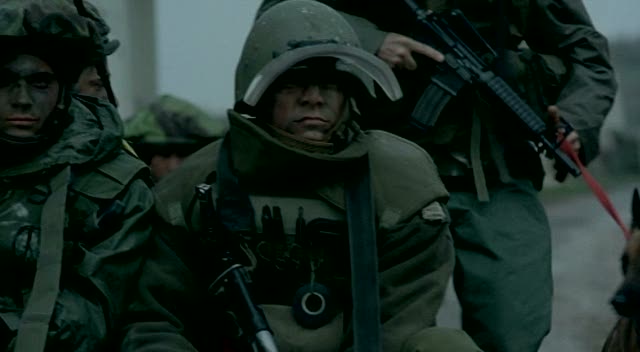
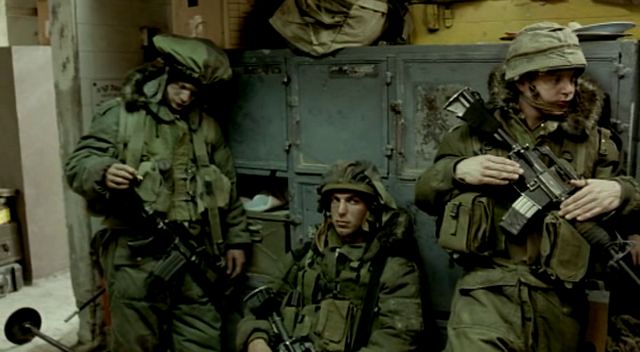
DUELING MOVIES: "Lebanon" vs. "Beaufort"


                The Lebanon War has been fodder for three significant war movies:  “Lebanon”, “Beaufort”, and “Waltz with Bashir”.  Two of them are good movies, one is a masterpiece.  All three are Israeli films with subtitles.  The Lebanon War began June, 1982 when the Israeli Army invaded southern Lebanon.  The goals were to expel the PLO, remove Syrian influence, and install a pro-Israel, Christian government.  The war was messy with the IDF battling the PLO, Syrian Army, and Muslim Lebanese.  The Israelis occupied southern Lebanon and surrounded the PLO in West Beirut.  A negotiated free passage was arranged for the PLO to evacuate Lebanon.  Things began to sour for Israel after the assassination of the Christian they had put into power – Bachir Gemayel.  The outrage that resulted from Israeli complicity in the massacres in the Sabra and Shatila Palestinian refugee camps, forced the IDF to pull out of Beirut.  The Israelis remained in southern Lebanon for another eighteen years.  The guerrilla war waged by Shi’a militant groups eroded Israeli public support for the war.  In 1985, most of the IDF was withdrawn from the country, but Israel retained control of an eight mile wide security zone along the border.
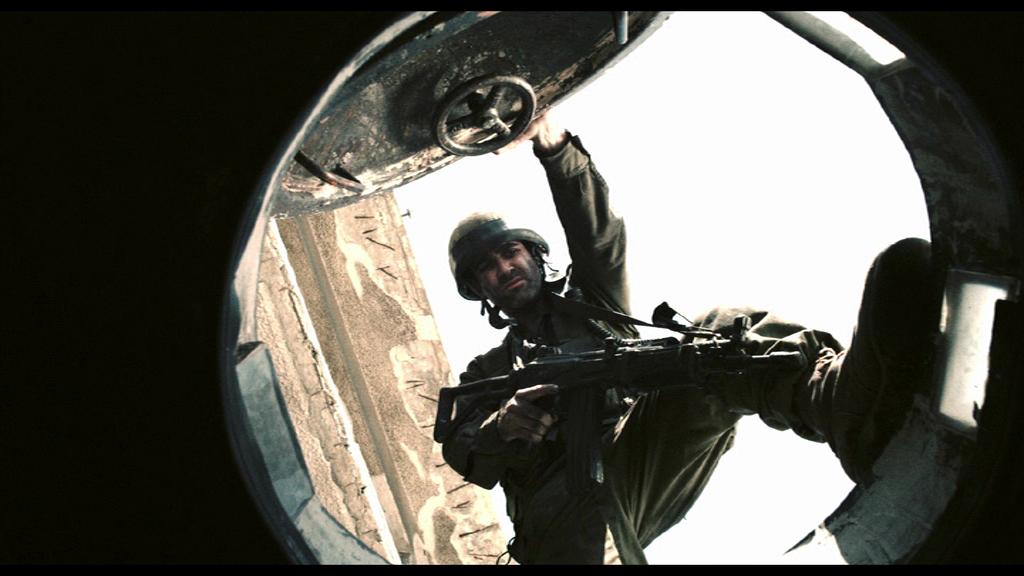
                “Lebanon” is set on the first day of the war.  It is an autobiographical tale of a tank gunner and his comrades in a Merkava tank.  Virtually the entire movie takes place inside the tank or views from inside the tank.  The movie opens with Shmulik’s (Yoav Donat) arrival as a new crew member.  The movie quickly developes into a small unit movie.  The crew of four is dysfunctional.  Azzi (Itay Tiran) is the tank commander who is not comfortable with the responsibility.  Hertzel (Oshri Cohen), the loader, is a mouthy malcontent.  Yigal (Michael Moshonov), the driver, is tightly wound.  
Gamil from guess where
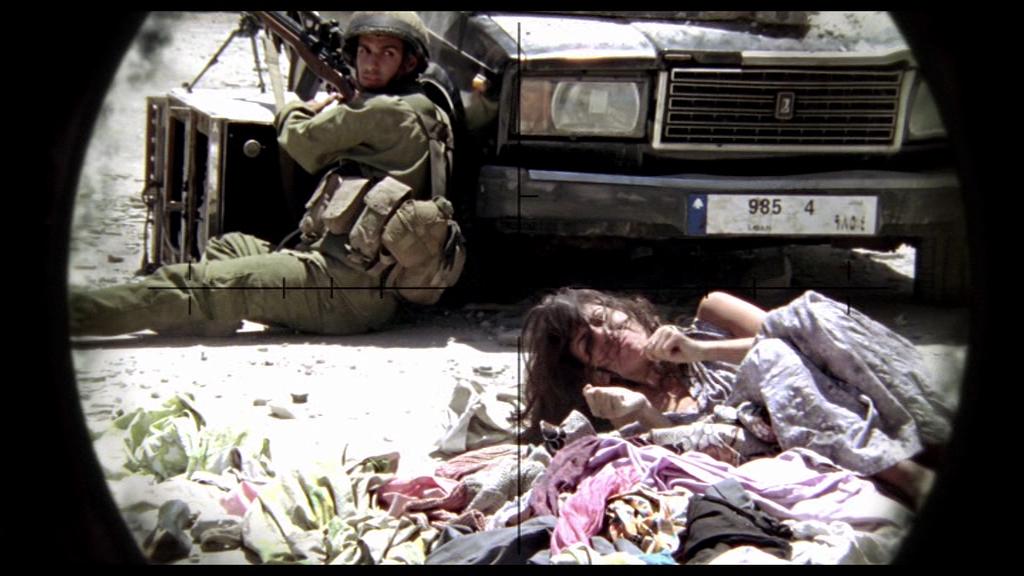
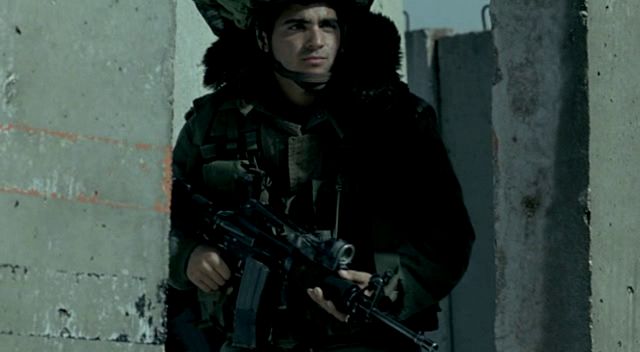
 The tank is ordered to support a paratrooper unit led by gung-ho Gamil (Zohar Shtranza).  The tank does not mesh well with the elite paratroopers.  Shmulik freezes in their first action and cannot bring himself to fire on a car and a paratrooper is killed as a result.  He had never fired at a human target before.  The dead body is placed in the tank.  Later (having learned his lesson), Shmulik does not hesitate to fire on a truck which turns out to be driven by an innocent chicken farmer.  War is hell and confusing.
war through a gunsight
war can be confusing
                They move into a town.  There are dead civilians everywhere.  Gamil calls for the use of phosphorous shells (but since they are against international law) he refers to the weapon as “flaming smoke”.  They begin to encounter “terrorists” as they call them.  A Syrian fires an RPG at the tank and dazes them.  He is captured and chained inside the tank.  At this point, the crew wants out.  They are not heroes.  Even Gamil panics as they get surrounded.  The paratroopers are saved by following a Mercedes driven by some Christian Lebanese.  The tank is left behind and comes under fire. Yigal loses it and starts crying for his mom.  Shmulik is forced to take command and the tank plows forward. 
                “Lebanon” is based on the director’s (Samuel Maoz) experiences as a young tank gunner in the war.  He chooses to give us a “tank’s eye” view of war.  Much of the movie is seen through the tank’s sight.  The sound effect of the turret hydraulics adds an eerie touch. This POV approach is interesting.  What he sees, we see.  And what he sees is war undiluted.  The scenes inside the tank are also undiluted.  The inside of the tank (although too spacious) is appropriately groddy.  It is hot, they are sweating.  The themes are the corrupting influence of war, the fogginess of combat, and conscripts don’t always develop into hardened veterans.  The movie does not show IDF soldiers in a positive light.  The criticism of this depiction seems to be warranted because really no one  (including Gamil) lives up to the image of the disciplined, tough Israeli soldier.
Libratti
                “Beaufort” takes place at the end of the war.  Beaufort was an old Crusader fort captured by the Israelis early in the war.  It became a strategic position in the security zone and was occupied by an Israeli garrison for eighteen years until withdrawn from in 2000.  The movie is based on the eponymous novel and covers the last few weeks.  It concentrates on the commanding officer, a twenty-something named Liraz Libratti (Oshri Cohen), but it falls firmly in the small unit subgenre and the “who will survive?” subsubgenre.
Ziv dressed for a job
waiting out a mortar barrage
                The movie opens with the arrival of a bomb disposal expert named Ziv.  He is helicoptered in to disarm a “device” threatening their supply route.  Ziv proceeds to get lost in the labyrinthian corridors of the fort.  His encounter with the bomb is reminiscent of the opening of “The Hurt Locker”.  After this journey outside the fort the movie settles into the claustrophobic confines of the installation.  The men are looking forward to going home, but the enemy (Hezbollah) are intent on making it look like their tails are between their legs as they leave.  The faceless enemy use rockets against the outposts.  It becomes apparent that not all of them will be going home alive.  There are similarities to the documentary "Restrepo".
                As losses mount and abandonment of the fort becomes more likely, disillusionment develops as Libratti and others question what was the point of holding the fort to begin with.  This aspect of the film reminded me of "Hamburger Hill"  This is amplified by the rumor that the fort was originally assaulted in a case of miscommunication after the high command had countermanded the order.  The situation has a latter part of Vietnam feel to it as the soldiers reference the public’s increasing opposition to the buffer zone.  The Four Mothers Movement (an anti-war organization created by mothers of IDF soldiers killed or stuck in Lebanon that put pressure on the government to fulfill it's promised withdrawal)  is specifically mentioned and Ziv’s father gives an interview lamenting his failure to instill an “instinct of fear” in his son.
                Although Libratti is the main character, the unit of heterogeneous soldiers is fleshed out.  They are a bit stereotyped, but not embarrassingly so.  Libratti is the most complex.  When we first meet him both his men and the audience question his leadership qualities, but although he does make some mistakes, his loyalty to his men and sincerity become apparent.  The second strongest personality is Koris (Itay Tiran) who is the clichéd cynical, embittered soldier.  He clashes with Libratti and argues that a good officer would disobey bad orders.  Oshri (Eli Eltonyo) is the friendly romantic.  Shpitzer (Arthur Faradjev) is the guy who could have been a classical pianist.  You get the idea.
                “Beaufort” is well acted.  The soldiers behave more realistically than the tank crew of “Lebanon”.  The dialogue is stronger and there is some soldier humor.  The cinematography is interesting, although not unorthodox like in “Lebanon”.  There is some effective use of hand-held to follow the movement of the men.  They are similarly claustrophobic.  It is more political and more of a message movie.  The message is the futility of war and how politics can even effect a small unit.  In spite of this, “Beaufort” was not as controversial as “Lebanon” because it questions the leaders, not the soldiers.  Whereas “Lebanon” traces the disintegration of a unit under pressure, “Beaufort” concentrates on coping.  Both are studies in command, but Libratti’s evolution is much more interesting and logical than that of Jamil and Azzi.
                In conclusion, “Lebanon” and “Beaufort” are good companions.  I knew very little about the Lebanon War before viewing them.  These movies (plus some research) have been good tutorials.  You can clearly see why the war has been called Israel’s Vietnam War.
Grades:  Lebanon =  B
               Beaufort =  A- 
Lebanon trailer

Lebanon full movie


Beaufort trailer