Showing posts with label WWII North Africa. Show all posts

Thursday, December 22, 2022

SAS: Rogue Heroes (2022)


                I had been waiting for this series and it finally got to me via Goran Hedlund.  The 6-episode series was made for the BBC and was one of the most costly projects in BBC history.  It also premiered on EPIX.  The director was Tom Shankland who is noted for other TV series.  It was filmed in Morocco.  They had a snake wrangler to clear the sets, but even then a sleeping asp was found sleeping under a chair causing a minor panic.  The crew included 50 stunt men.  They made use of Me-109 mockups, like in the “Battle of Britain”.  The series was written by Steven Wright.  He researched using Ben Macintyre’s “Rogue Heroes:  The History of the SAS, Britain’s Secret Special Forces Unit That Sabotaged the Nazis and Changed the Nature of Warfare”.  He also used first-person accounts and interviewed the veteran Mike Sadler (one of the characters).  He provided stories that were not included in Macintyre’s book.  Each episode starts with the disclaimer:  “Based on true story, the events depicted which seem most unbelievable… are mostly true.”  Cheeky, but true.  Knight insists that the more outrageous the incident, the more likely it actually happened. 

                The first episode is set in May, 1941.  It leads with snare drums on the soundtrack.  Before I can finish shaking my head at this trope, here comes an AC/DC song as a convoy crosses from Cairo to Tobruk.  The trucks come to a halt in the middle of the desert because they carried enough gasoline for 500 kilometers instead of 500 miles.  An officer named Stirling is disgusted with this incompetence.  Within the first ten minutes, it is obvious this is not your father’s WWII series

  The main characters are quickly introduced.  David Stirling (Connor Swindell) is a heavy drinker who has been in the Army since he was a teenager.  He has contempt for higher ups and the social standing to get away with it.  Paddy Mayne is a low-born brass-hater who is constantly in trouble.  His alcohol consumption makes him a loose cannon ready to explode.  Jock Lewes (Alfie Allen) is a strict officer, but good leader.  Lt. Col. Dudley Clarke (Dominic West) is first seen in drag, but he is an officer who is a wiz at deceiving the enemy.  Clarke is in league with a sexy French intelligence agent named Eve (Sofia Boutella), but she will be Stirling’s love interest.

                Stirling creates a commando unit that will harass the German/Italian supply line.  He brings on Lewes to train the hand-picked men.  You have to be a renegade to qualify.  Mayne is recruited by Sterling after escaping from a jail cell after he beat up a Major.  The other men are the usual motley group that you see in war movies that involve a suicide mission.  Originally, the idea was the SAS (Special Air Service) would be paratroopers.  Sterling talks Gen. Auchinleck into backing the unit by promising him the SAS will destroy more Axis planes than the Royal Air Force.

                Their first mission is going to be a paradrop, but a sandstorm makes it very risky.  Stirling forces the pilot to take off.  When they land, the wind pulls their parachutes across the desert.  Some of the men are killed when they strike objects.  The men are scattered, some are picked up by the jeeps of the Long Range Desert Group. (For American baby boomers, they would be similar to the Rat Patrol, but were used mainly for scouting and as a sort of taxi service for the SAS).  This introduces Sgt. Mark Sadler (Tom Glynn-Carney).  This fiasco results in 22 out of the 55 men being killed or captured.  One of the dead is Mayne’s best friend.  From now on, they will use jeeps to ingress. The next mission is more successful as the four main leaders attack four air bases using Lewes bombs named after their inventor -  Jock Lewes.  The episode jumps between groups and the places are identified on the screen.  (The series also does this to identify new characters.)  Mayne’s group sets one of the themes by slaughtering unarmed Germans in a barracks where they are socializing.  The theme is there are no gentlemanly rules in their type of warfare.  They start keeping score of how many planes each leader destroys.  This exacerbates the simmering dysfunctionality between Stirling and Mayne.  Not to mention the dispute between Stirling and Clarke as to who created the SAS and how it should be used.  This mission proves the efficacy of vehicular raids and the rest of the series will reenact several, with plenty of gunfire and explosions.  The vicious nature of their tactics are contrasted to their trips to Cairo for rest and recreation.

                In episode 4, the Brits are united with French paratroopers.  Stirling assigns Maynes, of all people, to train them.  Meanwhile Stirling infiltrates Benghazi with Randolph Churchill in tow.  Later, Stirling meets Randolph’s father.  He breaks the ice by telling Winston that he has a rash on his c---.  Unfazed, Winnie asks him to use the SAS to help get a crucial convoy to Malta through.  “Let slip the dogs of war” is Winston’s advice.   That would make a good motto for the unit.  This sets up the big final mission.  Not everyone will survive, but the Germans and Italians will suffer.  Don’t get too attached to any of the characters

                That AC/DC song sets the tone early.  The series is accompanied by 1980’s rock, including punk rock.  That is not the only genre.  In one sequence, the episode moved from a march to rock to swing to belly dance music.  Before you yell “anachronism!”, the idea behind the odd choice of music is the series is about a unit that does not play by the rules, so the series shouldn’t either.  Personally, I loved the music.  It does fit a series that is not your traditional WWII show.  The length of the series allows for the development of some fascinating individuals and they are all real people, except for Eve.  As you can read below, there were liberties taken with Stirling, Mayne, Lewes, and Clarke, but this was within acceptable artistic license.  The raids are well within acceptable history.  The series does not depict the missions in a hagiographic manner.  Mistakes are made and lives are lost.  The show has a big budget for blanks and those blanks are fired from vintage weapons.  The explosion budget was also high.  For men, this series has it all, including some cheesecake from Ms. Boutella.  Cover your kids’ eyes when she is in a bed, but you won’t need to for the action scenes as the series is not graphic.

                The cast is outstanding and they are all-in.  I don’t know what the experience was like filming in Morocco, but it probably helped them get into character.  The Stirling/Mayne dynamic is at the core and Swindell and O’Connell are outstanding.  There is a nice cameo by Jason Watkins as Churchill.  The actors get good dialogue to work with. The cinematography makes it an interesting watch. In a nice touch, archival footage is blended into the action.  Everything points to a prestige project. 

                The series ends with several questions unanswered.  They are already planning a second series to deal with the unit’s actions in Europe.  Let’s hope the high quality continues.  And it keeps its Quentin Tarantino vibe.

GRADE  =  A-

HISTORICAL ACCURACY:  David Stirling was the son of a general.  He left college to go to Paris to become an artist.  He was a mountaineer who was in training to climb Mt. Everest when the war began.  He joined the commandos. When Force Z (later called Layforce) was disbanded because of heavy casualties on Crete he was out a job.  He snuck in to see Gen. Auchinleck and got him to approve the idea that became SAS.

                Paddy Mayne was not lowborn.  He came from a landed family.  He became an outstanding rugby player, boxer, and golfer.  He was in the artillery before joining the infantry.  He became a commando and first saw action in Lebanon fighting the Vichy French.  He did attack a superior officer who he had a feud with.  The beating he doled out was provoked by the killing of his dog (not a chess game).  He was not imprisoned for it, but he was dismissed from Commando 11.  He did join the SAS with best friend Eoin McGonical.  During the period covered by the series, he was credited with the destruction of 100 aircraft.  He was awarded the Distinguished Service Order for his actions in their first successful attack.  It was Italians he massacred, not Germans.

                Jock Lewes was born in India and grew up in Australia.  He attended Oxford.  While working in Berlin for the British Council, he flirted with admiration for Hitler and Nazism.  It’s temporary.  He enlisted before WWII began.  He was an infantry officer before Stirling recruited him for the SAS.  He was in charge of training, but he also led raids.  He did invent the bomb named after him.  It was a combination of plastic explosives, diesel and thermite.  Spoiler:  he did die when his jeep was attacked by a plane.  He was hit by shrapnel in the leg and then killed by a bullet.

                Dudley Clarke was born in South Africa, but grew up in Britain.  For WWII, he joined the royal artillery and transferred to the Royal Flying Corps.  He spent the war in flight training.  In the interwar years, he returned to the artillery and then joined intelligence where he found his niche.  In Cairo in 1940, he was assigned the job of coordinating strategic deception.  He went on to become “the greatest British deceiver of WW2.”  One of his talents was creating orders of battle that would fall into enemy hands and convince them that the British had phantom units and/or placing actual units away from where they were.  The SAS was originally one of those fake units.  He also organized small commando raids into France.  Clarke did have wild personal life.  The series introduces him with an homage to his notorious arrest in pre-war Madrid dressed as a woman.

                As far as the missions, the series gets them mostly accurate.  On their first mission (Operation Squatter), they did foolishly jump in a sand storm with disastrous results. 22 of 55 were killed or captured.  They did set up base at Qaret Tartura on the edge of the Qattar Depression.  They did steal from a New Zealand unit to get set up.  They were equipment and vehicle poor until they got successful.  The first jeep (modified American jeeps) attack was basically as shown.  They hit three airfields in Libya and destroyed 60 aircraft.  Mayne’s group did slaughter unarmed Italians (Germans in the show).  Lewes was killed in the manner shown in the episode. 

                 Stirling did take Randolph Churchill on a raid into Benghazi.  It was not as successful as the series implies.  The episode does not show Randolph severely dislocating his back when the truck he was riding in overturned.  The series is accurate in depicting that the support of Winston Churchill got the unit all the weapons, vehicles, and manpower needed.  This manpower included a unit of French paratroopers led by Georges Berge.  He was captured in the raid on Crete

                Their biggest success is covered in episode 6.  On July 26-27, 1942, 18 jeeps raided five airfields along with the raid on Crete. Stirling did ride down the airfield at Benina strafing the aircraft.  Stirling was captured when his jeep was ambushed in Jan., 1943.  By then, Rommel was referring to the thorn in his side as “The Phantom Major”.  I think it’s safe to assume he won’t be playing a major role in the next season.  But since Mayne gets promoted to command the SAS, there’s bound to be plenty to entertain viewers. 

Saturday, May 2, 2020

FINALLY – Ice Cold in Alex (1959)


                    “Ice Cold in Alex” appears on some lists of the best war movies of all time.  I have been wanting to see it for years as part of my project to come up with my 100 Best War Movies.  Although seen often on British TV, it is not well-known in America.  Possibly because it got off to a rough start in the States as it was cut to only 79 minutes and shown under the ridiculous title “Desert Command”.  It was a big hit in Great Britain and was nominated for BAFTA’s for Best Film (losing to “Ben Hur”), Best British Film (losing to “Room at the Top”), Best Supporting Actor (Anthony Quayle), and Best British Screenplay.  The screenplay was based on a novel by Christopher Landon.  It was directed by J. Lee Thompson (Guns of Navarone), mostly in Libya.  It was a difficult shoot for the actors with the desert playing the role intended for it in the screenplay.  The copious sweating is real.  There was also a fly problem which was solved by dousing the cast with DDT.  The title comes from the desire of Capt. Anson (John Mills) to have a cold lager when they reach Alexandria.  That scene took fourteen takes and Mills was drunk by the end.  The scene was used forty years later in a Carlsberg lager commercial.  The actors made more from the commercial than from the film.

                    The movie opens up with narration outlining the situation in North Africa between the British 8th Army and Rommel’s Afrika Korps.  “The Desert Rats” is a good companion movie.  Places like Tobruk “paid for their brief fame in piles of rubble and smoking ruins as the grim struggle surged to and fro…. This is one of two million stories -  it happens to be true.”  With Tobruk about to be besieged, Capt. Anson is ordered to evacuate most of his RASC Motor Ambulance Company.  He will take an ambulance (called a Katy) and is joined by Sergeant Major Pugh (Harry Andrews) and two nurses.  Denise is panicky and Diana (Sylvia Syms) is made of sterner stuff.   They pick up a South African solder named van der Poel (Quayle) who is charming, but suspicious.  Their trek to Alexandria and that cold brew will become an odyssey.  It’s them versus the desert.  The plot is a series of obstacles that they have to overcome.  These include two encounters with Germans, a trip through a minefield, a muddy quicksand scene, and the crossing of a depression.  Along the way, personalities are fleshed out and a mystery is solved.

                    There aren’t too many WWII movies giving credit to the ambulance corps, so “Ice Cold in Alex” is pretty unique.  However, it is not really about the ambulance corps, although a Katy plays a leading role.  It is more about a quartet who takes on the desert.  It fits firmly in the lost patrol subgenre, but avoids most of the well-worn clichés.  It manages to stay fresh by putting the lost group in some unique situations like the encounters with the Germans and the quicksand scene.  There are several edge of the seat moments enhanced by the “who will survive?” vibe you have in movies like this.  The main draw is the interaction between a fine ensemble.  While Syms is in over her head (her nicely coiffed head), the male leads are outstanding.  Mills is great as the burnt-out, alcoholic Anson.  He drinks six times in the first fifteen minutes.  Andrews is perfect as his level-headed exec.  But it’s Quayle who steals the show as the jolly giant Poel.  He has great fun with the role as Poel may be a spy, but he is still a valuable member of the quartet.

                    A strength of the film is its unpredictability.  It has the requisite romance for poster purposes, but the relationship between Anson and Diana is refreshingly mature.  The ending is satisfying (like the lager) and is partly responsible for the fondness the movie engenders in Brits.  As far as it being a true story, that certainly is artistic license as in reality they would not have survived the journey depicted in the movie.

                    The movie was worth the wait.  I had purposely avoided reading a lot about it and was unaware of even the basics of the plot.  I was surprised how different it was from most of the movies set in the North African campaign.  When you have seen as many war movies as I have, different is always welcome.  The unusual aspects of the plot and characters set it a cut above, but are not enough to propel it to greatness.  I would not place it among the 100 best war movies.  However, it is a must-see and justifiably well-loved.

GRADE  =  B

Wednesday, January 13, 2016

QUEUE CLEANSING: Fortress (2012)


       “Fortress” is a direct to video air combat film set in the Mediterranean theater in WWII.  It purports to be an actual story of a B-17 Flying Fortress crew on a few of their missions to bomb targets in Italy.  The movie was the directorial debut of Mike Phillips.  He had about $3 million to work with.  His intention was to show the stress flight crews were under as they tried to achieve the minimum 25 mission threshold for ending their tours.  We are informed that only about 20% of the airmen survived 25 missions. 

                 The “Lucky Lass” is on a mission to bomb a city in Italy.  CGI allows for a large formation of bombers.  They have to drop out of formation which makes them Messerschmitt bait.  Even though the crippled bomber is a sitting duck, the Me-109s are unable to shoot it down.  They do manage to create openings for three new crew members before they inexplicably back off.  In an homage to bomber combat movies, the bomber suffers landing gear problems and the crew valiantly decides to stick with the plane rather than bail out.  They will have to hand crank the wheels down.  As we prepare for that suspenseful emergency landing, they are suddenly back at base.  I guess the screenwriter took the attitude that we’ve seen this scenario before so why insult us with actually showing it. 

 That mission was designed to launch our theme that the new replacement co-pilot must earn the respect of the veteran crew.  Mike (Bug Hall) gets off to a rough start since he is a teetotaler among a group that revels in drowning their stress with rot gut they brew themselves.  Capt. Willy (Donnie Jeffcoat) counsels Mike that in order to gain the respect of the men he needs to get drunk with them.  Mike is doubtful about this advice.  They did not teach that in flight school.  Things get worse for Mike on his first mission as he gets them lost and they are pounced on by a gaggle of Me-109s who are as bad shots as the last group.  Lucky Lass may not be lucky when it comes to staying in formation, but it sure is lucky when it comes to its opponents.  This time they are rescued by some P-40s in a fairly decent dog fight.  Willy is now considered not only a “stiff”, but a jinx.  Redemption time!  Make that a gremlin attracting jinx.  The next mission features the unexplainable malfunctioning of three engines.  Guess who falls out of formation again?  Could things get worse?  Only if the still blows up.

Mike earns the respect of the men when he helps the ground crew find the gremlin and rescues the boozehound O’Hara after he is arrested for stealing liquor.  Redemption achieved.  Now all that is left is the climactic mission which will feature buzzing the Colosseum and the rest of Rome.  It will also feature a wheel falling off.  Oh, and they fall out of formation.

“Fortress” starts off weak and gets a little better as it goes along.  This applies specifically to the acting which manages to rise to average.  Hall is the most solid as Willy.  The rest are doing their best, but it ain’t much.  There is one recognizable cast member – Chris Owens (“Sherminator”) from the “American Pie” series.  Although the movie attempts to give us a taste of bomber crew life, it is just rudimentary.  Apparently, they drank as much as fighter pilots and they had superstitions like peeing on a particular tent peg.  However, there is little character development other than Willy and his development is stereotyped.  The redemption route is admirably different, so there is that.  As far as dialogue, its lame.  What did you expect?  There are a few f-words for authenticity, but these guys do not sound like real airmen.  Speaking of real, the movie relies heavily on CGI, but I have no problem with that.  How many real B-17s do you think you can get with a budget of $3 million?  The CGI is video game quality.  The bomber interior is well-rendered.  Bizarrely, the music sounds like it is from a Civil War movie.

“Fortress” is supposedly based on a true story.  Just like “Memphis Belle” (which it appears to be a mockbuster of), all of the events depicted could have happened - to ten different bombers on ten different missions.  An early clue about the level of historical accuracy occurs when the last bomber in the formation is shot down and one of the Lucky Lass members says: “There goes our tail end, Charlie” to Charlie.  No one on the set caught that there was not supposed to be a comma in that line of dialogue because the reference was to the nickname given to bombers that brought up the rear of the formation.  Damn, I would enjoy movies like this more if I wasn’t so militarily literate!
 
I actually recommend “Fortress” as a watchable little trifle.  It is less predictable than its older brother “Memphis Belle” and surprisingly downbeat.  After all, war is downbeat.  Why not take a break from binge-watching on Netflix to watch a movie about binge drinking?


GRADE  =  C   

Sunday, December 29, 2013

Day 5: El Alamein - The Line of Fire (2002)


On the fifth day of Christmas, my true love gave to me:  5 bronzed Italians
 
 
             “El Alamein – The Line of Fire” is an Italian war movie set in North Africa at the start of the Battle of El Alamein.  It was released in 2002.  It follows five Italian soldiers from the Pavia Division.

                In October, 1942 a newbie named Serra (Paolo Briguglia) arrives at the front.  He’s a college boy who has dropped out to do his duty (ala Taylor in “Platoon”).  His guide is disintegrated by an artillery shell.  Too soon with the “war is hell” theme!  The depressed men are appropriately living in trenches near the Qattara Depression.  Serra is informed that the two biggest problems are thirst and dysentery.  Sgt. Rizzo (Pierfrancesco Favino) becomes his mentor and tells him every soldier gets three miracles and then fate comes knocking.  Some of those miracles come from surviving the random, intense, and amazingly accurate British bombardments.

                The central core of the movie is a series of vignettes that include going in minefield to loot a British truck, sparing the life of Mussolini’s horse, frolicking at a beach, and a mortar versus sniper duel.  You know, the usual war movie stuff.  This leads up to the big set piece which has the unit defending a sector of the front against the British onslaught.  They are given amphetamines to keep awake.  This is the first time I have seen reference to this WWII practice.  The assault occurs at night so the British tanks have their headlights on.  Did British tanks use headlights?  The combat is visceral with slo-mo, of course.  Although the British break through, when dawn breaks the Italians have held the position.  Without researching yet, I will call a foul on this.  From” last stand” the film transitions to “lost patrol” as Serra, Rizzo, and Lt. Fiore wander through the desert.

                “El Alamein” is pretty good for an Italian war movie, about the WWII Italian army.  Not exactly my favorite subgenre.  It can be boring at times, but so is war from a soldier’s viewpoint.  The movie is realistic about soldier life (privations and dysentery) and the randomness of death.  You definitely get the microview as the five main characters don’t have a clue about the big picture and neither does the audience.  You won’t learn much about the Battle of El Alamein from this movie.  You do learn that the Italian soldiers were human beings.  The main characters are well-played and appealing.  In fact, there are no villains in the film.  Serra may remind of Chris Taylor background-wise, but that is where the “Platoon” parallels cease.  Serra is welcomed into the unit and there is no hazing.  By the way, Rizzo reminded me of Sgt. Elias.

                The movie is well made.  The cinematography is average, but the music is outstanding.  It is eerie and foreboding at times.  The themes are pretty thick.  Abandonment, survival against the odds, soldiers are pawns, the role of luck (or miracles as the movie proclaims) in warfare.  Certainly the experiences of Italian soldiers in North Africa were rife for exploring these themes.  It is important to note that the movie is sad, but not maudlin.  I did not feel contempt for the Italians, like I have when reading about the war in North Africa.  The movie develops sympathy for them.  I guess they deserved that.

Christmas cheer?  It’s not bad, but I doubt I will remember it.

Grade =  B-

Saturday, October 19, 2013

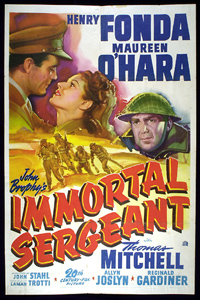
CLASSIC or ANTIQUE? Immortal Sergeant (1943)


            “Immortal Sergeant” was the first American WWII film set in North Africa.  It may be set there, but it was filmed on a sound stage.  It was directed by John Stahl and was based on the novel by John Brophy.  Although named after Sgt. Kelly (Thomas Mitchell), the main character is Cpl. Colin Spence (Henry Fonda).  Fonda hated the movie and looks miserable in it.  The 37 year old actor volunteered for the military and was set to go into the Navy when studio head Daryl Zanuck pulled strings to get his entry postponed so he could make one more film.  Fonda was pissed.  After the film, he served in Naval Intelligence and was awarded the Bronze Star (I’m sure he did something very brave to earn it).

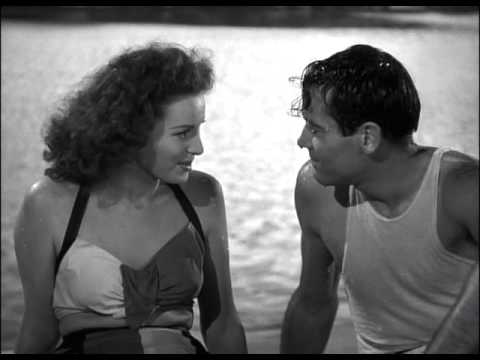
                Kelly and Spence are in the British 8th Army in the Libyan Desert.  Kelly is quickly canonized as emblematic of the greatness of the British Army.  Spence, on the other hand, is a milquetoast wuss who entered the Army to assuage the humiliation of losing his girl Valentine (Maureen O’Hara at her loveliest) to a cad named Benedict (more like Bene-dick!).  We know about this love triangle through frequent flashbacks that makes us want to slap the wimpy Spence across the face.  One reason Spence joined up was to grow a pair and a suicide mission seems to be the ticket.

                Spence and Kelly lead a patrol of fourteen (place your bets on how many will survive) behind enemy lines to blow stuff up.  Things do not go smoothly, naturally.  First, they come under attack from Italian fighter planes dropping bombs they do not have (how many times have I seen that in a war film?).  Spence tells one of the soldiers to “try for the pilot” and another to “go for the rear gunner” with their rifles!  LOL   But wait, I apologize because they shoot down one of the planes.  The plane makes a crash landing while aflame and proceeds to chase the patrols truck and ram into it killing eight of the men.  LOFL  This is one of the most hilarious scenes in war movie history.

                The remainder of the patrol continues on and receives a note sealed in a tin can dropped by a British plane.  The note warns them that there is an Italian armored car up ahead.  The note reads “Don’t worry, it’s only an Italian armored car”.  Just kidding.  They decide to take on the very fake looking vehicle.  In the ridiculous action scene, Sgt. Kelly gets wounded by a grenade even though he’s shielded by a sand dune.  Spence insists on dragging Kelly along so Kelly belies the title of the film by taking his own life.  He leaves behind his voice in Spence’s head.

                Kelly leaves some big shoes to fill (and a halo to wear), but Spence’s feet suddenly grow four sizes.  The remaining three soldiers find out quickly that Spence is channeling the tough sergeant.  It’s tough love as he shares his last cigarette.  They pass it around like a joint and then the last toker buries the butt because it could give away their position.  LOL   

                The quartet approach an oasis, but before they can reach it the Germans swoop in and take possession.  Spence goes to scout and it turns out he’s not alone.  Kelly is with him and they debate what to do.  Spence sneaks into the German camp and steals water and food.  He  convinces his mates to attack the Germans in a sand storm.  They kill all the Germans, use a grenade to blow up the German transport plane, and explode the ammunition dump.  Piece of cake.

                The film closes with Spence lying wounded in a hospital.  He is a hero now and when Benedict comes visit he gives him the old what-for.  Now Spence is going to fight for what he wants, just like America should.  Buy war bonds!!


a fiery redhead and her wimpy beau
                Even if you cut this movie some slack because of when it was made, you cannot get around the fact that it is atrocious.  I think Fonda hated it partly because of the circumstances he was forced to make it in and partly because he knew it would go on his resume.  The flashbacks are incredibly sappy and aggravating.  The Spence character is pitiful and his transformation into Rambo is ludicrous.  The acting is substandard.  What do you expect when your star is seething?  The sound stage is disconcertingly fake.  The music is hammy mood music.  The special effects are embarrassing, even for 1943.  The dialogue is corny and having Spence talk to Kelly in his head does not help matters.  The only positive thing I can say is the weaponry appeared to be realistic in the oasis attack scene.  I recognized bolt-action rifles, a Lewis gun, and Mills bombs.

                Classic or Antique?  Definitely an antique.  You should only watch this if you want to see what a 1943 propaganda film was like or if you want a good laugh.
grade =  F