Showing posts with label prisoner of war movie. Show all posts

Tuesday, February 1, 2022

Rambo: First Blood Part II (1984)


            With the success of “First Blood”, a sequel was inevitable.  James Cameron wrote the first draft of the script, but Sylvester Stallone made a lot of tweaks and additions.  Cameron wanted a tech geek / wisecracker buddy (to be played by John Travolta), backstories for the POWs, and not much politics.  Stallone nixed the idea of a partner who gets the jokes and wanted the movie to have a “we left worthy warriors behind after a war we should have let them win” message.  George Cosmatos (“Escape to Athena”) was tabbed to direct.  The movie was dedicated to special effects man Clifford Wenger, Jr. who was killed by an explosion.  Stallone spent eight months of four hour days bulking up.  He took SWAT courses on combat, archery, and survival.  (Why do SWAT members need to know archery?)  The movie was filmed in Mexico and Thailand.  It was the first movie to open in more than 2,000 theaters.  It made over $300 million and is the most influential (and mockable) of the Rambo series, although its “cartoonish” nature made it Stallone’s least favorite of the series.

            The movie opens with the Rambo of the first film breaking rocks at a prison.  It’s one of those prisons that has good hair care.  He is released for a mission supervised by a bureaucrat (the villain de jour of 1980s action movies) named Murdock (Charles Napier in a role turned down by Lee Marvin).  Spoiler alert for those who have never seen an action movie:  Murdock is going to turn out to be a villain.  Back on board as the psycho-whisperer is Col. Trautman (Richard Crenna).  The mission is to recon a prison camp in Vietnam, but not to free anybody.  Just take pictures, don’t engage.  Delta Force will do the rescuing.  We get the obligatory gearing up scene which includes him putting film in the camera!  He is given all kinds of new tech equipment, but not shown how to use it because they read ahead in the script and know he will be losing his equipment when he parachutes.  No problem because Rambo tells Murdock:  “I've always believed that the mind is the best weapon.”  (Raise your hand if you associate Rambo with a great mind.)  He makes contact with a Vietnamese agent named Bo Cao (Singaporean-American Julia Nickson).  Although all he has is a bowie knife, a bow with explosive arrows, and his biceps, Bo and the brute head off to the camp.  74 kills later, Rambo has won the sequel to the Vietnam War and freed men who fought in a good cause.  And some villains get their just rewards.

            I was surprised to learn that Stallone admits this movie is not good.  He feels the reason is it is too cartoonish.  He doesn’t mention his laughable acting.  But he is actually the worst actor in the cast.  The villains may be mustache-twirling, but they are effective.  Erickson does a good job keeping a straight face, even though she was nominated for a Razzie.  She lost, but the Picture, Stallone, screenplay, and song (“Peace Is Our Life” by Frank Stallone) won.  Incredibly, the movie won an Oscar!  It was chosen for Best Sound Editing.  And no that was not recognition for editing out all of Rambo’s dialogue.  He may not speak much, but when he does its quotable.   

            It deserves its cult status because it is better than all the copies.  However, it is not better than it’s mockers, like “Hot Shots!”.  And the movie has a huge target on its back.  Parts of it look like a satire itself.  Rambo being strapped to a metal mattress and being electro-tortured is iconic and idiotic.  The movie also has some iconic lines like “To survive a war, you gotta become war.”  Rambo became war, if you consider war to be like a video game.  He slaughters the bad guys and explodes things on a big screen!  He may start with just a knife and bow, but he up-arms to a helicopter.  Much of the plot is mindless violence, but the movie doesn’t start the killing until the 34- minute mark.  The script does lay the groundwork pretty well.  And the mayhem is not as predictable as you would think.  Granted, if you see it for the first time in 2022, you will know what is going to happen because the plot points are now ingrained in our society.  It created many of the cliches of the prisoner of war rescue subgenre.

                The movie is more than just a movie.  It spawned several copycats and some parodies.  But its greatest influence was on the public’s perception of the war.  Stallone took Cameron’s script and turned it into a hawk’s wet dream.  One message is the veterans were screwed by their treatment after they returned.  This message was explored in the first movie.  The sequel adds the message that the rules of engagement restricted the tactics to the point that the grunts could not win the war.  The most famous line is “do we get to win this time?”  This message includes the criticism of the strategy of a limited war that was forced on the military by the politicians.  Murdoch exemplifies this message.  People (42 million tickets were sold in America) came out of theaters saying “fuck yeah, we should have won.”  The movie is a key part of the Lost Cause narrative.  It perpetuated the conspiracy theory that we left POWs behind.

                No one would call this movie a documentary, but is there any truth in it?  It is based on the belief that some of the 2,500 missing in action were actually prisoners in secret camps in Vietnam, Laos, and Cambodia.  Because of pressure from veterans, the Pentagon did plan a mission by the Delta Force.  This was scrubbed partly because ex-Col. Bo Gritz was roiling the waters with his private ingresses to locate secret camps.  Congress also put pressure, but a committee led by veterans John Kerry and John McCain determined that there were no Americans that had been left behind.

                “Rambo:  First Blood Part II” is not a good movie, but it is a must-see movie for guys.  It is part of the bucket list we were born with.  And when you see it, don’t lie and say you didn’t enjoy the death of Col. Padovsky (Steven Berkoff).  Or all the other explosions.

GRADE  =  C

Sunday, March 28, 2021

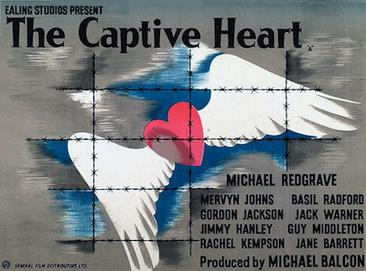
THE FIRST WWII POW MOVIE: The Captive Heart (1946)


                “The Captive Heart” is supposedly the first WWII prisoner of war movie.  This means it started a venerable subgenre.  It is a British film that was directed by Basil Dearden (“Khartoum”).  It was released in the U.S. under the terrible title of “Captive Camp 23” which I would assume consigned it to drive-in movie theaters.  It was a hit in Great Britain.  Not in the U.S.  The movie stars Michael Redgrave and Rachel Kempson who were married from 1935 until Redgrave’s death in 1985.  The movie was filmed partly at the Marlag und Milag Nord prison camp.  One of the co-writers was a prisoner there during the war.  Some of the actors in the movie had been POWs, including Derek Bond and Sam Kydd.  The production had the cooperation of the British Army of the Rhine, which provided soldiers for the camp scenes.

                The movie claims that it is “based on fact, but fictional characters”.  A narrator proclaims that the movie is dedicated to prisoners of war.  It opens in France in 1940.  British prisoners are being marched to prison camps.  One of them is Capt. Geoffrey Mitchell (Redgrave) who is actually a Czech escapee named Hasek from Dachau concentration camp.  He has assumed the identity of the dead Mitchell.  The prisoners march into the prison camp whistling and with their upper lips stiff, naturally.  Things get sticky when a Gestapo agent arrives who might remember Hasek.  While the suspense is brewing, the movie intercuts back to England to delve into the soap operaish relationships of some of the men.  There is a love quadrangle to entertain the ladies in the audience.  And of course, the POW camp as summer camp to entertain the men.  Hasek is corresponding with Celia Mitchell (Rachel Kempson) as part of his cover.  Celia wonders why her loutish husband is suddenly the sensitive type.  Nazis make good marriage counselors, apparently.

                “The Captive Heart” is middle of the road POW subgenre.  It is well acted by a good cast, which cushions some of the predictability.  The thing that stands out is the balancing of the men and their women.  This tends to be melodramatic, but it is an area that most POW movies do not dwell on.  Some of it is silly, as with most soap opera plots.  The main relationship, which is the one between Hasek and Celia, strains credulity, but it is the other arc to go along with the suspense of whether Hasek will be discovered by the stereotypical Gestapo agent.  This is about the only suspense in the camp as it is one of those POW movies that makes the camp seem to be a fun vacation from the war.  The men play cricket and garden as a pastimes and tunnel as a hobby.  The humor is very British and so is the dialogue.  One of the prisoners says “Bob is your uncle”. 

                Despite the schmaltzy romance and the coincidences and implausibilities, “The Captive Heart” is an entertaining trifle.  Its attempt to contrast the home front with the camp is commendable.  It would have been more realistic to show the men worse off than the women, but what the Hell.


GRADE  =  B

Saturday, September 6, 2014

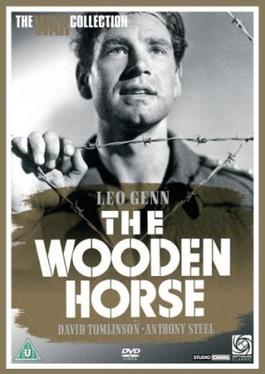
CLASSIC or ANTIQUE? The Wooden Horse (1950)


                “The Wooden Horse” is an extremely British Old School war movie.  It is based on a novel by Eric Williams which I can remember reading as a teenager.  He wrote the screenplay.  The movie is set in a German POW camp (Stalag Luft III) in 1943.  The camp is inhabited by mostly British airmen.  There is a tunnel going out from the washroom, but it is far from completion and far from a sure thing.  If only a tunnel could begin closer to the wire.

                John (Anthony Steel) and Pete (Leo Genn) are pondering this dilemma when John notices some prisoners doing leap frog.  (The only appearance of leap frog in the entire history of war movies.)  He adds leap frog to Trojan Horse to get vaulting horse.  The escape committee reluctantly agrees and we have ourselves a prison escape movie.  The first bit of suspense is John and Pete going out at night to steal lumber from a conveniently destroyed building in the camp.  This is the only WWII POW movie I have seen that has the guard dogs roaming the camp after dark.  Why didn’t all the other ones think of that?  Seems like a great way to reduce midnight forays.  They use the wood to construct a vaulting box (which you would think would be such an unusual item that the Germans might ask where the wood came from). 

                The idea is to get a cadre of friends to spend hours vaulting while either John or Pete digs the tunnel after being transported inside it to the site of the hole.  The movie handles the “what if a klutz tips over the horse” conundrum with a nifty little fake-out.  The film goes through the rollercoaster ride of crises.  Crisis 1 – a cave in that leaves a visible hole in the camp yard.  Crisis 2 – they are making slower progress than needed.  Crisis 3 -  The Germans raid the sand disposal site.  Once those three are averted, we get a montage complete with calendar to advance us to the escape.

                John and Pete allow their main vaulter Philip (David Tomlinson) to escape with them, but he insists on separating after the wire even though the producers tell him they don’t have enough film to follow two stories.  Once they are out John and Pete head to the rail station and take a train to the coast where the plan is to hitch a ride on a Swedish ship.  Crisis 4 -  they get chased away when they try to board a ship.  Luckily John speaks several languages and they hook up with some French workers who are quasi-Resistance.  Crisis 5 – Pete is tailed by a Gestapo-looking sinister dude.  Surprise, he’s not as evil as he seems. 

                John and Pete end up on a Danish ship with their patron Sigmund.  Apparently musical scores are not forbidden in Denmark because the moment they step ashore, the score kicks in.  A stop off at his sister’s apartment allows us to ogle a hot Danish chick.  John and Pete are chaste, but my eyes weren’t.  They will have to go by fishing boat to Sweden, but first…  Crisis 6 – John and Pete versus a German sentry.

                “The Wooden Horse” is a nice little movie, but it is not special.  I would have to put it is the middle of the pack in the subgenre of POW movies.  The acting is fine especially from the leads.  Nobody is flashy and there is no scene chewing.  They are all properly British.  However, the Germans are not your typical sinister, competent foes.  The commandant looks like an accountant and is neither malevolent (“Hart’s War”, “Stalag 17”) nor a noble fellow knight of the air (“The Great Escape”).  He does not play a major role and there is no bête noire of a camp guard.   A bonus for the ladies is John often has his shirt off.  Kudos to the horse which is stoically wooden and gets a rousing round of applause from the prisoners when it is hauled off to wherever the Germans took vaulting horses that aided escapes.  I assume an inescapable camp where they have placed all the scheming gymnastics apparatuses (apperati?).

                 The direction is very straight forward.  The cinematography does not stand out other than in the quick-cut, varying perspectives of the sentry fight scene.  Where the direction goes off reservation is in the score.  There are long stretches where there is no music setting the mood.  This is commendable, but might partly explain why the movie has a suspenseless feel to it.  There is also a curious lack of the British humor you usually find in their war films.  The best moment is when a German guard hears some classical music playing on a record player and comments “Beethoven, he’s a good German”.  A Brit retorts “Yeah, he’s dead.”   Speaking of which, the dialogue is sparse and unflorid.  The movie is not cloyingly patriotic.  It gets where it is going on the strength of the tale with few flourishes.

                  The set is German POW camp lite.  Unrealistically pristine.  Check out those cushy pillows and the pajamas laid out by their maids.  Not to mention the civilian-like grooming.  These are the cleanest, best-dressed, well-coiffed prisoners in war movie history.  Even after coming out of the tunnel John and Pete are not grimy and their hair is perfect.  The underground scenes are a highlight.  It is not an elaborate set-up like in “The Great Escape”, but appropriately claustrophobic.   

                The plot does flow well.  It efficiently takes us through the usual arc.  Idea – approval – plan – execution with problems solved – escape with one huge dilemma – journey to freedom with roadblocks.  The drawback is there is a lack of suspense for the most part.  The movie whiffs on several opportunities.  For instance, after introducing the concept of a German shephard menacingly patrolling the camp after dark, the prisoners easily distract the dog for the lumber run.  Another example is when John has to spend a night in the tunnel.  The movie glosses over what must have been a terrifying experience.  Basically, none of the crises is edge of the seat.  There is never any doubt that John and Pete will make it.  There is some doubt about the fate of Philip, but you are left waiting for a post script since the film fails to follow him once they exit the camp.  Hint:  this is not the type of movie that is looking for an expendable.

                Classic or Antique?  Somewhere in between.  Let’s call it Classtique.  It is entertaining and a must see for those into the subgenre, but not in the upper tier of those films.  I don’t think it attempted to be.

grade =  C