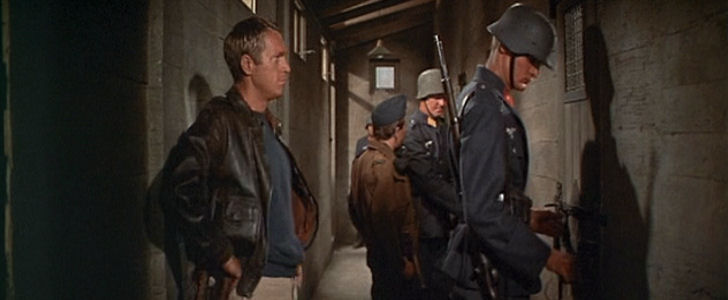
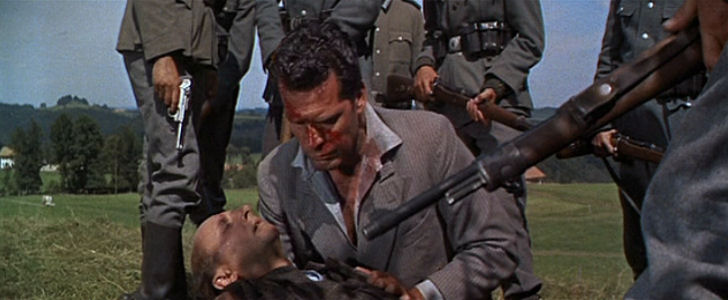
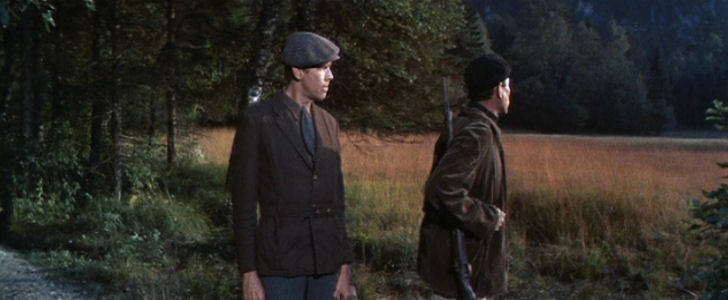
“Steel Helmet” was the first movie about the Korean War. It was released during the war in 1951. It was directed by WWII veteran Samuel Fuller. He also wrote and produced the film. It is a classic B-Movie which cost only $100,000. Fuller used a plywood tank and 25 UCLA students as extras. It made $6 million. The movie was “dedicated to the U.S. infantry”.
The movie opens with the survivor of a North Korean prisoner execution (his steel helmet had deflected the kill shot) crawling from the site with his hands tied. Sgt. Zack (Gene Evans) is freed by a Korean orphan who he dubs “Short Round” (William Chun). Zack is a racist who refers to Short Round as a “gook”, but he lets him tag along. They meet up with a black medic named Thompson (James Edwards) and it turns out Zack is an equal opportunity racist. The trio runs into a patrol led by Lt. Driscoll (Steve Brodie) who Zack hates and disrespects. The three go off on their own, but return to rescue the patrol from an ambush by snipers. This is a good scene although it was obviously shot on a sound stage.
The unit moves on to establish an observation post in a Buddhist temple. We have a typical heterogeneous unit including the black medic, grizzled sergeant, hick, conscientious objector, the quiet guy, the by the book officer, etc. Fuller can be excused for wanting his characters to represent the variety of the U.S. Army. Hiding in the temple is a Commie who knifes the quiet guy while the others sleep. They search the temple and Zack captures him. He turns out to be a Major who speaks English which comes in handy as he tries to persuade the minorities to switch sides. First he works on Thompson by pointing out the mistreatment of blacks in America. When this does not work, he reminds the Nisei Tanaka (Richard Loo) of the internment of Japanese-Americans in WWII. This was the first reference in a movie to this shameful episode in American History. Kudos to Fuller for rattling the cage.
Zack and Tanaka
Surprise, Zack has bonded with Short Round. Unfortunately, the kid gets killed by a sniper. Zack shoots the Major out of rage in a scene that was protested by the Army until Fuller pointed out that the killing of prisoners was not unheard of. This action by Zach also caused outrage in parts of “Red Scare” America as conservatives called for Fuller’s arrest for treasonous production of an anti-American propaganda film. Double kudos to Fuller for standing up to McCarthyism.
The Reds figure out that the temple is a forward observation post that is raining artillery fire on them. Fuller uses stock combat footage from WWII that does not blend well with the film. The enemy attacks in swarms. Weirdly, the indoor defense does not match up with the outside attack. The movie shifts to a “who will survive” mode. Being a 1951 black and white movie, the deaths come without blood or even bullet holes. (Is that the way Fuller remembered his war days?) If you bet on four surviving, you win. Zack is one of them. They hook up with a relief patrol, but first Zack replaces the helmet on Driscoll’s grave with his lucky steel pot. (Earlier Driscoll had asked Zack to trade and Zack had dissed him.)
This is one gritty film, which is saying a lot for a movie made at a time that grit could not be combined with graphic. In some ways it reminds me of “When Trumpets Fade” with its anti-hero main character. Zack is a great character. How rare to anchor a war from this time period on a dislikable protagonist. Evans probably did the best acting of his career. The studio had pushed for John Wayne, but Fuller stuck to his guns (and his budget). The rest of the cast are B-Movie actors that rose above the class. Edwards and Loo are particularly strong. Both characters could not have existed accurately in a WWII movie. However, the Korean War-era Army was integrated.
The movie is most reminiscent of a Western. The old surrounded-in-the-fort variety. There is a little “Stagecoach” in it as well. The biggest difference is no women to distract our warriors. Not saying that’s an improvement.
Does “Steel Helmet” crack the 100 Best War Movies? It deserves consideration for the balls that went into making it. It is safe to say it is one of the greatest war movies ever made for just $100,000 and shot in ten days.
“Red Tails” has everything that is wrong with a Hollywood history movie. It takes a story it claims is “inspired by true events” and uses those true events to structure an edifice of sappitude. In the tradition of atrocities like “Wind Talkers”, you can check off all the aspects that depress war movie lovers like me. Trite musical score – check. Sappy dialogue – check. Cliches – check. Stereotype characters – check. Gross exaggeration of historical events – check. Ridiculously over the top explosions – check. Pious moralizing – check. Evil Nazi antagonist – check. Tacked in romance - check
The movie begins with the unit limited to ground missions which at least allows them to blow up a train with lots of pyrotechnics. We are introduced to the usual stereotypes. The two main characters are “Lighting” Little (David Oyelowo) hot shot pilot, ladies man, disobedient (you know the type) and “Easy” Julian (Nate Parker) – bottle-hitter with daddy issues. Not to mention the super religious guy (Black Jesus fan), the field hand (for comic relief), the rookie, the grumpy crew chief, etc. We bounce back and forth from the air base to the Pentagon where the racists are trying to disband the unit because they do not shoot down German fighters. How can they when they aren’t given a chance?! (“Glory” be!)
When they are given a chance we are treated to set pieces that include their incredibly successful first dogfight (reminiscent of “Fly Boys” CGI whirling chaos), the strafe-destruction of an air field, the strafe-destruction of a German destroyer by “Lightning”, and a tangle with German jet fighters (which includes a duel between Lightning and Pretty Boy!). You get to catch your breath in between with the requisite romance between “Lightning” and a white Italian woman named Sophia (Daniella Ruah), Pentagon racism versus simmering give-us-a-chance-you-racist-bastard posturing, conflict between the hot shot and the rule-follower, and trite airmen banter.
The big breakthrough comes when the 332nd Fighter Group volunteers to provide close escort for the white bomber crews. Do you think they will gain the respect of the white crews? Will there be a scene where one of the blacks is refused admittance to an officers’ club followed later by a scene where the blacks are bonhommed at the same club? Guess.
If you took a shot every time someone says something cringe-inducing in this movie, you would be drunk very soon. Here’s a very limited sampler:
“They done shot down the whole Luftwaffer.”
“Lightning, when are you going to learn this is not a game?”
“How you like that, Mr. Hitler?”
“Die, you foolish African” (spoken by the Nazi “Pretty Boy”)
Surprisingly, the “true events” are ball-park true. They were limited to just ground missions which resulted in talk of disbanding based on lack of kills. They did participate in ground support for the invasion of Pantelleria (Operation Shingle in the movie). They did sink a destroyer. They did earn a reputation for disciplined escorting of bombers. They did successfully take on ME-262’s in a raid on a tank parts factory outside Berlin. The problem is all of these are grossly exaggerated in the movie.
The Tuskegee Airmen deserve a good movie. Now they have two strikes against them and it is highly unlikely they will ever get their just reward. George Lucas’ “Red Tails” is the second strike (the first was HBOs “Tuskegee Airmen”). I had eagerly waited for this movie because I teach about the Tuskegee Airmen, but the commercials gave me an inkling of my disappointment (although the CGI was not that bad in the movie) and then there was a pre-movie trailer for the new 3D “The Phantom Menace” to remind me of the damage Lucas is capable of. Premonition confirmed.
FACT OR FICTION?
1. None of the characters are real. Howard’s character, Col. Bullard, is obviously based on Benjamin Davis, Jr. The personification is pretty close to Davis. He did insist the unit not leave the bombers when they got the escort job.
2. The painting of the tails red began with the P-47s (this stage was skipped in the movie). I found no evidence that the color was foisted on them as a racial slur. It makes more sense that they chose it for the flamboyance.
3. They were assigned ground support duties that avoided air combat. The lack of kills did provide fodder for opponents in Washington who wanted the unit disbanded. The conversations in the movie get the basics right, but the unit was never on the edge of being disbanded.
4. Their first combat mission was in support of the landing on Pantelleria. It was successful, but not nearly as exciting as in the movie since there was no enemy contact in the air.
5. Surprisingly, the destroyer incident was fairly accurate. The incident involved eight planes, with two of the pilots making a second pass. They did heavily damage a German destroyer through strafing. (They sincerely thought that it sank.) It was the only incident of its type in the war. They were flying P-47s, by the way.
6. Although the movie does not make a big deal of it, the unit did not have a spotless record of never losing an escorted bomber as legend holds it. Recent scholarship sets the number at around 25 lost. The unit was well-respected by the bomber units.
7. They did have a mission against a tank parts factory outside Berlin where they ended up going all the way. They did encounter German jets and shot down three. They got the Distinguished Unit Citation for this mission.
8. The romance is unrealistic because Italian women were discouraged from hooking up with African-Americans.
After researching the real story, I have to admit the movie was accurate enough to be commended. If only the dialogue had been better and the actual facts had not been exaggerrated so much.
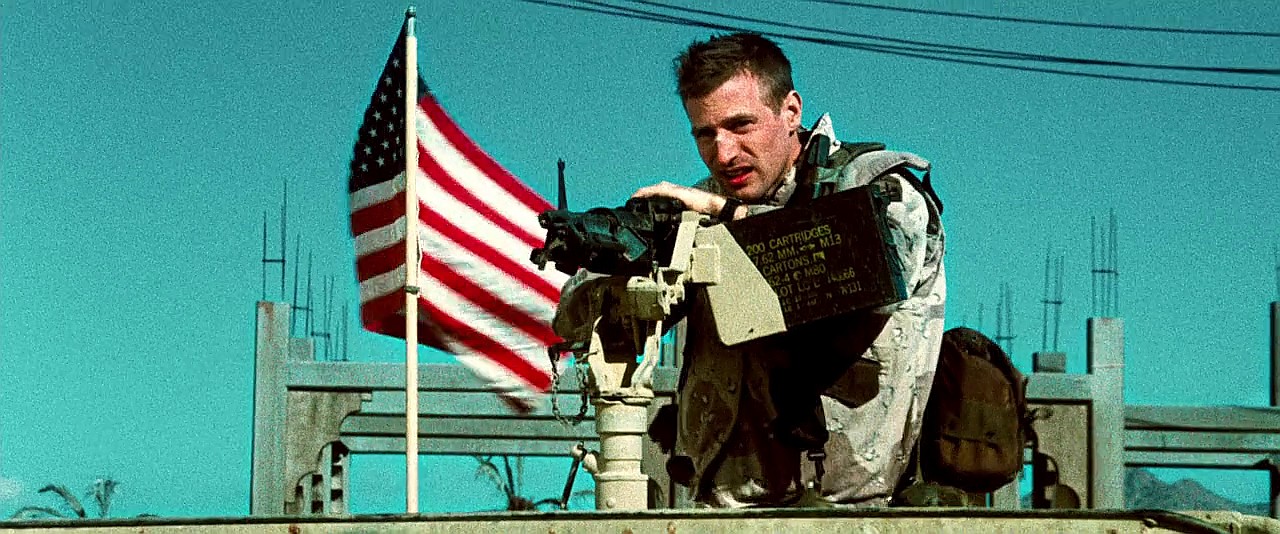
“Three Kings” is a war movie released in 1999. It was written and directed by David Russell from a story idea by comedian John Ridley. The movie was a moderate success at the box office, but was critically acclaimed. At the time of filming, George Clooney was a TV star hoping to make a splash in movies. He worked hard to get the reluctant Russell to cast him. Spike Jonze made his acting debut in the film. The movie is set in March, 1991 – “the war has just ended’. This is a reference to the Persian Gulf War.
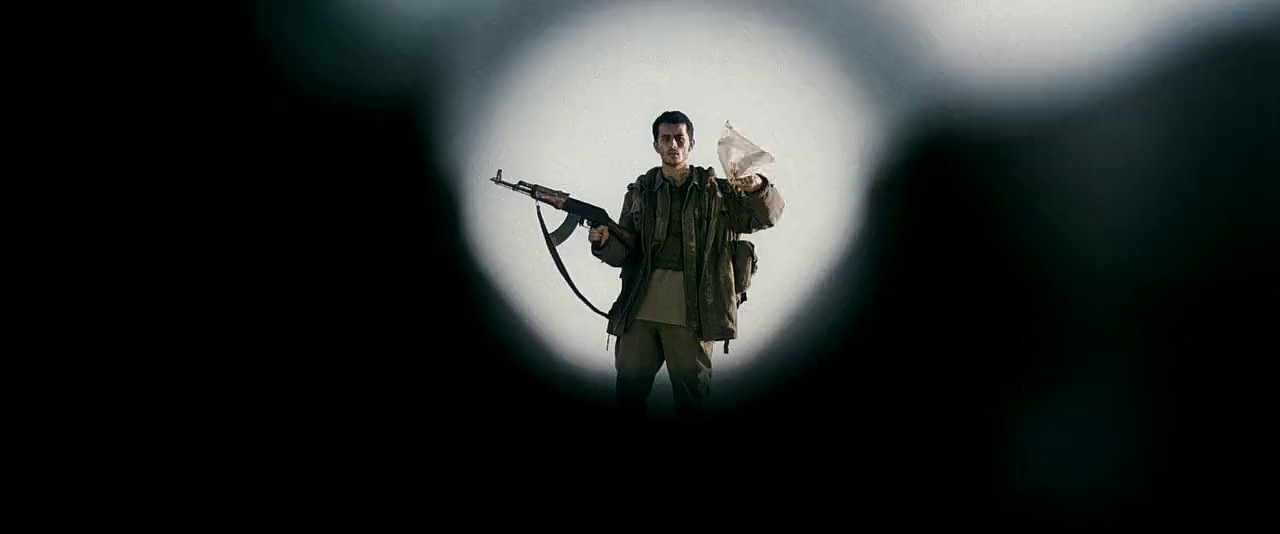
is this dude surrendering?
The movie opens with a provocative scene in which a soldier named Barlow (Mark Wahlberg) shoots an Iraqi soldier who may or may not have been trying to surrender. This was a common situation at the end of the war. The scene shifts to the celebration back at base camp. The movie is outstanding in showing the chaos at the end of the war.
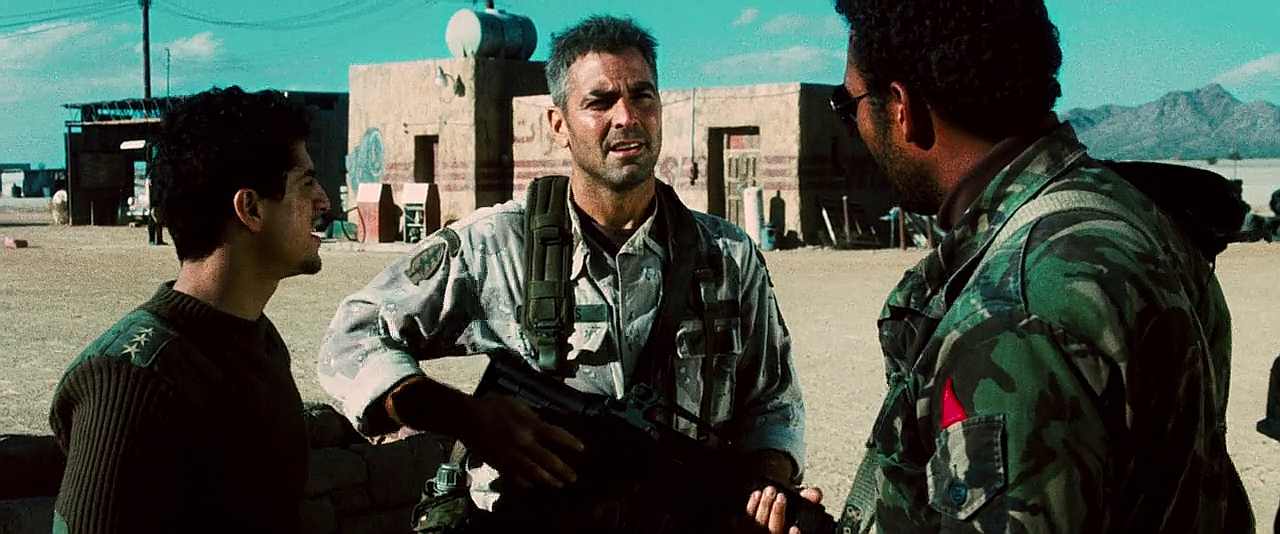
Gates, Barlow, and Elgin
During the searching of Iraqi prisoners, Vig (Spike Jonze) finds a paper stuffed in a prisoner’s anus. “I didn’t join the Army to pull paper out of people’s asses.” He also didn’t join the Army to become a millionaire, but the paper is a map to a bunker where Saddam Hussein has stashed millions in gold bars. When Major Gates (Clooney) gets wind of the map, he takes charge of the trio of Barlow, Vig, and Elgin (Ice Cube) and they go off in a humvee to get rich quick. Surprise – complications arise.
They find the gold, but they also encounter civilians being threatened by Hussein’s loyalists. The civilians are part of the rebellion against Hussein that was encouraged by the Bush Administration. Our heroes are only interested in the gold so they simply watch while the civilians are killed. Just kidding. Russell is not breaking new ground here. The quartet intervenes in a wild firefight that is one of the coolest ever filmed. The use of slo-mo and graphic visuals of bullets entering bodies is visceral. The battle is not depicted as a fireworks extravaganze, but more like a multi-player tennis match.
Vigs isn't giving up his gold
They flee with the civilians, but the enemy fire chemicals which turn out to be tear gas. Their vehicle crashes in a minefield. Don’t you hate when that happens? Actually, it was probably common in Iraq back then. They are rescued by rebels, but Barlow is captured. The rebels are angry that Bush has abandoned them. (There is some time compression here as this stage of the rebellion would not have been reached this early.) Gates makes a deal with the rebels. If they help him rescue Barlow, the Americans will help them cross the border into Iran safely.
Gates negotiates
Meanwhile, Barlow is being “interrogated” by an Iraqi soldier named Said (Said Taghmaoui) who lost his son to an American bomb. He is not a big fan of the U.S.A. He uses electric shock to show it. They debate the war and Said has some good debating points in his favor. When Barlow points out that the war was fought to stabilize the world, Said’s counterargument involves making Barlow drink oil. “This is your f****** stability.” Well played, Said.
The plan to rescue Barlow revolves around making the Iraqi captors believe Hussein is coming in person and boy is he pissed. Since the Iraqi soldiers are Iraqi soldiers, they fall for this and most run off. Unfortunately, an Iraqi helicopter arrives to change the equation. (This is a reference to how Hussein used helicopters to put down the Iraqi rebellion due to the fact that the Bush Administration did not cover non-fixed wing aircraft in its no fly ban.) Too bad the insurgents did not have explosive Nerf footballs like Elgin uses on the helicopter. Why did the U.S. encourage the rebellion and then not provide the explosive Nerf footballs? What kind of foreign policy is that?!
Barlow is rescued and in a “you had the better argument” recognition lets Said go. The quartet (minus one) get some trucks and head for the border with the rebel families. Unfortunately, at the border the Iraqis are not allowing anyone to enter Iran and Gates’ commanding officer arrives in a court-martialing mood. Luckily, being an American, he might be open to a bribe of golden bars. It’s redemption time for our scheming rogues.
“Three Kings” takes an historical event (the Iraqi uprising after the Persian Gulf War) and injects a fictitious story into that chaos. When the Persian Gulf War ended with Hussein still in power, the Bush Administration encouraged the Iraqi people to rise up. The Shia in the South took up the call and at first were successful. Unfortunately, the war ended with the Iraqi Republican Guard crippled, but not powerless. It was able to carry out Hussein’s orders to ruthlessly put down the rebellion because fighting lightly armed civilians was more its skill set than combating the U.S. Army. To make matters worse, the peace agreement did not forbid the use of helicopters. An oversight that was to bring disaster to the insurgents.
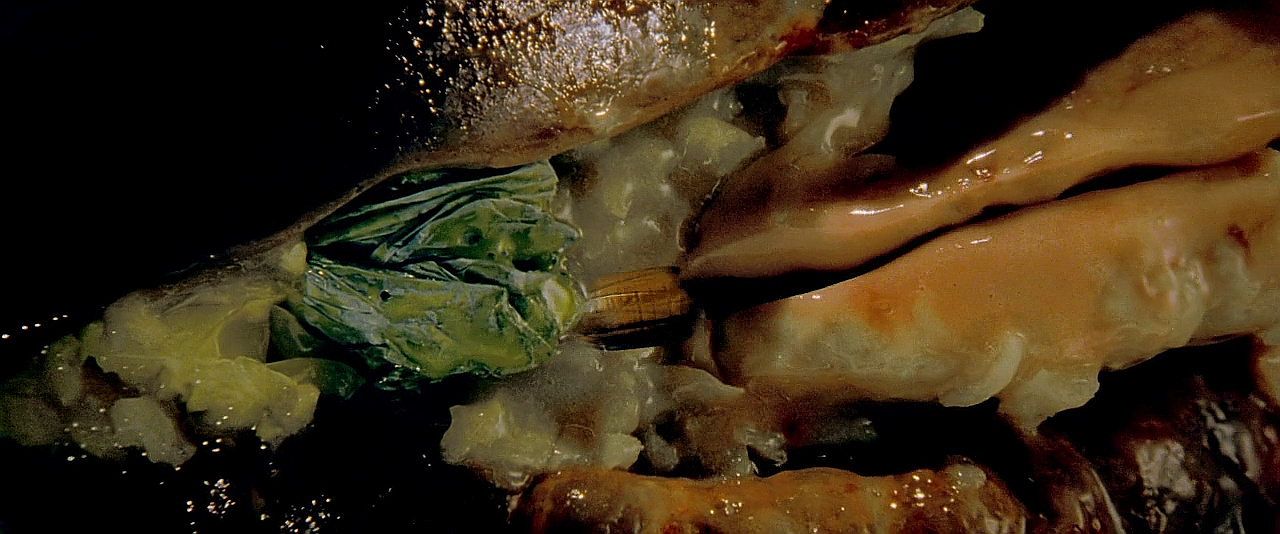
a bullet trail
The movie is very entertaining. It came out after “Saving Private Ryan” and “The Thin Red Line” and joined them in juicing up the war movie genre for modern audiences. It is different and more unorthodox than those other films. It is the MTV version of war. The use of hand-held cameras and Steadicams gives it a journalistic feel. It also uses CSI-style graphics to show the effects of bullet wounds. There is one remarkable view of a bullet penetrating a body and the resulting sepsis. This style reappears when Gates plunges a needle into Barlow’s lung to help him breath. Another scene uses Matrix type visuals to portray a firefight. It’s a war movie for the new generation, but my generation can admire the viscerality of it. Speaking of generations, "Three Kings" is the modern equivalent of "Kelly's Heroes".
The movie is not just eye candy. The acting is stellar from the ensemble. Even the novice Jonze holds his own. Clooney’s charismatic performance conclusively proves that his decision to jump from TV was a wise one. Wahlberg cemented his status as a major star. More importantly, the screenplay is thought-provoking. It does not preach, but makes it clear that the period at the end of the Persian Gulf War was a messed up situation and the U.S. should not be proud of our role in the Iraqi Insurrection. It even includes a sympathetic Iraqi torturer (Said). In some ways it is a biting satire of the military and the media. Although the bigger picture is conveyed, the movie dwells at the human interest level. It depicts how government decisions affect civilians.
BACK-STORY: “The Great Escape” is a WWII prisoner of war movie. It was released in1963 and was a huge hit and has grown in popularity over the years. It is the most famous movie in its subgenre. The film was directed by John Sturges and is based on the nonfiction book by Paul Brickhill. Brickhill was a prisoner in Stalag Luft III and helped with the escape although he was not one of the escapees. His book and the movie are dedicated to the fifty escapees who did not survive. The main screenwriter was James Clavell who spent time in a Japanese prison camp and the book “King Rat”. One of the tunnelers (Wally Floody) served as a technical advisor. Donald Pleasance was a prisoner in Stalag Luft 1 during the war. Steve McQueen insisted the motorcycle scenes be written in and did the stunts, not including the last jump (for insurance reasons).
Hilts' first trip to the cooler
OPENING: With the iconic opening theme playing in the background, truckloads of Allied POWs arrive at a brand new prison camp. Most of the main characters are briefly introduced as they case the new camp already plotting escape. The POW leader, Wing Commander Ramsey, is welcomed by the commandant who tersely explains that the camp is designed to hold all the most troublesome escape artists held by the Germans. Within minutes there are escape attempts that fail, but show that the prisoners are not impressed with the impossibility of breaking out.
SUMMARY: The movie has three distinct parts: the planning and execution of the escape, the escape, and the attempts to reach safety. The first part concentrates on the plan and each main character's role in it. The leader of the escape organization is Roger Bartlett (Richard Attenborough) who is known as “Big X”. He has been warned by the Gestapo that his next attempt will be his last. His plan is to create turmoil in the Third Reich by busting out 250 prisoners. It’s a massive undertaking involving three tunnels. Besides the digging of the tunnels, there are special jobs like forging documents and making disguised clothing. The main characters each have a specialty and gets screen time to demonstrate their prowess. These include the “Forger” Blythe (Donald Pleasance), the “Manufacturer” Sedwick (James Coburn), and the “Scrounger” Henley (James Garner). To break from the “grunt” work of escape preparation, the screenplay adds a cocky American named Hilts (Steve McQueen) to spice things up. He becomes the “Cooler King” for his frequent trips to isolation for insubordination and escape attempts.
The digging of the tunnel is in the hands of Willy (John Leyton) and Danny (Charles Bronson). The movie chronicles the problems and solutions to the tunneling. Example: problem – disposal of all the dirt / solution- bags containing dirt concealed in pants legs and then deposited on the camp grounds. Meanwhile everyone else is doing their job including uncredited actors acting as lookouts to watch for “ferrets” – Germans who tried to discover tunnels.
The tunneling follows a typical Hollywood story arc of smooth sailing, then numerous problems develop, followed by success. The problems start with the discovery of the main tunnel (Tom) while the camp is celebrating the 4th of July with American-made moonshine. A tragic death moves the movie into a darker direction. Some of the problems that now appear include Blythe going blind, Danny developing claustrophobia, and dangerous cave-ins. This leads up to the climactic break-out.
oops, this is not the woods
The buildup of problems culminates in the tunnel being twenty yards short of its destination – the safety of the woods. Hilts rigs up a rope tug system to get the escapees out whenever a nearby guard is not looking. 76 escape before the inevitable screw-up. Luckily, all the main characters were written in as getting out before #77.
Blythe dies in Hendley's arms
The rest of the movie follows the main characters in their attempts to elude their pursuers and return to Allied lines. The movie stays in chronological time by effectively skipping between characters. The individual stories are varied and unpredictable. Unfortunately, most of the men are unsuccessful. Hilts story dominates this section. He steals a German motorcycle and leads the Germans on a merry chase that ends with one of the most famous scenes in movie history.
CLOSING: Fifty of the recaptured men are executed by the Gestapo/S.S. The lucky ones who are returned to the camp are informed about their comrades. Henley pointedly asks Ramsey if it was worth it (a question the movie does not consider until this brief exchange and based on the underlying vibe definitely answers “yes!” to). Hilts steals one more scene as he is the last to get back. He taunts the ousted commandant and goes to the Cooler for some more throwing a baseball against the wall action.
one of the three that made it
RATINGS:
Acting – 9
Action – 7
Accuracy – 8
Realism – 8
Plot – 9
Overall – 9
WOULD CHICKS DIG IT? Although there is not a single female that has a speaking role in it, I would think most women would enjoy it but wonder what all the fuss is about. It is certainly aimed at the male audience (specifically 14 year old boys). However, the actors are appealing and the action is not graphic. It is undoubtedly entertaining.
HISTORICAL ACCURACY: The movie opens with the claim that it is based on a true story, but with composite characters and time compression. It boldly proclaims that every detail of the escape is true. That statement is too strong, but the movie is commendably close to the facts.
There was a Stalag Luft III and the Germans did put all their “bad eggs in one basket”. The attempted escapes on the first day actually occurred in the way depicted. The “X organization” did plan an escape of 250 men involving the construction of three tunnels named Tom, Dick, and Harry. Weirdly, the movie changes the names around for no discernible reason. Harry was actually the one under the stove and Dick was in the washroom. (It was abandoned and used for dirt storage after the Germans cleared the area it was to pop out in.) Tom was discovered by ferrets, but not during a celebration of the 4th of July. There was a moonshine celebration on a different day.
All the activities surrounding the escape are accurate. The forging of papers, disposal of the dirt, making of clothing, creation of the ventilation system, the singing of Christmas carols to hide the sounds of digging, the shoring up the tunnels with bunk bed boards, etc. The movie is extremely strong in depicting how the plan was put into effect.
The escape was essentially like the film shows. The tunnel was twenty feet short of the woods. There was an air raid that shut the lights down for a while. I could find no evidence that a rope was rigged up, but seventy-six men did escape before the exit was discovered by a sentry (probably not because someone fell). It is important to note that none of the seventy-six were Americans. The Americans had been moved to another camp before the escape. Gee, I wonder why the filmmakers decided to leave Steve McQueen and James Garner in the escape?
The third of the film dedicated to the main characters on the lam is substantially Hollywoodized. There was no theft of a plane or a motorcycle, for instance. The movie is close to the truth in its depiction of the success of Sedgwick (actually Dutchman Bram van der Stok) in reaching Spain (although the Resistance drive-by shooting is surely artistic license) and Willy and Danny (Per Bergsland and Jens Muller) stowing away on a ship to reach Sweden. The execution of fifty recaptured men is a fact, but they were not killed in a large group as shown in the movie.
Where the movie takes most of its liberties is in the characters, but it is up front in the composite nature of them. Some are close to a real person like Roger Bartlett representing Roger Bushell. Bushell was the leader of the X Committee and played an essential role in the escape. Ramsey was actually Herbert Massey and he did have a leg injury. Ives (the real Jimmy Kiddell) did die on the wire. Willy and Danny and Sedgwick were differently named and of different nationalities than their counterparts, but their escapes were true. The rest take some creative thinking to determine who they are supposed to be. The important thing is the roles they represent (scrounger, forger, manufacturer, etc.) were real and accurately depicted.
CRITIQUE: I have to be up front about the fact that this was my favorite movie when I was growing up. This was back when I and my brothers got to see it once a year on network TV. That was always a great night in our house. I may have seen it more than any other movie (not counting movies I have shown in class for decades). Sometimes our childhood favorites do not hold up when we watch them through adult eyes. This is not the case with “The Great Escape”. It was and still is one of the classic war movies.
The iconic nature of the film starts with the opening credits as we listen to the stirring theme music which every man of my generation instantly recognizes. Elmer Bernstein wrote the musical score and it is perfect. It dwells in the background of every scene and defines the moods. In this respect, the movie is very similar to another great guy movie – “The Magnificent Seven”. Speaking of which, the two movies also shared Sturges, McQueen, Coburn, and Bronson.
The movie is an expert blend of suspense, action, and humor. The humor works very well. It is dry and used sparingly, but effectively. Some of the lines are memorable. For instance, the ferrets bust in to the washroom and narrowly miss the trap door to Harry being sealed. Danny hustles into the shower and when the guard asks Sedgwick what he is doing there he responds “Watching him. I’m the life guard.”
The camp was constructed near Munich and accurately recreates a Stalag in layout, if not in atmosphere. The tunnel set allows for a cutaway view of the digging. The scenes are truly claustrophobic and the ever present danger of cave-ins adds to the suspense. The scenes outside the camp are authentic-looking since the movie was filmed in Europe. There is even some beautiful Alpine scenery.
The movie does a great job in its structure. The buildup to the escape concentrates on character development and is tutorial on the work that went on. This could have been tedious, but the injection of humor and Steve McQueen keep the narrative flowing. The movie, to its credit does not have a prolonged denouement after the escape. The alternating getaways are deftly juggled and suspenseful. Hilts motorcycle capers dominate, but they are edited such that we have to come back to him at least four times before the famous climactic jump sequence.
The movie ends on a sober note with the murders and the question – was it worth it? However, if ever there were a war movie that is not anti-war, this is it. Life in the camp is portrayed like it would be if you went to a POW fantasy camp. It seems like fun, which it assuredly was not. This is the biggest factor in keeping the movie from being a 10.
Finally, the acting is stellar. Whoever did the casting gets a gold star. The mix of dependable British thespians with cocky Americans is stimulating. This is an actors’ movie. In particular, watch Steve McQueen steal every scene with little eye-catching movements including shameful mugging. His co-stars either had sharing natures or were infuriated. Whatever, McQueen became a superstar based on his performance.
CONCLUSION: You might say I’m prejudiced, but “The Great Escape” is woefully underrated at #44. It is a better movie than its most obvious competitor – Stalag 17 (#18). It has everything that makes a war movie great, in my opinion. It is entertaining. It tells a story that deserves to be told. It teaches. It is accurate enough. It is realistic. Sometimes 14 year old boys are right. This movie rocks!
.jpg)


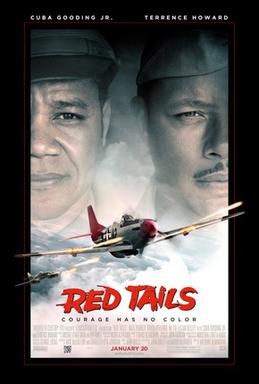
_poster_art.jpg)

_poster.jpg)