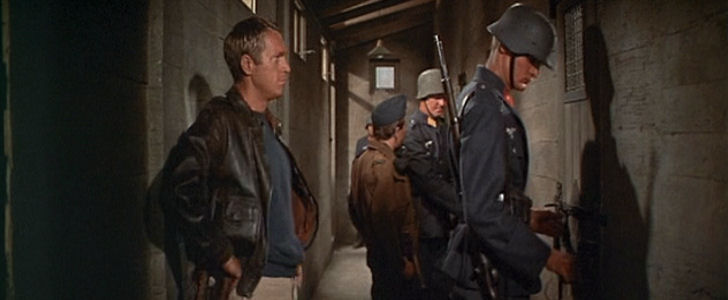
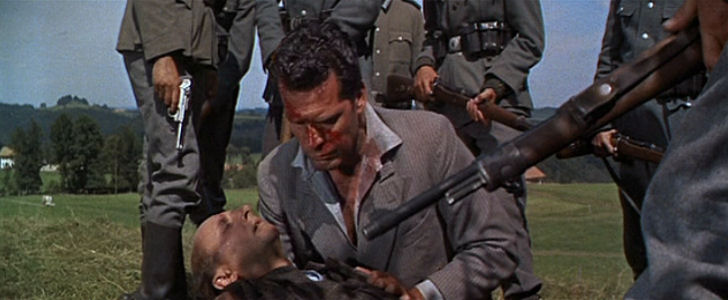
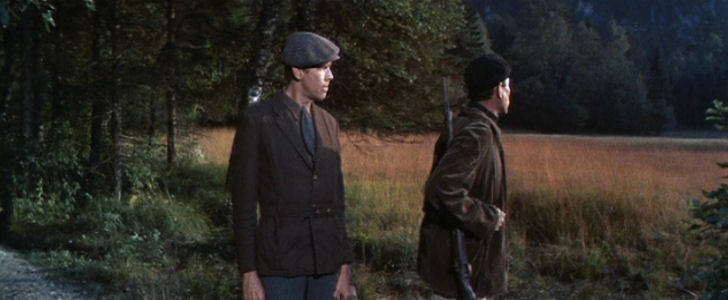
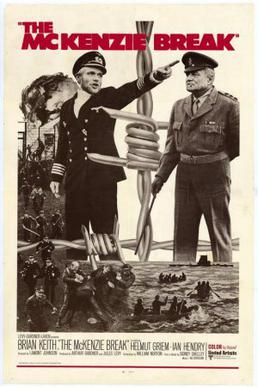
“The McKenzie Break” is a
prisoner of war movie released in 1970.It was directed by Lamont Johnson (“The Execution of Private Slovik”)
and was based on the novel The Bowmanville Break by Sidney Shelley.It tells the story of an attempted prison
escape by Germans who hope to hook up
with a u-boat.
The movie is set in Camp
McKenzie in Scotland during WWII.There
is a discipline problem in the camp as the Nazis are rebellious and the British
commandant does not have complete control over the camp.The Germans are led by a charismatic u-boat
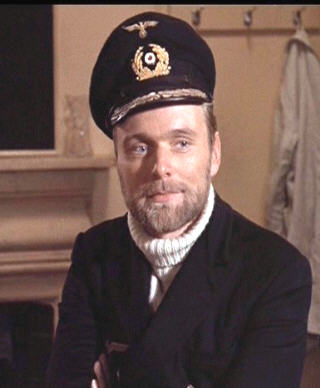
captain namedSchluter (Helmut
Griem).Captain Jack Conner (Brian
Keith) is brought in to restore control.He is a loose cannon who has been spared court-martial to do the
job.
The Germans are divided into two
factions.The Luftwaffe personnel want
to chill, but the Reichsmariners are hard core.Schuler accuses two of the non-rebels of being gay.That was unusual for a 1970 film.The submariners are at work on a tunnel
similar to the one in “The Great Escape”.The dirt is disposed in the attics.
garbage versus garbage collectors
Schuler stages an
insurrection which results in Conner sending in the fire brigade.A big brawl breaks out and two Germans
disguised as British are able to blend in with the British.They will make contact with a u-boat that
will pick up the escapers.One of the
Germans accused of being gay is badly beaten by his mates and is taken to the
infirmary.While there he is killed by
Nazis who make it look like a suicide.Before he dies, he tells Conner that there will be an escape
attempt.Conner decides to let the
escape go on to bait a trap for them.
The tunnel exit is under the
guard house.(Well, that is
unique!)Schuler purposely collapses the
ceiling with the dirt as a diversion.28
submariners escape and hook up with a truck.Conner is tracking them by plane. When they reach the beach,Schuler’s second in command decides that instead of camouflaging the
truck, he drives it intohuge hole
resulting in an explosion and smoke that attracts Conner’s attention.Ridiculous!Conner decides the smoke is nothing.Doubly ridiculous!!
Will they escape?See spoiler below.
“The McKenzie Break” is in the
middle tier of POW films.It is
moderately entertaining.Keith is his
usual dependable self and Griem makes a good asshole Nazi. The movie makes use of the strong
personalities clashing theme.Both men
are full of hubris and neither is likeable.Another theme is how far should you go to continue fighting once you are
captured.(Something explored in the
similar “Hart’s War”).Some of the cinematography is
interesting.Fades are used to blend
some scenes.There is some good tunnel
escaping music.However, the movie has a
made-for-TV feel to it.The plot does
have some unpredictability to it.This
includes the ending which unfortunately is weak and unsatisfactory.Speaking of which.
THE ENDING
The u-boat (which was obviously not a
u-boat) surfaces and the escapees paddle out to it.Conner spots the sub from his plane and calls
in a motor torpedo boat.Conner buzzes
Schuler’s boat prevent it from reaching the u-boat before it crash dives.Conner and Schuler stare at each other.One is going back to incarceration and the
other better be heading for that court-martial.
Schluter (Helmut Griem)
Conner (Brian Keith)
HISTORICAL ACCURACY
Surprisingly, the plot is based on an
actual incident.It happened at a camp
in Bowmanville, Ontario in Canada.An
audacious plan was hatched to get four u-boat captains out and back to sinking
Allied shipping.The leader of the group
was the famous u-boat ace Otto Kretschmer (who Schuler must have been based
on).Kretschmer did lead a rebellion to
protest prisoners being shackled.The
Germans called the escape plan Operation
Kiebitz.The prisoners contacted the
Reichsmarine via coded letters through the Red Cross.Unfortunately for this cool idea, the
Canadians broke the code and knew the basics of the plan which was to break out
via a tunnel, make the 870 mile trek to the Atlantic coast, and link up with a
u-boat.The Canadian counterplot was
called Operation Pointe Maisonnette (named after the destination of the
escapees).The Canadian plan was to
allow the escape and then catch the submariners in the act of escaping and capture
the sub at the rendezvous.The tunnel
was basically as depicted in the movie and dirt was stored in the attic.However, the ceiling collapse was not
intentional.The Canadians pretended to
not notice it.The escape was choked off
as soon as it began, but one prisoner managed to use a zip line to get over the
wire.Wolfgang Heyda was actually able
to reach the pick-up site but was arrested there.The u-boat surfaced but the captain was
suspicious and soon dove.The U-536
survived a depth charging from the waiting task force and escaped.
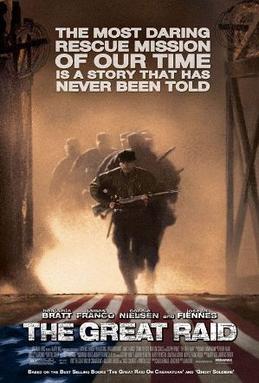
“The Great Raid” is “inspired by the
true events” of the Raid on Cabanatuan in the Philippines in WWII.The raid by U.S. Rangers was the most
successful raid on a prisoner of war camp in American History.The movie was based on two acclaimed books on
the subject:The Great Raid on
Cabanatuan by William Breuer and Ghost Soldiers by Hampton
Sides.It was directed by John
Dahl.Because of financial problems at
Miramax, the film did not make it to theaters until three years after
completion.
The movie opens with a necessary
summary of the situation in the Philippines connecting its fall with the
January, 1945 setting of the film.Footage from the National Archives is effectively used with the
narration.The opening scene recreates
the massacre of American prisoners on the island of Palowan by a unit of the
Kampeitei (the Japanese version of the Gestapo) led by Major Nagai (Motoki
Kobayashi).Later, American guerrilla
leader Maj. Lapham informs Gen. Krueger (Dale Dye!) that the same type of
atrocity could take place at Camp Cabanatuan.Krueger decides to send part of the 6th Ranger Battalion to
rescue the prisoners.The unit is
commanded by Col. Mucci (Benjamin Bratt), but he assigns Capt. Prince (James
Franco) as operational head.The mission
will involve going thirty miles behind enemy lines to liberate a camp that
there is limited intelligence about.It
is extremely risky, but noone questions the decision to use elite troops to
rescue the opposite.
The movie is a trio of plot
lines.One third of the film is
dedicated to life in the camp.This
focuses on a small group of prisoners including the ranking officer Maj. Gibson
(Joseph Fiennes).He is suffering from
malaria.His best friend Capt. Redding
(Morton Csokas) is suffering from the desire to escape even though the Japanese
have threatened to execute ten prisoners for each escapee.The prisoners are in terrible shape and
things get worse when Maj. Nagai arrives.This movie does not take the recent approach of sympathy for the other
side.Nagai is malevolent and there is a
very powerful execution scene that ramps up his hissability.In fact, this is not the only execution scene
in the movie.
The second plot line
concentrates on Margarat Utinsky (Connie Nielson).She is an American nurse who is working with
the Filipino Underground in Manila.She
is smuggling medicine into the camp.The
movie manufactures an unrequited romance between Gibson and Utinsky.At one point she is tortured by the Kampeitei
and members of her cell are executed.
The other third is the mission
of the Rangers.Mucci and Prince hook up
with Filipino guerrillas led by Juan Pajota (Cesar Montano).They reach the village of Patero where the final
plans are developed.Prince will lead
the assault on the camp under cover of darkness.The biggest problem will be the daylight
approach which requires crawling 800 yards over flat ground to reach the
camp.Pajota suggests the distraction of
a fly-over by an American plane.Part
two of the plan involves Pajota’s guerrillas neutralizing a large Japanese unit
camped nearby.Part three has another
guerrilla group blocking reinforcements from arriving from Cabanatuan City.All three parts must work flawlessly for the
mission to be successful.
“The Great Raid” was a terrible
flop in the theaters.It cost $80
million, but made only $11 million.Although not its fault, sitting on the shelf for three years made it
seem like damaged goods.Plus Miramax
did a poor and lackluster job of marketing.The movie deserved better.The
story of the raid deserved to be publicized and the movie is a worthy attempt
to bring the historical event to public attention in an entertaining
format.Unfortunately, most of the
public is unaware of the existence of the film and thus is unaware of one of
the greatest military tales in American History.
Critics were unduly harsh on the
movie (imagine that!)Most of the
criticism was for the slow build-up to the raid itself.You know, the same people who would have
carped had the movie been just action with little exposition.The romance was also lambasted and here the
critics are on more solid ground.It
feels forced and on first glance it appears that the Utinsky character is
fictional and the Underground element was added to make her an action
heroine.Fault was also found with the
lack of character development within the Ranger unit.There is not much coverage of soldier
behavior or talk.However, critics
missed that “The Great Raid” was a throw-back to the Old School small unit
movies where the unit itself is a character.
The movie is very
underrated.The acting is
serviceable.Some will complain about
the lack of emotion, but we are talking about emaciated prisoners, disciplined
soldiers, and secretive Resistance members.What would you expect?Franco is
almost morose, but the real Prince had that type of personality.Bratt also underplays, which is less
acceptable considering Mucci was charismatic and publicity-savvy.Nielson does a good job as the feisty
Utinsky, but Fiennes is left with little to do other than look
prisonerish.Acting honors goes to
Montano.The movie’s biggest accolade
goes to its portrayal of this Filipino hero.
The production is nothing
special.The score is understated and
has some good suspense when needed.The
cinematography uses muted colors to good effect.The effects are not mimicking the “Saving
Private Ryan / Band of Brothers” style.TGR is more comfortably placed in the Old School category.The film builds to the assault which is well
worth the wait.When the first shot is
fired, the screen is ablaze with violence unabated for a long stretch.This scene clearly depicts the American
military’s propensity to deal with combat situations via extreme
firepower.It also clearly depicts
Hollywood’s love of explosions.
Ghost Soldiers is one of
my favorite books.When I read it years
ago, I was on the edge of my seat for the raid.I remember thinking what a great movie could potentially come from the
book, but I expected the worst.When I
heard TGR had been shelved and then fizzled in the theaters, my fears seemed to
be confirmed.I have to say the movie
was a pleasant surprise.I do not know
if it could have been much better without going way off the accuracy reservation.The sad thing is that by adjusting the
original “Missing in Action” type script in favor of accuracy, the studio
probably lost a lot of money and has probably vowed not to make that “mistake”
again.How accurate is it?See History or Hollywood, but beware of spoilers.
"The Great Raid" (2005) is a sadly forgotten movie about the daring POW rescue raid on Cabanatuan in the Philippines in 1945. The behind the lines mssion by the U.S. Rangers was one of the great adventure stories of World War II. The plot is so incredible that you have to wonder just how true is this "true story".
GUESS WHICH OF THE PLOT
ELEMENTS IN “THE GREAT RAID” ARE TRUE.
1.American prisoners on the island of Palawan
were forced into air raid shelters and then the Kampeitei poured in aviation
gasoline, set it on fire, and machine gunned the survivors.
2.Gen. Krueger approved the mission and put
Mucci in charge.He, in turn, gave
operational command to Prince.
3.The senior camp officer was a malaria-ridden
Maj. Gibson.
4.Margaret Utinsky was an American nurse who
worked with the Filipino Underground to smuggle drugs into Cabanatuan, among
other activities.
5.The original camp guards left the camp and
the prisoners found a large stock of food.Later, Japanese returned and reestablished control of the camp.
6.The Rangers stop at the village of Balincarin
and witnessed the results of a massacre of villagers for aiding the
guerrillas.
7.Pajota suggested the raid be postponed a day because
of a temporary increase in Japanese forces and originated the idea of the
flyover.
8.Capt. Redding was caught escaping and he and
ten random prisoners were shot.
9.The Rangers crawled 800 yards over open
ground in daylight and used a flyover by a plane to get the Japanese to look up
instead of out.
10.The raid came as a complete surprise to the
Japanese and many were killed in their barracks by the intense fusillade.
11.A bazooka took out a Japanese tank.
12.The Japanese commander was killed in a duel
with Sgt. Wojo.
13.The two American casualties were a sniper
victim and the doctor who was mortally wounded by mortar shrapnel.
14.Pajota and his guerrillas held off a large
Japanese force at a bridge near the camp.
15.Mucci defeated a flanking attempt by Japanese
fording the river.
History or Hollywood?
1.American prisoners on the island of Palawan
were forced into air raid shelters and then the Kampeitei poured in aviation
gasoline, set it on fire, and machine gunned the survivors.HISTORYThe
incident did occur, but it was the Japanese 14th Area Army was
responsible.Survivors telling their
stories directly led to the idea of the Cabanatuan raid.
2.Gen. Krueger approved the mission and put
Mucci in charge.He, in turn, gave
operational command to Prince.HISTORYThe movie overplays disagreements
between Mucci and Prince about various aspects of the plan.It underplays Mucci’s “glory hound”
reputation.Prince did have a bad case
of jungle rot on his feet.
3.The senior camp officer was a malaria-ridden
Maj. Gibson.HOLLYWOODAll of the prisoners are fictional
4.Margaret Utinsky was an American nurse who
worked with the Filipino Underground to smuggle drugs into Cabanatuan, among
other activities.HISTORYSurprisingly,
much of this is true.Utinsky was the
wife of an American soldier who dies in Camp O’Donnell soon after the fall of
the Philippines.She elected to stay in
Manila and joined the Resistance.She
did smuggle drugs into Cabanatuan.She
was arrested and tortured by the Kampeitei, but for much longer (32 days) than
in the movie.She then spent six weeks
in a hospital suffering from a gangrenous leg.After that she escaped to the hills and joined the guerrillas.She did meet the prisoners when they reached
American lines.She was not romantically
involved with any of the prisoners.In
1946, she was awarded the Presidential Medal of Freedom by Pres. Truman
5.The original camp guards left the camp and
the prisoners found a large stock of food.Later, Japanese returned and reestablished control of the camp.HISTYWOODThe
Japanese did leave the prisoners for several weeks and they did fatten up on
Japanese supplies.The Japanese who
eventually reestablished control were not from the Kampeitei (Nagai is a
fictional character), they were mostly retreating Japanese units who basically
ignored the prisoners
6.The Rangers stop at the village of Balincarin
and witnessed the results of a massacre of villagers for aiding the
guerrillas.HOLLYWOODThere was no mention of this incident in my research.However, these types of atrocities did occur.
7.Pajota suggested the raid be postponed a day because
of a temporary increase in Japanese forces and originated the idea of the
flyover.HISTORY
8.Capt. Redding was caught escaping and he and
ten random prisoners were shot.HOLLYWOODI found no evidence of this
particular incident.It does conform to
Japanese policy and was done at the camp.By the way, most of the time the executions were done via beheadings.
9.The Rangers crawled 800 yards over open
ground in daylight and used a flyover by a plane to get the Japanese to look up
instead of out.HISTORYThe
plane was a P-61 Black Widow (the absolute perfect choice for this), but in the
movie they had to use a Lockheed Hudson.The P-61 did twenty minutes of acrobatics and faked engine trouble which
allowed the Rangers to transit the field.
10.The raid came as a complete surprise to the
Japanese and many were killed in their barracks by the intense fusillade.HISTORY The
movie gives the Japanese more of a fighting chance than the Rangers did.
11.A bazooka took out a Japanese tank.HISTYWOODA
bazooka team did take out a shed that was suspected of housing tanks and blew
up some trucks, but no tank.
12.The Japanese commander was killed in a duel
with Sgt. Wojo.HOLLYWOOD
13.The two American casualties were a sniper
victim and the doctor who was mortally wounded by mortar shrapnel.HISTYWOODDoctor
Fisher was wounded similar to the movie.The other death was an accidental friendly fire incident.
14.Pajota and his guerrillas held off a large
Japanese force at a bridge near the camp.HISTORYThis scene is very accurate.
15.Mucci defeated a flanking attempt by Japanese
fording the river.HOLLYWOODMucci spent the battle observing from the rear.
BACK-STORY:“The Grand Illusion” is a film by the acclaimed
French director Jean Renoir, son of the famous Impressionist painter. He wrote the screenplay along with Charles
Spaak.Renoir was inspired by his own
experiences as a reconnaissance pilot in WWI, but the film is far from
autobiographical.Von Stroheim wore
Renoir’s uniform in the movie.The title
of the film was influenced by the book “The Great Illusion” by British
economist Norman Angell.Angell argued
that war was useless because nations have common economic interests.Good call, Norm!The movie was famously banned in Italy and
Germany.Goebbels even had Renoir labeled
“Cinematic Enemy #1” and attempted to have all copies of the prints destroyed.Fortunately, a print was recovered by the
U.S. Army (no, not by the Monuments Men) after the war and Renoir was able to
accomplish a celebrated restoration.The
movie was the first foreign language film to be nominated for Best Picture at
the Academy Awards.
OPENING SCENE:In the bonne homme atmosphere of a base canteen,
a French pilot Lt. Marechal (Jean Gabin) is called to the commander’s office
and informed that he will be carrying a passenger on his next flight.Capt. Boeldieu (Pierre Fresnay) is an upper
class staff officer who wants a taste.Jump to a German officer’s club where the ace Rauffenstein (Erich von
Stroheim) is returning from shooting down a French plane.You don’t suppose?You guessed it. Rauffenstein invites his two
victims to dinner and establishes a bond with Boeldieu because they are both
aristocrats.Marechal is accepted
because he is a fellow knight of the air.
SUMMARY:Boeldieu and Marechal are sent to a prison camp
that reminds of a summer camp.This is
definitely not a WWII POW movie.They
are put in a room with a group of everymen who dine on non-slop with wine and
cognac.The fare is provided by a Jewish
prisoner named Rosenthal (Marcel Dallo) who belies the stereotype of his race
by sharing the contents of his parcels.(These guys eat better than their guards, but the guards are cool with
this.)The men get along smashingly well
and even tolerate the snooty Boldieu as he tolerates the unwashed.Which reminds me to mention that one of the
men gives Marechal a foot bath!What’s
the opposite of a POW movie cliché?One
of the prisoners is a barracks clown.It
is like if Lou Costello was in “The Great Escape”.
Rosenthal receives one of his wonderful parcels
The men are digging a tunnel and
dispose of the dirt in a manner similar to “The Great Escape” except that they
do not seem to care if German guards see them disposing of the evidence.Speaking of clichés, the camp receives a
trunk of women’s clothes which allows them to stage a vaudeville show.The clown sings a jaunty number and British
soldiers do their impression of the Folies Bergere.In the middle of the show word arrives that
the French have retaken Fort Douaumont in the Battle of Verdun.This prompts Marechal to lead the POWs in “Le
Marseillaisse”.(Note to “Casablanca”:
copy this.)Marechal is thrown is
solitary for this act of taunting.He
goes a little stir crazy since he is deprived of the gourmet dining.
Boldieu cleverly hides his bag of dirt
Just when we are primed for the
big tunnel escape scene, the men get sent to another prison camp.When told, they take it remarkably well.None curse their infernal luck.Boeldieu and Marechal end up in a converted
castle run by … Rauffenstein!He is
disabled from war wounds (which make him literally stiff) and has been relegated
to camp commandant.He is happy to see
Boeldieu who is a kindred soul (they both have monacles).Raffenstein reads a list of escape attempts
they made at the interim camps.Marechal
and Boldieu have been quite the artists, which is news to the audience.Raffenstein gives them a tour of the very
picturesque castle (filmed in an actual castle in Alsace) and proclaims it “inescapable” (like every
other prison camp in war movie history).
Boeldieu and Rauffenstein discuss aristocratic stuff
The quarters are even more
comfortable than the first camp.Once
again, their roommates are all swell guys.One of them is Rosenthal!He and
Marechal concoct an escape plan involving a homemade rope, but they will need a
distraction.Boeldieu suggests they have
all the inmates play flutes and raise a ruckus.Apparently the Red Cross has sent them 50 flutes.When stage one of the racket has succeeded,
Boldieu buys more time with a command performance with his flute as he roams
the upper reaches of the castle.Rauffenstein
is forced to fire on his soulmate and mortally wounds him.Boeldieu gets a great death scene with the
heartbroken Raffenstein by his bedside. He tells the German: “For the commoner,
dying in a war is a tragedy.But for you
and me, it’s a good way out.”He warns
Raffy that the days of the aristocracy are coming to an end and their kind will
have trouble adjusting to the new social order after the war.
My first blog GIF! confiscation of the flutes
Marechal and Rosenthal are on
the lam, but the biggest problems they face are themselves.They have a falling out until they realize
that everyone in this movie is supposed to like each other.They find refuge at a German farm belonging
to a war widow named Ella (Dita Parlo) who has lost her husband at Verdun and
two brothers in other battles.She holds
no grudges and falls in love with Marechal.Who wouldn’t?She has the cutest
little girl who, sticking with the main theme of the movie, is not a brat.
War is Hell!
CLOSING SCENE:Hard to believe, but Ella’s home is even better
than the German POW camps.Marechal and
Rosenthal settle in long enough for a relationship to develop between Marechal
and Ella.But as we all know, bros
before hoes in war movies.Marechal and
Rosenthal must be moving on to help win the war against Ella’s country.Marechal promises to return after the war.(Is this the Grand Illusion?)The movie leaves us hanging as it ends with
the duo making it to Switzerland ahead of a German squad that nicely restrains
from shooting them.This movie does not
have Nazis, it has Nicies.
WOULD CHICKS DIG IT?Sure.There
is no combat to offend anyone’s sensibilities.There is bromance and romance. There is a cute little girl.Jean Gabin was the French George Clooney of
his day.There are no villains to creep
out anyone.
HISTORICAL ACCURACY:The movie is not based on a true story, so
historical accuracy is not a factor.I
was very curious about the portrayal of the prison camps because they were so
different than what we are used to seeing in WWII POW movies.It turns out that the relatively cushy life
in the camps shown in the movie is fairly representative of reality.The Germans did establish camps for officers
(Offizierlagers) in castles, hotels, etc.The officers got much better treatment than the enlisted.They had more space, better food, and did not
have to work.They were allowed
recreational activities like theatricals.In some camps they were even allowed to go on walks outside the camp if
they swore on their honor not to escape!The Germans also had “reprisal camps” designed partly to punish escapees.It seems likely that Marechal and Boldieu
would have ended up in one of these instead of in the castle.Rauffenstein is representative of the fact
that commandants were sometimes disabled officers.The camp guards did have a reputation for
being humane so “Arthur” is typical.
The diet of the prisoners was
poor.Not surprising because due to the
Allied blockade the German people were suffering from malnutrition, too.The prisoners did get to supplement their
food with parcels from home, but it seems highly unlikely that Rosenthal’s
family could have sent enough parcels to allow the meals the crew routinely
eats in the camp.Plus, the French
prisoners were noted for receiving substantially less parcels than the British.
The reference to Fort Douaumont
seems accurate.The fort did fall to the
Germans in Feb., 1916 and then was recaptured by the French in Oct., 1916.The movie’s time frame must be actually
referring to the French recapturing part of the fort in May which they held
only temporarily.
CRITIQUE:“La Grande Illusion” is famous for its themes.
Renoir was aiming at class divisions.Specifically the gulf between the upper and lower classes.Marechal, a mechanic before the war, and Boeldieu,
a nobleman, represent the opposing classes. Surprisingly, Renoir does not show the
conflict between the classes.These
characters do not even have a rocky start before developing their friendship.Even Rauffenstein
treats the lower class inmates with respect, if disdain.Renoir does not make the case that the two
social classes can not live together, unless he is contrasting the egalitarian
prison camp to peacetime society.Boeldieu
blends in easily with his prison mates and only rolls his eyes
occasionally.The Boldieu character is
the least stereotyped in the movie.Second least is Rauffenstein.Stroheim had a reputation for playing villains so you do not expect him
to be so humane.Hell, he did not even
mean to kill Boeldieu – he was aiming at his leg.He is more stiffly (literally) upper class
than the Frenchman, but only slightly so.He has to work harder to tolerate the commoners, but he is not a pompous
ass.The subtheme is that the upper
class sticks together.Boeldieu and Rauffenstein
feel a kinship that goes beyond national boundaries.Renoir is making the case that in the future
there will hopefully be no national boundaries and no class distinctions.The movie makes this prediction.
The movie has the technical
hallmarks of a masterpiece.The
cinematography is not overblown, but shows the ability of a master.He tends toward long takes with few cuts.In other words, the opposite of a modern war
movie.When we are introduced to the
first group of prisoners, they share a meal (food was important to Renoir) as
the camera moves around the table.There
is a nice tracking shot during the theater rehearsal.The camera pans over items in Raffenstein’s
castle room to establish his Prussianness in the mise en scene.The dialogue is nothing special.You do not get the impression you are
watching a play transferred to the cinema.The music did not make an impression on me other than to notice there
were large stretches where there was no background music to set the mood of the
scene.
The acting is a strength
of the movie.The cast is appealing,
which is not surprising since all the characters are appealing.Gabin has a lot of charisma – enough to get a
German war widow (who he cannot communicate with) to fall in love with him in
record time.Fresnay is not as wooden as
Boeldieu could have (should have?) been.He does not twirl his mustache and his flute playing is
transcendent.Stroheim is good in
playing against his usual villainy.He
had a lot of say in the character’s development.Dallo is fine as Rosenthal and does not ham
up the Jewishness of the character.Rosenthal is an important cinematic figure given what was going on in
Europe at the time.
I was not kidding about that foot bath!
CONCLUSION:When I
first watched “La Grande Illusion”, I wondered what the big deal was.Then I watched the movie again with the
commentary track by a cinema expert and I wonder less, but still I don’t get
what the big deal is.I understand what
Renoir was trying to do, but I did not find it effective.It is not genius to point out there was a
class problem in Europe.What is
perplexing to me is why Renoir chose to make the upper class characters
likeable and why the two classes get along so well in movie.There is not a single negative character in
this movie.There is zero dysfunction.How unrealistic!Speaking of lack of reality, I know the
depiction of the camps was accurate in the basics, but to portray them as
better than being home with the wife was implausible.I also found that the movie lacked
suspense.They dig a tunnel and then
don’t get to use it. They escape from the castle and there are no shots fired
and no pursuit. They hide out in a German farm house and no one comes banging
on the door. I know it’s not “that kind of movie”, but that does not make it
great entertainment (as many claim).I
suppose you could argue that it is a great movie, but I do not think it is a
great war movie. It is tremendously overrated and does not belong in the Top 10. Discuss.
“Blood Oath” (also called “Prisoners of the Sun” in
the States) is an Australian film released in 1990.It was directed by Stephen Wallace and
written and produced by Brian Williams.Williams’ father John was the prosecutor in the trial depicted in the
film.The movie marked the screen debut
of Russell Crowe.
The film is set on the island of Ambon.Of 1,100 Australian and Dutch prisoners taken
when the Japanese took the island, only about 300 survived.The war is over and a mass gave has been
uncovered .Capt. Cooper (Brian Baker –
playing the role representing John Williams) heads a war crimes trial to bring
the perpetrators to justice.Crowe is
his aide.A flashback depicts the
mistreatment of prisoners supervised by the vile Sgt. Ikeuchi (Tetsu
Watanabe).The big fish is Adm.
Takahashi (George Takei) who is chaperoned by an American Maj. Beckett (Terry
O’Quinn).Cooper attempts to prove the
admiral gave the orders.He is acquitted
because of lack of evidence and flown back to Japan.
Now that the big fish has gotten away, Cooper
concentrates on four airmen who were shot down on Ambon and disappeared.His superior asks him why he needs the four
airmen when he has 300 corpses in a mass grave and plenty of eyewitnesses to the
brutality of the guards.Good question
and one that remains unanswered.One of
the captured airmen’s had a brother in the camp who witnessed not only his
torturing, but the subsequent beheading and burial.On the witness stand, the obviously
traumatized Lt. Fenton (John Polson) gives damning (but seemingly inadmissible,
evidence) against Icheuki.When Fenton
dies that night, Cooper beats up Icheuki withno consequences and a lot of irony.
With the new revelations and the discovery of the
grave site of the four airmen, Cooper focuses his efforts on Icheuki and a
milquetoast officer named Tanaka (Toshi Shioya).Tanaka testifies that Takahashi gave the
orders, but Beckett makes sure his boy is untouchable because he is part of the
post-war plans for Japan.As part of the
Pacification program the future of the world depends on him, according to
Beckett.Cooper counters with: “You’re
not working out the future of the world, you’re just preventing it from being
different from the past”.Oh, snap!It’s not just the emperor who will get off
easy.It’s just politics.Ikeuchi has no protector so he commits
hari-kari.Good riddance.There’s still that little matter of Tanaka
cutting off an airman’s head with no written orders nor proof of an official
court-martial.
“Prisoners of the Sun” is based on a true story.After Ambon fell, the Japanese executed 300
Australian and Dutch prisoners in what became known as the Laha Massacre.Three-fourths of the remaining prisoners died
before liberation due to overwork, disease, and mistreatment.93 guards were put on trial in 1946 in what
was the largest war crimes trial in the Pacific.Rear Admiral Hatekeyama was determined to
have ordered the executions, but he died before the trial finished.A different Hatekeyama was hanged for being
in direct command of the executions.Three other officers were hanged for assorted mistreatments of
prisoners.It appears the filmmakers
have taken many liberties with the facts.The whole subplot of Takehashi being protected by the American
government seems made up to advance the theme of politics trumping justice.
There is nothing special about the movie.The acting is fine.Baker is seethingly righteous.Watanabe is creepily malevolent.Shioya is effective as the pawn.The rest are okay with Crowe not deserving
his prominent placement on the poster and Takei slumming in a stunt
casting.A nurse is thrown in to provide
a female foil and undeveloped romance angle for Cooper.The score is new wave schmaltzy.The cinematography is standard.The set is pretty good.It does look like a prison camp.
The plot is the main flaw.Close examination leads to head
scratching.There should have been
plenty of evidence of brutality to convict the guards.After all, Fenton was not the only surviving
prisoner to witness and be subjected to violations of the acts of war.No other survivors are called as witnesses.The subplot of Takehashi getting off is an
indictment of the post-war coddling of war criminals and is
thought-provoking.It is also memorable
that Cooper’s obsession with convicting someone results in the conviction of
the less than villainous Tanaka.The
flashbacks, including the beheading of Fenton’s brother, are well done.
“Blood Oath” is the type of movie that takes a
forgotten moment in history and brings it to the public’s attention.For that, it deserves some praise.It did cause me to read up on the trial and I
found there is not a whole lot of information on the Internet.What little I found gave me the impression
that the movie is not really a good history lesson.It is fairly entertaining and the themes are
compelling, just not a movie to get excited about.Even if you are a Russell Crowe fan.
BACK-STORY: “The Great Escape” is a WWII prisoner of war movie. It was released in1963 and was a huge hit and has grown in popularity over the years. It is the most famous movie in its subgenre. The film was directed by John Sturges and is based on the nonfiction book by Paul Brickhill. Brickhill was a prisoner in Stalag Luft III and helped with the escape although he was not one of the escapees. His book and the movie are dedicated to the fifty escapees who did not survive. The main screenwriter was James Clavell who spent time in a Japanese prison camp and the book “King Rat”. One of the tunnelers (Wally Floody) served as a technical advisor. Donald Pleasance was a prisoner in Stalag Luft 1 during the war. Steve McQueen insisted the motorcycle scenes be written in and did the stunts, not including the last jump (for insurance reasons).
Hilts' first trip to the cooler
OPENING: With the iconic opening theme playing in the background, truckloads of Allied POWs arrive at a brand new prison camp. Most of the main characters are briefly introduced as they case the new camp already plotting escape. The POW leader, Wing Commander Ramsey, is welcomed by the commandant who tersely explains that the camp is designed to hold all the most troublesome escape artists held by the Germans. Within minutes there are escape attempts that fail, but show that the prisoners are not impressed with the impossibility of breaking out.
SUMMARY: The movie has three distinct parts: the planning and execution of the escape, the escape, and the attempts to reach safety. The first part concentrates on the plan and each main character's role in it. The leader of the escape organization is Roger Bartlett (Richard Attenborough) who is known as “Big X”. He has been warned by the Gestapo that his next attempt will be his last. His plan is to create turmoil in the Third Reich by busting out 250 prisoners. It’s a massive undertaking involving three tunnels. Besides the digging of the tunnels, there are special jobs like forging documents and making disguised clothing. The main characters each have a specialty and gets screen time to demonstrate their prowess. These include the “Forger” Blythe (Donald Pleasance), the “Manufacturer” Sedwick (James Coburn), and the “Scrounger” Henley (James Garner). To break from the “grunt” work of escape preparation, the screenplay adds a cocky American named Hilts (Steve McQueen) to spice things up. He becomes the “Cooler King” for his frequent trips to isolation for insubordination and escape attempts.
The digging of the tunnel is in the hands of Willy (John Leyton) and Danny (Charles Bronson). The movie chronicles the problems and solutions to the tunneling. Example: problem – disposal of all the dirt / solution- bags containing dirt concealed in pants legs and then deposited on the camp grounds. Meanwhile everyone else is doing their job including uncredited actors acting as lookouts to watch for “ferrets” – Germans who tried to discover tunnels.
The tunneling follows a typical Hollywood story arc of smooth sailing, then numerous problems develop, followed by success. The problems start with the discovery of the main tunnel (Tom) while the camp is celebrating the 4th of July with American-made moonshine. A tragic death moves the movie into a darker direction. Some of the problems that now appear include Blythe going blind, Danny developing claustrophobia, and dangerous cave-ins. This leads up to the climactic break-out.
oops, this is not the woods
The buildup of problems culminates in the tunnel being twenty yards short of its destination – the safety of the woods. Hilts rigs up a rope tug system to get the escapees out whenever a nearby guard is not looking. 76 escape before the inevitable screw-up. Luckily, all the main characters were written in as getting out before #77.
Blythe dies in Hendley's arms
The rest of the movie follows the main characters in their attempts to elude their pursuers and return to Allied lines. The movie stays in chronological time by effectively skipping between characters. The individual stories are varied and unpredictable. Unfortunately, most of the men are unsuccessful. Hilts story dominates this section. He steals a German motorcycle and leads the Germans on a merry chase that ends with one of the most famous scenes in movie history.
CLOSING: Fifty of the recaptured men are executed by the Gestapo/S.S. The lucky ones who are returned to the camp are informed about their comrades. Henley pointedly asks Ramsey if it was worth it (a question the movie does not consider until this brief exchange and based on the underlying vibe definitely answers “yes!” to). Hilts steals one more scene as he is the last to get back. He taunts the ousted commandant and goes to the Cooler for some more throwing a baseball against the wall action.
one of the three that made it
RATINGS:
Acting – 9
Action – 7
Accuracy – 8
Realism – 8
Plot – 9
Overall – 9
WOULD CHICKS DIG IT? Although there is not a single female that has a speaking role in it, I would think most women would enjoy it but wonder what all the fuss is about. It is certainly aimed at the male audience (specifically 14 year old boys). However, the actors are appealing and the action is not graphic. It is undoubtedly entertaining.
HISTORICAL ACCURACY: The movie opens with the claim that it is based on a true story, but with composite characters and time compression. It boldly proclaims that every detail of the escape is true. That statement is too strong, but the movie is commendably close to the facts.
There was a Stalag Luft III and the Germans did put all their “bad eggs in one basket”. The attempted escapes on the first day actually occurred in the way depicted. The “X organization” did plan an escape of 250 men involving the construction of three tunnels named Tom, Dick, and Harry. Weirdly, the movie changes the names around for no discernible reason. Harry was actually the one under the stove and Dick was in the washroom. (It was abandoned and used for dirt storage after the Germans cleared the area it was to pop out in.) Tom was discovered by ferrets, but not during a celebration of the 4th of July. There was a moonshine celebration on a different day.
All the activities surrounding the escape are accurate. The forging of papers, disposal of the dirt, making of clothing, creation of the ventilation system, the singing of Christmas carols to hide the sounds of digging, the shoring up the tunnels with bunk bed boards, etc. The movie is extremely strong in depicting how the plan was put into effect.
The escape was essentially like the film shows. The tunnel was twenty feet short of the woods. There was an air raid that shut the lights down for a while. I could find no evidence that a rope was rigged up, but seventy-six men did escape before the exit was discovered by a sentry (probably not because someone fell). It is important to note that none of the seventy-six were Americans. The Americans had been moved to another camp before the escape. Gee, I wonder why the filmmakers decided to leave Steve McQueen and James Garner in the escape?
The third of the film dedicated to the main characters on the lam is substantially Hollywoodized. There was no theft of a plane or a motorcycle, for instance. The movie is close to the truth in its depiction of the success of Sedgwick (actually Dutchman Bram van der Stok) in reaching Spain (although the Resistance drive-by shooting is surely artistic license) and Willy and Danny (Per Bergsland and Jens Muller) stowing away on a ship to reach Sweden. The execution of fifty recaptured men is a fact, but they were not killed in a large group as shown in the movie.
Where the movie takes most of its liberties is in the characters, but it is up front in the composite nature of them. Some are close to a real person like Roger Bartlett representing Roger Bushell. Bushell was the leader of the X Committee and played an essential role in the escape. Ramsey was actually Herbert Massey and he did have a leg injury. Ives (the real Jimmy Kiddell) did die on the wire. Willy and Danny and Sedgwick were differently named and of different nationalities than their counterparts, but their escapes were true. The rest take some creative thinking to determine who they are supposed to be. The important thing is the roles they represent (scrounger, forger, manufacturer, etc.) were real and accurately depicted.
CRITIQUE: I have to be up front about the fact that this was my favorite movie when I was growing up. This was back when I and my brothers got to see it once a year on network TV. That was always a great night in our house. I may have seen it more than any other movie (not counting movies I have shown in class for decades). Sometimes our childhood favorites do not hold up when we watch them through adult eyes. This is not the case with “The Great Escape”. It was and still is one of the classic war movies.
The iconic nature of the film starts with the opening credits as we listen to the stirring theme music which every man of my generation instantly recognizes. Elmer Bernstein wrote the musical score and it is perfect. It dwells in the background of every scene and defines the moods. In this respect, the movie is very similar to another great guy movie – “The Magnificent Seven”. Speaking of which, the two movies also shared Sturges, McQueen, Coburn, and Bronson.
The movie is an expert blend of suspense, action, and humor. The humor works very well. It is dry and used sparingly, but effectively. Some of the lines are memorable. For instance, the ferrets bust in to the washroom and narrowly miss the trap door to Harry being sealed. Danny hustles into the shower and when the guard asks Sedgwick what he is doing there he responds “Watching him. I’m the life guard.”
The camp was constructed near Munich and accurately recreates a Stalag in layout, if not in atmosphere. The tunnel set allows for a cutaway view of the digging. The scenes are truly claustrophobic and the ever present danger of cave-ins adds to the suspense. The scenes outside the camp are authentic-looking since the movie was filmed in Europe. There is even some beautiful Alpine scenery.
The movie does a great job in its structure. The buildup to the escape concentrates on character development and is tutorial on the work that went on. This could have been tedious, but the injection of humor and Steve McQueen keep the narrative flowing. The movie, to its credit does not have a prolonged denouement after the escape. The alternating getaways are deftly juggled and suspenseful. Hilts motorcycle capers dominate, but they are edited such that we have to come back to him at least four times before the famous climactic jump sequence.
The movie ends on a sober note with the murders and the question – was it worth it? However, if ever there were a war movie that is not anti-war, this is it. Life in the camp is portrayed like it would be if you went to a POW fantasy camp. It seems like fun, which it assuredly was not. This is the biggest factor in keeping the movie from being a 10.
Finally, the acting is stellar. Whoever did the casting gets a gold star. The mix of dependable British thespians with cocky Americans is stimulating. This is an actors’ movie. In particular, watch Steve McQueen steal every scene with little eye-catching movements including shameful mugging. His co-stars either had sharing natures or were infuriated. Whatever, McQueen became a superstar based on his performance.
CONCLUSION: You might say I’m prejudiced, but “The Great Escape” is woefully underrated at #44. It is a better movie than its most obvious competitor – Stalag 17 (#18). It has everything that makes a war movie great, in my opinion. It is entertaining. It tells a story that deserves to be told. It teaches. It is accurate enough. It is realistic. Sometimes 14 year old boys are right. This movie rocks!





_poster.jpg)