Monday, December 21, 2015

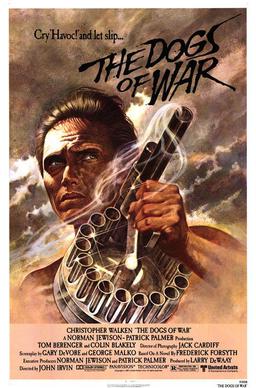
BOOK / MOVIE: The Dogs of War (1974/1980)


                “The Dogs of War” is a movie by John Irvin (“Hamburger Hill”, “When Trumpets Fade”) based on the novel by John Forsyth.  The movie was filmed in Belize and is set in a fictional African nation of Zangaro.  It is a story of an attempted coup by mercenaries on behalf of a British corporation that wants mineral rights in the country.  It stars Christopher Walken, two years removed from “The Deer  Hunter”.

                The movie begins with our anti-heroes fleeing from a botched rebellion in some Central American nation.  Their leader, Cat Shannon (Walken), returns to his seedy apartment in New Jersey and tries to reconcile with his ex-wife.  He wants to settle down and move to Wyoming or some such place.  She and the audience say “sure!”  Oh well, back to work.  Shannon gets a job from a shady character named Endean (Hugh Millhis).  His boss is the CEO of a large corporation which wants a crazy African dictator named Kimba overthrown because the tycoon wants to spread democracy.  Just kidding, he wants the mineral rights so he can add that next billion to his wallet.  Being a mercenary, Shannon takes the job and reunites the band.  First, he has to reconnoiter the capital of Zangaro.  Two things of significance happen on the scouting expedition.  He meets a comely African lass who turns out to be Kimba’s mistress.  The second thing is that because of the girl he gets tortured by Kimba’s lackeys.  In prison he meets a kindly doctor who lost the election to Kimba.  Upon return to America, Shannon begins preparation for the coup.  After acquiring the necessary weapons (including a bad-ass gun called a XM-18) , Shannon and his four buddies take a freighter to Africa.  They are joined by some Africans who will serve as cannon fodder.  The plan is to assault the Presidential compound with extreme prejudice and then Endean will bring in an equally repulsive African general to become the new Idi Amin.  Except this monster will be in corporation’s pocket.

                “The Dogs of War” is one of the more famous mercenary movies.  It bears closest resemblance to “The Wild Geese” and is part of a subgenre that continues with the recent “Expendables” movies.  “Dogs” is an above average entry in the soldiers of fortune milieu.  Like most of them, it is low budget.  And the cast is actors who are either going to be famous, or more likely, on the downside of their careers.  Usually these movies are ensemble pieces, but “Dogs” is really a one man show.  Walken dominates with his smoldering intensity.  He must have intimidated the editor because his second in command Tom Berenger got left mostly on the cutting room floor. The rest of the cast is blah.  And we don’t care because there is virtually no character development.  Technically the movie is average.  The cinematography is nothing special.  Irvin is not trying to stand out from typical merc flicks in his first feature film.  The action sequences are pedestrian.  The tired, but trusted trope of good guys firing randomly to create fireworks.  The one outside the box move was to include the XM-18 which is a multi-barreled assault weapon that can fire a variety of ordinance such as fragmentation, grenades, anti-tank, and anti-personnel.  It really livens up the party. 

                The plot is predictable and cliché-ridden.  Shannon is a war –weary warrior who only knows how to do one thing.  Naturally he loses his wife over his avocation.  He may not be a lover, but he is a killer with a heart of gold (or in this case, platinum). Endean represents the evil, greedy tycoon who is more powerful than any politician.  The movie includes some twists that the average mercenary movie fan will be surprised by, but the average viewer will see coming from a mile away.  (Oops, I think I just questioned the intelligence of merc movie maniacs.  Sorry.  Don’t get your panties in a bunch.  Oops.)  It would have been nice if the dialogue was a little tongue in cheek (like “Expendables”), but this is the young Walken, not the SNL Walken.  In fact, the funniest moment comes when the four mercenaries enter the compound and pose for a kick-ass movie poster with guns a blazin’.  The big action set piece is entertaining in a mindless way, but the buildup is boring.

                As  I have mentioned before, my theory is that any competently made movie based on a book should be better than the source material.  The only excuse is if the technology or budget is not capable of replicating scenes from the book.  There is no excuse for the plot to be worse than the book.  In this case, the plots differ in substantial ways.  The book is in many ways a tutorial for anyone who wants to overthrow an African dictator.  Forsyth was familiar with mercenaries, arms dealers, and African coups.  He spends the vast majority of the book showing off his insider’s knowledge.  Thankfully the movie just alludes to all the details that go into overthrowing an African government.  I found all the jetting around by the various team members to put all the pieces together to be tedious.  Maybe if I wanted to be a soldier of fortune someday, but the truth is that I could care less about an “end user” certificate.

                Where the book is superior to the movie is in the set-up and pay-off.  The novel gives the background that the movie is obtuse about.  Forsyth covers the geologist discovering the platinum at a mountain in Zangara and Marson’s subsequent efforts to get a monopoly on the site.  We also learn how Shannon finds out that the mission is wealth dominated.  Part of this knowledge comes from an affair with Marson’s sluttish daughter.  The book does not have the wife subplot.  (We get Jo Beth Williams instead of Bo Derek.)  The battle is also quite different, but ends up in basically the same place.  It is more realistic tactically than the film, but not as entertaining.  The aftermath of the coup is better in the book.

MOVIE =  C

BOOK  =  D

Sunday, December 13, 2015

SHOULD I READ IT? Stalingrad: Dogs, Do You Want To Live Forever? (1959)


                “Stalingrad: Dogs, Do You Want to Live Forever?” is a German movie made around the time German prisoners taken on the Eastern Front were returning home.  The few that survived captivity, that is.  It is noteworthy for its realistic take on the ultimate Wehrmacht disaster. 

                The movie opens with a narrator telling us that the year is 1942 and things are about to take a turn for the worst for the German army in the Soviet Union.  A Soviet counterattack is coming and this will be the story of some of the survivors of that maelstrom.  The main character is Oberleutnant Wisse (Joachim Hansen).  He has been assigned as liaison officer to a Rumanian unit.  You don’t see that role in many movies!  On the way to his posting, he helps a Soviet girl named Katya (Sonja Ziemann) avoid being deported.  When he arrives at the Rumanian camp, the officer he is replacing is in a big hurry to leave.  Oh, oh.  Another officer warns him about his superior – Major Linkmann (Wolfgang Preiss -  Rommel in “The Longest Day”).  Linkmann appears to be a kool-aid drinking Nazi.  The Rumanian general complains about the lack of everything.  The movie makes the point that the Rumanian allies were not so much incompetent as they were ill-supported. 

                On Nov. 11, they know the attack is coming.  Linkmann tells Wisse that the Hitler is using the Rumanians as cannon fodder and they will escape when the shit hits the fan.  Wisse turns action hero by blowing up a Soviet tank before they retreat.  Winter arrives.  They are trapped and Gen. Von Paulus resists advice that he needs to break out while they still can.  Wisse remains optimistic while the other officers grumble and criticize Hitler.  The rescue effort by Gen. Hoth (bizarrely subtitled “Hooth”) is chronicled.  Von Paulus remains pig-headed.  Meanwhile, Wisse is transferred to an artillery battery.  Guess who his new commanding officer is?  Linkmann.  He has morphed into Capt. Cooney from “Attack!”  In other words, he talks the talk, but is a closet coward.  He also reminds one of Capt. Stransky from “Cross of Iron”.  He stays in his bunker most of the time while he spouts about the greatness of der Fuhrer.  Until he decides he wants to take Stalin up on that surrender offer.  The movie is not just a two man show.  Wisse has his buddies Bose, Kramer, and Konowsky.  They make a likeable quartet making the best of a very bad situation.  And there is a surprise reappearance of a damsel who returns a favor.  No kiss because it’s not that kind of movie. The movie covers the entire siege of Stalingrad and ends with the German surrender.

                This movie was a revelation for me.  It is not very well known and has been overshadowed by the other Stalingrad movies like “Enemy at the Gates” and “Stalingrad” (1993).  I could make a case that it is the best of the lot.  Once again, I am amazed that after five years and over 200 war movie reviews, I still am seeing excellent movies that I have never seen before.  And I am also stunned at how accessible war movies are now.  There is no way I could be doing this even ten years ago.  Netflix has been the Holy Grail, but You Tube is also wonderful for war movie buffs.  I found this movie on You Tube.  We have come so far since my childhood when we would wait an entire year for the next network showing of “The Great Escape”.  What an incredible world for cinephiles!

                “Stalingrad:  Do You Want to Live Forever?” gives both the macro and micro view of the most important battle of WWII.  It is by far the best Stalingrad movie for those who want to learn about the battle from the German point of view.  Hell, you get actors portraying Von Paulus and Hitler!  The movie is excellent on command decisions.  The narration does an great job with the big picture.  We have a clear idea what the strategic situation is.  For example, the narrator explains that Goering’s supply air lift was a failure.  The movie has a documentary feel to it and uses archival footage effectively although some might carp about weapons systems appearing out of chronology.  Although a German film, it is not propagandistic.  It is fair to both sides and especially fair to the woeful Rumanians.  It does not sugarcoat the mistakes the Germans made, but it does omit the atrocities by both sides.

                The big surprise is in the production values.  The cinematography is nicely done and the archival footage is fairly seamless.  An interesting touch is the fading out of the scenes.  You don’t see that very often in a war movie.  The movie does a good job depicting the effects of the wintery weather.  The rubble is well-rendered and the sound effects of battle are realistic.  The acting is a real strength.  Preiss is his usual solid self and adds some gravitas as the only recognizable actor for an American audience.  Did he make any non war movies?  The rest of the cast is good, especially Hansen.  The characters are appealing and the movie even manages to get a female character in.  Katya bookends the movie in an unrealistic, but entertaining way.  The soldiers behave naturally and the dialogue fits.   The movie is not without clichés.  Linkman is your typical odious Nazi sycophant.  Wisse is a bit too good to be true. His arc from committed to disillusioned is a stretch, but represents a basic theme of the German soldier in the winter of 1942.

                War movie lovers need to see this movie.  And it’s so easy to do now that we have it on You Tube.  Don’t let the subtitles scare you away.  It is one of the 100 Best War Movies ever made.

GRADE  =  A

Tuesday, December 1, 2015

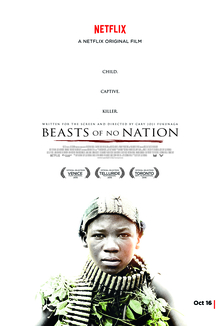
NOW STREAMING: Beasts of No Nation (2015)


                “Beasts of No Nation” is based on the acclaimed novel by Uzodinma Iweaga (2005).  The book is about a child soldier in an unnamed west African country.  Cary Joji Fukunaga wrote the adapted screenplay and directed the film.  He spent seven years on the project.  It was filmed in Ghana and the thirty seven day shoot was fraught with problems including Fukunaga contracting malaria.  The movie was a sensation on the international awards circuit and the world distribution rights were bought by Netflix.  When Netflix decided to stream it on their service simultaneously with releasing it to theaters this caused the major theater chains to boycott the film.  Netflix was being punished for violating the traditional 90 day wait before a movie can released after its appearance in theaters.  I have to go with the theater chains on this one. 

               A narrator tells us the country is at war.  Schools are closed and children are looking for things to do.  Oh oh.  Agu (Abraham Attah) and his family are living a decent life in a buffer zone protected by Nigerian peace-keepers.  This will change when the government’s military forces enter the zone.  Agu’s mother and siblings are sent away in the mass exodus, but he has to stay behind with his older brother and father.  Agu’s father and brother do not survive the cleansing process.  Agu escapes to the jungle where he is captured by a motley crew called the National Defense Force.  The creepily charismatic, but dangerously demented leader is “the Commandant” (Idris Elba).  He sees something in Agu and adds him to his band. Training montage intercut with indoctrination from the Commandant.  Initiation via a gauntlet.  Agu has found a new family.  He strikes up a friendship with a mute soulless comrade named Strika (Emmanuel Nii Adom Quaye).  The commandant insists Agu prove he belongs by executing a captive using a machete.  In an indelible scene in slo-mo and soundless, Agu complies and then some.  He is all in now.

                The NDF attacks a bridge and the Commandant uses his charisma to fire up his boys.  This charisma goes from sinister to demonic when the Commandant’s special interest in Agu turns sexual.  Fortunately, not graphically.  A village massacre is ill-timed because the supreme commandant Dada Goodblood is in the “we’re not thugs anymore” phase of his political evolution.  The Commandant is now a political liability and is demoted.  The high fives have turned into a dagger in the back.  So to speak.  He takes his force off to carve out his own domain.  Things do not go well.  The salad days of murdering, raping, and looting are sadly over.  And charisma can only carry you so far when your men are starving, diseased, and getting their asses whipped.  How long will Agu remain loyal to his molester?  Will he ever get to have that childhood?

                “Beasts of No Nation” is the best movie about child soldiers in Africa, but I found it a bit disappointing.  I read the book a while back and was disappointed in it as well.  It is hard to say what is missing.  The acting is stellar.  Obviously the big draw is the wonderful Elba and he is worth the price of admission (or a Netflix subscription).  He is perfect for the Commandant and may get some Academy Awards consideration.  His transformation from Machiavellian to Mephistophelian is intriguing.  Attah is excellent, but Agu’s arc is problematical.  He is not a typical child soldier (like Strika) because he does not lose his humanity.  He does not become hardened and a coldblooded killer.  This does not strike me as realistic.  Strangely, the plot sets up the expectation of a conflict between Agu and Strika as Agu becomes the new pet, but does not deliver. I give the film credit for being unpredictable.  There is no losing virginity scene, for instance.  The film can’t avoid the obligatory child play scenes.  In contrast, the movie pulls its punches on atrocities.  Well, not on the one where Agu earns his stripes.  But that is the only time Agu kills anyone. 

                “Beasts of No Nation” is a very good tutorial on child soldiers.  Unfortunately, it did not have the guts to tell it like it really is.  It is an interesting movie and has some great acting and some amazing cinematography.  It is well worth the watch, especially if you have Netflix and can stream it free.  I could get used to watching new quality war movies from the comfort of my study.  It’s just that after you have seen so many war movies that accurately portray the dehumanizing effect of war on adults, it’s a bit hard to swallow a happy ending for an impressionable boy.


GRADE  =  B        

Thursday, November 19, 2015

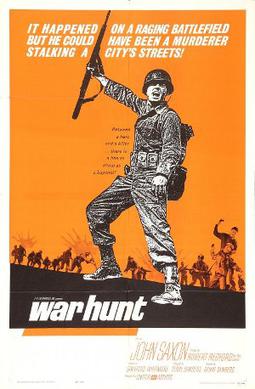
CLASSIC or ANTIQUE: War Hunt (1962)


                “War Hunt” is another mediocre Korean War movie.  I have to constantly remind myself that there are a lot of bad World War II movies, too.  In fact, I have a collection of 50 of them.  It just seems that the percentage of inferior Korean War movies is the highest of any war.  My theory is that most of the movies were produced during the waning days of Old School style.  This makes most of them seem stodgy.  The war itself did not help matters.  The war was not popular with the public and the studios realized this.  For this reason, they seem to have not put much effort into the movies.  Movies aimed at drive-ins are not going to be high quality. 

                “War Hunt” attempts to defy the stereotype by being provocative.  It was directed by Denis Sanders who had a reputation for taking chances.  As you can imagine, the studios were not that interested in his outside the box ideas.  He only had $250,000 for his budget and made the movie in only 15 days.  Much of the filming was done at night due to the budget.  No surprise that the filmmaker got no help from the Pentagon because the script was not exactly aimed at boosting recruiting or the military image!  This is in spite of the opening narration that mentions that the combat infantryman was the “tip of the spear”.  Unfortunately, the Army read the rest of the script.

                The movie is set in the closing months of the war.  A small unit is part of the U.S. effort to inflict pain to hurry along the peace negotiations.  This is actually a cogent analysis of the strategy of that time.  A replacement named Loomis (Robert Redford in his screen debut) arrives.  The unit is regaled by loudspeaker proclamations from Radio China and the Dragon Lady.  Loomis is introduced to the unit’s resident psycho serial killer named Endore (John Saxon).  Endore goes “AWOL in the wrong direction” each night.  He uses a knife to kill enemy soldiers.  The rest of the squad leaves him alone and the CO condones his actions because it’s a dirty little war.  Endore has adopted an orphaned little Korean boy named Charlie who is part of the fine tradition of “Short Round” from “Steel Helmet”.  Loomis decides to challenge Endore for the soul of the boy.  Things come to a head when the war ends and Endore is suddenly a murderer, not a dedicated warrior.

                “War Hunt” is a strange movie.  It plays like an American Playhouse drama.  This is especially evident in the lack of action.  This was undoubtedly due to the low budget.  There is a scene when Loomis is on outpost duty.  The Chinese attack.  The bombardment is not bad for a small movie and the sound effects are good.  Since it is necessarily at night. flares and lights are used effectively.  The assault is more of a human ripple than a human wave. but it’s not a bad effort.

                The best thing about the movie is the cast.  It includes Gavin McLeod, Tom Skerritt,  and Sydney Pollack.  Pollack and Redford began a friendship which led to collaboration in seven movies directed by Pollack.  Redford acquits himself well in his debut.  He definitely comes off as a future star.  Even then he had a clause in his contract that his hair could not be messed with.  Saxon underplays Endore effectively.  The movie uses eerie flute music and snare drums and some POV to depict how unhinged his character is.
 
                You have to give the movie credit for being different.  The theme reflects the fact that some Korean War movies anticipated the Vietnam War movies in their cynicism.  In this case, the statement is that killing is fine as long as there is a war on, then what?   


GRADE =  C+